
Articles

What is sin (Hebrew: “Qat”)

To understand sin (Hebrew: qat), Semitically speaking, we can apply the etymological formula for “truth” borrowed from the Proto-Indo-European “dr-/truth” sense, i.e., “root, stem, branches”, making the root of sin the “qat”, the stem of sin is the recipient of qat, and the sinful acts are the branches of qat.

Read More »

Forward to Book ‘Does Grace Have a Ceiling’

This work is a “sifter” of sorts using what I call “The 5 Noble Truths”. Some people might wince when the word “truth” is used, however, I use the mother meaning of the word “truth” found couched in classical Greek, Hittite, Sanskrit,  and the early reconstructed Proto-Indo-European language. I did

Read More »

Sumerian Lexicon and Genesis Narrative

In Sumerian, speech was e-me, and clay was i-mi-like Adam and Eve before the fall. When God bent down and shaped Adam from the dust, he didn’t just pack mud; he pressed in the word first. Sumerians knew this: you can’t write until you’ve got a tongue, and you can’t

Read More »

The Hebrew Arrow Part 2 “A Deeper Look”

I mostly dove into the Biblical and classical Greek to find the materials that supported my proposed theory on “the archer of intent” and “his/her” linguistic anatomy. Only later in my search for truths did I find my archery maxim to be fully substantiated in the Tanach (Hebrew Old Testament).

Read More »

Sumerian Genesis

 In Sumerian myth, the garden wasn’t called Eden. It was Edin (flat plain). In Sumerian Legend, the steppe was where the gods walked the plains.  In Sumerian, speech was e-me, and clay was i-mi-like Adam and Eve before the fall. When God bent down and shaped Adama from the dust,

Read More »

The Hebrew Arrow Summary

A Hebrew treatment for the Archer of God’s Intent A correlative study to the Greek toxophilus 1. Y-R-H (יָרָה): Root meaning “to shoot” (like an arrow) or “to teach/direct.” Y-R-H conveys intentional guidance and is much broader than just the “law”. Y-R-H encompasses teaching, instruction, and/ or a path such

Read More »

SUMERIAN Alive

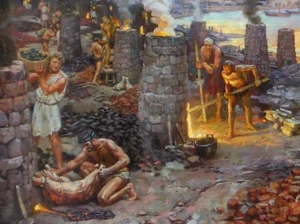
One. Practical is sustainable Thirty-two hundred years before Christ, southern Iraq smelled of mud and barley. Wet clay pressed against reed tips made the first pictures-three lines for grain, a goat’s head for goats. They weren’t pretty; they were practical. Priests counted offerings, traders measured debts. Every wedge was a

Read More »

A Cosmological Grammar

Once, when seas were younger and stars still argued over their places, there was a circle of light hovering above the Atlantic-a ring of twelve knights in a blazing celestial plate, each crowned by his own sun. They weren’t men, they were the zodiac itself, wearing flesh only because mortals

Read More »

Pharisees as Dragons

Jesus says in Matthew 16, what you bind on earth is bound in heaven. The Pharisees twist law into chains.  They make Sabbath rules so tight a man can’t heal, tithing taken while widows starve.   Concerning the Binding of many world serpent mythologies:  the dragon’s coil everything’s motion making all things

Read More »