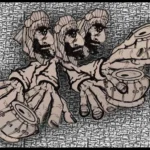
“The earliest ideas of Eternity were associated in pictographic form originally. This allowed for ‘pictures’ to be ‘as words’ in the European  world, let alone the recipients of the Semitic world. How much of these pictographic societies such as the Early Chinese, Sumerian, Egyptian, Hittite and Dravidian convey the idea of the ‘eternal’? Did these earlier cultures lose their weight in conveying a non-analytical idea of eternal ‘spatiality’ and ‘time’? How distant were these concepts to the Medieval World? Did King James’ translators have a grasp of any of this? Was *eternity* looked at as ‘segmented times’ in the Middle Ages amidst the Jacobian era? I can say a big Nope for all of these. Let’s take a light jab at this word *eternity* from  what our ancestors thought. This is only a light dig into a much deeper study that fomcm.com will endeavor. Thank you for listening!”

0:00
0:00
skip_previous
play_arrow
pause
skip_next
volume_up
volume_down
volume_off
share
description
view_headline
Nothing found!
close
close
0:00
0:00
skip_previous
play_arrow
pause
skip_next
replay_10
volume_up
volume_down
volume_off
description
view_headline
Nothing found!
close

Sacred Percussion

This lecture was initially given over a 2 day- 12 hour seminar to a group of yogis in which I deliverd a ethnomusicological treatment concerning East Indian culture, music, religion having it’s roots, not only from the Baltic region, but from the Kartvelian culture which might be identified geographically, and still culturally, from the region of modern day Southern Georgia, south of Russia.
Read More »

Poein vs Prasso

This is a lecture in which Sumerian and Hebrew beliefs are joined by the way of philology.  Astonishing pictograms rela An in-depth look into two Greek words, Poesis and Prasso. Poesis or Poetry designates the uninterrupted, natural and perfect flow of the Gospels—signaling Aristotle’s idea of “NATURE” while Prasso, or

Read More »

Skepticism

“Skopos”—Greek: “the view”A treatment on the ‘limitations’ mentioned in ‘6-types of histories’.  0:00 0:00 skip_previous play_arrow pause skip_next replay_10 volume_up volume_down volume_off description view_headline Nothing found! Auto scroll close

Read More »

Throwing Out Babylon

Showing how Babylon’s dynasty took ahold of Sumerian relayed texts and corrupted the meaning. The Hebrew Bible brings back the Sumerians’ experience and vantage point and justifies a story and event that is both Biblical and Historical. This lecture works well with our “Pictographic Societies” lecture and “Adam’s Rib”.

Read More »

Hebrew Words of Causation

Simply put: The ‘system’ of seeing and wanting; satisfying the eye, taste, hearing, etc. IS the system of Christmas and has made Israel fall and is making the Western Church incapable of being taken seriously.

Read More »

Adams Rib

This is a lecture in which Sumerian and Hebrew beliefs are joined by the way of philology. Astonishing pictograms relating the Hebrew’s alphabet with an ancient tale told in Sumeria! Much thanks to the pagan poet, Robert Graves for his wonderful mind and analysis in his Hebrew Myths work. Though his conclusions are nearly diametrically opposite to our ministry, we honor such scholars.

Read More »

Christ of the Zodiac

These lectures were broadcasted at Vanderbilt University’s WRVU in the Fall of 2011. The first lecture was exegetical. Starting at John 1:1’s first five words. The focus was on the nature of the Trinity to the pagan (a-moral) and the Biblical account. We find that one account necessitated the other with dimension and brilliance.

Read More »

The *VERB

In these mini lectures I discuss the Verb as God and us and the dead noun. I believe that The VERB rushes upon us causing us to breathe, move, think, repent, etc. **GOD IS THE LIVING VERB AND WE ARE THE DEAD NOUN who is *quickened by the VERB who is the Prime Cause (Prima Causa) and we are HIS effect.

Read More »