In parts 1 and 2 we did a brief glimpse into the socio-linguistic aspect of the New Testament *vocabulary*. A more complex study pertaining to parts 1 and 2 can be obtained by studying the Paideia of the Christian youth in the first and second centuries.

The application of historical-morphological filtering of word meanings down to an “age” of “collective reasoning” is necessarily implemented in order to find Biblical “vocabulary agreement’. With this said, for sure the Greek New Testament’s social context could be viewed as heavily influenced by two forces: (1) Socially Naturalized verbal usage from Logographic/ Pictographic Proto-Armenian (Syunik) to Hittite, Proto-Georgian/ Kartvelian and Sumerian pictographic society …and, (2) the ingenious handling of Aristotle’s deductive syllogism and Plato’s agreement of particulars in motion to the fuller receptacle of itself. Such a view synthesized pagan predeterminism with Theistic determinism. It has hyper focused the question of ‘direction’ and ‘duration’ by which the associative words ‘move forward’ in a given society which would therefore be superimposed by a Deity. Simply put, Plato’s etymological treatments concerning Natural elements, their associative words and the evolution of their abstractions became a grammatical and etymological “theology”.

I might add a very interesting point of this study of historical morphology: The “abstract” nature of an ancient Sumerian, Chinese, Egyptian, Hittite, Indus Valley, pictograph was designated as ‘abstract’ due to the Thalian (Thales) approach (starting with Thales, ca. 586 B.C. {the year Judah was taken captive into Babylon}).

Herein lies the beginnings of ‘specific-STRUCTURE’ deduction – a.k.a. “probabilities” – “proving via ‘observation’ “ vs. ‘acting within the ‘genius’ or ‘joining’ of a community without the weariness of analysis. Such examples might be found contrasted in tribal communities. Such as a New Guinean tribe living within their own biosphere perfectly adapted to the genius of the trees, streams, water, food gathering, family life, etc…. Such a lifestyle is what we might call, NATURAL… or “nature”. Language is, on the other hand, “Abstracted” (‘taken from’ “off” + “structure” –”nature at its origins”) from its ‘root form’ of Natural elements such as “sky, tree, stream, dirt, earth, fire, wind, etc.”. To this, there is a ‘meeting ground’ for me that solidifies a verbal-social *semiosis* within the telegraphed (i.e., to that era studied) socio-verbal bank. One needs the other to exist, past needs present and visa versa. If you will, out of time ‘semiosis’.

One might delve into Aristotle’s Rhetoric, generatione et corruptione (coming to be and going away) and Plato’s Cratylus for a wonderful side study on word morphologies and the limitations of their interpretations, aka, ‘semiotics’. So beautifully found for me were the “Natural” elements were linguistically ‘abstracted’ into a combined STORY. They had to go somewhere. The Morphology of the Folktale is all about the natural becoming unnatural and the Morphology of the Folktale also brought about the FULFILLMENT of all things (aeon) in the fullness of time to a mythopoeic and then prophetically instanced culmination of pagan and Biblical agreements. In this ‘eye’ I see NO contradiction between the movement of pagan tales and Semitic prophecy.

I see no distance between Biblical archetypes found either in the Bible or in the Norse Volsung Saga, Greek myths, Rig Veda, etc…..only movements to agreement by force of LOGOS.

The Padeia of the early Greek words found their fulfillments in a Hellenized Christ figure. The origins of Greek Society were in their pagan poets such as Aeschylus, Sappho, Homer, etc….so, how could they be a mistake if the God of the Bible created ALL THINGS (—aeon–)?!?

Such Semitic archetypes, shadows, types, and prophecies did Christ Jesus fulfill! Such European and Hellenized archetypes did Christ fulfill as the Messiah versus the limited Hero. Jesus was and is the physical fountainhead by which all myths, folklores, etc. were pointing to. It was, and still is, the negative of the pagan’s sociatal “photograph” of the Hero that the Christ fulfills. More than this, the efforts of the pagan that ‘miss the mark’ for joy, selflessness, consistency and specific direction are ‘naturally’ painted without cognisance of the Christ. Christ TRULY fills in the MISS (the lacking of the pagan). Truly, if there is a historical Odin that walked around the backstreets of Norway or Iceland no historian wrote it down, only the poets and bards created the mythos. Did Krishna sit down to dinner with a local Indian community in Historical reality? I think not. All of these beautiful pagan stories allude with cultural color a Christ to come and the solidification of the Language, the LOGOS, by which the Greek Words in the New Testament submitted and took to their stations. It is within this ‘imaginative field’ of the fantastic do I digress for I know the literary genius of Tolkien in this world. Yet, even Tolkien was a Christian who believed in the ‘collective consciousness’ of all myths had a bearing of LOGOS to which other worlds could be generated. But, Tolkien’s focus was just that and by THAT he accepted the Trueness of the LOGOS and the power of its deployment upon all of the aons of our existence. This is why I stay within such realities writing this paper which are not ‘subcreated’ within a vacuum of humankind’s opinion, or technical ‘idiocy’—’viewed as one perceives’.

Lastly, the Greek New Testament should be read within the context by which the Christ was in agreement with the Greek myths/ Hellenized Paideia, Christian Paideia, The Greek Old Testament (LXX/ Septuagent), the great philosophers – Plato and Aristotle and our parent, the Hebrew Bible, by which YHVH revealed HIS RHEMA, DABAR, SHEM, and SHEKINAH that we may operate within the confines of His WORDS.

The Perversion of the “HELL VERSES”

REASON BASED IN EXEGESIS TO FREEDOM FROM IGNORANCE

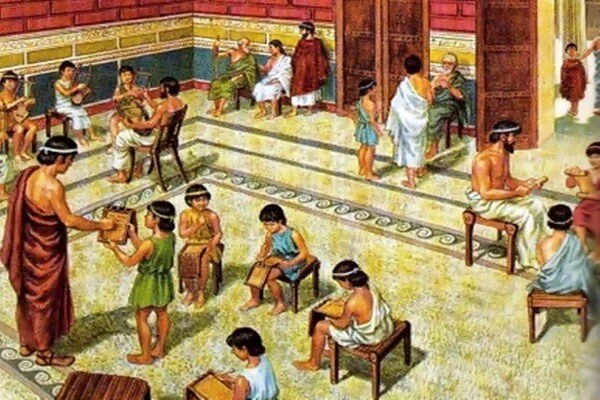
“Paideia” (cf. Dr. Werner Yeager’s treatment on “Christian Paideia” and “Classical Greek Paideia”) was the classical education for the first century Christian Children which means, “to walk; walk; the walk”—-i.e., “the little *footers*”. One could use the Star Wars term, “Padua (same term as Paideia) ”, for “young ones learning “The Force”. We see this term in “Pediatrics” for medical care for the youth.

The Paideia for 1st century Christian children consisted of (1) Greek and Latin language (2) Logic (3) Rhetoric. All such Classical education came DIRECTLY out of Aristotle and Plato’s Greek and references to the classical myths of Homer on down (cf. my treatment on Homeric ties with the synoptic Gospels). There would have been no confusion between the New Testament text presented by Paul and the Paideia because Paul was Hellenistically-classically trained. Paul cryptically if not openly referred to the classics and the Great Philosophers in the Scripture. Paul, by inspiration of God, fulfilled the philosophy of the Greek writings by stitching them into their final stages with the Resurrection of the unknown god at Mars Hill. Paul’s Christianity was understood by the Hellenized World, i.e., to the Barbarians, Pagan Rome, Greece, and Europe. Everyone would have understood the Greek usage of the Greek New Testament because the words were interlocked with the Hellenized culture which was Aristotelian based and enforced through his student, Alexander.

So, the Greek usage during the ante-nicene first century Church (ca. 33 A.D. to ca. 350 A.D.) was, for sure, philosophically and linguistically Aristotelian (and Platonic based). Alexander the Great, who “Hellenized (made everyone learn Greek/ think Greek) the world, was the direct padua/ ‘mathetikon’ of Aristotle —or, “Mathetekes (mathematician – i.e., “disciple” is known in the New Testament).

Now, let’s apply this knowledge to Biblical exegesis:

APAKATASTASIS (Acts 3:21) vs. THE ENGLISH ETERNAL “JUDGMENT

THE FIRST OF TWO ‘HELL-VERSES’

I will use this definition again within this treatment but I would like to place this first for our “mental coathangers”: Aristotle’s “Kolosis (judgment) is used for the SAKE/ BENEFIT of the one being punished” – i.e., IN ORDER FOR REMISSION OF THE SIN!/ A RECTIFICATION!!!

The ‘eternal scourging’ was and is our English idea of “Eternity” from the *interpolation -perversion* via the Latin Vulgate’s “Aeturnus” ((and not the original Biblical Greek, ‘Aeones’)) which, indeed, meant “eternity without end”.

In contrast to the Vulgate’s erroneous translation-usage of Aeturnus, the Biblical Aeones (a certain duration of time) and Kolosis (affliction for the benefit of the afflicted unto remission of guilt), which was not understood or applied in the Medieval mind of King James or his Biblical *version*, was used as an expression of the ‘baptism of fire’ (( Matthew 3:11: John the Baptist as an ‘enactment’ or ‘panomimist’ says: “I indeed baptize you with water unto repentance: but HE that cometh after me (JESUS) is mightier than I, whose shoes I am not worthy to bear: HE shall baptize you with the HOLY GHOST and WITH FIRE/ 1 Peter 4:12 – “Don’t think it a strange thing that a fiery trial would take place upon you”)) or ‘fiery trials which are to try us’ (The “evil” aspect of us as the ‘evil doer’) unto the remission of sins’ in order for their eye or hand to burn and not them (cf. Matthew 18:8 {paraphrased) if your hand, foot, or eye causes you to stumble, cast it into eternal fire lest the “WHOLE” body be thrown into eternal fire! ←– But now! In Philippians 2:13 it states: “For it is God WHO works in you to WILL and to ACT in order to fulfill HIS GOOD PURPOSE”. So, any “repentance” unto remission of sins is a GOOD *act, will, choice, doing, becoming, etc.*. So, WHO is doing the “casting of the limbs lest the whole body is cast into hell” thing? …Looks to me that this is a “META” idea. If we are “speaking” as “we see” then we are very well deluded. If we read, learn, obey, study, dig deep, etc. into the Biblical Greek and Hebrew text we WILL FIND that it is GOD who creates, does, WILLS ALL things for the ‘good’ of HIM and those who have been made to believe in HIM (Isaiah 45:7; ff—Isaiah 48; Romans 8:28-ff, etc.).

It would be psychotic to shed rageful anger and eternal damnation forever upon something, someone that is governed by YOUR WILL to begin with. Adversely, what IS LEFT IS REASON: In the FREEDOM of being within the INFINITE WEB of GOD’s existence as HIS *CHILDREN* to roam FREELY in HIS mansion/ domicile/dominion/’doom’/judgement = all the same word, etymologically (cf. my “WYRD HOARD” podcast on “Doom and Fates”) we are eternally bound to infinite possibilities of joy, love, experience, etc. Not even the Calvinists seem to take “Predeterminism” this far, yet, THIS KIND OF PREDETERMINISM is what concludes us to UNIVERSAL RECONCILIATION and Calvinists MUST HAVE THEIR JUDGEMENTS! It’s a schizophrenic approach to scripture to hold to either Calvinism for all of its predeterminism of “love” for the Calvinist and “Hate” for the non Calvinist. Worse yet, the “seeking” of the doomed. I become sickened at reading my own typing here because I know these words are ALL ‘ill-defined’ by ‘orthodoxy’.

It was King James, however, who wrote “Demonology” and was a supporter of a fifteenth century text written by the clergyman, Heinrich Kramer, called “Malleus Maleficarum (Medieval Latin: “the Hammer of Witches”)” which supported the Medieval “hunt for the **Judgment** of those that ‘seemed’ to be a witch. This book seems to match the Vulgate’s adopted fallible translation and perverse “judgment or ‘other judgment’ not mentioned in the Bible from  God.

Such a vengeful spirit was astutely addressed by Aristotle (as he defined all things) using his Greek. Such a Greek word that Aristotle contrasted with kolosin was ekdike, or, revenge.

Ekdike was Aristotle’s Greek for ‘revenge/ vengeful judgment’ in his work called, “rhetoric”. Aristotle said that “ekdike” was based on a ‘hunger-anger-appetite-revenge-emotional seated’ perversion. Such a definition of “revenge and judgment” based on a humanistically made “god” fit human ‘justification’ and fit King James and all of his witch hunting club’s views of ‘control, God, sexuality, possession, dominance, sexual deviancy, beastiality very nicely. For sure, the spirit of fear quelled the masses’ complaints and garnered the populus with an iron fist. Maybe the history of King James is hidden from most due to his disgusting appetites and sado-masochistic practices that anyone can read about now. What ‘modern orthodox King James Version thumper’ wants that out of the bag? This is not to say that we cannot use the King James Version to read the histories, peoples, Israel’s conflicts, internal strifes, etc… But, only to be aware of reading the English text *AT FACE VALUE DISMISSING THE ORIGINAL

GREEK*!!!!

Revenge – *JUDGEMENT* Recap:

“Revenge”: Greek: “ekdike”. Aristotle said that ekdike’ meant: “anger for revenge” Aristotle continued to define ‘ekdike’ and say: the action of inflicting harm or hurt on someone for an injury or wrong suffered at their hands) is a “habit” based on appetite and is rooted in emotions–human emotions” –> cf  Aristotle’s “Rhetoric”–Book 1/ Chapter 10/ vs. 13 in the “Basic Writings of Aristotle”.

This “ekdikes” is connotatively akin to the King James, “Judgment”. This puts God with emotional problems and relates to a humanistic-childish approach for ‘resolve’ if we interpolate THIS KIND OF JUDGMENT into the connotation of God’s Final Judgment, which has NOTHING TO DO WITH THE ORIGINAL GREEK TEXT OR ITS SEMIOTIC COMMITTED LANGUAGE.

Once again, New Testament word for Matthew 25’s, “judgement”: “Kolosin chastisement-judgement-for full acknowledgement of infraction and ‘coming to be’ to restitution)!!!

Let’s continue:

When we look at Matthew 25:41 Jesus uses the term “judgment {Greek: kolosis}. As we see the final usage of it in the “final judgment“ in the following verses: “Then He will also say to those on the left hand (sinister gyrate/ hand of no blessing), Depart from Me, you cursed, into the everlasting fire prepared the the devil and his angels (this does not mean that we won’t be ‘singed’ and ‘remitted’ for sins through ‘the fire that burns’. That is, there is a heat or “orge” that we will experience when we break the law. This has nothing to do with another topic, i.e., OUR SALVATION. These are entirely two different things. : for I was hungry and you gave ME no food: I was thirsty and you gave ME no drink. …etc.

Here’s something that needs to be understood before the next paragraph: Jesus is aligning Himself with King David, the Messiah to Come, The Sun of the Son, and the Father. His WORDS are in unity and conjunction with the LINE of the Lion (Lebayu) of Judah. Saul was named the same, Lebayu,….the Lion. But, his actions of jealousy and murder assigned him a new NAME or Shem: “SAUL” which is the same word for “HELL”—i.e., “SHEOL”. Saul was, “The Lord’s ANOINTED”. How can a saved man be in hell? …. These are the concepts we must understand to correctly read the Bible. “In Darkness” meant, “SHEOL”…or, in the Germanic, “HOLEN”…in the “hole”…in the place of “Darkness”. This is also Latin for DUCARE’ …which means, “Darkness”…hence, “e + ducare” = “education” = “out of + darkness”. Saul was ‘coming to be’. Saul was “God’s Anointed” 0000 yet he had to “fall into darkness” AS AN ANOINTED OF GOD!!! Hmmmmmm, ever happen to you? Do you ever ‘fall into darkness, feel like you’re in hell – so distant from God due to your ‘actions’ that here and now do judge you unto repentance by the Holy Spirit?!?!?!! I know of NO OTHER WAY. I HAVE NO OTHER REFERENCE TO MY LIFE WITH GOD BUT THIS. Do I call out to God in hell to help me?! Do I ask Him to save me and do I profess the HE is ALONE my ONLY Savior while I’m in HELL: “holen- German-”darkness”/ Sheol – Hebrew- “darkness/ phulake – Greek -“prison (as known as the dark caverns guarded by the prison watch)

Might I remind you that King David spoke to God using the exact same words as the Aristotelian defined, “Kolosus”, by David’s enemies being in the process of the ‘destroyed enemies’ in order that THEY could ‘’come back to be ashamed”. Who are the “THEY” if they are both sent off to ‘eternal damnation’ and yet, “come back to be ashamed”?!??!?!?! Refer to the previous paragraph!

Here are Christ’s words in Matthew 25 echoed in Psalms 6:9: “Depart from me, all ye workers of iniquity; for the LORD has heard the voice of my weeping”..(David continues this prayer in Psalms 6:10, “Let all my enemies be ashamed and sorely vexed; LET THEM RETURN AND BE ASHAMED”.

Is this NOT a *RETURN* – repentance?! Is this NOT a return to the ‘acknowledgement’ of their wrong?! Is this not the meaning of “REPENTANCE” —metanoia –’a changed mind, a repented mind’?!?!? Yes, yes it is!!! Again, Is this NOT the VERY usage of “Kolosis”—”Judgment” in the Greek New Testament of Christ’s words that Aristotle used of “JUDGMENT- Kolosus”!?!? Let’s go on:

GOING BACK TO THE TEXT OF CHRIST’S ‘JUDGMENT’

Jesus continues to express *those* who did NOT give charity: “…as you did not do unto the least of them you did not do it unto ME”.

*These beings* who act as non-charitable are not the full ‘being’, not the ontological-‘’coming to be” –whole “ person who is FINALLY RECTIFIED. If there was the word, “REVENGE”, as Aristotle continues, it would be for the benefit of the Avenger. This ‘revenge’ would be “in reaction” to an act by the infractor of the Law. Aren’t works of the Law Destroyed by Christ?! The VERY THING that holds to account damnation upon the infractor of the Law?!?!

Again, look at the words in Matthew 25:40: “The KING (! quoting King David right here from Psalms 5-6!) will say, –The KING will reply, ‘Truly I tell you, whatever you did for one of the least of these brothers and sisters of mine, you did for me. Then he (King David – past in foreshadowed *language*) will say to those on his left, ‘Depart from me, you who are cursed, into the eternal fire prepared for the devil and his angels….”. .

Are not even the angels subdued under Christ’s feet at the end where death, hell, all powers and principalities subdued?! Continuing Matthew 25: “…..will go away into everlasting punishment ( kolasin aionion —durative infliction for the benefit of the sinner as Aristotle defined and original language used in the New Testament), but the righteous into eternal life”.

These are two different allotments and two kinds of ‘beings’. Once again, Aristotle does indeed use this term in his “rhetoric”: Aristotle: “Kolosus (judgment)” is used for the SAKE/ BENEFIT of the one being punished” – i.e., IN ORDER FOR REMISSION OF THE SIN!/ A RECTIFICATION!!!

The eternal scourging (not our English idea of “Eternity” from the perverted Latin Vulgate, “Aeturnus”, which was moreover used in the Medieval King James *version*) is a tool put upon the ‘evil doer’ in order for their eye or hand to burn and not them! Aristotle says that “anger for revenge (Greek: “ekdikes – the action of inflicting harm or hurt on someone for an injury or wrong suffered at their hands} is a “habit based on appetite that is rooted in emotions–human emotions” –> cf. Aristotle’s “Rhetoric”–Book 1/ Chapter 10/ vs. 13 in the “Basic Writings of Aristotle”. This kind of revenge is ‘retributory’ and you see it working in legalism throughout the Middle East. Wars find their way fairly easy into such common grounds of “eye for an eye” mentality.

Once more: Kolosin Aeonon = “a duration or time of beneficial affliction to bring one back to restoration”. THIS is the meaning in the classical, Platonic and Aristotelian Greek from which the New Testament was the “catcher’s mitt” for such terms. Therefore, terms such as judgment, salvation, faith, God, Logos, etc. have been all too familiar for the Greek speaking New Testament Church who knew EXACTLY what they meant when they were edified and taught their children in the Paideia!!!

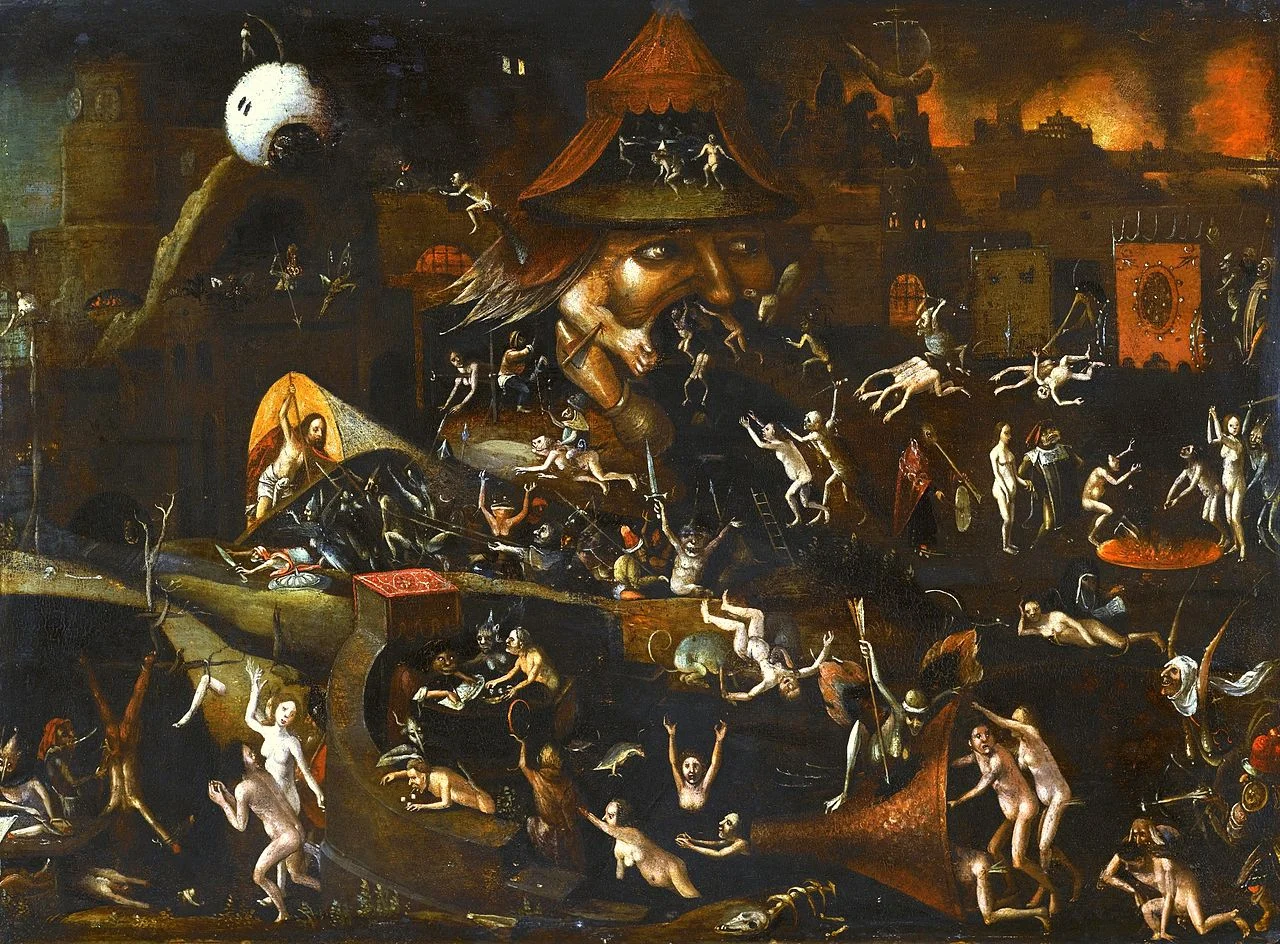
Where do we see Hell as a real place? I see it HERE and NOW. It has meaning if IT is Here and Now.

The Classical Greek Paideia was originally the classical education for the early Greek youth. The central Philosophers such as Plato and Aristotle comprised a large component of this Paideia. Language, Logic, and Rhetoric were the primers by which all further study into the sciences could ‘rationally’ be obtained. The language by which these primers functioned was a result of Platonic and Aristotelian reasoning and cultural bearing.

Therefore, any word used in the Paideia (language, logic, rhetors) was *refined*, delineated, syllogistically filtered, deduced, re-examined, etc. The words found in the Paideia were therefore known in the sense by which their Greek “glossary” used its “howness”. It is no wonder that the word, “Disciple”, in the Platonic, Aristotelian, …and, yes, Biblical New Testament language was called the “Mathetikon” or “mathematician (of the Words)”.

To add, this “howness” would have been used in its Platonic and Aristotelian sense. Might I add here that I do not in any way disenfranchise Plato and Aristotle from Greek culture, rather, they simply are the most notable fountainheads of Greek culture.

The New Testament Greek language must be understood from its roots founded in The Paideia of the ancient pagan (amoral) Greeks. Therefore, the implementation of any word used in the New Testament was based centrally upon the verbal bank of Plato and Aristotle. Yes, there are other ‘sources’ but the well read Philosophers, Plato and Aristotle, were baptized by their Greek heritage and contemporaries. That is, Plato and Aristotle were the “result” of Greek Heritage…therefore, the consequential “Parents” of classical Greek scholasticism.

As a linguist, it is of most import to know the etymologies, morphological rules, socio-linguistic phenomena, etc. of any given language to fully comprehend its worth. It shouldn’t be a hard jump to understand that Alexander the Greek, the Hellenizer of Palestine brought with him the Greek culture by which Palestine was baptized into. Moreover, Alexander’s teacher was the renowned Aristotle himself!!! Straight from the horse’s mouth to the One who would order a new language be spoken.

Alexander, for sure, was the leopard in Daniel’s prophecy and a necessity for the spread of Christianity via Greek language and reason to a Hellenized pagan Europe.

With all that I have said, I conclude with this: there is consensus and concentrated agreement with HOW the Greek language was implemented in the days of the early Greek New Testament writers. For sure, the Gospel writers were Hellenized. Paul was highly educated both in the Hebrew and Greek systems of thinking and his fluency of both Hebrew and Greek was known and expressed in his writings. Therefore, it would be blasphemous on a secular and theological level to “Anglicize” the Paideia of the Pagan Greeks, the Paideia of the New Testament Christian Youth (taught by the Christian Mothers!) OR the New Testament Text.

Deep analysis of the HORRID perversion of Anglicizing the rest of the world will begin at the New Testament verses concerning “eternal damnation” in our 3rd piece to this series.

One could safely say that until the past century, especially at the point of understanding Einstein’s equation E=mc2 , “time” was relatively not understood. Moreover, the Universe was not understood as to how it worked. Spatiality was beheld by objects *relatable* such as “to the top of the mountain from here”, “where the land meets the ocean”, “the darkness created by the depth of an abyss”, “the unseen in the darkness of the waters”, etc. With this in mind, “relatable” objects such as the horizon (i.e. sky touching earth) would have been used to express where heaven meets the earth, hence, “eternity” was a ‘spatial understanding’ in that the earth stopped accounting for spatiality.

Another example of relatable understanding: the sun was the roving eye of God searching the hearts of humankind and scanning the actions of humankind as it appeared in the sky or heavens where God abided.

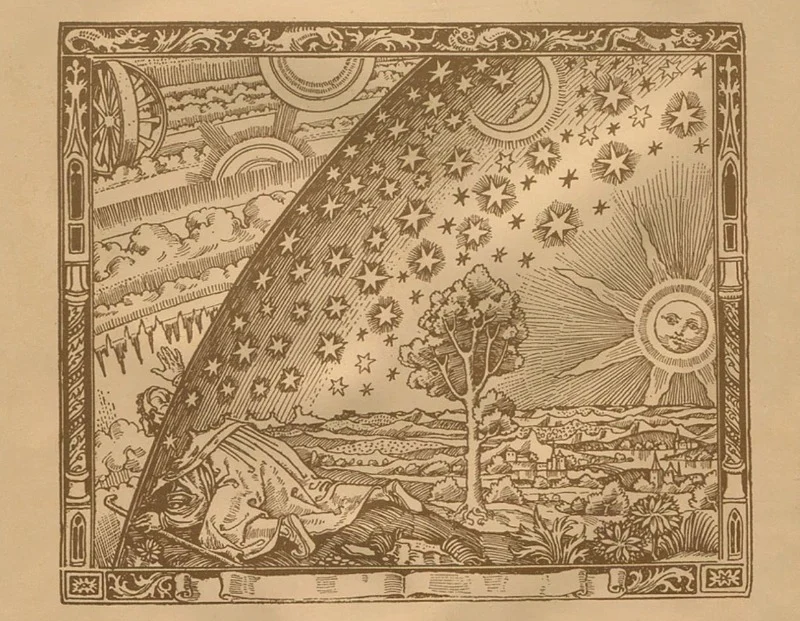
The earth might have been seen as ‘round’ but as a globe probably not. Therefore, to the ‘primitive’ genius, the ‘water-course’ of the seas ‘circled’ the flat-circular earth. It is within these waterways that our primitive-genius ancestors find the lore, of sorts, that “Leviathan” swims his course ‘round the earth. What a great story to tell your children when not wanting them to get too close to the water!

These were primitive understandings but not stupid. “Primitive” is the strongest-purest foundation by which all other mental structures are established. So, as I stated- “primitive-genius”- I meant it. “Genius” means to ‘be joined’, ‘to be connected’ to everything and ‘act’ or ‘participate’ within this *connectivity* or *genius*. For each level of evolution of participation of the figurations of WORD signaling, we have deeper fulfillment to the higher complexity of the original generative WORD. The “Genius” is Pregnant with higher fulfillments yet to come both semiotically and spiritually. Therefore, I witness that each Biblical epoch/ era/ aeon/ etc. was needed to fulfill a greater archetype (as do we need the grace to ‘evolve’). We will see that the terms“permanence” and “eternity” will use the terms ‘epoch’, ‘era’, and ‘aeon’ to substantiate the vagaries of contextual meaning later on in the Biblical text and pagan authors by which the Bible borrowed.

Truths of God were not the same as the Biblical Patriarch’s understanding of their surroundings. Nonetheless, there was a symbiosis between YHVH and Israel through YHVH’s ‘metalogue’.

God might say “forever” concerning HIS statutes …yet, there was no example of specific relatable ‘time mapping’, only conceptualizing of ‘referred continuance’ by the tools given to the primitive sense not lesser ‘sense’. (“Forever”: Hebrew: Olam: Genesis 9:12; Ecclesiastes 12:5;

Isaiah 26:4; Psalm 145:13; etc. { all such usages allude to a ‘duration’ of non-accounting}). As we delve into the concept of “permanence” vs. “eternal” we will see ‘relational differences such as ‘being with God in a “RELATIONSHIP” that never ends versus and ‘PERMANENT’ ordinance that “NEVER ENDS” but is superseded by it’s fulfilments and becomes the stronger “archetype” for its “exponential ‘primacy’ “.

To conclude:

The Biblical Patriarch/ Matriarch was a recipient of God’s Word and had a limited skill set for a specific purpose. Nonetheless, the conveyed Words were relayed by God while the recipient of God’s Words participated in obedience. Obedience is the key word. Obedience is necessary to have completion of God’s telegraphed ending to HIS Narrative = our Marriage to Him.

For the Primitive-Genius to ‘analyze’ or ‘parse’ the etymologies of God’s Rema or divine expressions would be not only ludicrous but, in Old Testament Times, idolatrous. This is the evolution of consciousness and levels over time of “how” a tribe is to participate with the God of Ancient Israel. “Analysis” would begin the VERY YEAR that Judah was taken captive (last of the 3 deportations) by Babylon. Thales would introduce deductive thinking and jumpstart a new ‘era’ of ‘anatomizing’ versus ‘collectively participating’. Genius would leave and Wit (Greek: ‘eido’ = “to see”/ “observe”) would begin.

SETS OF ‘MOTIONS’ / PLATO’S DIALOGUES TO BIBLICAL FULFILLMENT

Loeb Classics; Plato; Cratylus; pg 121; vs. 418

SET ONE OF ‘MOTIONS’

Dei’on – “obligation” (Root: ‘to go through’)

*de’o—-* (root of Dei’on) – “to bind” as a prisoner or animal—-Mt. 18:18

(Cf. “Deismos” as cognate)

Blaberon (cognate)

SET TWO OF ‘MOTIONS’

(Plato says that these particular names signify the principle of *arrangement* and *motion*

Owe-fee’-lee-mohn – “useful”

Lusitelon – “profitable”

Kerda.lay’on – “gainful”

Agathon – “good”

Ksoom-fe’ron – “advantageous”

Euphoron – “prosperous”

SET THREE OF MOTIONS

Zay.mee.OH’.dayce “that which binds motion” – in a good way (halting from trouble)

(Other spelling: daymiOH’dayce = good”)

SET FOUR OF MOTIONS

Hay.doe.nay (from, “hedonism”) – “pleasure”

Lupay – “pain”

Epithumea – “desire”

SET FOUR OF MOTIONS

Hay.doe.nay (from, “hedonism”) – “pleasure”

Lupay – “pain”

Epithumea – “desire”

SET FIVE OF MOTIONS

‘Haydonay’ – ‘the action that tends towards advantage 

(Root of haydonay: “eonay” – PN – TO BREATHE

LUPAY – “dissolution of the body which takes place through the process of pain”

Ania – “sorrow – that which hinders motion”

(Root to ‘ania’: “algaynos” – “distress” – “having a hard time”

SET SIX OF MOTIONS

Odu’nay – “grief; putting on the pain; 

Aksthaydon – “vexation” – as in weight 

Aksthos – “burden” – “as vexation of weight puts upon motion”

Loeb Classics; Plato; Cratylus; pg 125; 420, B, .5

SET SEVEN OF MOTIONS

Doxa  (“opinion” – i.e., ‘shooting for the goal or intention to meaning without knowledge or certainty as of yet’).

In Plato’s dialogue, Doxa comes from the pursuit {‘dioxis’} which the soul carries on as it pursues the knowledge of the nature of things, or, most likely, from the *SHOOTING OF THE BOW (toxon)*; i.e., though we can’t say for sure that we have hit the mark, we are aiming with good intention. 

Oi’.ay.sis – “belief” —- “the sense of the MOTION of the soul towards the essential nature of every individual thing (i.e., *trajectory*; *intention*; *goal towards someTHING; from the universal to the particulars {from the Heavenly to the Earthly—Kyle})

Just as “oi.ay.sis” acts in its motion, so does “Boulay”.

Boulay –  “intention” – denotes “shooting (Bolay)”

Boulesthai – “wish”

Bouleu’esthai – “plan” = denoting “aiming at something”

SET EIGHT OF MOTIONS

Kara – “joy”

Diakoosis – “of the flow of the soul”

Terpsis – “delight”

Terpnon – “creeping of the soul” – “delightful”

{page: 123; vs. 419}

(Root of “terpnon” – *-pnoay [pne-] = “breath”)

Eufrosu’ne – “mirth” = {“harmony with all things/ universe}

{eu – well; good + sunay – “all things ‘summed’/ ‘joined’ (together)”

EpithuMEE.ah – “desire”; thumos = thusis = “boiling over; boiling of”

*’Ee.oo.sa* = “goes into thumos” – cf. below with above

SET NINE OF MOTIONS

Hay’.me.roos – “longing”; “the day”; 

(Root: “hay’.mee” + “rous”

** Hay.mee.ros** = emera + roos = longing for the flow; the flow that goes away; takes away; the “rush away as a stream from the soul”; “yearning”

(Cf hay.meh.nos)

Pothos- “yearning”

“Allothi pou” – “that which is elsewhere”

“Hay.me.roos” “present (object)” – “The Day that Has Come Upon””

“Pothos” – “absent”

*Eros – “flows in from out” 

(Cf. Root Eros —> root: “esrei” = ‘eis’ = ‘into’ + “roos” = ‘river’ = ‘flows INTO as a river [ from an outside source]. 

SET TEN OF MOTIONS

Aboulia – “evil”; “without intention”, “ill-advised” (cf. to notes below)

(“A” = alpha privative = Greek prefix for making negative, negating the meaning)

So, Boulay + alpha privative = “Aboulay” – “evil”; “ill advised; without intention, plan, goal, desire, wish, trajectory; *therefore, a *failure to hit* = cf. “sin” = Greek: “harmateia” = sin, senex, sine, missing the mark (even if planned to hit the mark)

Anankay – (‘anagkay’ = ana’g {“g” takes the nasal/liquid-“n”}kay) – “compulsion”

Hekou’sion – “voluntary” —( Hekou’sion means ‘voluntary’ because ‘hekou’sion’ comes *in line* with the ‘events’ of motion to the *YIELDING* (Greek:eikon = English: ‘icon’) and not in opposition. 

Anankay is the converse of of “hekou’sion” and is ‘compulsory’ and ‘resistant’, which is contrary to the will and is associated with error and ignorance. Anankay is likened to *walking through ravines (‘ankay’ {cf. “angst”}), because they are hard to traverse, rough, and rugged, and *RITARD MOTION*. 

SET ELEVEN OF MOTIONS

CONVERSE OF NOBLEST AND THEIR HINDRANCE TERMS OF MOTION 

Aletheia (‘to wander with’ + ‘god (goddess)’ = “To wander with the God”); “Divine Motion”; Divine Motion of the Universe

Pseudos – “the opposite of Motion”; ‘held back and kept silent – hence, associated with ‘slumberers’ – heu’dousi {the addition of “ps” {or “psi”}, says Plato through Socrates’ daemon {deity mind}, simply conceals the ‘slumber’ word, “heu’dousi”.

Onoma – signifying “this is *a being about* which our search is”.

Summation

So, Aletheia means ‘motion forward’, Pseudos is known by being the opposite of “truth” or “aletheia” —-the slumber from Divine motion, and onoma

*signifies* what the divine wandering is about. 

This summation gives us hints to our New Testament Theology within the Greek. “Nomos” is the Name is “onoma” is “authority”. Jesus is the “Name” of God represented on earth. His “motion” was THE *Sign* or “Onoma” of God the Father’s Will or “boulay”. The Disciples *followed* or *wandered* with the Name of God, the Onoma of God-Father, aka, Jesus. Their ‘motion’ driven by the God on earth followed in line with the Narration of the Universal Divine Motion of doing and fulfillment. Pseudos, to my view, indicates the ‘hated’ mentioned in Romans 9. “Before they were born, God loved Jacob and hated Esau. The “slumber” is the meaning of Esau. As the Greek gives us “miseo” for “hate” in this passage of Romans 9, it does NOT say, “I, the Lord, despise you”, rather, it means “dismiss”, “not include for the narration of motion of Divine Wandering, hence, the Jews to Jesus to the Disciples to us. The “Sign (onoma)” of God is in US now. This does NOT mean that Esau, as the Middle Eastern race, shall be damned. Rather, for now, Islam is not the indicative “Onoma” of Grace, forgiveness, salvation through Jesus’ atoning blood. This is simply factual and not condescending. 

Calvert Watkins’, “How to kill a Dragon”, explains “hindrance (from the societal ideas of “stoppage”)” as stoppage of waterways to plenish their respective cultures.

Yahweh, the cult of metallurgy.

Everywhere the ensign of Yahweh went so did the secret art of the cauldron and its smithy go. Kennites (the Canaanite smelters) are the Cainites are the Khanites. Cain never stopped believing in Yahweh.

In antiquity, south-eastern Canaan was a very important centre for copper smelting. While it is likely that there existed a patron deity of metallurgy, the identity of the Canaanite god of smelting remains unknown. Although some biblical writings suggest a south Canaanite origin of Yahweh, no details are provided concerning his worship prior to him becoming the god of Israel. This study explores whether Yahweh was formerly the Canaanite god of metallurgy. The following observations corroborate this hypothesis: (1) Yahweh was worshiped by the Edomites, and especially by the Kenites, a small tribe regarded as the Canaanite smelters; (2) the Israelite cult of Yahweh was associated with copper and with a bronze serpent, a typical symbol of metallurgy; (3) the melting of copper is considered in Exodus 4 as the specific sign of Yahweh; (4) a parallel exists between Yahweh and the god of metallurgy worshiped in Egypt (Ptah), Mesopotamia (Ea/Enki) and Elam (Napir), all of them being a mysterious lonely deity; (5) fighting the (other) gods is common to Yahwism and to ancient metallurgical traditions. These data suggest that, before becoming publicly worshipped in Israel, Yahweh was formerly the god of the Canaanite guild of metallurgists. Keywords: Cain, copper smelting, Yahweh, Edom, Kenite, origin of monotheism.

Until now, investigations into the origin of Yahweh worship have remained highly speculative, not least because the deity is almost ignored outside of the biblical writings. Many scholars have emphasized the occurrence of a crisis of polytheism during the second half of the second millennium BCE in Egypt, Canaan and Mesopotamia.1 In such a context, some scholars have proposed a foreign origin for Yahweh.2 And yet, no evidence exists towards a foreign cult of Yahweh. Other scholars have assumed the existence of an endemic tribal cult of Yahweh in Canaan prior to the deity’s metamorphosis into the ‘national god’ of Israel. In this case, the increasing importance of Yahweh would result from a political expansion of the tribes worshiping him, and monotheism would emerge as a consequence of a gradual subordination of all Canaanite gods to Yahweh prior to their progressive ‘collapse’.3 However, such a ‘gradualist’ explanation is not entirely satisfying. The raising up of a clan-deity and his transformation into a ‘national god’ is considered as a common feature in the history of religion, yet it does not always evolve towards monotheism. Furthermore, as observed with the raise of Marduk at Babylon, the transformation of a clan-deity into a national deity is generally concomitant with the concentration of political power towards the town this god patronized. In the Canaan of the early Iron Age, no such concentration of political power can be used to justify the collapse of the whole pantheon. Shechem, a place of central importance for the ancient Israelite religion,4 was not the capital of any vast kingdom at the beginning of the first millennium BCE. Even Jerusalem, the town sub- sequently associated with Yahweh, was formerly patronized by Shalem, an epithet of the Canaanite god Resheph.5

Since no substantial evidence exists to confirm the gradualist sequence from local clan-deity to universal monotheism, a ‘latent monotheism or monolatry’ inherent to the Canaanite culture is sometimes postulated in order to account for the emergence of Yahwism. 6 However, such an ad hoc argument is no more than an attempt to convert the final conditions into a ‘starting point’, thus transforming the historical explanation into a tautology. By analysis of biblical texts, some scholars have assumed for a long time that Yahweh was formerly worshipped in the south of Canaan (especially in Edom and/or by the Kenites).7 The claim that ‘Yahweh comes from Seir’8 has been strengthened by the discovery of Canaanite inscriptions evoking ‘Yahweh of Teman’,9 but also by Egyptian writings mentioning Negeb and northern Sinai as ‘the land of Ywh’.10

The idea of an Edomite origin for Yahweh may be of crucial impor- tance for discovering his former identity, because the south-eastern part of Canaan was known from the earliest times as a very important place for copper metallurgy.11 At Punon (Feynan), the most important centre of metallurgy in the Arabah, archaeologists have estimated that between

6. For example, Norbert Lohfink (‘Gott und die G tter im Alten Testament’, Theologische Akademie 6 [1969], pp. 50-71 [mentioned by Gnuse, No Other Gods, p. 91]) assumes that a latent monotheism or monolatry existed in the ancient Near East.

7. The southern origin of Yahweh was already suggested in the nineteenth century; see, for example, Karl Budde, Die Religion des Volkes Israel bis zur Verbannung (Giessen: Alfred T pelmann, 1900). Recent scholars defending this opinion are discussed by Gnuse, No Other Gods, and include G sta Ahlstr m (see pp. 77-79), Hermann Vorlander (see pp. 86-88) and P. Kyle McCarter (see pp. 97-98).

8. Judg. 5.4: ‘LORD, when you went out from Seir, when you marched from the region of Edom’. For the correspondence between Seir and the land of Edom, see Z. Kallai, ‘The Campaign of Chedorlaomer and Biblical Historiography’, Shnaton 10 (1989), pp. 153-70.

9. See J.A. Emerton, ‘New Light on Israelite Religion: The Implications of the Inscriptions from Kuntillet Ajrud’, ZAW 94 (1982), pp. 2-20. See also A. Lemaire, ‘Les inscriptions de Khirbet el-Qom et l’Ashera de YHWH’, RB 84 (1977), pp. 595-608; J. Hadley, ‘The Khirbet el-Qom Inscriptions’, VT 37 (1987), pp. 39-49.

10. See de Moor, The Rise of Yahwism, p. 111. See also M. Weinfeld, ‘The Traditions Relative to Moses and Jethro at Mount Elohim’, Tarbiz 56 (1988), pp. 449-60 (Hebrew). See also K.A. Kitchen, ‘The Egyptian Evidence on Ancient Jordan’, in P. Bienkowski (ed.), Early Edom and Moab: The Beginning of Iron Age in Southern Jordan (Sheffield Archaeological Monographs, 7; Sheffield: JSOT Press, 1992), pp. 21-34.

11. E.A. Knauf and C.J. Lanzen, ‘Edomite Copper Industry’, in A. Hadidi (ed.), Studies in the History and Archaeology of Jordan (Amman: Department of Antiquities, 1987), III, pp. 83-88.

Downloaded from http://jot.sagepub.com at UBO Bibliotek for on June 8, 2009

390 Journal for the Study of the Old Testament 33.4 (2009) 150,000 and 200,000 tons of slag resulted from copper metallurgy in the period from the Chalcolithic to the Iron Age.12 Even the emergence of Edom as a political entity, during the first millennium BCE, has been related to the sudden increase in mining and smelting activities in this area.13 Thus, it would be extremely surprising if metallurgy had not impacted the Edomite way of life and religion.

Based on the central importance of Levantine copper smelting from the earliest times,14 the patron of the Canaanite smelters would certainly have been famous. And yet, strikingly, this deity has not been yet identi- fied among the 240 Canaanite deities mentioned in the Ugaritic texts.15 In parallel, it is interesting to notice that the Ugaritic texts also ‘forgot’ to mention Yahweh. All these indications invite the testing of the hypothe- sis that Yahweh was formerly the Canaanite god of metallurgy. 2. Yahweh, an Edomite God Many ‘theophoric’ names including the divine name Qos have been found in Edom. Accordingly, it has been assumed that Qos was the main 12. V.C. Pigott, ‘Near Eastern Archaeometallurgy: Modern Research and Future Directions’, in J.S. Cooper and G.M. Schwartz (eds.), The Study of the Ancient Near East in the Twenty-first Century (Winona Lake, IN: Eisenbrauns, 1996), pp. 139-76. According to these authors, a collapse in copper metallurgy industry is observed during the second millennium BCE. 13. Bienkowski (ed.), Early Edom and Moab, pp. 1-13. Concerning the metallurgic activity in Edom at the beginning of the first millennium BCE, see T. Levy et al. ‘Reassessing the Chronology of Biblical Edom: New Excavations and 14C Dates from Khirbat en-Nahas (Jordan)’, Antiquity 302 (2004), pp. 865-79. 14. See G.N. Amzallag, The Copper Revolution: Canaanite Smelters and the Origin of Civilizations (Shani: Hameara, 2008 [Hebrew]). 15. See J.C. de Moor, ‘The Semitic Pantheon of Ugarit’, UF 2 (1970), pp. 187-218. Canaanite gods have been identified in recently discovered Ugaritic texts, but the god of metallurgy is yet absent from these writings. See D. Pardee, Les textes para-mytho- logiques de la 24e campagne (Paris: Edition Recherche sur les Civilisations, 1988). In Ugaritic mythology, Kothar is the god who produces copper artifacts both for the other deities and for the heroes, suggesting that he was the patron of the coppersmiths. However, one has to keep in mind that during Antiquity, smelting (the genesis of copper from ore) and metal craft (the cold-working, hot-working and casting of copper) were activities carried out by distinct corporations; see T. Levy and S. Shalev, ‘Prehistoric Metalworking in the Southern Levant: Archaeometallurgical and Social Perspectives’, World Archaeology 20 (1989), pp. 352-72. See also Amzallag, The Copper Revolution, pp. 46-63. Thus it is likely that the patron of metal crafts and the god of metallurgy were distinct entities.

Downloaded from http://jot.sagepub.com at UBO Bibliotek for on June 8, 2009

Edomite deity.16 However, nothing is known about Qos worship since no public cult is found in Edom.17 Neither is the interpretation of Qos as the main Edomite deity supported by the biblical writings, where this name is never mentioned. In fact, the name of no other Edomite is mentioned. This situation contrasts with the explicit mention of Chemosh and Milkom as the ‘national’ deities of Moab and Amon respectively.18 This silence about the Edomite deity is probably not incidental. Edom, the bitter enemy of Israel, is never blamed for idolatry by the prophets. This suggests that Edom did not oppose Israel in the name of any other god.19 The silence of the biblical writings about the Edomite deity provides circumstantial evidence for its identification with Yahweh. Further indications strengthen this claim. First, Edom is qualified as ‘the land of wisdom’ in Jer. 49.7 and Obad- iah 8. In a monotheistic context, it is difficult to assume that wisdom would have a source other than Yahweh.

Furthermore, it seems that the book of Job, the main ‘wisdom book’ of the Bible, has an Edomite origin,20 thus strengthening the linkage between Edom and Yahweh. Second, the worship of Yahweh in Edom is explicitly mentioned in Isa. 21.11 (‘One is calling to me [Yahweh] from Seir’), and the duty of Yahweh in regard to his Edomite worshippers is stressed by Jer. 49.11 (‘Leave [Edom] your orphans, I [Yahweh] will keep them alive; and let your widows trust in me’). 16. See J.A. Dearman, ‘Edomite Religion: A Survey and an Examination of Some Recent Contributions’, in D.V. Edelman (ed.), You Shall Not Abhor an Edomite for He is Your Brother (Atlanta: Scholars Press, 1995), pp. 119-36.

17. See also J.R. Bartlett, Edom and the Edomites (JSOTSup, 77; Sheffield: JSOT Press, 1989) (see especially Chapter 11: ‘Religion in Edom’, pp. 187-207).

18. For Chemosh, see, for example, Num. 21.29; Judg. 11.24. Concerning Milkom, see 1 Kgs 11.33 and 2 Kgs 23.13.

19. Concerning the outstanding position of Edom in the prophetic literature, see B. Dicou, Edom, Israel’s Brother and Antagonist: The Role of Edom in Biblical Prophecy and Story (JSOTSup, 169; Sheffield: Sheffield Academic Press, 1994).

20. About the Edomite origin of the book of Job, Uz, the country of Job (Job 1.1), has been identified with Edom in Lamentations (4.21). Teman, the homeland of Eliphaz (Job 4.1), is also located in the south of Canaan. The name Job has been also related to Jobab, mentioned in Gen. 36.33 as a grandson of Esau and king of Edom. Furthermore, a short text very similar to a fragment of the book of Job has recently been discovered at Khirbet Uzza (south of the Dead Sea), providing further evidence for the Edomite origin of the book of Job. See V. Sasson, ‘An Edomite Joban Text with a Biblical Joban Parallel’, ZAW 117 (2006), pp. 601-15.

Downloaded from http://jot.sagepub.com at UBO Bibliotek for on June 8, 2009

392 Journal for the Study of the Old Testament 33.4 (2009) Third, according to the book of Exodus, Esau–Edom and not Jacob– Israel had to inherit Yahweh’s benediction from Isaac (Exod. 27.2-4). This suggests that, before emergence of the Israelite alliance, Esau was the ‘legitimate trustee’ of the Yahwistic traditions.21

1. The Israelite nazirim (the men self-consecrated to Yahweh in Israel) are compared by Jeremiah to the Edomites: ‘For thus says the LORD: If those [the Israelite nazirim] who do not deserve to drink the cup still have to drink it, shall you [Edom] be the one to go unpunished? You shall not go unpunished; you must drink it.’22 Such a parallel between the elite of the Israelite worshippers (nazirim) and the Edomite people as a whole also suggests that Edom was the first ‘land of Yahweh’.

2. The primacy of Edom did not disappear quickly from the Israelite collective memory. This point is clearly stressed by Amos (9.11-12): ‘On that day I will raise up the booth of David that is fallen, and repair its breaches, and raise up its ruins, and rebuild it as in the days of old; in order that they may possess the remnant of Edom…’ Together, these five points suggest the conclusion that Yahweh was truly the main (if not the only) deity worshipped in Edom. In this case, it is likely that (1) the name of Yahweh was not used publicly in Edom,23 and (2) ‘Qos’ was an Edomite epithet for Yahweh rather than an autonomous deity.24

21. This prevalence is confirmed by the fact that Jacob had to disguise himself as Esau in order to receive Yahweh’s benediction (Exod. 27.20-26).

22. See Jer. 49.12. A similar parallel is established in the book of Obadiah (16). This linkage confirms the relationship existing between the Kenites, Edom and Yahweh. The interdiction against consuming wine is common to the nazirim in Israel (Num. 6.2-3; Judg. 13.4-5; Amos 2.12) and to the Kenites (Jer. 35.5-6).

23. A lack of public use of the name of the metallurgic deities is well known and relates to the initiatory dimension of the cults related to metallurgy; see Amzallag, The Copper Revolution, pp. 64-97; and M. Eliade, Forgerons et Alchimistes (Paris: Flammarion, 1977), pp. 45-53. Even though the Israelite cult of Yahweh was public, it seems that the ‘use’ of his name was submitted to severe restrictions (see, e.g., Exod. 20.7 and Deut. 5.11).

24. See M. Rose, ‘Yahweh in Israel—Qaus in Edom?’, JSOT 4 (1977), pp. 28-34.

Downloaded from http://jot.sagepub.com at UBO Bibliotek for on June 8, 2009

AMZALLAG Yahweh, the Canaanite God of Metallurgy? 393 3. The Metallurgic Dimension of Yahwism

Yahweh, a Kenite God

From the earliest of times, production of metal from ore (a stone) in the furnace was interpreted as an act of creation of matter.25 Interestingly, the name Cain derives from the Semitic root (QN) that formerly referred to acts of creation.26 Accordingly, it is not surprising that Cain is the common name of the smelters in ancient Canaanite, and that Tubal-cain is regarded in the book of Genesis as ‘the father of every smith’ (Gen. 4.22).

The Kenites (the sons of Cain), a small tribe mentioned in the Bible, have been identified for a long time as the Canaanite copper metallur- gists.27 Bringing together data from many biblical sources reveals that this small tribe originated from the land of Edom, and especially to the area of Bozrah–Sela–Punon,28 the homeland of the Canaanite copper metallurgy.

The intimate link existing between Yahweh and the Kenites is strengthened by the following observations:

1. The first mention of Yahweh (neither Elohim nor Yahweh– Elohim) in the book of Genesis is related to the birth of Cain: ‘Now the man knew his wife Eve, and she conceived and bore Cain, saying, “I have produced a man with the help of the LORD’ (Gen. 4.1). This may be a symbolic way to claim that the ‘discovery’ of Yahweh is concomitant to the discovery of metallurgy.

2. Enosh is mentioned in Genesis as the first man who worshipped Yahweh: ‘To Seth also a son was born, and he names him Enosh. At that time people began to invoke the name of the LORD’ (Gen. 4.26). Interestingly, Enosh is the father of Keynan (= Cain). Again, the worship of Yahweh appears to have been linked to the discovery of metallurgy.

25. This explains why metallurgists were generally considered as men with divine powers. See Eliade, Forgerons et alchimistes, pp. 71-81; M. Martin, Magie et magiciens dans l’Antiquit (Paris: Errance, 2005), pp. 17-54. See also Amzallag, The Copper Revolution, pp. 46-63.

26. This initial meaning is mentioned in Gen. 14.19, where the verb qnh is used to express the act of creation of the earth and the heaven by ‘El Elyon’.

27. See S. Abramsky, ‘The Kenites’, ErIs 3 (1953), pp. 116-24 (Hebrew). See also M. Rosen and S. Bendor, The Origin of Kingdom in Israel: An Introduction to the Book of Samuel (Tel Aviv: Sifryat Poalim, 1959 [Hebrew]).

28. See Abramsky, ‘The Kenites’. Downloaded from http://jot.sagepub.com at UBO Bibliotek for on June 8, 2009

394

Journal for the Study of the Old Testament 33.4 (2009)

The Kenites had a sign (taw) on their forehead. From Gen. 4.15, it appears that this sign signalled that Yahweh protects Cain and his sons. From Ezek. 9.4-6, it seems that, at the end of the First Temple period, a similar sign remained the symbol of devotion to Yahweh.

The book of Jeremiah confirms the existence of a Kenite wor- ship of Yahweh as follows: ‘Jonadab son of Rechab shall not lack a descendant to stand before me [Yahweh] for all time’ (Jer. 35.19).29

When considered together, these data suggest that Yahweh was inti- mately related with the metallurgists from the very discovery of copper smelting.

Yahweh and Copper Smelting

An essential link between Yahweh and copper is suggested in the book of Zechariah, where the dwelling of the God of Israel is symbolized by two mountains of copper (Zech. 6.1-6). In his prophecies, Ezekiel describes a divine being as ‘a man was there, whose appearance shone like copper’ (Ezek. 40.3), and in another part of this book, Yahweh is even explicitly mentioned as being a smelter (Ezek. 22.20).30

In Isa. 54.16, Yahweh is explicitly mentioned as the creator of both the copperworker and his work: ‘See it is I who have created the smith who blows the fire of coals, and produces a weapon fit for its purposes’. Such an involvement of Yahweh is never mentioned elsewhere for other crafts or human activities.

Extensive use of copper is made in the construction of the ‘tabernacle of Yahweh’ (Exod. 27)and the Jerusalem temple (1 Kgs 7). In the latter case, the entrance to the temple is described as being flanked by two large columns wholly made of copper (termed Boaz and Yakhin, 1 Kgs 7.15-22). These two bronze columns are not pillars supporting the roof the Temple. Devoid of any architectural function, their presence should

29. This fidelity of smelters and smiths to the initial Yahwistic tradition may explain why the liberators of Judah, Israel and Jerusalem are depicted as smiths in the book of Zechariah (Zech. 2.3-4).

30. A similar association is encountered in the book of Zechariah (Zech. 13.9). It is interesting to notice that these visions are not simple popular metaphors. Both Ezekiel and Zechariah described processes of metal purification (fractionation through melting for Ezekiel and cupellation for Zechariah), suggesting that the authors of these two books had a deep knowledge not only of Yahwistic traditions, but also of metallurgy.

Downloaded from http://jot.sagepub.com at UBO Bibliotek for on June 8, 2009

AMZALLAG Yahweh, the Canaanite God of Metallurgy? 395 be considered as purely symbolic. By their outstanding dimensions (about 9 meters height and 2 meters in circumference), they were the most prominent symbol of the Temple.31 Interesting evidence of the essential link between Yahweh and copper metallurgy is provided by the story of the first ‘encounter’ between Moses and Yahweh on Mt Horeb, near the ‘burning bush’ (Exod. 3), where it is related that Moses is involved in the mission to deliver the sons of Israel from Egyptian tyranny. It is also stressed that Moses had to perform a ‘prodigy’ in order to demonstrate that he acts in the name of Yahweh (Exod. 4.5). This prodigy is depicted as the reversible transfor- mation of a matteh into a nahash (Exod. 4.2-5).

The term matteh is generally understood as designating a wood-made staff, but this meaning is probably secondary. From Isa. 10.15 and Ezek. 19.13-14 it appears that a matteh was formerly a copper scepter hung up on a wooden staff.32 The term nahash is generally translated as ‘serpent’. However, the closeness existing in Hebrew between the terms nahash (‘serpent’) and nehoshet (‘copper’) suggests that nahash may also designate copper.33

31. Also the ‘sea of copper’, another unique masterpiece of art of metallurgy (1 Kgs 7.23-36), is especially reminiscent of the praise of a god of metallurgy. The central importance of the bronze columns and the sea of bronze is also stressed in 2 Kgs 25: among the seven verses relating the Temple’s destruction (vv. 9, 10, 13-17), three (vv. 13, 16, 17) are devoted to the removal of the bronze columns and the sea of bronze. Apparently, this act was considered as the symbol of the Temple’s destruction.

32. The term matteh is explicitly used to designate the wooden staff in Exod. 17.16- 23. But the initial meaning is revealed in Isa. 10.15, when it is asked, ‘Shall the axe vaunt itself over the one who wields it, or the saw magnify itself against the one who handles it? As if a rod should raise the one who lifts it up, or as of a staff should lift the one who is not wood!’ If a matteh cannot be hung up without a wooden staff, it is clear that it is not the wooden staff itself but something that is fitted with it. Furthermore, in his lamentation about the destruction of Israel, Ezekiel mentions the fact that the staff supporting the matteh will burn and will provoke a qeyna (Ezek. 19.13-14), a term designating the smelting of copper (and by extension its melting). This strongly suggests that the matteh is a copper-scepter. In some cases, traces of wood have been found in the inner space of the scepter, confirming that such items were probably borne upon wooden staffs. See P. Bar Adon, The Cave of the Treasure (Jerusalem: Israel Exploration Society, 1980).

33. The term nahash is also used to designate copper in languages closely related to Hebrew= (Ugaritic, Aramaic, Arabic). In the book of Chronicles, the term nahash is used once to designate copper: Ir Nahash was a town founded by a descendant of Celoub (Caleb), a clan of metalworkers (1 Chron. 4.11-12), so that it designates the town where

Downloaded from http://jot.sagepub.com at UBO Bibliotek for on June 8, 2009

396 Journal for the Study of the Old Testament 33.4 (2009)

Accordingly, the prodigy performed ‘in the name of Yahweh’ becomes the transformation of a copper artifact (matteh, the scepter) into melted copper (nahash, the serpent). It is interesting to notice that such a ‘prodigy’ (occurring not so far from the camp of Jethro the Kenite) happens after Moses threw his matteh on a hot source, the ‘burning bush’, which may be a poetic evocation of live charcoal. If the reversible matteh–nahash conversion is considered in the book of Exodus as a specific sign of Yahweh, this implies that this deity was intimately asso- ciated with copper melting,34 at least in the period prior to the Israelite Alliance.

4. Homology between Yahweh and the Other Gods of Metallurgy

In his comparative study, Forgerons et alchimistes, Mircea Eliade observed a high level of similarity in way of life and beliefs of metallur- gists all over the ancient world.35 This singularity has been related to their mode of organization as a guild of craftsmen travelling very long distances for trade, copper smelting and mining survey.36 This over- extended metallurgical network is, at least partly, the source of the broad degree of homogeneity among the Bronze Age civilizations.37 Strong similarities are observed between beliefs and traditions of metallurgists from Bronze Age cultures of Africa, Asia and Europe. Accordingly, we may expect to find affinities between the god of metallurgy from (among other places) Egypt, Mesopotamia, Elam and Yahweh, in the event that he is truly the Canaanite god of copper metallurgy. copper was smelted or worked (see Abramsky, ‘Ir Nahash’, in Encyclopaedia Biblica, VI [Jerusalem: Bialik Institute, 1971], pp. 218-19).

34. The production of molten copper occurs both during the smelting process and after heating copper ingots for casting. Thus, it is not exclusively related to smelting. Copper is molten not only during the smelting process (the production of metallic copper from ore), but also during the re-melting (purification, alloying and casting of the already-existing metal). However, these activities, being the late stages of production of copper, may be also integrated into the smelting process.

35. See Eliade, Forgerons et alchimistes, pp. 14-20.

36. See J.D. Muhly, ‘Copper and Tin: The Distribution of Mineral Resources and the Nature of the Metal Trade in the Bronze Age’ (unpublished PhD dissertation, Yale University, 1969). See also K. Kristiannsen and T.B. Larsson, The Rise of the Bronze Age Society: Travels, Transmissions and Transformations (Cambridge: Cambridge University Press, 2005). See also Amzallag, The Copper Revolution, pp. 22-45.

37. See Kristianssen and Larsson, The Rise of the Bronze Age Society.

Downloaded from http://jot.sagepub.com at UBO Bibliotek for on June 8, 2009

AMZALLAG Yahweh, the Canaanite God of Metallurgy? 397

The Mysterious Great God

The god of metallurgy generally appears as an outstanding deity. He is generally involved in the creation of the world and/or the creation of humans. The overwhelming importance of the god of metallurgy reflects the central role played by the copper smelters in the emergence of civilizations throughout the ancient world.

Ptah, the Egyptian god of metallurgy, was considered to be the source of the Ka, the vital principle dwelling both in gods38 and humans. He was also contemplated as a mysterious deity devoid of any shape, vitalizing the world as a whole.39 The Mesopotamian god of metallurgy, Ea/Enki, was one of the three main deities of the Akkadian pantheon.40 Like Ptah in Egypt, he was celebrated in Sumerian hymns as ‘the intelligent’, but also as the ‘lonely god’.41 At Dilmun, he was worshipped as the god that both created the world42 and opened a new era of prosperity. Ea/Enki was also the god reigning over the domain of Apsou, through which he ensured a perma- nent vitalization of the world.

Undoubtedly, these attributes conferred on Ea/Enki an outstanding position among the gods.43

Elam was termed ‘the country of copper’ in Mesopotamia, and archae- ology has confirmed the central importance of copper metallurgy in the

38. This special status should not be related only to the fact that Ptah was the tutelary god of Memphis. Amon-Re, the patron of Thebes, was also considered as the creator of the universe.

In order to make this association, the poets had first of all to identify him to Ptah. In the Theban papyrus 1350, it is written: ‘You [Amon] self-transform in Ta-Tenen (Ptah) to engender the first deities in the time of origins’ (S. Sauneron and J. Yoyote, ‘La naissance du monde selon l’Egypte ancienne’, in A.M. Esnoul and P. Garelli (eds.), La naissance du Monde [Paris: Seuil, 1959], p. 61).

39. See Sauneron and Yoyote, ‘La naissance’, pp. 73-74.

40. H. Koch, ‘Theology and Worship in Elam and Achemenid Iran’, in J.M. Sasson (ed.), Civilizations of the Ancient Near East (New York: Macmillan, 1995), III, pp. 1959– 65. Ea/Enki was regarded as the ‘father’ of the gods who patronized crafts, but he was also intimately related to metallurgy. Ea/Enki was the patron of Eridu (the town of Urud, which means ‘copper’), and also dwelled at Dilmun, a very important centre of metal- lurgy and copper working during the Bronze Age.

41. S.N. Kramer, ‘Enki and Ninhursag’, BASOR Supplement 1 (1945), vv. 65-66.

42. In the Dilmun myth of creation, Nintu, the earth-goddess, engendered the world after being impregnated by Enki.

43. A parallel exists between Hayoum (the living), the name given to Ea in the Ebla texts (see R.R. Stieglitz, ‘Ebla and the Gods of Canaan’, Eblaitica 2 [1990], pp. 79-89) and Elohim Hayim (the ‘living god’) used to designate Yahweh in the Bible (see 1 Sam. 17.26, 36; Jer. 10.10, 23,

36). A similarity may be also noticed between the Akkadian Ea and the Canaanite Ya or even Yahu.

Downloaded from http://jot.sagepub.com at UBO Bibliotek for on June 8, 2009

398 Journal for the Study of the Old Testament 33.4 (2009) development of the Elamite civilization.44 Akkadian scribes established a parallel between Napir (the great deity of Elam) and Ea, confirming that the Elamite religion is organized around metallurgy. However, beyond this evidence, the Elamite religion is still poorly understood.45 This obscure situation is partly due to the lack of traces of any official cult in Elam and the lack of representation of the gods. Even the names of the deities worshiped were generally hidden and replaced by attributes, as we see with Tempt (‘my lord’), Napir (‘the great’) or Kiririsha (‘the great goddess’).46 A similar mystery is found in Elam and in South Canaan concerning the cult related to metallurgy. This mystery features the lack of figuration of the deity, which is common to Yahweh and to the Elamite god of metallurgy.

The Bronze Serpent Cultic bronze serpents are frequently encountered at Dilmun, the land associated with metallurgy south of Sumer. Bronze serpents have also been found at Elam, and it seems that Napir, the great god associated with metallurgy, was symbolized by a human-headed bronze serpent.47 Enki, the Sumerian homolog of Napir, was also intimately associated with serpents.

Athena, the Greek goddess of crafts, was from ancient times represented as being associated with snakes. Her son Erechthonios (also the son of the smith god Hephaestus) was symbolized by a bronze

44. See T.F. Potts. Mesopotamia and the East: An Archaeological and Historical Study of Foreign Relations 3400–2000 BC (Archaeology Monograph, 37; Oxford: Oxford University Press, 1994).

45. R. Labat (‘Elam, c. 1600–1200 BC’, in The Cambridge Ancient History, II, Part 2 [Cambridge: Cambridge University Press, 1975], pp. 379-416) concluded that ‘The original bases of the native religion [of Elam] still escape our knowledge’ (p. 416). Twenty years later, Koch (‘Theology and Worship’) opened his review paper on the Elamite religion as follows: ‘It is very difficult to say anything certain about Elamite religion’ (p. 1959).

46. The primordial importance of metallurgy is not restricted to the Near Eastern traditions. Also in Chinese mythology, the first deities are described as a couple of burning serpents (dragons, probably homolog to the Canaanite seraphim), Fu-Hi (male dragon) and Niu-Kua (female dragon). The latter engendered humankind. She has also instructed Yu the great, the first civilizing hero of China who was strongly associated to the metal element (as one of the five basic elements of the world). See M. Kaltenmark, ‘La Naissance du monde en Chine’, in Esnoul and Garelli (eds.), La naissance du Monde, pp. 457-61.

47. Labat, ‘Elam, c. 1600–1200 BC’.

Downloaded from http://jot.sagepub.com at UBO Bibliotek for on June 8, 2009

AMZALLAG Yahweh, the Canaanite God of Metallurgy? 399 serpent, and a sacred snake dwelled in the Erechtheum on the Acropolis of Athens.48 Cultic bronze serpents are also frequently encountered in Canaan.49 There association with metallurgy is suggested by the discovery of a bronze serpent in the Midianite shrine of Timna (dating from the end of the second millennium BCE), near the copper-ore mines.50 According to the books of Kings, a bronze serpent called Nehushtan was worshipped at Jerusalem until the reign of Hezekiah (2 Kgs 18.4). Since this cult of a bronze serpent is not explicitly condemned as idolatry by the author of the book of Kings, it is likely that it was related to the (former) cult of Yahweh. Furthermore, it is claimed in the book of Numbers that this bronze serpent was made by Moses ‘in the name of Yahweh’ (Num. 21.8-9).51 This Nehushtan is termed seraph (‘the burning’) in Num. 21.8. This appellation may be related to the strong sensation of burning felt follow- ing the bite of the saw-scaled viper (Echis coloratus), a snake widespread in south Canaan, while Isaiah mentioned seraphim (‘burning snakes’) lauding the Israelite deity around his throne (Isa. 6.2-3). In this context, seraph probably does not evoke a dangerous snake.52 Naming a bronze

48. For testimonies about the serpent cult in the Erechtheum, see R. Parker, ‘Myths of Early Athens’, in J. Bremmer (ed.), Interpretations of Greek Mythology (London: Barnes & Noble, 1987), pp. 187-214. See also G. Ferrari, ‘The Ancient Temple on the Acropolis at Athens’, AJA 106 (2002), pp. 11-35.

49. In Canaan, cultic bronze serpents have been found in cultic areas at Megiddo, Gezer, Hazor, Tel Mevorakh and Shechem. At Hazor, the two bronze serpents have been discovered in the holy of holies area of the Temple; see K.R. Joines, ‘The Bronze Serpent in the Israelite Cult’, JBL 87 (1968), pp. 245-56. According to Mesnil du Buisson (Etude sur les dieux ph niciens h rit s par l’empire romain (Leiden: E.J. Brill, 1970), pp. 131- 36, this profusion of cultic bronze serpents suggests that the snake was the symbol of holiness in Canaan.

50. See B. Rothenberg, ‘The Alveolated Temple of the Timna Valley’, in Israel Am Vehaaretz (Tel Aviv: Tel Aviv Museum, 1984), pp. 93-100. It seems that this Midianite sanctuary replaced an Egyptian temple devoted to Hathor, the goddess protecting the copper-ore mines.

51. This detail indicates that Moses is considered in the Bible both as the founding- father of the public cult of Yahweh in Israel and as a coppersmith (see G. Garbini, ‘Le serpent d’airain et Moise’, ZAW 100 [1988], pp. 264-67).

52. According to J. de Savignac (‘Les “seraphim” ’, VT 22 [1972], pp. 320-25), the seraphim should be assimilated to the Uraeus, the symbol of sanctity in Egypt. A parallel between the biblical Seraph and the Egyptian winged serpent (also being a symbol of deity and power) is clearly established by O. Keel (Jahwe-Visionen und Siegelkunst [Stuttgart: Verlag Katholisches Bibelwerk, 1977], pp. 70-79).

Downloaded from http://jot.sagepub.com at UBO Bibliotek for on June 8, 2009

400 Journal for the Study of the Old Testament 33.4 (2009) serpent ‘burning’ evokes rather the melted copper released from a fur- nace, which winds on the ground before solidification. Again, in this case, Yahweh can be seen as strongly related to metallurgy.

Fighting the Gods

Fighting the gods is a common feature in metallurgic traditions.53 In Greece, the Cyclops (the creatures symbolizing the former metallur- gists54) are mentioned as the first creatures that revolted against Ouranos, the main god of the ancient pantheon, and against all the gods.55 Prome- theus, the one that revealed metallurgy to humankind, was also the hero that restricted forever the part devoted to the gods in sacrifices.56 The deity patronizing the metal crafts is frequently represented as a limping god. Bes, an avatar of the Egyptian patron of the smiths, was depicted with leg malformations. Hephaestus, the patron of the Greek smiths, was called ‘the famous cripple’ by Homer. Vulcain, his roman homolog, was also described as a limping god. A similar infirmity affected Volund, the patron of the Scandinavian smiths.57 The meaning of this singularity is revealed by the Greek mythology: Hephaestus limped because Zeus threw him down from the Olympus after he challenged his authority and that of all the other gods.58 According to the book of Genesis, Jacob had his name changed to Israel after he successfully fought against a ‘divine being’.59 Here again,

53. Eliade, Forgerons et alchimistes, pp. 54-59.

54. The Cyclops are sometimes depicted as assistants of Hephaestus in his workshop

or as metallurgists dwelling in the volcano of Lipari. See R. Graves, Greek Myths (Paris: Fayard, rev. French edn, 1967), section 22d, p. 132. See also C. Salles, Quand les dieux parlaient aux hommes (Paris: Tallandier, 2003), p. 170.

55. Chuvin, La mythologie grecque (Paris: Fayard, 1992), p. 39.

56. This characteristic has been maintained for a long time. In the Dogon mythology (Western Africa), the first metallurgist is considered as the hero who has challenged the gods for the benefit of humans (see L. Levi Makarius, Le sacr  et la violation des interdits [Paris: Payot, 1974], p. 128).

57. See Martin, Magie et Magiciens, p. 19. Concerning the initiatory dimension of the cult of Volund, see also R.L. Dieterle, ‘The Metallurgical Code of the Volundarkvida and its Theoretical Import’, History of Religions 27 (1987), pp. 1-31.

58. According to Homer (Iliad 1.586-94), it is Zeus who threw him from Olympus. Another interesting case of limping is reported by Apollodorus (1.6.3), who tells that Typhon, the serpent god, cut off the leg sinews of Zeus during their fight, provoking his limping.

59. ‘You shall no longer be called Jacob, but Israel, for you have striven with God and with humans, and have prevailed’ (Gen. 32.28).

Downloaded from http://jot.sagepub.com at UBO Bibliotek for on June 8, 2009

AMZALLAG Yahweh, the Canaanite God of Metallurgy? 401 this victory was associated with a mutilation that caused him to limp: ‘When he [the divine being] saw that he did not prevail against him [Jacob], he struck him on the hip socket; and Jacob’s hip was put out of joint, as he wrestled with him’ (Gen. 32.25).

This association between the transformation of Jacob into Israel (the one who fights against gods) and his limping coincides with what is known in other metallurgical traditions. This suggests that the exclusive- ness of the cult of Yahweh in Israel is not a late development, which is generally assumed. Rather, it appears to be rooted in the ancient tradi- tions and way of thinking of metallurgists.

The Over-extended Domain of Yahweh It is very interesting to observe that, in the Bible, Yahweh is not exclusively linked to Israel.60 This point is clearly stressed in the book of Amos, where it is claimed: ‘On that day…they may possess the remnant of Edom and all the nations who are called by my name, says the LORD who does this’ (Amos 9.11-12). Indeed, it appears from many biblical sources that Yahweh also ‘protects’ the Canaanite alliances of Edom, Moab and Amon, sometimes against the political interest of the Israelite Alliance.61

Even more intriguing is the special attention, in the book of Jeremiah, devoted to the far country of Elam:

I [Yahweh] will terrify Elam before their enemies, and before those who seek their life; I will bring disaster upon them, my fierce anger, says the LORD. I will send the sword after them, until I have consumed them; and I will set my throne in Elam, and destroy their king and officials, says the LORD. But in the latter days I will restore the fortunes of Elam, says the LORD (Jer. 49.37-39).

This oracle is amazingly similar to those devoted to Judah and Israel. Such a commitment concerning Elam suggests that the Elamites were

60. This reality is especially interesting considering that the south of Canaan is considered to be one of the world’s most ancient centres for metallurgy. See J.D. Muhly, ‘The Beginnings of Metallurgy in the Old World’, in R. Maddin (ed.), The Beginnings of the Use of Metals and Alloys (Cambridge, MA: MIT Press, 1988), pp. 2-20.

61. It is especially mentioned that the Israelites cannot conquer the lands of Edom, Moab and Ammon, since Yahweh has given them forever to the sons of Esau (Deut. 2.5) and Lot (Deut. 2.9, 19). In Jer. 9.24-25, Edom, Moab and Ammon are considered together with Judah as the circumcised, the peoples of Yahweh. The Amos oracles against Amon, Moab, Damas or Edom (Amos 1 and 2) not only mention their ‘crimes’ against Judah and Israel, but also all the ‘crimes’ perpetrated between and among them in regard to Yahweh.

Downloaded from http://jot.sagepub.com at UBO Bibliotek for on June 8, 2009

402 Journal for the Study of the Old Testament 33.4 (2009) also regarded here as a ‘people of Yahweh’. In this case, however, one has to assume a homology (if not an identity) between Yahweh and Napir (‘the great god’), the main deity of Elam, who was also the god of metallurgy.

A singular statement of commitment of Yahweh towards Egypt appears in the book of Isaiah: ‘The Lord will strike Egypt, striking and healing; they will return to the Lord, and he will listen to their supplicants and heal them’ (Isa. 19.22). A similar promise concerning Yahweh’s redemption of Egypt is also found in the book of Ezekiel.62 Moreover, Egyptians are considered as being circumcised (Jer. 9.24), a detail generally mentioned in order to distinguish the people belonging to the Alliance of Yahweh from others. This is mentioned especially con- cerning the king of Egypt (Ezek. 31.18).63

Memphis was the symbol of unification of Egypt from the beginning of the First Dynasty. Yet it was also the city of Ptah, the god of metallurgy. This fact strongly suggests an intimate link between metal- lurgy and the early kingdom in Egypt.64 A homology between Ptah and Yahweh is suggested in the book of Isaiah. There (Isa. 19.13), Memphis is qualified as the ‘city of wisdom’, the same expression used to describe Edom in Jeremiah (see above). A parallel between Ptah and Yahweh is clearly observed in the book of Ezekiel: ‘I [Yahweh] will destroy the idols and put an end to the images in Noph’ (Ezek 30.13). Hence, if Yahweh ‘intends’ to eliminate idolatry especially from Noph (Memphis), this is probably in the name of a strong homology with Ptah, the god of metallurgy intimately related to the city Memphis from its foundation.

62. ‘Further, thus says the Lord GOD. At the end of forty years I will gather the Egyptians from the peoples among whom they were scattered; and I will restore the fortunes of Egypt, and bring them back to the land of Pathros, the land of their origin; and there they shall be a lowly kingdom’ (Ezek. 29.13-14).

63. It seems that the central importance of circumcision, for the Israelites, may also be related to metallurgy. This link is revealed by the parallels observed between the metallurgical traditions from antiquity and those from traditional societies of Africa; see S. Blakely, Myth, Ritual, and Metallurgy in Ancient Greece and Recent Africa (Cambridge: Cambridge University Press, 2006). In many of the African mythologies, circumcision is introduced by the first smelter, and it is still practiced by smiths and smelters in traditional African societies; see Blakely, Myth, Ritual, and Metallurgy, p. 4; H. Tegnaeus, Le h ros civilisateur (Upsala: Studia Ethnographica Upsaliensa, 1950), pp. 23-29, 50, 104; and Makarius, Le sacr  et la violation des interdits, p. 143, and the references cited there.

64. This may explain why the king of Egypt is depicted in the book of Ezekiel as the nicest tree of the Garden of Eden (Ezek. 31.9).

Downloaded from http://jot.sagepub.com at UBO Bibliotek for on June 8, 2009

AMZALLAG Yahweh, the Canaanite God of Metallurgy? 403 According to these considerations, the over-extended domain of Yahweh should not be regarded as the consequence of a rapid diffusion of the Israelite religion during the First Temple period. It is rather the expression of a very ancient homology (if not identity) existing between the gods of metallurgy during the Bronze Age.

5. Conclusion

The present study reveals a strong parallel existing between Yahweh, as described in some of the biblical writings, and the gods of metallurgy known from antiquity. The evidence enables us to challenge the current paradigm depicting Yahweh as being formerly a tribal deity. While the current view about the origins of Yahweh is quite unverifiable (naturally, nothing may be known about the traditions of a small, nomadic Bronze Age tribe), the assumption that Yahweh was\ formerly the Canaanite god of metallurgy is open to testing.65

If confirmed by further investigations, the identification of Yahweh as the Canaanite god of metallurgy may have significant implications for the way we approach the history of Israel and the emergence of monotheism.

First, the worship of Yahweh suddenly emerging with the Israelite Alliance becomes an Iron Age movement, the popularization of the beliefs of the Canaanite smelters. In this case, the novelty of the Israelite Alliance consists of the transformation of the (initiatory) cult of the Canaanite guild of copper smelters into a public cult.

Second, the uncompromising attitude observed in Israel towards deities other than Yahweh becomes a resurgence of a very ancient tradi- tion, that of the Canaanite smelters, challenging the current gradualist view of emergence of monotheism from monolatry and henotheism.

Third, it seems that many of the biblical writings include traces of very ancient traditions, including those of the Canaanite metallurgists from the Bronze Age. Their identification and their comparison with other metallurgical traditions may be a tool that can be used in the identification of the various strata of redaction of the biblical texts.

65. The hypothesis of the Kenite origin of Yahwism had already been formulated in earlier scholarship. However, the absence of reliable information about metallurgical traditions in antiquity meant that this assumption was considered improvable; see R. de Vaux, ‘Sur l’origine kenite ou madianite du Yahwisme’, ErIs 9 (1969), pp. 28-32.

Downloaded from http://jot.sagepub.com at UBO Bibliotek for on June 8, 2009

404 Journal for the Study of the Old Testament 33.4 (2009) Today, metallurgy is considered only as a craft, making it difficult to believe that Yahweh was formerly the god of metallurgy. In addition, our ignorance of this reality results from the exclusion of almost all direct evidence linking Yahweh to metallurgy in the biblical writings. How- ever, as shown by the sources cited in this study, something about the ‘metallurgic roots’ of Yahwism was certainly known at least by the authors of the book of Genesis, Exodus, Numbers, Kings, Isaiah, Jeremiah, Ezekiel, Amos, Obadiah, Habakkuk, Zechariah and Job. For this reason, the hiatus existing in the Bible concerning the former identity of Yahweh should be considered as intentional. Understanding the source of this attitude may certainly help to elucidate many obscure points in the emergence of monotheism in Israel.

Downloaded from http://jot.sagepub.com at UBO Bibliotek for on June 8, 2009

PREFACE

One of the key lessons to be learned from the newly founded and transcribed petroglyphs of Ararat was the concept of “The Door”.

In Syunik or Old Armenian-Ararat petroglyphs preceding the ice-age, the Door has been understood to mean: “gateway, eye, fountain, well-spring, rushing water, gushing water, gushing entrance and exit for which all life giving essence comes from, God’s eye, the Sun, the Lion, and the Ram or Aries. Such a constellation as Aries carries a tremendous study of astral signs of portent by name of Messianic reference. Such Messianic portents did not start with the Biblical account alone. Nor, is the Biblical account a ‘copy’ of other religions making it ‘fraudulent’. The Bible accounts for signs or signals of ancient cultures looking for the same Messiah but in different types of “Bibles” such as the Stars and the Petroglyphs of Armenia. The encounter of the Neo Sumerian/ Babylonian Job who retained the Mazzaroth’s account to validate the ancient’s serious approach to the meaning of the Stars. Such serious accounts are found namely in the Star maps of Sumer called the Star Map of Esne, the Egyptian Dendorah Zodiac and the Mazzaroth by which the Hebrew scriptures refer to in Job 38: 32 wherein Job was more than likely a contemporary of the neo-Sumerians, Egyptians and Akkaddians. China, Tibet, India and the Middle East are strong sources as well for “Heavenly Bookkeeping”.

THE FIRST DOOR/ WHEN THE STARS DESCEND AND TAKE THEIR NARRATION TO REEL OUT UPON THE EARTH

The Two Seeming “Counter-Roles”; two seeming “Counter-Doors”

THE HERO

One is the “Heroic” line. We might find a heroic typology with Nimrod and his EMPIRE. Nimrod (Enmerkar {Sumerian Ruler who constructed URUK –and attributed to a 420 year reign; found in the Ad-gi4 {Archaic Word List-cf. Miguel Civil’s brilliant work on this treatment} list; attributed as the first either of himself and/ or his assembly, to take a previous pictographic language and put it to Cuneiform}), Merodach, Narmer, Nebrod (The Greek name for Nimrod and also mentioned in the book of Jubilees) Amraphel (the King of Shinar and the one who warred with Abraham later in Genesis {Genesis 14:1-9 – confer to , “King-Priest-Prophet-Warrior” through this NIMROD of Genesis 11 who *said* what his god said. To control the masses, what better way than to have all offices wrapped up into ONE man!?!?

Acknowledgement of Amraphal’s Kingship of Shinar.

We can linguistically observe an explosion of languages (“Sephah” {Hebrew} – “lip, boundary, tongue, speech {relating to prior mentionings/ cf. to my fomcm.comhttp://fomcm.com/the-national-monuments-started-in-genesis-11/ }”) to have come from the Turkic, Armenian, Georgian and Steppe regions. We can follow these Ururtian/ Syunik linguistic roots into early Iceland, Greenland, and Early American Indian languages showing a direct genetic and linguistic link. 47 out of 50 of the primary-earliest American Indian Languages do indeed match that of the early Armeno-Turkic related languages that I just mentioned – (cf. my website, “Fomcm.com” http://fomcm.com/turkish-language-and-the-native-americans/).

This early Turkic-Proto Armenian (Syunik) based language would have been dispersed somewhere in the mountainous regions of Ururtu (Ararat), Nimrut Dagh and its surrounding Taurus (the Bull/ The Hero’s symbol) mountains. Also, Azerbaijani and Early Northwest Iran have shown an “EDENIC” relationship to the words hinted to us in the Biblical account of Eden (cf David Rohl’s, “Legend” book and “In Search of Eden” D.V.D./ youtube).

Again, the Sumerian language, called, “eme-sol” by the Sumerians, means, “perfect and pure speech”. This emesol was spoken on the plains of Shinar. As my good friend David Rohl says, “Shem-arian” IS Sumerian IS the people and IS the language…. – cf. to David Rohl’s account of Sumer and “SHEM” in his book, Legend. You might also listen to our interview on fomcm.com (click “Interviews”) and my podcast, WYRD HOARD, on the “addendums” section.

I am proud to have learned from Dr. Anna Meskhi from our several podcasts and multiple phone calls, emails, facetime and skype her thesis on the “lock and key code” relationship between Kartvelian and Sumerian. The very efforts to create such a Nationalistic language are proven through her work on Kartvelian and Sumerian “forgings” to attempt to create * A NEW SHEM*. Her thesis supports both the historical-linguistic and cultural account of the Biblical story.

I do see that from Nimrud Dagh or Nimrod’s Mountain as both a later superimposed tomb site upon which a much more ancient archeology can be found. The Turks do say that this IS the Mountain of Nimrod. Dr. Calvert Watkins, a leading Indo European linguist, wrote a diagram showing a linguistic border hem from which a diffusion of languages commenced seemingly instantaneously. The location of “the Mountain of Nimrod” or “Nimrud Dagh” shows a centrality to where the ‘linguo-historical’ border-hem contained a pure-’one lingua-franca’ – Proto Indo European Mother Language (P.I.E.) once existed. This ‘central P.I.E. language’ seems to be related to Proto Syunik (Earliest form of Armenian/ Ururtian language), and Kartvelian – where the famous account of Ezekiel’s Meshech and Tubal existed in Georgia (Russian Region).  Sumerian continues to prove that it has a cognate relationship with both Kartvelian languages and Old Armenian-Syunik-Araratian (Ururtian) languages which are basically one and the same.

The “SHEM” language means the authoritative language of commerce, law, unity, government, etc. The Genesis 11 event where the leader of this particular area did indeed order this STYLE, KIND, TYPE of language to be ordered under.

I am also reminded of the literal ‘false doors’ at Gobekli Tepe within their stylized Temples that are closed. This can mean an entrance to an undefined meta-world within the psychology of the observances the the Gobekli Tepe ancients. Nonetheless, to me, it is amazing that the “Door” is a symbolic passageway in the “potbelly hill (“Gobekli Tepe”)” of Orencik, Turkey.

I never really thought much about what a door was past the basic meaning of it’s everyday usage. It opens in order to allow in or out, it locks to protect those inside and keeps those who are not wanted to enter to stay out. Good enough. Makes sense.

The “door” is an *obstructor* and an “entrance point”. The “Door” is *that thing* which obstructs, hinders, keeps out, keeps in, lets out, lets in. The “Door” is a *guardian* for which *treasure* is kept, hoarded, safeguarded, etc.

We see in the Indo-Iranian myths of Zoroastrianism, the *ur-tram is the “resistance” or “hindrance” by which *life giving forces* are blocked. Winter was associated with the myths of death, chaos, blockage, halting of growth, halting of fructivity, stagnation, pent-up (frozen) waters, resistance, etc. So, anthropomorphising winter as a ‘dragon’ embodies “evil” as the “anti-hero” requiring a “hero” to unblock these pent-up life-giving forces. (give examples) Gog and Magog, i.e., his plain or land, must be in the Georgian region.

Gog was the Prince of “Rosh (today’s “Russia”). In Hebrew, Rosh means “head”, “top”, “Arch”, “Chief”. Gog was the Prince (Hebrew: “nesiy” – “prince”; “one who gives victory”; same root letters and meaning, *nsy/ nsr*, found in India, Iran, Sudan, etc…..) of Meshek and Tubal in his “Magog-ian” land.

Magog accompanied by his countrymen-Gog, who is the chief prince of Meshech and Tubal

MESHECH

These are Kartvelian or Georgian peoples. The “Chief” or “rosh malek” IS Magog and IS the Archetype and Future Anti-God/ Anti-Christ.

Assyrian sources give us the Mushkebi or Muskebi. The Assyrian King, Tiglath-Pilesar I, says: “During my reign, 20,000 Musks and their five kings, who had never been defeated by any of the kings in the battlefield, came to Kummuxi and conquered it”.

“Musk” is a tribal name for the ancient Georgians. Hence, “Muski” means “of the Musks”.

The Megrul-Chan pronunciation of the Muskis is called, “Mos-xi”.

The Svan call them, “Mes-xi”.

The Kartvels (Georgians) call them, “Masxi”.

To this day, the Leks (North Caucasion people) call them “Mosoxs”

TUBAL

The “Tabali” is the other Georgian tribe first mentioned in the inscription of the Assyrian king Shalmaneser II who reigned from 860 to 825 B.C. The inscription reads as follows: “in the twenty-second year of my reign, I crossed the Euphrates for the 21st time and arrived in the land of Tabal, where I received presents from 24 Tabal kings”.

In Herodotus’, “Histories”, Book 3, chapter 94, Herodotus makes it clear that the Mosxs and Tibarenians were neighbours.

In my lecture on Metallurgy, Cain, and Yahweh, I show that Cain’s progeny goes back from Nod (Noqti) to the Northwest area of our modern Iran and then descending down the Steppes region to Eridu, the First City. Cain, Tubal Cain, Irad —hence, the city, “Eridu”, or “city of Irad {Jared}” which literally means, “The Descended Ones”.

Cf. page 385 Meshke…Karvelian Linguoculturology.

I find it interesting that different Endomyms support “THE STORY” for the people that a particular culture writes about.

“Georgia” means “agriculture” in Greek and where we might associate the ‘agriculturalists’ of old in this region from a European sense. But not so in the Biblical sense nor in the Armenian sense which had a ring side view when naming the “Georgians”. The Georgians called themselves the “Qalibi” which meant, “black smiths”. The origin of Qalibi goes back, for me, to a linguistic relation of “angel, snake cult, Cherub, Choraba, Gryphon, Seraph, “Na’os (place/ temple of the snake), etc. Nonetheless, this term, “Georgia” – “Qalibi”, is THAT of the smiths of Cain’s line. It was in the Steppe region, right in the Georgian plain, that Tubal Cain lived and descended with Jared (Irad) into Eridu. Metallurgy, Yahwism belief, swords and instruments, artisanship, artists and NOT Tribal leaders they were. In 2 Kings 24:15-16 we see the Bablyonians taking these very smiths into captivity FROM the Jews. We see them mentioned in making Solomon’s Temple in 1 Kings 7:45-47. These were the Kenites. They wore a cross on their forehead or had it burned into their forehead to distinguish them from any other tribesperson or clan member. Their journey ended in Canaan by which many scholars believe this is the name of Cain’s land that would be replaced by the Hope of Israel and the Messiah to come out of.

The Armenian root: “gogol”; “gog-” means “death”, “burial”, “ashen-white”, “bleached (as in old bones)”. This Proto Indo European/Kurgan word would have forced itself into the earliest of times and echoed itself into the Shemetic, “Golgotha (G L G from the shuresh or root, “K R G” – ‘guttural’ + ‘rotex’ +’guttural’)”. Such a Shemitic word can be found in meaning for “ The Place of the Skull” in the New Testament (cf. Mark 15:22).

It is of import to know that this Greek Koine word, “Kranion”, or “Kraniou topos” was historically testified to be the place outside of Jerusalem where Jesus was crucified. “Then they brought Jesus to the place of the skull”. Do we not see the ‘war between ‘the spirit of Gog and Magog as KURGAN’ against Christ?! Kranion is often translated as ‘skull’ in English, but more accurately means, “Cranium”, that is, **the part of the skull which “encloses the brain”!… The very meaning for “Kurgan” in Polovtsian and Kipchak (Kurgan languages) is “”qori” (guttural + rotex) for, “to enclose”, “encase”, “make a grave around”. The Greek, Kranion, is translated to the Latin as “Calvariae Locus” from which we get the name, “Calvary”. Again, Gutteral + Rotex = q + r = c + l = k + r.

( cf. Gog, Magog, Tubal and Meshech on pages 380-393 of Anna Meshki’s, Kartvelian Linguoculturology).

In Proto Indo European (P.I.E.), “Caucus” holds the root, “gog”, for its meaning. So, the collage’ meaning: ‘white; ashen; skull; Caucasion; “white people (as opposed to the “black headed people” which were historically referred to as the “Sumerians”, ancestor tomb dwellers, grave dwellers, etc. were part of those.

Putting this together, we find the meaning of the *white hordes of the *wheel, barrow, and horse* culture. The Kurgans’ name from the Polovtsian/ Kipchak language conveys: “fortress, embankment, high grave”. Also, Turkic etymological associations come into play with the KURGAN root, “qori” – meaning, “to close, to block, to erect, furnish or stir”.

Though, hard to find the Sanskrit, Vedic and Indo-Iranian etymological tie-in, the sociological meanings are nearly the same. For, a Dragon (a seeker), Scorpion (a liar) , Serpent (a subtle one), Shaman (a ‘seer’), etc. carry the same *function*, regardless if the older terms are pictographic, cuneiform, or Romanized/ Hellenized which can be hard to ‘weed’ through.

The sociological term for Kurgan can match that of the Indo-Iranian for “dragon” ,”Devil”, “Hoarder”, “Guardian”, “encloser”, “Border-maker”,“Demon”. All such terms mean those things which cause ‘stoppage’ of the flow of natural life giving forces and give way to the ‘forging’ in contrast to ‘poesis’ or ‘freely flowing’.

Imagery of Kurgans very well might be found in the 1980s film, “Highlander”. Though exaggerated and much license taken on many points in the film, I still say that to an early European witnessing a Rosh-Horde-Kurgan coming on horseback to conquer their land would have been quite disturbing. Images of Kurgans combing the hillside with skulls on their heads and their ancestors’ bones strapped to their tribal clothing would have represented demons from hell coming to battle you.

Once the Kurgans came over the Steppe Region into Eastern Europe, we immediately went from an agricultural culture to “kings and conquerors”. Dr. Marija Gimbutas did a wonderful treatment called, “The Living Goddess” and “The Language of the Goddess” where she shows that a good 30,000 years of fairly peaceful-agrarian life was lived within the Goddess-Eve-Agricultural Culture UNTIL the Kurgans arrived.

It seems that ENMERKAR is the one who is ‘hoped for’ in this continued Steppe Plain, mostly inhabited by the Mongols at present if one talks to scholars such as Dr. Anna Meskhi. Therefore, the “Spirit of AntiChrist”, or, “Gog”, would truly agree with Ezekiel’s Apocalyptic vision in Ezekiel 37 and into 38 concerning this Steppe Region within Georgia, between the Black and Caspian Sea. It is nearly horrifying to hear a HIGHLY educated Dr. of linguo-culturology tell me that THESE PEOPLE, MANY OF THEM, do look for a returning “HERO”, either as or in “THE SPIRIT” of ENMERKAR –a.k.a Nimrod. Again, the regions: Russia = Rosh, (Ezekiel’s) Tubal = Tblisi/(Ezekiel’s) Meshek =Meshke match where these hoards came down to the world from the Altai regions of Siberia/ Russia and **Descended** upon the world as it was known – i.e., The “EROTZ” in Hebrew, or, the “WHOLE EARTH”.

THE SECOND DOOR

I will wait until the last to explain in detail a very historically-linguistic and sociologically connected message of Salvation by which “The Second Door” is presented through the petroglyphs of Armenia. I believe that “even the stones of the ancient Syunik culture (ancient Armenian/Ururtian/Araratian Petroglyphs) cried out JESUS’ NAME (authority) as we have hinted to us in the Gospel of Luke.

Luke 19:40: Jesus replied to the Pharisees, “I tell you,….if they keep quiet (that is, the believers of Jesus as God kept quiet by the Pharisees) those saying, *Hosanna* (fulfillment of Jesus’ coming into Jerusalem as God), the stones will cry out”.

Finally, for my preface, these petroglyphs that our blessed Noah witnessed might very well be by the hand of Noah. These writings very well might explain the story of our entire existence. The depth of meaning by which we will *enter* might give you a new respect for the PROPHET Noah who believed and did what God told him. These petroglyphs might give us the door, key, and entrance into WHY and HOW we think.

The message of the Messianic Hope is about THE “door” for which Armenia has carried through Noah’s line and could very well be the CENTRAL SOURCE of all Hamitic, Shemitic, Japhetic, and Asiatic languages. If this can be proven, then, meaning itself, from God to man, would have had its entire beginnings at the Mountains of Ararat.

John 10:9- Jesus says, “I am the DOOR (Greek: “Thura”/ Strongs 2374) by which anyone who walks through me will be saved—-”. This is the Messianic line. The Messianic door.

The Modern Shepherd

Phillip Keller, a literal Shepherd, wrote, “A Shepherd looks at the 23rd Psalm”. In his treatment on being a literal Shepherd in reference to Psalms 23, Phillip discusses in detail the job of the Shepherd *as the Door*.

Phillip defines the Shepherd as the protector. He is the *WAY* for the sheep to enter into ‘legal (Nomos – {root}) food (trophay) for grazing’ or the Greek – *nomimi trofi gia fagito*. The Gate of Grace is the ‘way’ into the protecting place, the “housing” for lawful action, peace, comfort, protection, food, drink, etc.

The clencher for me in this book was when Phillip Keller explained in his book that The True Shepherd (Christ/ Hermes-Kriophoros)would take a wayward sheep (one who would lead other sheep astray), break its leg, and carry the afflicted (cf. Kolosin – afflicted to become restored) sheep on HIS shoulders. The Reason: The Sheep, who’s leg was broken by the Shepherd, once healed, NEVER LEFT THE SHEPHERD’S SIDE AGAIN (cf. “Hermes” or “Kriophoros” – The Greek mythological Shepherd who was always seen carrying a Ram or Sheep on His back. He was “THE LORD OF THE SHEEP; THE LORD OF THE SHEPHERDS”).

True Value

The TRUE SHEPHERD is worthy to be called this because HE shows his worth to the value by which a SHEPHERD is defined. That is, HE lays HIS life down for HIS sheep. A Mercedes Benz shows its TRUE VALUE by being demolished in a wreck yet saving the passengers that were in the car. THIS is the TRUEST VALUE of the car.

THE LEGAL HOUSE (ECONOMY = oikos-‘HOUSE’ + nomos- ‘LAW’) and THE REAL DOOR

Metaphorically-Poetically-Literally, THE SHEPHERD is the DOOR into Heaven.

Psalms 23:1-6 –

“The Lord is my shepherd

I shall not want.

He makes me lie down in green pastures

He leads me beside quiet waters.

He restores my soul;

He guides me in the paths of righteousness

for the sake of His name

Even though I walk through the valley

of the shadow of death

I will fear no evil,

for You are with me;

Your rod and Your staff, they

comfort me.

You prepare a table before me

in the presence of my enemies.

You anoint my head with oil;

my cup overflows.

Surely goodness and mercy will follow me

all the days of my life,

and I will dwell in the house of the LORD

forever”.

I typed in bold face print a few points that I would like to make.

a) “The Lord is my Shepherd”. Well, there you go. Metaphorical, Eternal-Literal, Poetical and Spiritual.

b) “He makes me lie down in green pastures”. Where are these “green pastures”? They are *in the Gate of legal food for grazing, i.e., the “NOMOS”=”The Legal Boundary of acting within the NAME or AUTHORITY of the SHEPHERD-GOD.

c) “He guides me in the paths of righteousness for the sake of HIS NAME (SHEM – “AUTHORITY”; “LAW”; “Legal boundary”; “legal speech”)”. What does this mean? Well, it means that you are being guided to righteousness not for YOUR sake (as YOU are known for your sin and incompleteness) by HIS AUTHORITY that WILL make you be glorified in HIM.

d) “Your rod and Your staff, they comfort me”. HIS tools are both for our correction and protection FROM evil…or, if you will, the SIN that would ‘beset you’ to err. I love the etymological sense for “sin” in the Latin here. “Senex” or “Senile” is naming a condition by which the person with ‘senility’ “walks off the path” or “derivates” from the norm. We see this in physics for “Sine”. That is, even though our “sinusoid” or “sine wave” show exactitude in our ‘oscillations from a straight line’ we always have reference to that which is straight by how far and frequently we ‘sin from the line’. Just a little playing with words.

e) “I will dwell in the House of the LORD forever”. The HOUSE of the LORD is the study I did concerning “Doom, Domicile and Dominion”. These are words to signal us to “a place of righteous judgement within which we are “right-a-fied” or “rectified”. The HOUSE of the LORD is here and now WHEN we are corrected and straightened from our “SINE”. A straight and narrow barrier from which no shadow of turn is made.

I find it fascinating the myth of Hermes, THE SHEPHERD. In the classical Greek myths, Hermes’ name is KRIOPHOROS —“ram (Greek: Krio)” + ”bring (Greek: Phoros–’to bear’; ‘to carry’)”. THIS IS THE NAME or ‘nomos’ for “CHRIST”! Hermes, or Kriophoros, led his sheep to water. He was the LORD of the SHEEP. HE was the LORD of the SHEPHERDS. His image was that of a Shepherd who carried a RAM on HIS back. Kriophoros is a Bucolic or Pastoral symbol versus a “hunter-gatherer” iconic symbol. This meant peace.

But, is this Shepherd answerable to the world’s question for what our earliest ancestors knew? Saw? Experienced? Or, was “The Shepherd ”, as a GOD, just a Middle Eastern conventional mythos based on natural surroundings? That is, due to observable surrounding phenomena, did the Bedouin simply create a fable of ‘the ultimate hero’? A hero that they could relate to?

–Maybe both.

THE DEEPEST SENTIENT HISTORY

Before Assyria (beginning ca 2nd millennium B.C..), Akkadia (ca.2,500 – 600 B.C.), Sumer (ca. 4,500 – 1,900 B.C.), Shanidar ( ca 33,000 B.C. Neanderthal culture –but in 10,000 B.C. for sentient Neolithic culture {Natufian} which displayed orderly placement of their ancestors’ and parents’ cemeteries ), Portasar ( Gobekli Tepe: ca. 10,000 B.C.-highly structured temple sites; deeply religious/ astrological observant culture) developed cultures

NOW! — This is the end of part 1 of “The Door”.

REASON BASED IN EXEGESIS TO FREEDOM FROM IGNORANCE

“Paideia” (cf. Dr. Werner Jaeger’s treatment on “Christian Paideia” and “Classical Greek Paideia”) was the classical education for the first century Christian Children which means, “to walk; walk; the walk”—-i.e., “the little *footers*”. One could use the Star Wars term, “Padua (same term as Paideia) ”, for “young ones learning “The Force”. We see this term in “Pediatrics” for medical care for the youth.

The Paideia for 1st century Christian children consisted of (1) Greek and Latin language (2) Logic (3) Rhetoric. All such Classical education came DIRECTLY out of Aristotle and Plato’s Greek and references to the classical myths of Homer on down (cf. my treatment on Homeric ties with the synoptic Gospels). There would have been no confusion between the New Testament text presented by Paul and the Paideia because Paul was Hellenistically-classically trained. Paul cryptically if not openly referred to the classics and the Great Philosophers in the Scripture. Paul, by inspiration of God, fulfilled the philosophy of the Greek writings by stitching them into their final stages with the Resurrection of the unknown god at Mars hill00000. Paul’s Christianity was understood by the Hellenized World, i.e., to the Barbarians, Pagan Rome, Greece, and Europe. Everyone would have understood the Greek usage of the Greek New Testament because the words were interlocked with the Hellenized culture which was Aristotelian based and enforced through his student, Alexander.

For, Gregory of Nyssa, one of the greatest thinkers of the 4th century, considered the Paideia as the ultimate understanding of “morpheine” or “morphe”. It was the ultimate study in classicism and Christianity as “coming to be”. It rendered “judgement” null and void because if God is “bringing about the salvation and evolution of all, then, the ‘coming to be’ cannot be judged by man or God. For it is in “the FORM” of Plato’s Universals that we came from, are becoming, and going back to in all of its perfection. SO, there is no ‘imperfection’ in the MOTION of “coming to the perfect form”.

So, the Greek usage during the ante-nicene first century Church (ca. 33 A.D. to ca. 350 A.D.) was, for sure, philosophically and linguistically Aristotelian (and Platonic based). Alexander the Great, who “Hellenized (made everyone learn Greek/ think Greek) the world, was the direct padua/ ‘mathetikon’ of Aristotle —or, “Mathetekes (mathematician – i.e., “disciple” is known in the New Testament).

Now, let’s apply this knowledge to Biblical exegesis:

APAKATASTASIS (Acts 3:21) vs. THE ENGLISH ETERNAL “JUDGMENT” THE FIRST OF TWO ‘HELL-VERSES’

Hell and all of its humanistic -ologies.

When we look at the “Biblical English’s” face value, such as the KJV/ NIV/ ASB/ ESV, etc.., we are guaranteed to ‘see’ contradictions. The reason for these contradictions is this: the English and American languages carry a 2+ thousand year gap from the original Biblical speakers. That is, intended social transmissions for communication were participated in the day that they were spoken.

Any culture’s language fits their own social construct. Therefore, we are not a Greek speaking society in America or England and do not think like an Alexandrian or Ist century Greek speaking citizen. Nowhere today, including modern Israel, is there a remnant Ancient Middle Eastern Hebrew speaking society referencing an interfering God who comes out of pillars of fire or through His prophets 2,900 years ago–though. I’m sure some cults might attempt to argue that failingly.

Suffice to say, we have pockets of Greek and Hebrew culture in America and England, but the modern Koine Greek and modern Koine Hebrew is molded to modern times and is thus far removed from the ancient cultures from which the Bible was born.

On the adversus of ancient semiotics, that is, *agreement with linguistic expressions in their social confines of ancient times* These seemingly contradictory verses are rooted in actualities or instantiations that make sense within, by, from, to, for us concerning our particular Semiotic references. This might be why it is so hard to *participate* in an ancient and foreign sentence that denotes that we are dead nouns activated by the Verb of intensity that rushes upon us—-another way to say it: *God*– in HIS motion upon us. This ancient Near East way of thinking COUNTERS THE “US causing to BE”.

If brought to a modern Christian, these ancient antinomies -or seemingly irreconcilable contradictions- are sadly and abhorrently thrown out as dismissed representations of a bygone era no longer needed to convey God to a modern church. Modern ministers who do such injustice to the original Scripture are devoid and devoid others of the Ancient Hebrew and Greek which held their ancient social configurations into a fixed semiotic gridlock. Most importantly, this Western action uproots the very core of God as the VERBS OF CAUSATION, A.K.A. – “YHVH”, “EYEH”, “EL”, or “YA”.

Sadly, the depth of western presbyters seems to lack more than triumph in efforts to convey these FOUNDATIONAL foreign Theological syntagma and the paradigms for which they are beset. We are left to our western CONNOTATIONS which participate as a grammatically, Theologically and socially “idolatrous” Occidental culture. God is no longer the Verb and we are no longer the Noun of His Glory, rather, WE have become the VERB that Rushes upon our IDEA of the Paper Christs we make. That is, we have made

ourselves the “verbs of action” that can “move upon God” and change His Eternal Will. We, in perverting the Scripture to the Western or Occidentally mode of social and linguistic grammar, are now – in our imaginations – the written characters in the Book which can jump off the page and ask vehemently, “What are YOU DOING!?!”.

Everyone has a ‘worldview’ but that doesn’t mean that they are scientifically or Theologically more advanced. It only means that they ‘participate’ within their means to a delegated social environment . Everyone has a language by which they respond or react to. Our participations within the configurations given to us carry over built in reactions. Words are the agents for all of this social transmission.

If the English/ American ‘grammatical numbers’ are skewed then how can you trust that a culture of social and semiotic relativism can add its seeming 2 plus 2 to equal 4? That is, how about if there is something else behind the “2s”? How about if each “2” was a REPRESENTATION of “two sets of 9”? And, the “9s” were representing the 9 efforts for counting the stars of differing constellations?

We cheaply “represent” a semiotically multi-layered text for its face value alone – leaving the Western *CONNOTATIONS* to ensue. We have now “accepted” into our Western societies a “Normalcy” to these perversions. Giving ‘credence’ to the Appellate of Christ, we dismantle the Verb, the Authority, aka, the NAME of Christ. Moreover, many Western ministers are proud of their so called “”Orthodoxies”” and condemn *any foreign thought* to their Numinous or Spiritual *configurations*. I dare not say, “Theologies”, lest I conform somehow to giving credit to sinful chaos that could never obtain an -ology or ‘reasonable categorical assemblage’. I just can’t.

So, where am I headed with this? Well, I’ve already made a point good enough for a morning devotional (the kind that gouges error out of us). But, I’m headed somewhere. I’m leading up to a world of “English and American contradictions” that we cannot help but face in the various English and American Bibles. I’m leading us to wonder, “How is it possible to continue with a corrupt text, ancient – incomplete thought patterns that follow all the way to a posible *contradictory god figure*. Here, if this were true, we SHOULD lose faith in this all too humanistic god written by many people over a millenia.

IF the Occidental Scripture’s representations of God and His people lead us from and to something less that full coherency, inerrancy, testation for life’s trials with a perfect world view of WHY all of these trials are happening, marital calibrated terms for endearment of the God who took us and married us with a true Husband’s language, etc. then we have no reason to hang on to fallible antiquity. We should be “face value” with life. Have enough “guts” to “FACE” life and death without resurrection because, isn’t that what we’re doing with the Scripture?!—going ‘head on, FACE on’…like a Bull in a China Shop!

In this piece, I’m bringing up Scriptural passages that do not weigh up when
*face value western connotations* -aka, “western orthodoxies” are applied.
I present to you two terms that will be used selectively throughout this piece: “Aporias”, “Paradox”, “Aleatory Contracts or Clauses”.

  1. a)  Aporia: *an irresolvable internal contradiction or logical disjunction in a text, argument, or theory*

  2. b)  Paradox:*astatementthisisseeminglycontradictoryoropposedtocommon sense and yet is perhaps true.

  3. c)  Aleatory Contract: “a mutual agreement between two parties in which the performance of the contractual obligations of one or both parties upon *AN ACT OF GOD* —-(a.k.a. –a tornado or hurricane destroys your house causing the insurance company *TO ACT* upon something not foreseen by human perception).

  4. d) antinomy:*referringtoaREALorAPPARENTmutualincompatibilityoftwolaws —such as, “There is no absolute Truth”. In order to make this an ‘absolute’ truthful statement, one would have to contradict the concept of *absolutism*, hence, nullifying one’s own statement. Or, the Kantian ‘antinomy’: “Free will can’t exist if there is *UNIVERSAL CAUSALITY*” (((–here is a point that we can ONLY answer via a Biblical Hebrew and Greek *combined* mind. For the Hebrew mind looked at Time as shapes or forms. Time was an event that already, is, will happen as a solid form. “IT IS DONE”. “IT IS GOOD”. Like a Buffalo in the water with his hind legs and on the ground with his front legs. He’s ***BOTH*** in the WATER and ON GROUND!!! For, Kant used classical knowledge from Thales forward. Deductive Syllogisms were both a salvation to the world of science and a complete devolved sense to our relationship with God when it was the ONLY approach to “MEANING”…for deductive analysis’ power lie in the ‘classifying’ of objectivity, not the heart’s reason, faith, love, or passion to act prior to complete though or reason. Such is “faith” in science out the window, huh? —better not act on practicing science lest you don’t have reason to know what you’re doing… (a paradox) ))).

Revelation 21:8

“But {di} as for the cowardly {tois deilois} and {kai} the faithless {apistois} and the detestable {ebdelugme’nois}….and…as for murderers {phoneusin} and the sexually immoral {pornois} and sorcerers {pharmakois} and idolaters {eidololatrais} and all {kai pasin} the liars {tois pseudesin}

THEIR PORTION {to’ meros} in the lake {limnos} that burns {kaiomene’} with fire {puri} and sulfur {theio}, which is the second {deuteros} death {thanatos}”.

Who’s not bore any of these traits, even to the present time? I’m referring to Christians for the moment. You’d be a liar if you denied that you didn’t have at least one of these traits. And, being a liar defaults you back to this category of ‘those whose *portion* will burn with fire and sulfur’. I won’t argue the agents of chastisement ( I.e., “fire and sulphur”) in the lake but I will approach the “portion” ( the ‘offending eye or hand’ that is attached to the saved person) that WILL be cast out later.

  1. a)  Coward (cowardice/fearfulness) = Greek: “deilia”. In 2 Timothy 1:7 it says, “God has not given us the spirit of *deilia. Yet, in John 14:27, there is instruction given to us to “not let your heart be troubled, neither let it be afraid”. Well, if there’s instruction given then there is a directive path to come *from* some state of being *to* another. The early church was being addressed concerning their *Deilia*..in that they should NOT be *deilia*. Does this damn them to hell due to their prior status if they are ‘coming to be’ or ‘coming out of’ *deilia*? No. How are they ‘coming to be’ Christians…”in the Likeness thereof” —by their power? No….., by God’s Predeterminate AND Prognosis (foreknowledge) council before the world began, YES. Romans 8:29 “For those whom He Foreknew He ALSO PREDESTINED (pro’/horisen = ‘set before the light came upon it’) to be conformed (sunmorphous – summed, tied together, joined and shaped into the same) to the image (icon) of HIS Son, IN ORDER THAT HE MIGHT BE THE FIRSTBORN AMONG MANY BROTHERS” ….that is, HE, JESUS, will be our Bigger Brother. How SWEET is THAT!!???!!! Let’s continue this passage. :30, “And THOSE WHOM he PREDESTINED HE also called (ekelasen —accou —’sounded out’), and those whom HE called HE also justified (edikaiosen), and those whom HE justified (e’dikaiosen – dike’ = ‘make right/ make straight {versus “sine”/ “curved”) and those whom HE justified HE also glorified (‘edoxsasen’ = “the Shooter/ the bowman/ the Archer who ‘participates in the shot that is already done; in the boule or ballistics co-rightly to make the shot to the bullseye”). The Scripture continues: “What shall we say to these things then?! If God is for us who can be against us? HE WHO did not spare HIS own SON but gave HIM up for US ALL (‘emon panton) how will HE not also with HIM graciously give us all things?! Who shall bring any charge against God’s Elect? IT IS GOD WHO JUSTIFIES. WHO IS TO CONDEMN!?!!?!?!? CHRIST JESUS IS THE ONE WHO DIED (WAS CONDEMNED) —MORE THAN THAT, WHO WAS RAISED – WHO IS AT THE RIGHT HAND OF GOD, WHO IS INDEED INTERCEDING FOR US” …. Sigh… please continue on your own to read the rest of Romans!!!

  2. b)  Faithless = Greek: “apistos”. John 20:27 – Jesus says, “Be not faithless, but believing..”…. Why would Jesus *instruct* this, command this IF there was not a deficiency of faith? The *apistia* spouse will be INDEED saved by the believing Spouse (1 Corinthians 6: 13, 14). Are there ‘levels’ of being ‘cut off and sent into fiery-sulfuric hell forever? – Well, if there are, then the ‘cut off’ is worse for the man in 1 Timothy 5:8–”for if anyone does not provide for his relatives (idion/ {Genitive; plural; masculine}), and especially for members of his household (oikeion), he has denied the *Pistis* or *Faith*

and IS WORSE THAN AN UNBELIEVER (**APISTOU**). Just to play with this, ‘my relatives’ would ONLY MEAN in the literal Greek: “of my genes, plural, only the males”—just saying! Now, up til their deaths, I took care of my Mom and Dad at our own home, cleaning them, bathing them, wiping them, administering their medications, feeding, clothing, putting them to bed…day after day until there’s nothing left of me. I thought I would die before them. I didn’t. Presently, I’m in the same situation with my mother in law who weighs around 275 lbs, has borderline personality disorder, and is bi-polar. My wife and her brother have been tortured by her since their youth. They still can’t be around her for too long from such trauma that she imposed on them. Her in-laws and friends (minus one) never come over. No one will have her in their home or can. She is vicious and cruel to me. I am the one who takes care of her from 6:30 am until ca 5 pm when my wife gets back. I’m still sharing the load in helping. I have an eighty hour week’s worth of work from home as an online teacher, recording artist, book writer, graphic artist, podcast and website minister, …I have so little time to breathe. I have 3 children under one roof, the aforementioned mother in law and Wife. Am I an infidel (apistia) at 54 if I have done all of these things and something happened to me? Let’s say, God forbid, I was rendered physically incapable of not ‘providing’ this kind of care for my ‘ideon’ = ‘relatives’,PLUS my ‘oikeion’= my own home/ house. Would I be an infidel?!?—-There’s a ***gist*** in this scripture not tackled by the literal fascia in Greek nor English. What is it?…. I’ll tell you what it is: It’s not what the literal says it is. So, where do we go from here then? The ANSWER begs for a different path than ‘looking to condemn’.

c) Detestable Greek: ebdelugmenois. Strongs #948 Titus 1:16 “They profess to know God, but they deny (arnountai) HIM by their works. They are *detestable (bdeluktoi) and disobedient (apeitheis) and unfit (adokimoi) for any good (agathon – beneficial/ productive/ constructive/ wholesome/ whole) work (ergon). How many of you have gone to a Christian Bible school? How many of you have gone to a Christian University? How many of you, if you are in one of these camps, has professed Jesus as Lord but was disobedient in youth, at that time, before life’s lessons, reality, heaviness of loss, destruction beset you?—that is, ALL OF THE THINGS OF “RA’AH” OR *DESTRUCTION* THAT GOD ORDAINED IN YOUR LIFE (ISAIAH 45:7-FF..”I, THE LORD, CREATE BOTH GOOD AND EVIL {WHOLESOMENESS AND CALAMITY} I
THE LORD DO ALL OF THIS FOR MY PURPOSES”. How can we even claim to ‘have done’ the *evil* that we assume is going against God’s WILL? His Sovereign WILL, PATH, PLAN, DIRECTION?!? Wouldn’t this kind of faith actually be demonic?—if “demonic” could actually mean ‘against’ God’s Will. Ephesians 2: 1-4 states that ****ALL (pantes)**** of US, the body of Christians, were sons of wrath (orge’—’rage’) and disobedient (apatheia) <–as Titus 1:16 says in the passage I just quoted for “those who will receive the burning of the lake of fire and sulphur”. Well, isn’t that us? Let’s continue with the context of Ephesians 2 to eliminate any perverted sense that *we had the free will to repent of this *detestable* nature that will be thrown into fire and sulphur. Ephesians 2:4: “But God being rich in mercy, because of the great love with which he loved us, {vs. 5} EVEN WHEN WE WERE DEAD (NEKROS) IN OUR TRESPASSES, MADE US ALIVE (SUNEDZOPOIESEN) TOGETHER WITH CHRIST — BY GRACE

(CHARITY/ XARITOS) YOU HAVE BEEN SAVED. HMMMMM….. Doesn’t sound like you did anything to ‘cause (ergon)’ your salvation then, huh?. Doesn’t sound like any merit is involved on OUR PART now, does it? Sounds like WE ALL HAVE BEEN *DETESTABLE (ebdelugmenois)* —**earning hell**…. We can’t even “earn” hell, if God is the One who Ordained our salvation! We were *DEAD* and, therefore, NOT CONSCIOUS to make a ***LIVING DECISION*…to “””””choose our own destruction OR salvation**** . Who’s the AUTHOR now of our lives?!

d) Murderers Matthew 5:21 21“You have heard that it was said to the people long ago, ‘You shall not murder (Greek: murder: phoneusin) and anyone who murders will be subject to judgment.’ 22 But I tell you that anyone who is angry with a brother or sister will be subject to judgment. Now, confer to the following passage of 1 Chronicles 22:8: “You (David) have shed much blood and have fought many wars. You are NOT to build a house for MY NAME (SHEM – authority = Greek: Nomos = Name, Authority), because you have shed much blood on earth in my sight”. At what point did David sin the sin of “murder” when he ‘killed’ more than Saul? Yet, David was instructed to kill Philistines in the NAME of God, by GOD, for GOD – 1 Samuel 23:1-25, “David asked the Lord, “should I go and fight these Philistines?” The LORD answered David, “Yes, go attack the Philistines. Save Keilah”. Funny enough, the very next sentence in this verse mentions Israel’s Army’s own “FEAR”—the very ‘character’ that *gets you thrown into hell* in Revelation 21: 8!….. Did Israel’s Army under David go to hell? I mean, let’s stick with the face of the text…let’s be literal or not! It did say that. I’ve answered to their ‘apportionment’ that will and the Christ in them that won’t. Let’s continue. We don’t have to have an accountant, only God’s *REASON* for categorizing David’s heart for having a “PORTION” of it as being ‘murderous’. In the story of the young warrior David and Saul, there was a jealousy that came over Saul because David was a greater killer of enemies than Saul and David was getting recognized by everyone for this skill over King Saul. Within this gift that David had to kill Israel’s enemies, SOMEWHERE, David’s heart received a murderous portion. As the Bible tells us, David could not complete building the temple to God and gave the command to his son, Solomon, to finish it. The reason WHY David could not complete the Temple’s construction was due to David’s “blood lust” –his apportioned murderous heart. God established David as a Great Warrior, nonetheless, “blood-lustful” or “blood on his hands”. At the same time, David had an PORTION (MERIMNA) THAT WAS SAVED—-his heart for God. Do we remember his “Sexual Immorality (porneo)” with Bathsheba that caused a rift through out his home? Isn’t this the same “sexual immorality”–aka “adultery” that *gets you into the eternal fiery lake of sulfur? Hmmmmm….could this “PORTION” of David been purged by the eternal lake of fire? Could this apportionment of necessary narrative sin be burning in, from, by the *eternal (aeones–not adunae) lake now until “all be subdued under God’s hand” (1 Corinthians 15:25—-The Son Himself {Christ Jesus} Will reign until He has put ALL things under His feet)? Will not death and hell be destroyed by HIM?! = Revelation 20:14, “Then death and Hades were thrown into the lake of fire. The lake of fire is the second death”. There are two births, as Jesus tells us in John 3: . The first is the flesh, the second, the spirit. The ‘book of life’ does account for us, “those that are judged by their deeds are being

purged by the lake of eternal fire” …just as one is ‘baptized’ by an ever flowing river when one walks into its depths (and out again….lest they drown). John 3:14 continues with Jesus saying that “everyone who believes in HIM may have eternal life”… → John 12:32 Jesus: “And I, when I am lifted up from the earth, WILL DRAW (Greek: “elkouso” = Strongs 1670 – “DRAG; INDUCE; HAUL”) EVERYONE (Greek: “Pantas” = ALL) * TO MYSELF”. So, if THOSE who ‘are generated to confess Christ and *believe* do not receive death in hell (as ‘modern orthodoxy’ presents), then, we should look to the “THOSE”. WHO are the “THOSE” that *WILL PROFESS JESUS AS LORD? Romans 14:11- “….every knee WILL bow (kampsei) and every tongue WILL confess (‘exs/homo/logesetai {one word}) to God. Following this, Romans 14:13 says, “THEREFORE (oun – now, therefore, going forward), NO LONGER, SHOULD WE JUDGE (a sinful act) because this (thinking) eliminates stumbling blocks and snares for our brothers (and sisters). Backing up to Romans 10:9, “If you openly declare that Jesus is Lord and believe in your heart that God raised Him from the dead, you will be saved. Now, did not the latter verse in Romans 14:11 declare that you WOULD do this very thing!?! Yes, it did. It did *by Force of God. How’s that for your freedom to die and burn a miserable eternal death in eternal fire and sulphur. YOU, as you are HIS, will NOT die in hell. The portion, the ‘offending eye’, ‘the offending hand’ —the ‘portions’ of the total you will be “cast into the purge”…but this is a transcendent or meta way to explain the complexity of the VERB, THE GOD, causing the entire Narrative to move forward, be, have been written, and conclude. How do we continue to talk ‘meta’ all day long in our physical tempo?….I say it’s easier because it makes EVERYTHING MAKE SENSE FOR A CHANGE. …I’m speaking as an incomplete–coming to be human.

1 John 3:4

“Everyone who makes a practice (poein) of sinning (harmateia) also practices lawlessness (anomos); sin is lawlessness; sin is lawlessness. You know that he appeared (ephanerothe) to take away (‘aray) sins, and in Him there is no sin. No one who abides (menon–”remains”) in Him keeps on sinning; no one who keeps on sinning has either seen (eorake’) Him or known (‘egnoken/ ‘gnoia’) Him”.

Who are we to be ‘known’ by? That is, by what “NAME (Greek: authority, lineage, heritage, law, boundary, hedge, gate, “sheep gate”)” are we retained by? By what NAME are we *becoming* more and more alike. We see in Romans 8: 28-31 that we are *predestined to become (becoming) like Christ. The word, “sunmorphe” used in the Greek for this Predestined ‘coming to be’ literally means, ‘summing into the shape or form of Christ’.

The Fulfillment of the Law

Matthew 5: 17

“Do not think that I have come to abolish the Law or the Prophets; I have not come to abolish them but to fulfill them. 18For truly I tell you, until heaven and earth disappear, not the smallest letter, not the least stroke of a pen, will by any means disappear from the Law until everything is accomplished. 19Therefore anyone who sets aside one of the least of these commands and teaches others accordingly will be called least in the kingdom of heaven, but whoever practices and teaches these commands will be called great in the kingdom of heaven. 20For I tell you that unless your righteousness surpasses that of the Pharisees and the teachers of the law, you will certainly not enter the kingdom of heaven.

Murder

21“You have heard that it was said to the people long ago, ‘You shall not murder, a and anyone who murders will be subject to judgment.’ 22 But I tell you that anyone who is angry with a brother or sister will be subject to judgment. Again, anyone who says to a brother or sister, ‘Raca,’ is answerable to the court. And anyone who says, ‘You fool!’ will be in danger of the fire of hell. Matthew 5:22 – Str. 3912/ 2 Corinthians 11:23 – Str. 3912/ Strong’s paraphroneo – “Insane, silly, *mind -swirling*” (Kyle, find passages where Jesus says/ Paul says, “Fool”)

23“Therefore, if you are offering your gift at the altar and there remember that your brother or sister has something against you, 24leave your gift there in front of the altar. First go and be reconciled to them; then come and offer your gift.

25“Settle matters quickly with your adversary who is taking you to court. Do it while you are still together on the way, or your adversary may hand you over to the judge, and the judge may hand you over to the officer, and you may be thrown into prison. 26Truly I tell you, you will not get out until you have paid the last penny.

Adultery

27“You have heard that it was said, ‘You shall not commit adultery
(28) but I tell you that anyone who looks at a woman lustfully has already committed adultery with her in his heart.
(29) If your right eye causes you to stumble, gouge it out and throw it away. It is better for you to lose one part of your body than for your whole body to be thrown into hell (30) and if your right hand causes you to stumble, cut it off and throw it away. It is better for you to lose one part of your body than for your whole body to go into hell (*so, does this mean the “merina”

or “portion” of damnable existence goes into everlasting fire?—I think so/ the ‘ontology of the sinful man’/ Christ is, for sure, not referring to physical mutilation).

Divorce

31“It has been said, ‘Anyone who divorces his wife must give her a certificate of divorce’ (32) but I tell you that anyone who divorces his wife, except for sexual immorality, makes her the victim of adultery, and anyone who marries a divorced woman commits adultery (so there is no forgiveness in Grace here?–I say this is not what Jesus is talking about). .

Oaths

33“Again, you have heard that it was said to the people long ago, ‘Do not break your oath, but fulfill to the Lord the vows you have made’ (34) but I tell you, do not swear an oath at all: either by heaven, for it is God’s throne; 35 or by the earth, for it is his footstool; or by Jerusalem, for it is the city of the Great King (36) and do not swear by your head, for you cannot make even one hair white or black. 37All you need to say is simply ‘Yes’ or ‘No’; anything beyond this comes from the evil one (then why is there advocacy in dialogue amongst the Attorney and Judge?/ Why is there TESTIMONY – oath by the defendant which abides by Romans 13:1 –which is established by God HIMSELF? – ).

Eye for Eye

38) “You have heard that it was said, ‘Eye for eye, and tooth for tooth.’

39) But I tell you, do not resist an evil person. If anyone slaps you on the right cheek, turn the other cheek also.

40) And if anyone wants to sue you and take your shirt, hand over your coat as well. 41) If anyone forces you to go one mile, go with them two miles.

42) Give to the one who asks you, and do not turn away from the one who wants to borrow from you.

Love for Enemies

43“You have heard that it was said, ‘Love your neighbor and hate your enemy.’ 44) But I tell you, love your enemies and pray for those who persecute you,

45) that you may be children of your Father in heaven. He causes his sun to rise on the evil and the good, and sends rain on the righteous and the unrighteous.

46) If you love those who love you, what reward will you get? Are not even the tax collectors doing that?

47) And if you greet only your own people, what are you doing more than others? Do not even pagans do that?

48) Be perfect, therefore, as your heavenly Father is perfect.

The Rich and the Kingdom of God

Matthew 19:16

Just then a man came up to Jesus and asked, “Teacher, what good thing must I do to get eternal life?”

17) “Why do you ask me about what is good?” Jesus replied. “There is only One who is good (Romans 3:1-ff/ – {logically, THEN, how can anyone DO GOOD to get into Heaven AND judgement {a KIND OF JUDGEMENT does exist – obviously for ALL who do bad/ evil—i.e., ALL OF US). If you want to enter life, keep the commandments.”

18) “Which ones?” he inquired.

Jesus replied, “ ‘You shall not murder, you shall not commit adultery, you shall not steal, you shall not give false testimony,

19) honor your father and mother,’ and ‘love your neighbor as yourself.” 20) “All these I have kept,” the young man said. “What do I still lack?”

21) Jesus answered, “If you want to be perfect, go, sell your possessions and give to the poor, and you will have treasure in heaven. Then come, follow me.”

22) When the young man heard this, he went away sad, because he had great wealth.

23) Then Jesus said to his disciples, “Truly I tell you, it is hard for someone who is rich to enter the kingdom of heaven.

24) Again I tell you, it is easier for a camel to go through the eye of a needle than for someone who is rich to enter the kingdom of God.”

25When the disciples heard this, they were greatly astonished and asked, “Who then can be saved?”

26Jesus looked at them and said, “With man this is impossible, but with God all things are possible.”

This brings me to the point of Grace. I feel that many Universal Reconcilationists do somewhat the same error that all “orthodoxies” (I use this term with tongue and cheek) do. They follow the lead of the Commentator, Minister, Theologian, Teacher versus following the TRUTH of what God is REALLY telling us in Biblical common sense terms through His Bible. We are AFRAID (deilois—-that damnable term) to think for ourselves lest we burn in hell……no joke!!!!

Origin proposed a “free will” that he deemed necessary to fulfill the relationship between us and God that would commence us into Apokatastasis or Universal Reconciliation. Without this ‘free will’, said Origen, we wouldn’t have the glory, nor would GOD, of being reconciled together in a marriage at the very end.

To me, Origen’s kind of “free will” bears no weight on this Holy Marriage. Many humanistic terms employed to obtain God’s Meta actions fall short of explaining God’s INFINITE STRINGS.

But here is the higher point to law and its condemnatory element under Grace: The law only showed our inability to “get saved”…. Nothing we could have done would have granted our damnation or salvation ‘just’ by our works. This means that God “caused” / “created” the *SIN*. Let’s talk *SIN*. Sin means to ‘miss the mark’ (Greek: Harmateia). It is also conveyed in Latin as “Senex” or ‘one who is ‘senile’ and wanders off the straight and narrow’. Then there’s the trigonometric function, “SINE”, from the Latin root, “sinus”, or, “fold in a garment, ***BEND***or ***CURVE***. We have the Arabic geometrical equivalent of SINE, “jiba”, which means, “CHORD OF AN ARC”. Furthermore, Sanskrit gives us the same in “JYA” for “bowstring”.

We are free FROM our *sin* (sine: ‘curving away’) by being tightly pulled into the WILL (Greek: Boule: “the arrow’s shot to the bullseye”) of God by His Grace. His
Grace gives us a *NEW* and *ETERNAL* condition, namely, “Free FROM the WILL of the Flesh” which does ‘will’ to error without one iota of human ability to stop that.

Grace means no judgement (all penalties are dropped past, present and future) because there is no more condemnation from the law that no one could fulfill anyway.

If we can look at Creation from beginning to end, all of its evolutions, the Bible’s STORY of absolute meaning and message of Salvation, gives us the explanation of how the entire sum of

ENERGIES THAT BE. The Bible shows us how Creation (physical, relationships, love, hate, fear, covetousness, lying, saving, heroism, cowardice, believing, not believing, restoration, etc) are all sutured together in one mass of GOD’S rhetorical narration. Can the characters in the Book that was written by the AUTHOR jump off the page and tell the AUTHOR, “I refuse Chapter 5!!!” ? How much more is the creation a tight NARRATION written by the Great Author?!?!

Final note:
I return for a moment to “timidity” or the Greek, “deilias”, which was translated into several English translations as “cowardice”. Delias has its synonyms: Phobos and Eulabeia.

Taking the synonym, Phobos; isn’t “The fear (phobos) of the Lord the beginning of wisdom”? It’s in the context of respect that we are ‘regarding the degree by which we see the LORD in respect to us. When one doesn’t “know” fully God yet, they could have Phobos of others. They could regard others as greater than them. Truly, James 1:27 mentions these people who are spiritual orphan, widows, fatherless, oppressed who need no further *condemnation* to the state they are already in. Did they truly *choose* their path which led them to live on the street or be abused? I think not.

I recall Hosea 2:14-ff where the Pre-incarnate Christ talks through Hosea in ca. 650 B.C. to Judah (all of us) and says, “On that Day you will no longer refer to me as Ba’al but as ISHI. Ba’al was an ‘owner of chattel’ and owned his wife in her fear. She knew he, the Ba’al or Lord, could disown her if he simply felt like he wanted to. ISHI, on the other hand, was the TRUE and GOOD HUSBAND who adored, protected, rallied in and loved HIS wife. Which sounds like the ‘fear’ of losing a marriage due to a whimsical or oppressive Lord, Master, God? Which sound likes a Gracious Christ? DO WE WORSHIP IN FEAR FOR OUR SALVATION?! DO WE WORSHIP LEST WE BE CAST OUT?! Or, do we worship because we are IN LOVE with our Spiritual HUSBAND…our ISHI. This is the structure in Hebrew for YESHUA. Our Husband-Saviour for WHOM we LOVE and ADORATE.

Isn’t it a logical contradiction to have phobos or delia in worship of God that you might go to hell if you do wrong? Then why is it taught in most ‘’’orthodox”” churches today? Jesus said, “In the last days, many will profess Christ as Lord but DENY (ARNOMAI) the POWER of Him. They call themselves Christ followers yet deny HIS ultimate Predeterminate counsel and all saving Grace.

REASON BASED IN EXEGESIS TO FREEDOM FROM IGNORANCE

“Paideia” (cf. Dr. Werner Yeager’s treatment on “Christian Paideia” and “Classical Greek Paideia”) was the classical education for the first century Christian Children which means, “to walk; walk; the walk”—-i.e., “the little *footers*”. One could use the Star Wars term, “Padua (same term as Paideia) ”, for “young ones learning “The Force”. We see this term in “Pediatrics” for medical care for the youth.

The Paideia for 1st century Christian children consisted of (1) Greek and Latin language (2) Logic (3) Rhetoric. All such Classical education came DIRECTLY out of Aristotle and Plato’s Greek and references to the classical myths of Homer on down (cf. my treatment on Homeric ties with the synoptic Gospels). There would have been no confusion between the New Testament text presented by Paul and the Paideia because Paul was Hellenistically-classically trained. Paul cryptically if not openly referred to the classics and the Great Philosophers in the Scripture. Paul, by inspiration of God, fulfilled the philosophy of the Greek writings by stitching them into their final stages with the Resurrection of the unknown god at Mars hill. Paul’s Christianity was understood by the Hellenized World, i.e., to the Barbarians, Pagan Rome, Greece, and Europe. Everyone would have understood the Greek usage of the Greek New Testament because the words were interlocked with the Hellenized culture.

So, the Greek usage during the ante-nicene first century Church (ca. 33 A.D. to ca. 350 A.D.) was, for sure, philosophically and linguistically Aristotelian and Platonic based. Alexander the Great, who “Hellenized (made everyone learn Greek/ think Greek) the world, was the direct padua/ ‘mathetikon’ of Aristotle —or, “Mathetekes (mathematician – i.e., “disciple” is known in the New Testament).

Now, let’s apply this knowledge to Biblical exegesis:

APAKATASTASIS vs. THE ENGLISH ETERNAL “JUDGMENT”

THE FIRST OF TWO ‘HELL-VERSES’

I will use this definition again within this treatment but I would like to place this first for our “mental coathangers”: Aristotle’s “Kolosus (judgment) is used for the SAKE/ BENEFIT of the one being punished” – i.e., IN ORDER FOR REMISSION OF THE SIN!/ A RECTIFICATION!!!

The ‘eternal scourging was/is our English idea of “Eternity” from the perverted Latin Vulgate, “Aeturnus”, meant which was, “eternity without end”.

Aeones (a certain duration of time) Kolosis (affliction for the benefit of the afflicted unto remission of guilt) which was not understood or applied in the Medieval mind of King James or his Biblical *version*) is a tool put upon the ‘evil doer’ in order for their eye or hand to burn and not them!

Aristotle says that “anger for revenge (Greek: “ekdikes – the action of inflicting harm or hurt on someone for an injury or wrong suffered at their hands) is a “habit” based on appetite and is rooted in emotions–human emotions” –> cf. Aristotle’s “Rhetoric”–Book 1/ Chapter 10/ vs. 13 in the “Basic Writings of Aristotle”.

Let’s continue:

When we look at Matthew 25:41 Jesus uses the term “judgment {Greek: kolosus}. As we see the final usage of it in the “final judgment“ in the following verses: “Then He will also say to those on the left hand (sinister gyrate/ hand of no blessing), Depart from Me, you cursed, into the everlasting fire prepared the the devil and his angels: for I was hungry and you gave ME no food: I was thirsty and you gave ME no drink. …etc.

Might I remind you that King David spoke to God using the exact same words and defined “Kolosus” in the process of the ‘destroyed enemies’ actually ‘’coming back to be ashamed”: Psalms 6:9: “Depart from me, all ye workers of iniquity; for the LORD has heard the voice of my weeping”..(David continues this prayer in Psalms 6:10, “Let all my enemies be ashamed and sorely vexed; LET THEM RETURN AND BE ASHAMED”.

Is this NOT a *RETURN* to repentance?! Is this NOT a return to the ‘acknowledgement’ of their wrong?! Is this NOT the VERY usage of “Kolosus”—”Judgment” in the Greek New Testament of Christ’s words that Aristotle used of “JUDGMENT- Kolosus”!?!? Let’s go on:

Jesus continues to express *those* who did NOT give charity: “…as you did not do unto the least of them you did not do it unto ME.

*These beings* who act as non-charitable are not the full ‘being’, not the ontological-’’’coming to be” –”whole” person who is FINALLY RECTIFIED. If there was the word, “REVENGE”, as Aristotle continues, it would be for the benefit of the Avenger. This ‘revenge’ would be “in reaction” to an act by the infractor of the Law. Aren’t works of the Law Destroyed by Christ?! The VERY THING that holds to account damnation upon the infractor of the Law?!?!

Again, look at the words in Matthew 25:40: “The KING (! quoting King David right here from Psalms 5-6!) will say, –The KING will reply, ‘Truly I tell you, whatever you did for one of the least of these brothers and sisters of mine, you did for me. Then he (King David – past in foreshadowed *language*) will say to those on his left, ‘Depart from me, you who are cursed, into the eternal fire prepared for the devil and his angels….”. .

Are not even the angels subdued under Christ’s feet at the end where death, hell, all powers and principalities subdued?! Continuing Matthew 25: “…..will go away into everlasting punishment ( kolasin aionion —durative infliction for the benefit of the sinner-Aristotle defined/ New Testament used), but the righteous into eternal life”.

These are two different allotments and two kinds of ‘beings’. Once again, Aristotle does indeed use this term in his “rhetoric”: Aristotle: “Kolosus (judgment)” is used for the SAKE/ BENEFIT of the one being punished” – i.e., IN ORDER FOR REMISSION OF THE SIN!/ A RECTIFICATION!!!

The eternal scourging (not our English idea of “Eternity” from the perverted Latin Vulgate, “Aeturnus”, which was moreover used in the Medieval King James *version*) is a tool put upon the ‘evil doer’ in order for their eye or hand to burn and not them! Aristotle says that “anger for

revenge (Greek: “ekdikes – the action of inflicting harm or hurt on someone for an injury or wrong suffered at their hands} is a “habit based on appetite that is rooted in emotions–human emotions” –> cf. Aristotle’s “Rhetoric”–Book 1/ Chapter 10/ vs. 13 in the “Basic Writings of Aristotle”. This kind of revenge is ‘retributory’ and you see it working in legalism throughout the Middle East. Wars find their way fairly easy into such common grounds of “eye for an eye” mentality.

Once more: Kolosin Aeonon = “a duration or time of beneficial affliction to bring one back to restoration”. THIS is the meaning in the classical, Platonic and Aristotelian Greek from which the New Testament was the “catcher’s mitt” for such terms. Therefore, terms such as judgment, salvation, faith, God, Logos, etc. have been all too familiar for the Greek speaking New Testament Church who knew EXACTLY what they meant when they were edified and taught their children in the Paideia!!!

Revelation 21:8

“But {di} as for the cowardly {tois deilois} and {kai} the faithless {apistois} and the detestable {ebdelugme’nois}….and…as for murderers {phoneusin} and the sexually immoral {pornois} and sorcerers {pharmakois} and idolaters {eidololatrais} and all {kai pasin} the liars {tois pseudesin} THEIR PORTION {to’ meros}  in the lake {limnos} that burns {kaiomene’} with fire {puri} and sulfur {theio}, which is the second {deuteros} death {thanatos}”.

Who’s not bear any of these traits, even to the present time? I’m referring to Christians for the moment. You’d be a liar if you denied that you didn’t have at least one of these traits. And, being a liar defaults you back to this category of ‘those whose *portion* will burn with fire and sulfur. I won’t argue the agents of chastisement in the lake but I will approach the “portion” that WILL be cast out later.

Coward (cowardice/fearfulness) = Greek: “deilia”. In 2 Timothy 1:7 it says, “God has not given us the spirit of *deilia. Yet, in John 14:27, there is instruction given to us to “not let your heart be troubled, neither let it be afraid”. Well, if there’s instruction given then there is a directive path to come *from* some state of being *to* another. The early church was being addressed concerning their *Deilia*..in that they should NOT be *deilia*. Does this damn them to hell due to their prior status if they are ‘coming to be’ or ‘coming out of’ *deilia*? No. How are they ‘coming to be’ Christians…”in the Likeness thereof” —by their power? No…..,  by God’s Predeterminate AND Prognosis (foreknowledge) council before the world began, YES. Romans 8:29 “For those whom He Foreknew He ALSO PREDESTINED (pro’/horisen = ‘set before the light came upon it’) to be conformed (sunmorphous – summed, tied together, joined and shaped into the same) to the image (icon) of HIS Son, IN ORDER THAT HE MIGHT BE THE FIRSTBORN AMONG MANY BROTHERS” ….that is, HE, JESUS, will be our Bigger Brother. How SWEET is THAT!!???!!!  Let’s continue this passage. :30, “And THOSE WHOM he PREDESTINED HE also called (ekelasen —accou —’sounded out’), and those whom HE called HE also justified (edikaiosen), and those whom HE justified (e’dikaiosen – dike’ = ‘make right/ make straight {versus “sine”/ “curved”) and those whom HE justified HE also glorified (‘edoxsasen’ = “the Shooter/ the bowman/ the Archer who ‘participates in the shot that is already done; in the boule or ballistics co-rightly to make the shot to the bullseye”). The Scripture continues: “What shall we say to these things then?! If God is for us who can be against us? HE WHO did not spare HIS own SON but gave HIM up for US ALL (‘emon panton) how will HE not also with HIM graciously give us all things?! Who shall bring any charge against God’s Elect? IT IS GOD WHO JUSTIFIES. WHO IS TO CONDEMN!?!!?!?!? CHRIST JESUS IS THE ONE WHO DIED (WAS CONDEMNED) —MORE THAN THAT, WHO WAS RAISED – WHO IS AT THE RIGHT HAND OF GOD, WHO IS INDEED INTERCEDING FOR US” …. Sigh… please continue on your own to read the rest of Romans!!!

Faithless = Greek: “apistos”. John 20:27 – Jesus says, “Be not faithless, but believing..”…. Why would Jesus *instruct* this, command this IF there was not a deficiency of faith? The *apistia* spouse will be INDEED saved by the believing Spouse (1 Corinthians 6: 13, 14). Are there ‘levels’ of being ‘cut off and sent into fiery-sulfuric hell forever? – Well, if there are, then the ‘cut off’ is worse for the man in 1 Timothy 5:8–”for if anyone does not provide for his relatives (idion/ {Genitive; plural; masculine}), and especially for members of his household (oikeion), he has denied the *Pistis* or *Faith* and IS WORSE THAN AN UNBELIEVER (**APISTOU**). Just to play with this, ‘my relatives’ would ONLY MEAN in the literal Greek: “of my genes, plural, only the males”—just saying! Now, up til their deaths, I took care of my Mom and Dad at our own home, cleaning them, bathing them, wiping them, administering their medications, feeding, clothing, putting them to bed…day after day until there’s nothing left of me. I thought I would die before them. I didn’t. Presently, I’m in the same situation with my mother in law who weighs around 275 lbs, has borderline personality disorder, and is bi-polar. My wife and her brother have been tortured by her since their youth. They still can’t be around her for too long from such trauma that she imposed on them. Her in-laws and friends (minus one) never come over. No one will have her in their home or can. She is vicious and cruel to me. I am the one who takes care of her from 6:30 am until ca 5 pm when my wife gets back. I’m still sharing the load in helping. I have an eighty hour week’s worth of work from home as an online teacher, recording artist, book writer, graphic artist, podcast and website minister, …I have so little time to breathe. I have 3 children under one roof,  the aforementioned mother in law and Wife.  Am I an infidel (apistia) at 54 if I have done all of these things and something happened to me? Let’s say, God forbid, I was rendered physically incapable of not ‘providing’ this kind of care for my ‘ideon’ = ‘relatives’,PLUS my ‘oikeion’= my own home/ house. Would I be an infidel?!?—-There’s a ***gist*** in this scripture not tackled by the literal fascia in Greek nor English. What is it?…. I’ll tell you what it is: It’s not what the literal says it is. So, where do we go from here then? The ANSWER begs for a different path than ‘looking to condemn’.

Detestable Greek: ebdelugmenois. Strongs #948 Titus 1:16 “They profess to know God, but they deny (arnountai) HIM by their works. They are *detestable (bdeluktoi) and disobedient (apeitheis) and unfit (adokimoi) for any good (agathon – beneficial/ productive/ constructive/ wholesome/ whole)  work (ergon). How many of you have gone to a Christian Bible school? How many of you have gone to a Christian University? How many of you, if you are in one of these camps, has professed Jesus as Lord but was disobedient in youth, at that time, before life’s lessons, reality, heaviness of loss, destruction beset you?—that is, ALL OF THE THINGS OF “RA’AH” OR *DESTRUCTION* THAT GOD ORDAINED IN YOUR LIFE (ISAIAH 45:7-FF..”I, THE LORD, CREATE BOTH GOOD AND EVIL {WHOLESOMENESS AND CALAMITY} I THE LORD DO ALL OF THIS FOR MY PURPOSES”. How can we even claim to ‘have done’ the *evil* that we assume is going against God’s WILL? His Sovereign WILL, PATH, PLAN, DIRECTION?!? Wouldn’t this kind of faith actually be demonic?—if “demonic” could actually mean ‘against’ God’s Will. Ephesians 2: 1-4 states that ****ALL (pantes)**** of US, the body of Christians, were sons of wrath (orge’—’rage’) and disobedient (apatheia) <–as Titus 1:16 says in the passage I just quoted for “those who will receive the burning of the lake of fire and sulphur”. Well, isn’t that us? Let’s continue with the context of Ephesians 2 to eliminate any perverted sense that *we had  the free will to repent of this *detestable* nature that will be thrown into fire and sulphur. Ephesians 2:4: “But God being rich in mercy, because of the great love with which he loved us, {vs. 5} EVEN WHEN WE WERE DEAD (NEKROS) IN OUR TRESPASSES, MADE US ALIVE (SUNEDZOPOIESEN) TOGETHER WITH CHRIST — BY GRACE (CHARITY/ XARITOS) YOU HAVE BEEN SAVED. HMMMMM….. Doesn’t sound like you did anything to ‘cause (ergon)’ your salvation then, huh?. Doesn’t sound like any merit is involved on OUR PART now, does it? Sounds like WE ALL HAVE BEEN *DETESTABLE (ebdelugmenois)* —**earning hell**…. We can’t even “earn” hell, if God is the One who Ordained our salvation! We were *DEAD* and, therefore, NOT CONSCIOUS to make a ***LIVING DECISION*…to “””””choose our own destruction OR salvation**** . Who’s the AUTHOR now of our lives?!

Murderers  Matthew 5:21 21“You have heard that it was said to the people long ago, ‘You shall not murder (Greek: murder: phoneusin) and anyone who murders will be subject to judgment.’ 22 But I tell you that anyone who is angry with a brother or sister will be subject to judgment.    Cf. the following the passage of 1 Chronicles 22:8: “You (David) have shed much blood and have fought many wars. You are NOT to build a house for MY NAME (SHEM – authority = Greek: Nomos = Name, Authority), because you have shed much blood on earth in my sight”. At what point did David sin the sin of “murder” when he ‘killed’ more than Saul? Yet, David was instructed to kill Philistines in the NAME of God, by GOD, for GOD – 1 Samuel 23:1-25, “David asked the Lord, “should I go and fight these Philistines?” The LORD answered David, “Yes, go attack the Philistines. Save Keilah”. Funny enough, the very next sentence in this verse mentions Israel’s Army’s own “FEAR”—the very ‘character’ that *gets you thrown into hell* in Revelation 21: 8!….. Did Israel’s Army under David go to hell? I mean, let’s stick with the face of the text…let’s be literal or not! It did say that. I’ve answered to their ‘apportionment’ that will and the Christ in them that won’t. Let’s continue. We don’t have to have an accountant, only God’s *REASON* for categorizing David’s heart for having a “PORTION” of it as being ‘murderous’. In the story of the young warrior David and Saul, there was a jealousy that came over Saul because David was a greater killer of enemies than Saul and David was getting recognized by everyone for this skill over King Saul. Within this gift that David had to kill Israel’s enemies, SOMEWHERE, David’s heart received a murderous portion.  As the Bible tells us, David could not complete building the temple to God and gave the command to his son, Solomon, to finish it. The reason WHY David could not complete the Temple’s construction was due to David’s “blood lust” –his apportioned murderous heart. God established David as a Great Warrior, nonetheless, “blood-lustful” or “blood on his hands”. At the same time, David had an PORTION (MERIMNA) THAT WAS SAVED—-his heart for God. Do we remember his “Sexual Immorality (porneo)” with Bathsheba that caused a rift through out his home? Isn’t this the same “sexual immorality”–aka “adultery” that *gets you into the eternal fiery lake of sulfur? Hmmmmm….could this “PORTION” of David been purged by the eternal lake of fire? Could this apportionment of necessary narrative sin be burning in, from, by the *eternal (aeones–not adunae) lake now until “all be subdued under God’s hand” (1 Corinthians 15:25—-The Son Himself {Christ Jesus} Will reign until He has put ALL things under His feet)? Will not death and hell be destroyed by HIM?! = Revelation 20:14, “Then death and Hades were thrown into the lake of fire. The lake of fire is the second death”. There are two births, as Jesus tells us in John 3: . The first is the flesh, the second, the spirit. The ‘book of life’ does account for us, “those that are judged by their deeds are being purged by the lake of eternal fire” …just as one is ‘baptized’ by an ever flowing river when one walks into its depths (and out again….lest they drown). John 3:14 continues with Jesus saying that “everyone who believes in HIM may have eternal life”…   John 12:32 Jesus:  “And I, when I am lifted up from the earth, WILL DRAW (Greek: “elkouso” = Strongs 1670 – “DRAG; INDUCE; HAUL”) EVERYONE (Greek: “Pantas” = ALL)  *  TO MYSELF”. So, if THOSE who ‘are generated to confess Christ and *believe* do not receive death in hell (as ‘modern orthodoxy’ presents), then, we should look to the “THOSE”. WHO are the “THOSE” that *WILL PROFESS JESUS AS LORD? Romans 14:11- “….every knee WILL bow (kampsei) and every tongue WILL confess (‘exs/homo/logesetai {one word}) to God. Following this, Romans 14:13 says, “THEREFORE (oun – now, therefore, going forward), NO LONGER, SHOULD WE JUDGE (a sinful act) because this (thinking) eliminates stumbling blocks and snares for our brothers (and sisters). Backing up to Romans 10:9, “If you openly declare that Jesus is Lord and believe in your heart that God raised Him from the dead, you will be saved. Now, did not the latter verse in Romans 14:11 declare that you WOULD do this very thing!?! Yes, it did. It did *by Force of God. How’s that for your freedom to die and burn a miserable eternal death in eternal fire and sulphur. YOU, as you are HIS, will NOT die in hell. The portion, the ‘offending eye’, ‘the offending hand’ —the ‘portions’ of the total you will be “cast into the purge”…but this is a transcendent or meta way to explain the complexity of the VERB, THE GOD, causing the entire Narrative to move forward, be, have been written, and conclude. How do we continue to talk ‘meta’ all day long in our physical tempo?….I say it’s easier because it makes EVERYTHING MAKE SENSE FOR A CHANGE. …I’m speaking as an incomplete–coming to be human.

1 John 3:4

“Everyone who makes a practice (poein) of sinning (harmateia) also practices lawlessness (anomos); sin is lawlessness; sin is lawlessness. You know that he appeared (ephanerothe) to take away (‘aray) sins, and in Him there is no sin. No one who abides (menon–”remains”) in Him keeps on sinning; no one who keeps  on sinning has either seen (eorake’) Him or known (‘egnoken/ ‘gnoia’) Him”.  

Who are we to be ‘known’ by? That is, by what “NAME (Greek: authority, lineage, heritage, law, boundary, hedge, gate, “sheep gate”)” are we retained by? By what NAME are we *becoming* more and more like. We see in Romans 8: 28-31 that we are *predestined to become (becoming) like Christ. The word, “sunmorphe” used in the Greek for this Predestined ‘coming to be’ literally means, ‘summing into the shape or form of Christ’

The Fulfillment of the Law

Matthew 5: 17

“Do not think that I have come to abolish the Law or the Prophets; I have not come to abolish them but to fulfill them. 18For truly I tell you, until heaven and earth disappear, not the smallest letter, not the least stroke of a pen, will by any means disappear from the Law until everything is accomplished. 19Therefore anyone who sets aside one of the least of these commands and teaches others accordingly will be called least in the kingdom of heaven, but whoever practices and teaches these commands will be called great in the kingdom of heaven. 20For I tell you that unless your righteousness surpasses that of the Pharisees and the teachers of the law, you will certainly not enter the kingdom of heaven.

Murder

21“You have heard that it was said to the people long ago, ‘You shall not murder, a and anyone who murders will be subject to judgment.’ 22 But I tell you that anyone who is angry with a brother or sister will be subject to judgment. Again, anyone who says to a brother or sister, ‘Raca,’ is answerable to the court. And anyone who says, ‘You fool!’ will be in danger of the fire of hell. (Kyle, find passages where Jesus says/ Paul says, “Fool”)

23“Therefore, if you are offering your gift at the altar and there remember that your brother or sister has something against you, 24leave your gift there in front of the altar. First go and be reconciled to them; then come and offer your gift.

25“Settle matters quickly with your adversary who is taking you to court. Do it while you are still together on the way, or your adversary may hand you over to the judge, and the judge may hand you over to the officer, and you may be thrown into prison. 26Truly I tell you, you will not get out until you have paid the last penny.

Adultery

27“You have heard that it was said, ‘You shall not commit adultery

(28) but I tell you that anyone who looks at a woman lustfully has already committed adultery with her in his heart.

(29) If your right eye causes you to stumble, gouge it out and throw it away. It is better for you to lose one part of your body than for your whole body to be thrown into hell (30) and if your right hand causes you to stumble, cut it off and throw it away. It is better for you to lose one part of your body than for your whole body to go into hell (*so, does this mean the “merina” or “portion” of damnable existence goes into everlasting fire?—I think so/ the ‘ontology of the sinful man’/ Christ is, for sure, not referring to physical mutilation).

Divorce

31“It has been said, ‘Anyone who divorces his wife must give her a certificate of divorce’ (32) but I tell you that anyone who divorces his wife, except for sexual immorality, makes her the victim of adultery, and anyone who marries a divorced woman commits adultery (so there is no forgiveness in Grace here?–I say this is not what Jesus is talking about). 

Oaths

33“Again, you have heard that it was said to the people long ago, ‘Do not break your oath, but fulfill to the Lord the vows you have made’ (34) but I tell you, do not swear an oath at all: either by heaven, for it is God’s throne; 35 or by the earth, for it is his footstool; or by Jerusalem, for it is the city of the Great King (36) and do not swear by your head, for you cannot make even one hair white or black. 37All you need to say is simply ‘Yes’ or ‘No’; anything beyond this comes from the evil one (then why is there advocacy in dialogue amongst the Attorney and Judge?/ Why is there TESTIMONY – oath by the defendant which abides by Romans 13:1 –which is established by God HIMSELF? – ).

Eye for Eye

38“You have heard that it was said, ‘Eye for eye, and tooth for tooth.’ 39 but I tell you, do not resist an evil person. If anyone slaps you on the right cheek, turn to them the other cheek also. 40And if anyone wants to sue you and take your shirt, hand over your coat as well. 41If anyone forces you to go one mile, go with them two miles. 42Give to the one who asks you, and do not turn away from the one who wants to borrow from you.

Love for Enemies

43“You have heard that it was said, ‘Love your neighbor and hate your enemy.’ 44But I tell you, love your enemies and pray for those who persecute you, 45that you may be children of your Father in heaven. He causes his sun to rise on the evil and the good, and sends rain on the righteous and the unrighteous. 46If you love those who love you, what reward will you get? Are not even the tax collectors doing that? 47And if you greet only your own people, what are you doing more than others? Do not even pagans do that? 48Be perfect, therefore, as your heavenly Father is perfect.

The Rich and the Kingdom of God

Matthew 19:16

Just then a man came up to Jesus and asked, “Teacher, what good thing must I do to get eternal life?”

17“Why do you ask me about what is good?” Jesus replied. “There is only One who is good (Romans 3:1-ff/ – {logically, THEN, how can anyone DO GOOD to get into Heaven AND judgement {a KIND OF JUDGEMENT does exist – obviously for ALL who do bad/ evil—i.e., ALL OF US). If you want to enter life, keep the commandments.”

18“Which ones?” he inquired.

Jesus replied, “ ‘You shall not murder, you shall not commit adultery, you shall not steal, you shall not give false testimony, 19honor your father and mother,’ c and ‘love your neighbor as yourself.’ d ”

20“All these I have kept,” the young man said. “What do I still lack?”

21Jesus answered, “If you want to be perfect, go, sell your possessions and give to the poor, and you will have treasure in heaven. Then come, follow me.”

22When the young man heard this, he went away sad, because he had great wealth.

23Then Jesus said to his disciples, “Truly I tell you, it is hard for someone who is rich to enter the kingdom of heaven. 24 Again I tell you, it is easier for a camel to go through the eye of a needle than for someone who is rich to enter the kingdom of God.”

25When the disciples heard this, they were greatly astonished and asked, “Who then can be saved?”

26Jesus looked at them and said, “With man this is impossible, but with God all things are possible.”

This brings me to the point of Grace. I feel that many Universal Reconcilationists do somewhat the same error that all “orthodoxies” (I use this term with tongue and cheek) do. They follow the lead of the Commentator, Minister, Theologian, Teacher versus following the TRUTH of what God is REALLY telling us in Biblical common sense terms through His Bible. We are AFRAID (deilois—-that damnable term) to think for ourselves lest we burn in hell……no joke!!!!

Origin proposed a “free will” that he deemed necessary to fulfill the relationship between us and God that would commence us  into Apokatastasis or Universal Reconciliation. Without this ‘free will’, said Origen, we wouldn’t have the glory, nor would GOD, of being reconciled together in a marriage at the very end.

To me, Origen’s kind of “free will” bears no weight on this Holy Marriage. Many humanistic terms employed to obtain God’s Meta actions fall short of explaining God’s INFINITE STRINGS.

But here is the higher point to law and its condemnatory element under Grace: The law only showed our inability to “get saved”…. Nothing we could have done would have granted our damnation or salvation ‘just’ by our works. This means that God “caused” / “created” the *SIN*. Let’s talk *SIN*. Sin means to ‘miss the mark’ (Greek: Harmateia). It is also conveyed in Latin as “Senex” or ‘one who is ‘senile’ and wanders off the straight and narrow’.  Then there’s the trigonometric function, “SINE”, from the Latin root, “sinus”, or, “fold in a garment, ***BEND***or ***CURVE***. We have the Arabic geometrical equivalent of SINE, “jiba”, which means, “CHORD OF AN ARC”. Furthermore, Sanskrit  gives us the same in “JYA” for “bowstring”.

We are free FROM our *sin* (sine: ‘curving away’) by being tightly pulled into the WILL (Greek: Boule: “the arrow’s shot to the bullseye”) of God by His Grace. His

Grace gives us a *NEW* and *ETERNAL* condition, namely, “Free FROM the WILL of the Flesh” which does ‘will’ to error without one iota of human ability to stop that.

Grace means no judgement (all penalties are dropped past, present and future) because there is no more condemnation from the law that no one could fulfill anyway.

If we can look at Creation from beginning to end, all of its evolutions, the Bible’s STORY of absolute meaning and message of Salvation, and that the entire sum of all ENERGIES THAT BE are sutured together in one mass of rhetorical narration. Can the characters in the Book that was written by the Author jump off the page and tell the author, “I refuse Chapter 5!!!” ? How much more is creation a tight NARRATION written by the Great Author?!?!