Preface
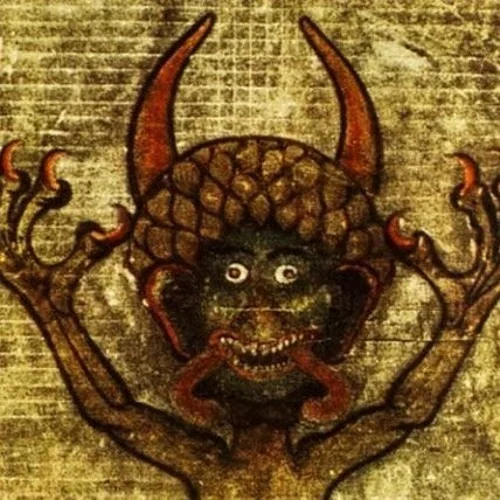
Who is the ‘god’ of this Age?

Let’s start here in Ephesians 2: “Once (pote – ‘a *time when*) YOU (the predestinated child Ephesians 1:4) WALKED according to the age (AEON- era) of the world…of this accordance to the “archon” or “ruler” ***of the air*** and the ***spirit** NOW working in the sons of disobedience.

This is the Greek archon, leader or god of the age (aeon/era/ hora/ hour/horizon/) by which 2 Corinthians 4:4 refers: 

“The god of the age (aionos-era) has blinded (tuphlos) the eyes of the unbelieving (*apeitheia* = ap {not} + peitho {persuaded}. So, at one time you, believers, were ‘hardened, immovable, insensitive, not persuaded so as not to beam forth (augasai) illumination of the gospel”.

So, Ephesians 2 and 2 Corinthians 4 give us terms such as “ruler, authority, air, spirit, —all which are *now working (Greek: Nunti)* , in the sons of disobedience. This means that we have a ‘present day god’ who is currently-now working (energountos) in the ‘sons of apeitheias (‘the immovable-unrepentant’)’.

So, I continue with WHO is this ‘god’? Well, he walks, talks, rules, blinds, acts, acts within THIS AGE, THIS TIME, THIS DURATION, THIS ERA, THIS AEON.1

This is most important to understanding what he is by name. The Indo European root for “Time” is “timon” which shares the exact origin with Demon. “D’-mn is the P.I.E. root for “divider of time + god” . To find the zero grade root for ‘time’ and ‘demon’ has its primacy-root in “de”. A good treatment on this amazing root can be found in Dr. Joseph Shipey’s work on Proto Indo European roots to the American and English language. It is in the here and now as to when and where “The Divider” acts. That is, both in space and tempo. Should it be a wonder therefore, that the Latin Vulgate gives us the Latin “TEMPUS” for “Temptation”. It means ‘to be strung across time, to be stretched, pulled, torn, divided, rent, —i.e. “TEMPO- ed” … or, “OVER-TIMED” …i.e., you have been tested on the duration of your faith.

1 Chronos, as in ‘time’ and ‘god’, most certainly fits the bill for “The Satan as ‘tempo’ or ‘tempter’. Chronos ‘consumes’ us all in his ‘divisions’ of time and is the head or “archon” of ‘time divisions/ the eras’. His consort/ bride is Ananke. Ananke was given a tremendous treatment in Plato’s “Cratylus”. She/ It is the
field of thorns and thicket by which one traverses for their erotic fulfillment at the end of such a telegraph. The outcome is never what it seems to be in one’s hopes and initial desires.

James 1:13,14 – “(let) no one being tempted (“Tempo – Latin/ Greek:peirazomenos – put through trials, dragged, pulled through {in this age/ time/ duration} ) say, “By God I am being tempted –for God cannot be tempted and He tempts no one. A man is tempted (*peirazetai* – drawn out, pulled through, dragged, put through) by his own desire ( epithumias – passions that drive one) – being drawn away and being enticed (deleazo – ‘baited’, ‘lured’) …THEN, *desire* or your *passions* (eros – ‘e’ – ‘out’ + ‘rous’ – ‘flow’/ ‘river’), having conceived, gives birth to sin (harmateia – that which misses the mark). Once sin has become fully grown it brings death”. ——-/// So, I’m immediately brought to the first chapter of Job in the dialogue of God and “the Satan”. Satan was given the boundary lines by which he could ‘do his work, authority,
authorship, energy, work, etc). Satan was always known in the Farsi, old Hebrew, and old Slavic as a word that denotes ‘sifting without mental cognisance’. Even when “the Satan” in the book of Job answered YHVH as to what he was doing his reply was, “Going to and fro” – i.e., ‘meandering, roving’. In Zechariah 4:10 –God’s eyes were considered “The Satans” because they rove in judgment. / His (Satan) was governed by an overriding force and in our terms, bound to or limited to which he could ‘work’ or ‘sift’. In Isaiah 45:7 – ff. it is God who says, “I, the Lord, *create both Good and Evil”. The Hebrew says that “evil” is “ra’ah” which means ‘falling down, destruction’ (such is found in the “evil” or “ra’ah” that God creates in Isaiah 45:7). So, it is God’s essence that is shared with Father and Son having set the ordained plan from God’s Tselem (Hebrew “mind/ imagination”) to create all things and to reconcile all things unto Christ. /It is God’s eyes which are ‘fully fit’ to scan, judge, see, etc. — i.e., His “Satans”…Zech 4

Does the god of this age have free agecy?

Colossians 1:15-20: (15) (Jesus) is the image of the invisible God, the firstborn of every creature: (16) For by him were all things created, that are in heaven, and that are in earth, visible and invisible, whether they be thrones, or dominions, or principalities, or powers: all things were created by him, and for him. (17) And he is before all things, and by him all things consist. (18) And he is the head of the body, the church: who is the beginning, the firstborn from the dead; that in all things he might have the preeminence. (19) For it pleased the Father that in him should all fullness dwell; (20) And, having made peace through the blood of his cross, by him to reconcile all things unto himself; by him, I say, whether they be things in earth, or things in heaven.

Isaiah 53:1-ff (750 B.C.) supports the brutal enactments unto a predetermined glorious ending:
(1) Who hath believed our report? and to whom is the arm of the LORD revealed?

(2) For he shall grow up before him as a tender plant, and as a root out of a dry ground: he hath no form nor comeliness; and when we shall see him, there is no beauty that we should desire him.

(3) He is despised and rejected of men; a man of sorrows, and acquainted with grief: and we hid
as it were our faces from him; he was despised, and we esteemed him not.

(4) Surely he hath borne our griefs, and carried our sorrows: yet we did esteem him stricken, smitten of God, and afflicted (Scapegoat/ Sacrificee theme fulfilled).

(5) But he was wounded for our transgressions, he was bruised for our iniquities: the
chastisement of our peace was upon him; and with his stripes we are healed.

(6) All we like sheep have gone astray; we have turned every one to his own way; and the LORD hath laid on him the iniquity of us all.

(7) He was oppressed, and he was afflicted, yet he opened not his mouth: he is brought as a lamb to the slaughter, and as a sheep before her shearers is dumb, so he openeth not his mouth.

(8) He was taken from prison and from judgment: and who shall declare his generation? for he was cut off out of the land of the living: for the transgression of my people He was stricken.

(9) And he made his grave with the wicked, and with the rich in his death; because he had done no violence, neither was any deceit in his mouth.

(10) Yet it pleased the LORD to bruise him; he hath put him to grief: when thou shalt make his soul an offering for sin, he shall see his seed, he shall prolong his days, and the pleasure of the LORD shall prosper in his hand.

(11) He shall see of the travail of his soul, and shall be satisfied: by his knowledge shall my righteous servant justify many; for he shall bear their iniquities.

(12) Therefore will I divide him a portion with the great, and he shall divide the spoil with the strong; because he hath poured out his soul unto death: and he was numbered with the transgressors; and he bare the sin of many, and made intercession for the transgressors.

As we see in this prophecy (Isaiah 53:10) 750 years before the Birth of Christ that it pleased God (Father) to ‘bruise’ Jesus —put Him to agony unto death…for the PURPOSE of (Colossians 1:20) *reconciliatory (apokatallazai) salvation literally ‘unto all’ (Panta – every) …not a random meaningless pointless act but a Providential Intention.

This includes the *works of evil* which is done by God’s ‘tool of evil’ – “the adversary” – “the antagonist” – The Satan – The Devil “. Otherwise, “evil” would exist as part of the essence of God and therefore Creation would have evil in its essence via its Creator. This leads to senseless arguments about redefining the lines of evil and creation at this juncture. If there be ‘evil’ *as* God, or at least part of His ‘essence’ then it wouldn’t be called ‘evil’….it would be called God.
Therefore, there is a “narrative” of *good* and *evil* as is defined through the complex and multilayered stories of the Bible.

How does the god of this age ‘work’ with a Sovereign
God in all of His goodness?

Does evil have an office by which it acts in accord with
God’s Sovereignty?

Is sin your choice or is it an ensign to remind you of your
inability to go to God?

ENTER SIN INTO THE HOLY

Is ‘sin’ a random act from a compulsory sense of being or is ‘sin’ participatory in the ‘coming to be’ process to shed ‘what is’ in the scheme of God’s ordination?

If (Romans 13:1-ff) ‘all powers (“archons” – ‘governments/ leaders/ rulers’) “that be” are ordained of God” then what are we to think of the ‘coming to be’ of both good and evil leaders? Can Hitler claim ‘independent agency’ in his actions if (1) his sins be true – by the literal definition and (2) Romans 13:1 says that God ordained his actions? Not by etymon – not by Scripture.

sin (n.) (the more simple definition)
Middle English sinne, from Anglo Saxon synn, syn “violation of divine law, offense against God; moral wrongdoing,” also “injury, mischief; enmity, feud; guilt, crime, misdeed,” from Proto-Germanic *sundiō “sin” (source also of Old Saxon sundia, Old Frisian sende, Middle Dutch sonde, Dutch zonde, German Sünde “sin, transgression, trespass, offense,” extended forms)

**The older notion of ‘sin’ means “it is true,” i.e. “the sin is real” (compare Gothic sonjis, Old Norse sannr “true”), from PIE *snt-ya-, a collective form from *es-ont- “becoming,” present participle of the root *es- “to be.”

The semantic development would be via the notion of “to be truly the one (who is guilty),” as in Old Norse phrase verð sannr at “be found guilty of,” and the use of the phrase “it is being” in Hittite confessional formula. The same process probably yielded the Latin word sons (genitive sontis) “guilty, criminal” from present participle of sum, esse “to be, that which is.” Some etymologists believe the Germanic word was an early borrowing directly from the Latin genitive.

As I have found that “sin” is found in the Latin “SENEX” to mean ‘old, without direction, wavering, stumbling, demented, to have travelled from the line, traverse past the straight line. Interestingly, “SENATE” connotes “elders” of the State who ‘have come to be true to their seat’ —- though they be full of maturity in their office have they ‘spoiled’? After all, where do you go when you have absolute to near absolute power?

Another support to the fuller color of this meaning: Aristotle’s “Coming to Be” and “Going Away” treatment give us the disposition by which we should ‘know something or someone’. The question he poses is simple: “And then what did it do? and then? and then? and then?…etc. This leads to (maybe in all respect, came from) Plato’s study of “Phusis” or “nature”. With all that is defined concerning “sin” plus both genius minds of Plato and Aristotle we come to the conclusion we see that sin means ‘a concluded truthful view of the actions of something’.

Evil entered Holy Creation through sin. But this has nothing to do with an idea of what we think “free will” means. If Jesus was the Lamb slain from the foundation of the world then JESUS was a part of the Holy act of creation — INCLUDING the “””evil””” that man would do to put HIM on the ordained cross. In other words, ALL that was in the mind of God to *CREATE* the beginning to end and ALL of the sequences of events in the middle were set before they happened and this *IS GOOD* (“good” – Hebrew: *tov*-”beneficial”; “builds upon itself”, “anabolic”, “supports itself and the next step”). “Tov” or “Good”, as the Hebrew mind conveys, is not necessarily ‘happy’ but ‘beneficial’ in the plan of God, not sinful man’s plans.

God did not sin but ordained the ‘archons’ or ‘rulers’ in HIS grand Narrative to put Jesus to death at the act of creation (Revelation 13:8). It pleased God the Father to This was not an act of man’s ‘free will’ but an act of ordination by God – > Acts 2:23 “Him (Jesus), being delivered by the determinate counsel (‘te’- BOULE = “the WILL”) and (also) the foreknowledge of God—– (this verse goes on to speak of the ‘narrative’ by which the ‘actors’ do put Jesus to death—”ye have taken (you have taken Jesus), and by wicked hands have crucified and slain”. Again, Revelation 13: 8 makes it clear that Jesus is the Lamb that was slain from the foundation of the world…i.e., at the “creation point” our God-Father WILLED (boule) Jesus be put to death. Moreover, Revelation 13: 1-8 un-caps’ {apo = ‘off’ + kalupto =’cap that covers’} the Kingdoms of the earth for whom power was given (by God) to mock God in HIS holy temple service. Babylon-Persia (lion), Greece (leopard) and Rome (Bear). Not just the Bible but us…as to how *we* should play out. As Revelation 13 continues we read that there is yet another Beast that had/has not/ will have a power likened to that of the first – I believe this first beast was Babylon led by the ‘god-king’ with various names for the various cultures which called him by their view of him: Nimrod/ Nebrod/ Marduk/ Enmerker/Narmer. In any case, it is “new Babylon” with its Final System of Worship – much like that of the Old Kingdom where ALL bowed to
Nimrod. This time though, the ‘system’ would be a full-on contagion that marks the world with His power. Anyone not worshiping his system – a.k.a. ‘receiving the *mark* of his likeness’ should be put to death. I remember studying the Sumerian/ Babylonian word for such a mark or ‘demarcation’ of *power*. The Sumerian word was called: “ME”. Not as in “me” in the English
(yet ironically – exactly what it is). The Sumerian word “ME” defined by Dr. John Halloran meant: “essence, function, office, responsibility, ideal norm; the phenomenal area of a deity’s power; divine power; divine decree; cult {the culture beset by the norm of operations}; silence as to anything against such a system”.

Such a system was ORDAINED yet—-the ‘authority’ by which it stands was already mentioned here in reference to Ephesians 2:2: “The ruler of authority of the air – aka, the Spirit now working in the sons of disobedience”. Also, read on in 2 Corinthians 4:4 – “the god of this aeon – “. Satan as a ‘roaring lion’. In all such cases, this Satan character is the head of the cosmokriton (world) and aeon (age) but not the Kingdom of Men as we see in Daniel 4:17. All men, whether in the faith or not, experience the Roaring Lion, Satan, in the world. In 1 Peter 5:8 says, “Be sober, be vigilant; because your adversary the devil, as a roaring lion, walketh about (just as the Satan in
Job), seeking whom he ****may (‘be allowed’ to do his nature)**** devour: (9) Whom (Satan) ‘resist stedfast *in the Faith*, **** knowing that THE SAME AFFLICTIONS ARE ACCOMPLISHED IN YOUR BRETHREN THAT ARE IN THE WORLD.****

Is this not Universalism? Is this not Sovereignty? From the oldest book in the Bible, that is, the book of Job, we have absolute agreement as to how Yahweh uses Satan to do YHWH’s desire. 

This devouring is done on all men to ‘accomplish’ us. We have read this all wrong in the English!!! ugh!!

Another example is prophecy. Unless everything goes perfectly (that is: required WILLED ‘ra’ah {“evil”} and ‘tov’ {“good”}, then prophecy could never come about. Just as in Daniel 8 and 9 prophecies an exact number of years for the Messiah to come back concerning the 70-sevens/ Shavua (490 years) from decree to Jesus and the final 7 years (Shavua) of the 490 being Revelation’s final 7 years. Unless Nehemiah was given a decree by Artaxerxes, the Persian King, to go back into Jerusalem and rebuild the temple..then we wouldn’t have the final prophetical event of Daniel – i.e., Christ, to the Day, riding into Jerusalem as King of Kings. One act requires the next and so on. Daniel 9:24 – “Seventy Shavua (490 years) are determined upon thy people…..etc. :25 “from the going forth of the commandment to rebuild Jerusalem (Historically, we know that this was ca. 445 B.C.) UNTIL THE MESSIAH will be 69 SHAVUA (483 years {this puts Jesus roughly at 34 – 38 A.D. – depending on the calendrical formulas proposed by numerous ‘calendricists’. After this, the sons of disobedience (sons of the Prince/ANTICHRIST) will destroy the Temple (at Masada–ca. 70 A.D.). (then-at a futurative date) He (antiChrist) will confirm a ‘covenant’ for 7 years <- that is, the last “SHAVUA”. ///

So, this is ‘mathematically’ set at the beginning of Daniel’s prophecy to us. Daniel lived as a Persian captive who knew Persian astrology and probably taught this prophecy to the Persian Magi. Even the horrors of Herod slaughtering all of the children under two years of age (Prophesied by Jeremiah 31:15 and fulfilled in Matthew 2:16 – 18) was a necessary evil to drive Mary, Joseph and an unborn Jesus to Bethlehem where Daniel most assuredly told the Magi where Jesus would be…otherwise, the Magi were told directly by God.

Either way, all of these chain events could not be at ‘random’ if the Scriptures concerning prophecy about “what Will happen”. There are no dates that the heathen, atheist, agnostic, or anyone has placed on the prophecy of Daniel that would nullify the coming of Christ on a donkey and being praised as The King of Kings.

Part 2

Satan is the Agent of Evil While the Lord is the Prime
Cause, Intender, Motivator, and Predeterminer of Evil
June 26, 2023

Look at the phrase: “The Patience of Job”. Why is this such a catch phrase for the ages? It is because Job exercised “patience” in God’s will….not in a chaotic action by an arbitrary ‘evil’ force. Otherwise, we would have a dualistic ‘faith’, i.e., ‘believing’ that either good or bad ‘might’ win. Using reason, this IS an insane ‘kind’ of faith. Sadly, in our Christian culture, this is where we’re at. Therefore, why not ‘believe’ in the Devil if he is the ‘other’ lord of action, force, dynamism in this world? Optionally, “dualism”, -i.e., good vs. evil, renders theological insanity within the Christian church.

Examples go as follows for ‘dualism’ in the Church: “Eugene died in a horrible car crash – God would never have this happen”. “Those Christians in the train wreck died not at the hand of God”. Etc. So, where is God? Where is the Hand, Intent, Providence, Predeterministic God of the Bible? Our Biblical answers to our modern day catastrophes can be found in the ancient but timeless Word of God: The Evil (or The Satan found in Job) is a *quantity* brought by The LORD (cf.Job 42:11). Job’s family comforted Job ‘’from all the evil that the LORD had brought upon him (Job)’’. Again, the *agent* of destruction is The Satan. The Satan is found in the first two chapters of Job as being ‘directed’ to Job. The LORD ‘limits’ Job’s destruction at the
‘borderline of death’ —but everything else is within the “legal limitations of destruction by Satan”.

Dr. Tur Sinai in his book, “The Book of Job”, makes it clear that “Satan” did not have the suffix“-an” originally–as in “Shat-an” or “Sat-an”. Rather, this added suffixial “-an” came later to make it personal…i.e., “THE doer of disparaging- destroying, etc.” Such was NOT the case in ‘ITS’ original and oldest Semetic form as in Shat, which meant “to disparage”. Here, we must contrast “Shat/ SHT” from “Shatan, Satan, Shaytan”. For it was a social convention in assimilating with the neo-Babylonians and Persians that the Jews in Neo-Babylonian and Persian captivity adopt the ideas of the Babylonian and Persian ‘verbs of motion’. These approaches, for sure, gave power to the quality of action as “the mover, intender, actor upon, etc.{ cf to footnote 1}”. This
was not so in the earlier conventions of language concerning a Satan – i.e., SHT or Shat. ”Shat/SHT” was not a personalized doer, rather, SHT was the *agency* by which destruction occurred in the context of the story. It was the INTENDER that was the Prima Causa to the agency.

I find it interesting that the ancient usage of “SHAT” or “SHT”, i.e., “to disparage”, is the verb which means ‘to belittle to nothing; to make someone feel like nothing’. It is the VERY *picture* of the New Testament Greek word“MISEO” which is used in Romans 9 to mean “hated” in the sense of “reduced to non-importance, dismiss (hence the Greek: “Miseo”, not count (at least, for now)”. It is little things like this (from Sumerian to Older Hebrew/ Semetic to New Testament Greek semiotic/ endonymic agreement) that give me the rest in the consistent Theology of a
timeless God and His agents. This is why it is so important to study the ancient pictographs of the old world – for when the pictograph went away for ‘advancing societies’ the picture went away as to the IDEA to the word. Yet, not all is lost! Much study can ‘reconstruct’ the Sovereign Word of God which holds us all together.

Another highly interesting point that I have found in Scripture is that “SATAN” is used as the agent OF God and Later ‘dismissed’ into non-existence for the Story’s sake. Zechariah 3:1 makes it clear that Satan was an adversary innately while he was *at the right hand of God*. And, yes, Satan was *rebuked* because Zecharia’s prophetic *Joshua (i.e., the archetypical Jesus found here in Zecharia’s prophecy)* would be tempted and overcome. Was the act of overcoming sin by the prophesied Joshua/ Jesus THE rebuke, THE dismissal of Satan in this timeless-a-tempo prophetical scenario? I say, YES. Zechariah lived nearly a
thousand years after Joshua and YSHUA is both Jesus’ name and Joshua’s name.

This development of *the word and idea* is encased in a web of traditions that I plan on solving by going back to the very origin of Word and Idea.

WORD AND IDEA

Let’s start with the unbelievable comparative philologies and threading to both THE WORD “Ba’al – zebub’ and the Idea of what the “Lord of the Flies” really meant (*repulsion, offense, directives due to such repulsion, hating yet needing, etc.) to the ancient Philistines — probably an ancient Agean culture with its 5 main cities encamped in old Philistia (Canaan — now Israel).

Words related to the birth of the Name, “SHT”

Here are some of humankind’s oldest languages (nearing the Mother of all of our languages) with their similarities in a composite sketch for “Satan”. KEEP IN MIND, WE ARE DEALING WITH PICTOGRAPHIC SOCIETIES WHICH ‘DEPICTED’ STORIES WITHIN THEIR ‘WORDS’…SOMETIME, MANY EVENTS ARE SEEN WITHIN ONE PICTOGRAPHIC WORD.

Proto Uralic Saksa – filthy; unclean/ SIT – to bind/ SITTA – (slang) shit/ SIJTE – Grove – offering place (garden)/ SIB (as in the Philistine “FLY” – Lord of the Flies) ‘to cast a spell”

Sumerian —- (all Sumerian words represented here for 1) filthy 2) bind 3) (slang) ‘shit’ 4) Grove/Garden/’offering place 5) ‘fly’ (as pestilence) are cognates to the Proto Uralic, Ugric, and Finnic (Finnish) — i.e., Sumerian matches the P.U., Ugric, and Finnish — even nearing in spelling (Grimm’s equivalents)

Ugric (same as above)

Finnish (same as above)

*Conclusive ideas:

1)There was ONE STORY that was CARRIED THROUGH THESE PICTOGRAMS and
germaine to the entire old literate world spanning from the Saami (Old Finnish) culture to the Ural Mountain ranges to southern Mesopotamian Sumeria. This WAS the World.

2)The ‘nature’ of “the Satan” is to tempt, but, the mover of the agency of temptation is the Lord
Himself. Keep in mind, the suffix “-an” for Satan was not Hebrew, rather, a loan suffix given by a corrupted Neo-Babylonian and Persian idea which they corrupted from a much earlier form –i.e., SHT/ Shat..

3)When the pictograph went away the picture went away as to the IDEA to the word.

4)To think that “SATAN” came from its first beginnings as the literal “shit” and where we have taken it into some ‘rogue’ agent that can fight the Lord’s will IS “satanic”..lol

5) The Evil (or The Satan found here in Job) is a *quantity* brought by The LORD (cf.Job 42:11). Job’s family comforted Job ‘’from all the evil that the LORD had brought upon him (Job)’’. Again, the *agent* of destruction is The Satan. The Satan is found in the first two chapters of Job as being ‘directed’ to Job. The LORD ‘limits’ Job’s destruction at the ‘borderline of death’ —but everything else is within the “legal limitations of destruction by Satan”.

Footnote #1 The Arabic borrowed this later meaning, Shaytan or Satan, and once again, loaned it into the later medieval Hebrew language – which reinforced it as a Word of Assimilation into the Hebrew Culture. Yes, the Hebrew translators could have used “SHT” for a more contextually fitting “SHT” – i.e., “satan” – versus our modern ‘rogue actor of evil’. This is, for sure is a result of the Babylonian influence on the Hebrew Pharisees in Babylon which ‘borrowed’ this word and I believe has caused our modern Church to be ‘dualistic’ and corrupt.

Part 3 – Biblical – Historical/ Zechariah 3’s Achaemenid
“Satan/ Satrap”

The middle argument for Persia’s influence on Judaism’s language

Zechariah 3:1 ►

NASB Lexicon

NASB © Hebrew Strong’s Origin

Then he showed וַַּי ְר ֵ֗א ִני

(vai·yar·’e·ni) 7200: to see a prim. Root

me Joshua יְהֹו ֻׁשֻׁ֙ש ַ֙ע

(ye·ho·v·shu·a’) 3091: “the LORD is salvation,”

Moses’ successor, also the name of a number of Isr.

from Yhvh and yasha

the highַ הָּג ֔דֹול

(hag·ga·do·vl,) 1419: great from gadal

priest ַה ֹּכֵ֣הן

(hak·ko·hen) 3548: priest from an unused word

standing עֵֹ֕מד

(o·med) 5975: to take one’s stand, stand a prim. Root

before ִל ְפֵנ֖י

(lif·nei) 6440: face, facesfrom panah

the angel ַמ ְלַ֣אְך

(mal·’ach) 4397: Strong’s Exhaustive Concordance

ambassador, angel, king, messenger;

From an unused root meaning to despatch as a

deputy; a messenger; specifically, of God, i.e. An

angel (also a prophet, priest or teacher) —

ambassador, angel, king, messenger.a messenger

from an unused word

of the Lord, יְ ָהו֑ה

(Yah·weh) 3068: the proper name of the God of

Israel from havah

and Satan וְ ַהָּׂשָ֛טן

(ve·has·sa·tan) 7854: adversary, also the name of the

superhuman adversary of God of uncertain

derivation

standing עֵֹ֥מד

(o·med) 5975: to take one’s stand, stand a prim. Root

at his right hand יְ ִמ ֖ינֹו

(ye·mi·nov) 3225: right hand from an unused word

to accuse ְלִׂש ְט ֽנֹו׃

(le·sit·nov.) 7853: to be or act as adversary

denominative verb from satan

him.

I argue that the first appearance of the term “Satan” as a noun in the Hebrew Bible ought to be understood as an administrative official. It is in the ‘solidity’ of the Achaemenid Empire that one can now apply this ‘Satan’ as official to the Achaemenid council, Jewish Priestly class, and the angelic hierarchy. From the bottom up, the politically known evidence for Achaemenid structures provide a new way to read Zech 3 as we find in Herodotus’ account of Darius and his organizing the Persian Empire into tax districts or “satrapies”.

In the honorary Davidic era it was always the king who chose the high priest. In the
Achaemenid era, the priest would be chosen by the Great King. We have a parallel of
‘grounded- political actions founded by both political entities. Amongst the Persians the kingly duties were fulfilled by royal surrogates, the satraps. That the satraps represented the king and— as our Biblical Satan is with his emissaries, likewise, the
Persian satraps attempt to replicate the Persian King’s Kingly abode and jurisprudence. This ‘representation’ by the satraps to the King’s realm is a well documented fact.

As I stated previously concerning Zech 3, Joshua stands before “the Angel”. Again, it is so interesting to read in Hebrew that “MELEK” means “angel” here as much as it means “King” in other places. Who should decide which is a better translation? Context gives us the means by which we can translate more accurately. Therefore, why can’t this be another allusion to the Christ figure? It is YHWH’s “KING” – (as it is equally translatable to “angel”) that is presented. Would the King “TO COME” not be Christ Himself in this allegorical consecration? Are we still not in Zechariah 3’s prophetic vision? Yes, we are.

The temporal authority by which the satrap had to establish satraps as royal representatives is found in Zechariah being transferred to the heavenly realm, where the King/Angel of YHWH fulfills the same role in relation to YHWH himself. Such an act fulfills the satrap to the Persian King and the extension of the Lord via the Satan. In other words, Zech 3 would represent a court of a lower scale than in the pre-exilic period. 

Zech 3 is described as a consecration ceremony for Joshua – the.already-high-priest. Yet the text is promulgating an “otherness” consecration or consecrations. Indeed, Joshua is described as already “Great Priest,” as Job was a great god-fearing man. Zachariah 3’s scenario appears to be dealing with an accusation. This “consecration” seems to fit the antemetabole role by reversing the act of consecration. Surely this is abnormal for a priestly consecration.. /// I call this next part “the sandwiching” or “stacking” of layered elements that put us into a kaleidoscope of events all into one past, present-future- earthly – priestly-Heavenly:

(1) Zechariah 3 does not show here any biblical reference of literature on Priestly
consecration such as festivities, sacrifice, or priestly processionals.

(2) Joshua is before the Melech (“King”) of YHWH instead of YHWH himself, and this
parallels the place of the Christ.

(3) The ceremony involves elite rather than priestly clothing. This makes a priestly ordination
unlikely.

Yet, the “Melech” of YHWH gives me thought that it is neither a Achaemenid courtly act nor a Judaistic-Priestly act, but a Spiritual act using the Achaemenid court and Judaistic Priestly analogies to promote a higher picture of the Messiah.

Historically, if Zech 3 is read as a scene of satrapal confirmation, then the figure of the Satan would only correspond to the accusers who read the written accusation against Tiribazus (a satrap in the time of the Pharaonic Darius 1st) in Diodorus. At this point we could simply end reading the prophetical text of Zechariah. I do not believe such is the case. We know that the satraps had the role of reading the accusation and commenting on its legal validity. In the Persian satrapy system even a lower rung satrap could represent the king. Still, a satrap consulted other officials for objections to new appointments before confirming them and acquiring their oaths of loyalty. Such legal action held the criteria for some form of interrogation
to be established.

The Zech 3 passage depicts the moment where Joshua was vetted by the satrap by having to profess his loyalty to the king and in return was allowed to set-up a civil cult irregardless of how he had been chosen for the priestly position by the Judaeans. Using a theological interpretation in Zecharia 3 we can see where Joshua the priest did the same towards YHWH’s angel and that The Satan (a.k.a. spiritual ‘satrap’) was ready and waiting to vet the Priest of YHWH. Theologically, I see Joshua as Yeshua {or Jesus} acting as the *afflicted suffering servant* WHO served humanity, His Father in Heaven, Rome’s laws —as Pontius Pilate saw no fault in. Also, Jesus fulfilled the philosophies and wisdoms of the Greeks and their Paideia, which ironically
concluded the Gospels as the fulfillment of Platonic and Aristotelian LOGIC. Finally, Jesus, the GREAT PRIEST that was vetted by Satan, fulfilled the Law and Prophets of the Jews. The ‘straight’ in which Zecharias’s Joshua found himself would only be a light foreshadowing of the Messiah to come. The comparisons of the Achaemenid political-historical-reality was a striking reflection of Zecharia’s prophetic panoramic vision. Why do we ‘choose’ to see only one or the other? Why can’t the multidimensional God project HIS revelation into the Political, Priestly and
Angelic abodes? I think this approach would solidify a ‘composite sketch’ that only a Sovereign God could draw and force us to see more deeply with a faith in such a Sovereign Deity.

Therefore, it is easy to see how the Satan/ Satrap figure is also an ‘archangel-type’ when the theological meets the political Achaemenid assembly tradition. If Zoroastrianism was interpolated into the minds of the Jewish Rabbis and Scribes causing the Zoroastrian Angra Mainyu (destructive spirit/ mentality) connotative redactions in Persian captivity, it is not hard to understand how the original “class of satraps” later became a ‘referent’ to the Archangel of Destruction – i.e., “The Satan”. Is this a corruption of the Biblical text or God’s imprint through time using us all?

PART 4

Joab, the archetype of the Satan and David’s doer of dirty deeds-emissary

We should go back in the past to get this fuller story of Joab and David. The scene began as follows. Young David was a warrior in the house of King Saul of Israel, a close friend of the king’s son and heir apparent, Jonathan, and the husband of the king’s daughter Michal. But out of jealousy, King Saul turned against David and drove him from his service. Saul soon after lost the favor of God, and was killed in battle. When Saul and his sons died, David took the field of battle, and after a series of conflicts established himself first as king of Judah and after as king of all Israel.

Joab first shows up as a commander in David’s service when David was ruler of Judah in the south of the holy land, while one of Saul’s remaining sons, Ishbosheth, was still ruling northern Israel.

Abner, a commander from the north, met Joab and his brother Ashael in lands between north and south, and fighting broke out. Abner reluctantly killed Ashael in self-defense and fled, with Joab in pursuit. The men remained mortal enemies ever after this first armed encounter.

King David wanted peace with the northern kingdom, and agreed to meet with Abner, and the two men greeted each other with courtesy and terms of friendship. On hearing this, Joab used his role as a commander in David’s service to request to speak with Abner after he left David’s presence. When these two men met, instead of greeting Abner in peace as David had done, Joab stabbed him in the belly. (2 Samuel 3:27)

David made a long lamentation, fasted for sorrow for the murder of Abner and declared that he had absolutely nothing to do with the murder of the popular northern commander.

Joab next appears in the story of David’s adultery with Bathsheba, the wife of Uriah, whom David impregnated while her husband was on duty in the army. David was unable to persuade Uriah to go home and sleep with his wife to cover up his own adulterous act.

He then gave a message to Joab to make sure Uriah got slaughtered in battle, and the evil deed was done. God later punished David for his sin, but Joab got off the hook again.Joab knew when to keep the king happy. When he was made commander of the army of Israel, he made sure David got credit for his own cunning in battle (2 Sam. 11:26 ff.)

Then, God spoke through David’s seer named Gad giving David 3 options of punishment. David took the shortest punishment in duration. In 1 Corinthians 21:14 God sent pestilence upon Israel killing 70,000 men. In vs 15 God sent an angel to destroy Jerusalem and halted the angel as the angel had done enough.

Again, we see the arm of God doing horrible things. Moreover, we see God Himself sending pestilence to kill innocent people for an evil that David did, —while Satan goes untouched by God and so does Joab—the one who went out to collect the immoral census.

Reaching back through 1 Chronicles we can see what a blood thirsty General Joab was. Joab had wreaked fear not only in Israel’s enemies but also in David’s army and David himself. David told Solomon that Joab must be killed in order to stop the violence of David’s echoing war machine.

Is it too hard to see that Joab was a *kind* of Satan and that David was a *kind* of archetypical, at least in part, Christ?
**
Joab’s ability to use hard politics reached its zenith when King David had to contend with his troublesome son Absalom. Prince Absalom had first gotten into trouble when he avenged the rape of his sister Tamar by murdering her attacker against the king’s will.

The politically astute Joab cared little for Absalom, Tamar, the rape, or the revenge murder. But he could see that David did not want to punish his favored son in spite of his guilt, so he arranged for a pardon to please the king.

But when Absalom subsequently revolted against David, Joab led the king’s army against Absalom, and defeated him in battle. When the other officers refused to kill the king’s beloved rebel son, Joab had no such scruples.
He fired three darts into Absalom’s heart and buried his corpse in a pit, not a royal grave. Joab did what was in the best interests of the king, and therefore himself.

King David promptly went into mourning for his wayward son, and the troops who had secured the victory glumly wandered back into Jerusalem, sorrowing with the king. But Joab had the political sense to tell the king to declare it a victory, to hide his feelings, and to reassert his power. David followed Joab’s grim advice.

Tired of his hatchet man who had polished off his beloved son, David demoted Joab and appointed one Amasa as the new commander of the army. But very soon, Joab took care of that matter.In a subsequent military encounter, Joab asked to speak privately with his new commander. Joab made to give General Amasa the kiss of peace, and while puckering up, Joab grabbed Amasa’s beard and stabbed him in the bowels with a concealed sword.

While Amasa was bleeding to death in the street, Joab rallied the men on the very military expedition David had sent Amasa on, and won the day. He got his old job as David’s warlord back as well.

Joab made only one serious political mistake. When David was on his deathbed, one of his other sons, Adonijah, attempted to make himself king in his father’s place. Adonijah wisely consulted Joab, and got his support.

But David’s favor went to his son Solomon, and Adonijah soon was discredited, and for a time Joab kept his head low enough to keep it connected to his neck. But when David’s actual death drew near, he summoned Solomon to his side and reminded him of every single thing Joab had ever done.

David advised Solomon on dealing with his evil but useful nephew Joab, saying, “Now therefore hold him not guiltless, for you are a wise man; you will know what you ought to do to him, and you shall bring his gray head down with blood to Sheol.” (1 Kings 2:9)

When the discredited Adonijah stupidly asked his brother Solomon to wed his father’s beautiful but still virginal handmaid, Solomon had Adonijah put to death on the very day he made the request. Sleeping with the old king’s wife might have been seen as a claim to David’s throne, and this King Solomon could not tolerate.

It also provided an excuse to deal with Joab. Hearing of Adonijah’s fall, Joab fled to the tent of the Lord and grabbed onto the horns of the altar, pleading for sanctuary. Solomon was not impressed and ordered Banaiah son of Jehoiada to hack Joab to bits at the altar, which he gladly did.

In 1 Chronicles 21:1 we see Satan as he ‘stood up against Israel and provoked David to number Israel’.

Initially, Joab is the first mentioned to whom David is speaking. Only after the mention of Joab does the Scripture include ‘the rulers of the people’ with Joab. We see that Joab actually tells David that it is a trespass against the Lord to take a census of David’s army. Yet, it is Joab who is the arm of David and goes out to do this heinous act.


Then, God spoke through David’s seer named Gad giving David 3 options of punishment. David took the shortest punishment in duration. In 1 Corinthians 21:14 God sent pestilence upon Israel killing 70,000 men. In vs 15 God sent an angel to destroy Jerusalem and halted the angel as the angel had done enough.

Reaching back through 1 Chronicles we can see what a blood thirsty General Joab was. Joab had wreaked fear not only in Israel’s enemies but also in David’s army and David himself. David told Solomon that Joab must be killed in order to stop the violence of David’s echoing war machine.

Is it too hard to see that Joab was a *kind* of Satan and that David was a *kind* of an
archetypical Christ— at least in part?

Joab ran to the tent of the Lord and grabbed onto the horns of the altar, pleading for sanctuary. Regardless of the humble sentiment displayed by Joab, Solomon ordered Banaiah to chop up Joab to pieces at the altar.

Benaiah was made commander of the army and then spent his days murdering Solomon’s opponents, as Joab had done for David before him.

Is Benaiah another Satan figure for Solomon? Returning to Isaiah 45: 7 – ff. “I form the light, and create darkness, I make peace, and create evil; I the Lord do all these things”. Isaiah 46:10 “Declaring the end from the beginning, and from ancient times the things that are not yet done, saying, My counsel shall stand , and I will do all my pleasure”…etc. If it is God who is ‘good’ and ‘creates evil’ then what does Satan do?

***In 1 Chronicles 21:1 we see Satan as he ‘stood up against Israel and provoked David to number Israel’.

Initially, Joab is the first mentioned to whom David is speaking which begs me to question who was Satan here? I will not conclude anything here. Only after the mention of Joab does the Scripture include ‘the rulers of the people’ with Joab. We see that Joab actually tells David that it is a trespass against the Lord to take a census of David’s army. Yet, it is Joab who is the arm of David and goes out to do this heinous act.

Look at the phrase: “The Patience of Job”. Why is this such a catch phrase for the ages? It is because Job exercised “patience” in God’s will….not in a chaotic action by an arbitrary ‘evil’ force. Otherwise, we would have a dualistic ‘faith’, i.e., ‘believing’ that either good or bad ‘might’ win. Using reason, this IS an insane ‘kind’ of faith. Sadly, in our Christian culture, this is where we’re at. Therefore, why not ‘believe’ in the Devil if he is the ‘other’ lord of action, force, dynamism in this world? Optionally, “dualism”, -i.e., good vs. evil, renders theological insanity within the Christian church.

Examples go as follows for ‘dualism’ in the Church: “Eugene died in a horrible car crash – God would never have this happen”. “Those Christians in the train wreck died not at the hand of God”. Etc. So, where is God? Where is the Hand, Intent, Providence, Predeterministic God of the Bible? Our Biblical answers to our modern day catastrophes can be found in the ancient but timeless Word of God: The Evil (or The Satan found in Job) is a *quantity* brought by The LORD (cf.Job 42:11). Job’s family comforted Job ‘’from all the evil that the LORD had brought upon him (Job)’’. Again, the *agent* of destruction is The Satan. The Satan is found in the first two chapters of Job as being ‘directed’ to Job. The LORD ‘limits’ Job’s destruction at the ‘borderline of death’ —but everything else is within the “legal limitations of destruction by Satan”.

Dr. Tur Sinai in his book, “The Book of Job”, makes it clear that “Satan” did not have the suffix “-an” originally–as in “Shat-an” or “Sat-an”. Rather, this added suffixial “-an” came later to make it personal…i.e., “THE doer of disparaging- destroying, etc.” Such was NOT the case in ‘ITS’ original and oldest Semetic form as in Shat, which meant “to disparage”. Here, we must contrast “Shat/ SHT” from “Shatan, Satan, Shaytan”. For it was a social convention in assimilating with the neo-Babylonians and Persians that the Jews in Neo-Babylonian and Persian captivity adopt the ideas of the Babylonian and Persian ‘verbs of motion’. These approaches, for sure, gave power to the quality of action as “the mover, intender, actor upon, etc.{ cf to footnote 1}”. This was not so in the earlier conventions of language concerning a Satan – i.e., SHT or Shat. ”Shat/SHT” was not a personalized doer, rather, SHT was the *agency* by which destruction occurred in the context of the story. It was the INTENDER that was the Prima Causa to the agency.

I find it interesting that the ancient usage of “SHAT” or “SHT”, i.e., “to disparage”, is the verb which means ‘to belittle to nothing; to make someone feel like nothing’. It is the VERY *picture* of the New Testament Greek word“MISEO” which is used in Romans 9 to mean “hated” in the sense of “reduced to non-importance, dismiss (hence the Greek: “Miseo”, not count (at least, for now)”. It is little things like this (from Sumerian to Older Hebrew/ Semetic to New Testament Greek semiotic/ endonymic agreement) that give me the rest in the consistent Theology of a timeless God and His agents. This is why it is so important to study the ancient pictographs of the old world – for when the pictograph went away for ‘advancing societies’ the picture went

away as to the IDEA to the word. Yet, not all is lost! Much study can ‘reconstruct’ the Sovereign Word of God which holds us all together.

Another highly interesting point that I have found in Scripture is that “SATAN” is used as the agent OF God and Later ‘dismissed’ into non-existence for the Story’s sake.
Zechariah 3:1 makes it clear that Satan was an adversary innately while he was *at the right hand of God*. And, yes, Satan was *rebuked* because Zecharia’s prophetic *Joshua (i.e., the archetypical Jesus found here in Zecharia’s prophecy)* would be tempted and overcome. Was the act of overcoming sin by the prophesied Joshua/ Jesus THE rebuke, THE dismissal of Satan in this timeless-a-tempo prophetical scenario? I say, YES. Zechariah lived nearly a thousand years after Joshua and YSHUA is both Jesus’ name and Joshua’s name.

This development of *the word and idea* is encased in a web of traditions that I plan on solving by going back to the very origin of Word and Idea.

WORD AND IDEA

Let’s start with the unbelievable comparative philologies and threading to both THE WORD “Ba’al – zebub’ and the Idea of what the “Lord of the Flies” really meant (*repulsion, offense, directives due to such repulsion, hating yet needing, etc.) to the ancient Philistines — probably an ancient Agean culture with its 5 main cities encamped in old Philistia (Canaan — now Israel).

Words related to the birth of the Name, “SHT”

Here are some of humankind’s oldest languages (nearing the Mother of all of our languages) with their similarities in a composite sketch for “Satan”. KEEP IN MIND, WE ARE DEALING WITH PICTOGRAPHIC SOCIETIES WHICH ‘DEPICTED’ STORIES WITHIN THEIR ‘WORDS’…SOMETIME, MANY EVENTS ARE SEEN WITHIN ONE PICTOGRAPHIC WORD.

Proto Uralic Saksa – filthy; unclean/ SIT – to bind/ SITTA – (slang) shit/ SIJTE – Grove – offering place (garden)/ SIB (as in the Philistine “FLY” – Lord of the Flies) ‘to cast a spell”

Sumerian —- (all Sumerian words represented here for 1) filthy 2) bind 3) (slang) ‘shit’ 4) Grove/ Garden/’offering place 5) ‘fly’ (as pestilence) are cognates to the Proto Uralic, Ugric, and Finnic (Finnish) — i.e., Sumerian matches the P.U., Ugric, and Finnish — even nearing in spelling (Grimm’s equivalents)

Ugric (same as above)

Finnish (same as above)

*Conclusive ideas:

1)There was ONE STORY that was CARRIED THROUGH THESE PICTOGRAMS and germaine to the entire old literate world spanning from the Saami (Old Finnish) culture to the Ural Mountain ranges to southern Mesopotamian Sumeria. This WAS the World.

2)The ‘nature’ of “the Satan” is to tempt, but, the mover of the agency of temptation is the Lord Himself. Keep in mind, the suffix “-an” for Satan was not Hebrew, rather, a loan suffix given by a corrupted Neo-Babylonian and Persian idea which they corrupted from a much earlier form –i.e., SHT/ Shat..

3)When the pictograph went away the picture went away as to the IDEA to the word.

4)To think that “SATAN” came from its first beginnings as the literal “shit” and where we have taken it into some ‘rogue’ agent that can fight the Lord’s will IS “satanic”..lol

5) The Evil (or The Satan found here in Job) is a *quantity* brought by The LORD (cf.Job 42:11). Job’s family comforted Job ‘’from all the evil that the LORD had brought upon him (Job)’’. Again, the *agent* of destruction is The Satan. The Satan is found in the first two chapters of Job as being ‘directed’ to Job. The LORD ‘limits’ Job’s destruction at the ‘borderline of death’ —but everything else is within the “legal limitations of destruction by Satan”.

Footnote #1 The Arabic borrowed this later meaning, Shaytan or Satan, and once again, loaned it into the later medieval Hebrew language – which reinforced it as a Word of Assimilation into the Hebrew Culture. Yes, the Hebrew translators could have used “SHT” for a more contextually fitting “SHT” – i.e., “satan” – versus our modern ‘rogue actor of evil’. This is, for sure is a result of the Babylonian influence on the Hebrew Pharisees in Babylon which ‘borrowed’ this word and I believe has caused our modern Church to be ‘dualistic’ and corrupt.

THE THING THAT HAS BEEN IS THAT THING WHICH SHALL BE; AND THAT WHICH IS DONE IS THAT WHICH SHALL BE DONE; —THEREFORE, THERE IS NO NEW THING UNDER THE SUN. Ecclesiastes 1:9

THAT WHICH HAS BEEN IS NOW; AND THAT WHICH IS TO BE HAS ALREADY BEEN; AND GOD REQUIRES THAT WHICH IS PAST. Ecclesiastes 3:15

DECLARING THE END FROM THE BEGINNING AND FROM ANCIENT TIMES PAST THE THINGS THAT ARE NOT YET DONE, GOD SAYS – ‘MY COUNSEL SHALL STAND AND I WILL DO ALL MY PLEASURE. Isaiah 4:10

I FORM THE LIGHT, AND CREATE DARKNESS; I MAKE PEACE, AND CREATE EVIL. I THE LORD DO ALL THESE THINGS Isaiah 45:7

I HAVE EVEN FROM THE BEGINNING DECLARED IT TO YOU; BEFORE IT CAME TO PASS I SHOWED IT TO YOU – LEST YOU SHOULD SAY ‘MY IDOL DID THIS’
Isaiah 48:5

Let’s start here in Ephesians 2: “Once (pote – ‘a *time when*) YOU WALKED according to the age (AEON- era) of the world…of this accordance to the “archon” or “ruler” ***of the air*** and the ***spirit** NOW working in the sons of disobedience.

This is the “god” of the age (aeon/era/ hora/ hour/horizon/) by which 2 Corinthians 4:4 refers: “The god of the age (aionos-era) has blinded (tuphlos) the eyes of the unbelieving (*apeitheia* = ap {not} + peitho {persuaded}. So, at one time you, believers, were ‘hardened, immovable, insensitive, not persuaded so as not to beam forth (augasai) illumination of the gospel”.

We’ve got terms such as: ruler, authority, air, spirit, *now working* , in the sons of disobedience./// So, we have a ‘present day god’ who currently-now (Greek: “Nunti”-now) works (energountos) in the ‘sons of apeitheias

So, I continue with WHO is this ‘god’? Well, he walks, talks, rules, blinds, acts, acts within THIS AGE, THIS TIME, THIS DURATION, THIS ERA, THIS AEON.1

This is most important to understanding what he is by name. Demon. “D’-mn is the P.I.E. root for “divider of time + god” in Dr. Joseph Shipey’s work on Proto Indo European roots to the

1 Chronos, as in ‘time’ and ‘god’ most certainly fits the bill for the Satan as ‘tempo’ or ‘tempter’. Chronos ‘consumes’ us all in his ‘divisions’ of time. His consort/ bride is Ananke. Ananke was given a tremendous treatment in Plato’s “Cratylus”. She/ it is the field of thorns and thicket by which one traverses for their erotic fulfillment at the end of such a telegraph. The outcome is never what it seems to be in one’s hopes and initial desires.

American and English language. This book is backed by a litany of academic scholars concerning this P.I.E. language (proto indo european).

It is in the here and now as to when and where “The Divider” acts. That is, both in space and tempo. Should it be a wonder therefore, that the Latin Vulgate gives us the Latin “TEMPUS” for “Temptation”. It means ‘to be strung across time, to be stretched, pulled, torn, divided, rent, —i.e. “TEMPO- ed” … or, “OVER-TIMED” …i.e., you have been tested in duration your faith.

Now, as to WHO causes this. I will appropriately take that time at a sooner than later date. I have to tend to the Family.

James 1:13,14 – “(let) no one being tempted (“Tempo – Latin/ Greek:peirazomenos – put through trials, dragged, pulled through {in this age/ time/ duration} ) say, “By God I am being tempted –for God cannot be tempted and He tempts no one. A man is tempted (*peirazetai* – drawn out, pulled through, dragged, put through) by his own desire ( epithumias – passions that drive one) – being drawn away and being enticed (deleazo – ‘baited’, ‘lured’) …THEN, *desire* or your *passions* , having conceived, gives birth to sin (harmateia – that which misses the mark). Once sin has become fully grown it brings death”. ——-/// So, I’m immediately brought to the first chapter of Job in the dialogue of God and “the Satan”. Satan was given the boundary lines by which he could ‘do his work, authority, authorship, energy, work, etc). Satan was always known in the Farsi, old Hebrew, and old Slavic as a word that denotes ‘sifting without mental cognisance’. Even when “the Satan” in the book of Job answered YHVH as to what he was doing his reply was, “Going to a fro” – i.e., ‘meandering, roving’. In Zechariah 4:10 –God’s eyes were considered “The Satans” because they rove in judgment. / His (Satan) was governed by an overriding force and in our terms, bound to or limited to which he could ‘work’ or ‘sift’. In Isaiah 45:7 – ff. it is God who says, “I, the Lord, *create both Good and Evil”. The Hebrew says that “evil” is “ra’ah” which means ‘falling down, destruction’. So, it is God’s essence which sets the ordained plan from the Tselem (Hebrew “mind/ imagination”) but the *work of evil* is done by God’s ‘tool of evil’. Otherwise, “evil” would exist in God and Creation would have evil in its essence via its Creator which has an essence of evil. If this is the case, the creation would fall apart…by the very meaning of “Ra’ah (Hebrew: “collapse”; “break down”)”.

Evil entered Holy Creation through sin. But this has nothing to do with an idea of what we think “free will” means. If Jesus was the Lamb slain from the foundation of the world then JESUS was a part of the Holy act of creation — INCLUDING the “””evil””” that man would do to put HIM on the ordained cross. In other words, ALL that was in the mind of God to *CREATE* the beginning to end and ALL of the sequences of events in the middle were set before they happened and this *IS GOOD* (“good” – Hebrew: *tov*-”beneficial”; “builds upon itself”, “anabolic”, “supports itself and the next step”). “Tov” or “Good”, as the Hebrew mind conveys, is not necessarily ‘happy’ but ‘beneficial’ in the plan of God, not sinful man’s plans.

If we can agree to see how Scripture is coherent here then we can conclude that the Scripture conveys a PREDETERMINER–GOD. Looking at Scripture from this view God did not sin but

ordained the ‘archons’ or ‘rulers’ in HIS grand Narrative to put Jesus to death at the act of creation (Revelation 13:8). This was not an act of man’s ‘free will’ but an act of ordination by God – > Acts 2:23 “Him (Jesus), being delivered by the determinate counsel (‘te’- BOULE = “the WILL”) and (also) the foreknowledge of God—– (this verse goes on to speak of the ‘narrative’ by which the ‘actors’ do put Jesus to death—”ye have taken (you have taken Jesus), and by wicked hands have crucified and slain”. Again, Revelation 13: 8 makes it clear that Jesus is the Lamb that was slain from the foundation of the world…i.e., at the “creation point” our God-Father WILLED (boule) Jesus be put to death. Moreover, Revelation 13: 1-8 un-caps’ {apo = ‘off’ + kalupto =’cap that covers’} the Kingdoms of the earth for whom power was given (by God) to mock God in HIS holy temple service. Babylon-Persia (lion), Greece (leopard) and Rome (Bear). Not just the Bible but us…as to how *we* should play out. As Revelation 13 continues we read that there is yet another Beast that had/has not/ will have a power likened to that of the first – I believe this first beast was Babylon led by the ‘god-king’ with various names for the various cultures which called him by their view of him: Nimrod/ Nebrod/ Marduk/ Enmerker/Narmer. In any case, it is “new Babylon” with its Final System of Worship – much like that of the Old Kingdom where ALL bowed to Nimrod. This time though, the ‘system’ would be a full-on contagion that marks the world with His power. Anyone not worshiping his system – a.k.a. ‘receiving the *mark* of his likeness’ should be put to death. I remember studying the Sumerian/ Babylonian word for such a mark or ‘demarcation’ of *power*. The Sumerian word was called: “ME”. Not as in “me” in the English (yet ironically – exactly what it is). The Sumerian word “ME” defined by Dr. John Halloran meant: “essence, function, office, responsibility, ideal norm; the phenomenal area of a deity’s power; divine power; divine decree; cult {the culture beset by the norm of operations}; silence as to anything against such a system”.

Such a system was ORDAINED yet—-the ‘authority’ by which it stands was already mentioned here in reference to Ephesians 2:2: “The ruler of authority of the air – aka, the Spirit now working in the sons of disobedience”. Also, read on in 2 Corinthians 4:4 – “the god of this aeon – “. Satan as a ‘roaring lion’. In all such cases, this Satan character is the head of the cosmokriton (world) and aeon (age) but not the Kingdom of Men as we see in Daniel 4:17. All men, whether in the faith or not, experience the Roaring Lion, Satan, in the world. In 1 Peter 5:8 says, “Be sober, be vigilant; because your adversary the devil, as a roaring lion, walketh about (just as the Satan in Job), seeking whom he ****may (‘be allowed’ to do his nature)**** devour: (9) Whom (Satan) ‘resist stedfast *in the Faith*, **** knowing that THE SAME AFFLICTIONS ARE ACCOMPLISHED IN YOUR BRETHREN THAT ARE IN THE WORLD.****

Is this not Universalism? Is this not Sovereignty? From the oldest book in the Bible, that is, the book of Job, we have absolute agreement as to how Yahweh uses Satan to do YHWH’s desire.

This devouring is done on all men to ‘accomplish’ us. We have read this all wrong in the English!!! ugh!!

Another example is prophecy. Unless everything goes perfectly (that is: required-WILLED ‘ra’ah {“evil”} and ‘tov’ {“good”}, then prophecy could never come about. Just as in Daniel 8 and 9

prophecies an exact number of years for the Messiah to come back concerning the 70-sevens/ Shavua (490 years) from decree to Jesus and the final 7 years (Shavua) of the 490 being Revelation’s final 7 years. Unless Nehemiah was given a decree by Artaxerxes, the Persian King, to go back into Jerusalem and rebuild the temple..then we wouldn’t have the final prophetical event of Daniel – i.e., Christ, to the Day, riding into Jerusalem as King of Kings. One act requires the next and so on. Daniel 9:24 – “Seventy Shavua (490 years) are determined upon thy people…..etc. :25 “from the going forth of the commandment to rebuild Jerusalem (Historically, we know that this was ca. 445 B.C.) UNTIL THE MESSIAH will be 69 SHAVUA (483 years {this puts Jesus roughly at 34 – 38 A.D. – depending on the calendrical formulas proposed by numerous ‘calendricists’. After this, the sons of disobedience (sons of the Prince/ANTICHRIST) will destroy the Temple (at Masada–ca. 70 A.D.). (then-at a futurative date) He (antiChrist) will confirm a ‘covenant’ for 7 years <- that is, the last “SHAVUA”. ///

So, this is ‘mathematically’ set at the beginning of Daniel’s prophecy to us. Daniel lived as a Persian captive who knew Persian astrology and probably taught this prophecy to the Persian Magi. Even the horrors of Herod slaughtering all of the children under two years of age (Prophesied by Jeremiah 31:15 and fulfilled in Matthew 2:16 – 18) was a necessary evil to drive Mary, Joseph and an unborn Jesus to Bethlehem where Daniel most assuredly told the Magi where Jesus would be…otherwise, the Magi were told directly by God.

Either way, all of these chain events could not be at ‘random’ if the Scriptures concerning prophecy about “what Will happen”. There are no dates that the heathen, atheist, agnostic, or anyone has placed on the prophecy of Daniel that would nullify the coming of Christ on a donkey and being praised as The King of Kings.

CAIN’S HISTORY

Solluba

The Solluba, also known as the Sleb, Solubba and the Sulayb (Arabic: ُصلبة, صلیب ), were a Hutaym tribal group in the northern part of the Arabian Peninsula who were clearly distinguishable from the Arabs. Due to social stigma, very few people openly identify as Ṣulayb today.

Origin

The Solluba have been identified with the Selappayu in Akkadian records, and a clue to their origin is their use of desert kites and game traps, first appearing in archaeological records around 7000 BC. Cambridge linguist and anthropologist Roger Blench sees the Solluba as the last survivors of Palaeolithic hunters and salt-traders who once dominated Arabia. They were the peoples who assimilated in the next wave of humans consisting of cattle herders in the 6th millennium BC. These people introduced cows, wild donkeys, sheep and dogs, wild camels and goats. They may have engaged in trade across the Red Sea with speakers of Cushitic languages or Nilo-Saharan languages. In the 3rd and 2nd millennium BC speakers of Semitic languages arrived from the Near East and marginalized and absorbed the rest.

Western travellers reported that the Bedouin did not consider the Solluba to be descendants of Qaḥṭān. One legend mentions that they originated from ancient Christian groups, possibly Crusaders who were taken into slavery by the Bedouin. Werner Caskel criticizes the Crusader origin theory and proposes that the term “Solluba” describes a host of groups hailing from different backgrounds. Caskel proposes the Solluba to be those of al-Ḥasā being of 12th- to 13th-century AD migrants from southern Persia, He also believes the Solluba to be the group composed of communities emerging after their defeat by the Wahhabis.

Society

The Solluba were reported, by western travelers, as having different physical features other than other Arabs, often with fairer eyes and hair. They also spoke a distinct variety of Arabic that contained several words exclusive to their dialect.The Bedouin usually differentiated between the Solluba and other Hutaymi groups. Unlike the Hutaymis, the Solluba were independent and did not require protection from the Bedouin. The Arab Bedouin despised the Solluba and counted them as men of no honor and thus inferior to them. Their deep knowledge of the desert however earned them the title Abu al-Khala (Fathers of the empty spaces–Fathers of Chaos).

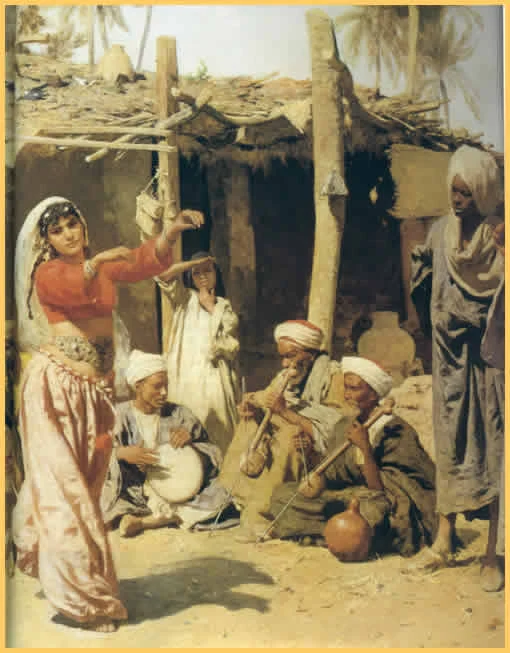
The Solluba followed occupations such as carpentry, metallurgy, and leather-working. They were also known as fortune-tellers and magicians, as well as musicians and poets. The Bedouin valued their knowledge of the desert, often hiring them as scouts, and depended on them to heal their animals. Despite their dependence on the Solluba, the Bedouin did not appreciate them and often looked down upon them. Unlike other nomadic Hutaymi and Bedouin groups,the Solluba did not engage in plundering and were in turn viewed as neutrals and often spared when raids took place. Despite their low status, their hospitality was accepted, especially when a warrior was sick or wounded as they were famed as healers.

During spring the Solluba lived close to Bedouin settlements and lived off the milk of their cattle. In summer they trekked deep in the desert accompanied only by their wild asses and lived on hunting. The Solluba owned certain slopes and valleys in the desert and young men gave portions of their territory as dowry to the family of brides to hunt on.

Most Solluba disregard Islam. They seem to have retained some of their traditional beliefs. They worship the boulder al-Weli Abu Ruzuma, located in the Syrian Desert. Their emblem, which was shown at ceremonial festivities, was a cross wrapped with a dress. Generally, they were seen as Kafir (non-Muslims) and suffered Wahhabi raids, with a notorious massacre in the ʿAr valley.

Robert Graves, ‘the great pagan poet’ – as some refer to, gives better history to the Sollubu or “Slab” history. Robert’s piece on the Slab gives us this nearly lost history by telling us that “Cain’s “Brand” was the cruciform or *skin gouging/ etching into the human flesh*. This cruciform was worn as a tribal mark on the brow by the KENITES (Canaanites), or “descendants of Cain”. The Sollubu or Slab were and are a vagabond tribe of METAL-WORKERS, shepherds and musicians whose successors are the present day Slab….The Slab wear the same cruciform as ‘their mark’ since ca. 6 millennia ago. Is it a wonder that is Cain’s name?

DAEG

The “DAY” can mean several things to many people in different cultures. “Daeg” is the term for day in Anglo Saxon. Daeg can refer to the time that the sun brightens the sky. Daeg can also refer to the ‘event’ of some kind of ‘time’ such as a ‘time’ of happiness, ‘time’ of sorrow, in the abstract, the ‘time’ of creation. It can mean someone’s ‘time’ to be alive—i.e., ‘their era’. When they are past, their life or ‘time’ can be a ‘time’ to be celebrated or honored– a memorial.

Such related names can and do go back as far as the Akaddian, “Digir” – “god”, Proto-Indo-European, “Dyaus” – day/sun/god/deity, “Theos”, “Zeus”, “Deus”…etc. all, which can relate to the “SUN” as god, the “Sun-God”, and “GOD” as the sun.

My intimation is that Beowulf is seen *as* the Sun/ god/ King and Grendel is seen *as* the Night, Evil one, Dark one (nith; nicor, NICK {cf. “old Nick”} in this astrological battle.

UHT

This anatomy of DAEG-time connotes the ending of night or “UHT”. Uht requires ‘darkness’ to leave since Uht is the ‘end of night’. Specifically, Uht is the ‘time’ right before daybreak. Nevertheless, darkness -i.e., UHT, – still has its reign during its time.

In the Anglo Saxon text of Beowulf we see the “time” at which the demonized Grendel acted. Grendel is a creature of the night. He attacked Heorot at night, at least once in the uhta, Uht, (or uhte), i.e., the hour of darkness before dawn, this being the deepest part of the night.

1 Grendel’s association with ‘wan’ (“to wane”) may also inform puns. It may be no coincidence that in persecuting Heorot and its inhabitants he wið rihte wan ‘fought against right’ , or that he wan / hwile wið Hroþgar ‘fought for a time against Hroðgar’. In both cases wan is obviously the past tense of winnan ‘to fight’, but may pun on the adjective wan ‘dark’. Also, when held fast by the arm in Beowulf’s grip, Grendel is heard “sar wanigean” – ‘bewailing (his) pain/wound’. Here the verb wani(ge)an (with long root vowel) may pun on wanian ‘to wane, diminish’ (with short root vowel). Of course, ‘the pain/wound diminishing’ is precisely the opposite of what is actually happening in a direct, physical sense, but may also detect a subtle anticipation of Grendel’s dismemberment as an image of the lunar wane, of the moon’s ‘dying’. This suggestion is encouraged by Beowulf’s likely description of how “hyne sar hafað / in niðgripe nearwe befongen” ‘the pain/wound has him [i.e., Grendel] narrowly/darkly/encompassed in a hostile/dark-moon. If there is a hint of Grendel’s ‘waning’ as he loses his arm, his ‘un/bad-sword’, then we may have an implicit parallel to the subsequent loss by ‘waning’ of the blade of the giant sword which serves as an extension of Beowulf’s sword-arm. Were Beowulf to contain more direct lexical references to the moon’s waning or dark phases, the proposed association of Grendel (and, we shall find, his mother and the climactic dragon) with the waning or dark moon would be strengthened. Old Norse has a specific word for the waning or dark moon: nið. This noun is attested both as a simplex and as the first element of compounds, including mythological personal names and toponyms. It may well be related to the Old Norse adverb niðr ‘down’, ‘beneath’ and Thus, early in the poem we hear that after Grendel had attacked Heorot, Ða wæs on uhtan mid
ærdæge / Grendles guðcræft gumum undyrne, a passage that might be translated: ‘Then, at the juncture of the last hour of darkness with dawn Grendel’s battle-strength was unsecret [i.e.,
revealed] to men’ – i.e., Beowulf (a shadowing “messianic” figure) fought and dismembered Grendel ( the demonized “Satan” figure) in the “uhthelm þone ‘the hour-before-dawn uproar/crash’ “.

Grendel was referred to as one of the “scaduhelma gesceapu” or “shapes of shadow-helms”. Grendel is related to the moon waning or “wana” —i.e., “the moon’s want of light”. Such fulfills the UHT idea *as* Grendel.

One of my biggest intrigues is that Grendel and his mother were “Moor-Walkers”…that is: they walked up to and on the border line of the dark swamp but did not cross over into the cultivated area of Herot until Grendel could take no more of Hrothgar’s revelry with feasts of drinking and gormandizing.

Some scholars say that this was a “christianizing” idea of Satan entering into the garden of Eden. I feel that both pagan, Jewish and Christian ideas of ‘horizons’, ‘boundaries’, ‘pagan’, ‘heathen’, ‘cutting off point’, ‘illegal entry’, etc.. could be compatible here in this luscious story of Beowulf.

DAEG-RIMA

Next in our sequence of horizons is the “Dawn” or “Daeg-Rima”. This means the “rim” or “border” of the day. This is the narrow space of time between night and day, when the sun just peeps over the horizon. Daeg-red and daeg-rima are followed by “Aer-Morgen” or “Daybreak”. After “Aer-Morgen” is Morgen or “morning”.

Here is a beautiful Old English text that brings together Easter for me today:

“THE LORD HIMSELF OVERCAME DEATH AND MADE THE DEVIL FLEE. THE PROPHETS OF THE ANCIENT DAYS HAD SAID HE WOULD DO SO. IT ALL HAPPENED AT ‘’UHT’’, BEFORE

‘’’DAEG-RED’’’. A DIN RESOUNDED, LOUD FROM THE HEAVENS, WHEN HE DESTROYED AND DEMOLISHED THE GATES OF HELL”.

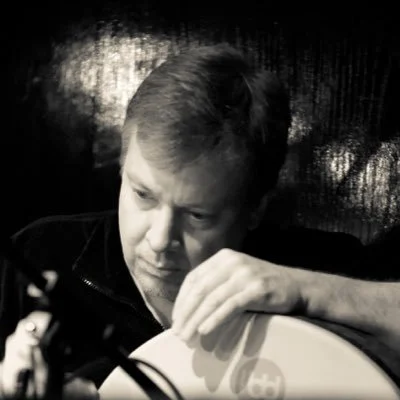
As I played percussion this morning for the Sunday Sunrise Service this Easter Morgen outside I was aware of this beautiful idea that many of our ancient mothers and fathers knew this resurrection theme of ascent through the horizons. It was 43 degrees, quite chilly, but an icey-fire shot through my soul arresting
all of my senses as I was halted in awe of God’s SON as HE rose above the horizon in Resurrection for ALL of us.

OE niðer. Since the darkness of night ensues when the sun passes below the horizon, it was perhaps thought that when the moon was apparently absent from the sky on a cloudless night, it too was beneath
the ground.

In the language of Anglo Saxon Theology, great things happen at UHT. Such Great Things include the Greatest happening; Our Christ’s “Harrowing of Hell”. We see this idea in medieval art and literature.

The Harrowing of Hell is the “time” when Christ went into “NIGHT”. 2
From this descension and all of the horizons by which HE passed through to the depths of the Holle or Hell, HE came back through these Horizons to show HIS mastery over times, space, matter, etc. HE, Jesus Christ, is without bridle to the elements which bind us.

2 Here we have the final word, night, that I need to dig into. The word “night” has a very interesting etymology. To go past Anglo Saxon and to return again we might go to the Greek: Nux, nuktos, nyk, nek, etc. Such words were associated with “dark, danger, death… . The Greek nyctalopia, nikto-tropism, nyktophobia, etc. are examples of “NYK ” as ‘NIGHT’ in their meanings.Take for example the Genus of
night flowers in Greek called Nyktanthes or NYKTEA— the genus of the snowy owl of the night hunt. Nyctereutes is the genus of the raccoon dog. Nykteris is the genus of bats. Nykticorax is the genus of the Night Heron. 

Continuing this NYTOPIA we now turn to the “privative” or ‘negation’ of the dark acting thing to speak of its “light-bearing-actions”. Hence, in the Greek, “Aktis” means..”Ray of Light” instead keeping its common prefix “N” or “nu” in the Greek alphabet. Otherwise, “Naktis” would be related to “night activity”. The Germanic “night” seems to be used in the sense of ‘the unseen’ or something not in sight — as does the Hebrew, Sheol, “the unseen”, or “Holle” which can mean, “hell” as in ‘a hole in the ground’, ‘a separation’, ‘an unseen place’, ‘darkness’, ‘without light in a dark hole’ The German goddess *Frau-Holle* was a kind and hidden goddess of frost or cold. She is recognized in particular in the winter as the sun is reduced in length at mid winter solstice. Again, to the pagan world…. ‘Where the god’s eye–or sun, or
Heaven’s gate is seeing us less’ . The deadly “nightshade” is euphemistically called “Belladonna” in Italian. Mr. O. Winslow in his “The Inner Life ” written in 1850 figuratively says: “Satan has ever sought to engraft the deadly nightshade of error upon the life-giving ROSE OF SHARON:. Belladonna is Italian for “beautiful lady” –which opens the pupil – also does the deadly drug. In E. Hamilton’s “discussion of Flora” in 1851 she says, “Belladonna was employed by Leucota, a famous poisoner of Italy, to destroy the beautiful women of whom less beautiful but more powerful ladies were jealous” — as to put the beautiful ones ‘out of sight’.

In our ancestor’s primitive rituals of enacting the dying god as scapegoat,  the god impersonates the innocent. That is, the roles are reversed and it is the god identified as the “nascent-minded”, “idiot” or “fool”. This seemingly simple minded one or village idiot is selected usually by their meekness and innocuous nature which ‘stands out’. Rene Girard coins the term “satanic contagion” as the acts of overwhelming desire for sex-murder-greed-fear-sympathy-respect. 

In James Frazier’s, Golden Bough, the idiot brings attention to him or herself. Such a  release of tension we should know from our youthful school days when the focus of the group collective or “clique” was set upon ‘that different one’ or the one who ‘stands out’. The more amplified the group contagion of hate put upon the idiot – the less focus on the inadequacies were brought to light on the group collective. Therefore, *naturally* and brutally the  community could mock, despise, put their judgement to, discard, dismiss, etc. the villiage or community “idiot”. 

Rene’ Girard calls this collective hate the “Satanic contagion” or “mimetic contagion”. Both aforementioned terms support each other. For it is the inability to escape the very D.N.A. that needs to express both sexual desire and  hate as two entities combined into ONE ‘collective orgasmic rage. Furthermore, these collective feelings must have an object of desire. I call this social cannibalism. 

We might find a Theological allusion here. In the first act of murder—- or “gracious” ‘driving off’ of the village idiot—-we have no communal, social, anthropological or individual resolve within the participation of this social cannibalistic act. 

It is the ego, not the person or community, which wills two perspectives. These two are: (a) —a failure to save yourself or the community from the desire to cannibalize  and (b) the will, which is not theirs or our own, to hate – and at the same time—long for or desire THE ONE who can ‘break the cycle’ of the human condition  Naturally, social cannibalism attempts the act of resurrecting beyond its will. By the Satanic Contagion —its own will is that which drives humanity to its demise – as we see Legion in Luke 8 willing itself in the presence of Christ to ‘go away’ into a mythological chthonic taxi – a.k.a. – the herd of swine seen in our most primitive representations as the carrier of souls to hell. For a further study on this, see Kerenya’s work on Eleusis. 

In their fallenness-innocence, it is the child – by their nature— to both want to destroy and at the same time require death and resurrection. That is: the child requires the same person (their parent – the image of God to them)  who they destroyed to be their patient saviour and to resurrect through the child’s tyrade showing the ‘better way’ to act. The child tests the parent – the god – to see if the parent “can take it”. 

It is not enough to complete such a duo of deepest sympathies. We need the god/ GOD Who would resurrect and overcome an overwhelming and inherited multiplicity of desires which drive our wills to enact the Mimetic contagion of social cannibalism. 

This is somewhat ‘touch base’ with my lecture on Messiah vs. The Hero where I explain that “the Hero-god-king’s cycle of perpetual death and rebirth” beckons a ‘repeat’ of the Satanic-Mimetic-Contagion. This Satanic Mimetic-Contagion is in adversus to the Messianic Line where the Christ-Messiah figure “draws” straightly “out of the circle” of social cannibalism. 

In opposition to the Satanic Mimetic Contagion…the Messianic Line is a drawn line with a POINT to refer to. That is, the point of reference or “ontic referent” is a lead – star that guides us out of the contagion with intent from an Intender WHO offers a road map. The teleos on this Line drawn out of the circle is the Christ of Salvation. 

We leave the cycle of “WHO should be killed next?”

Again, the contagion that we have enacted or mimed from time immemorial has perpetually showed us that it is never enough to merely “complete” such a duo of deepest sympathies – that is, the antinomies “orgasmic rage” and “sympathy” are deeply imbedded in our D.N.A. —- and this ‘uncatchable ball’ is what only a True God can resolve. 

Read the Old Testament, Sir James Frazier’s works, Rene Girard, Kerenya, Joseph Campbell, etc…..and find out what only the Gospels answer. In the Gospels you will find the Genius of the True – Undying God that resolves our double vision. We enact prophecy of Christ by doing everything else but what Jesus did. See the antithesis/ see the Messiah

The True Scapegoat and Sacrifice found in Isaiah 53:

1 Who has believed what he has heard from us?a And to whom has the arm of the LORD been revealed?

2 For he grew up before him like a young plant, and like a root out of dry ground; he had no form or majesty that we should look at him, and no beauty that we should desire him.

3 He was despised and rejectedb by men, a man of sorrowsc and acquainted withd grief;e and as one from whom men hide their facesf he was despised, and we esteemed him not.

4 Surely he has borne our griefs and carried our sorrows; yet we esteemed him stricken, smitten by God, and afflicted.

5 But he was pierced for our transgressions; he was crushed for our iniquities; upon him was the chastisement that brought us peace, and with his wounds we are healed.

6 All we like sheep have gone astray; we have turned—every one—to his own way; and the LORD has laid on him the iniquity of us all.

7 He was oppressed, and he was afflicted, yet he opened not his mouth; like a lamb that is led to the slaughter, and like a sheep that before its shearers is silent, so he opened not his mouth.

8 By oppression and judgment he was taken away; and as for his generation, who considered that he was cut off out of the land of the living, stricken for the transgression of my people?

9 And they made his grave with the wicked and with a rich man in his death, although he had done no violence, and there was no deceit in his mouth.

10 Yet it was the will of the LORD to crush him; he has put him to grief;g when his soul makesh an offering for guilt, he shall see his offspring; he shall prolong his days; the will of the LORD shall prosper in his hand.

11 Out of the anguish of his soul he shall seei and be satisfied; by his knowledge shall the righteous one, my servant, make many to be accounted righteous, and he shall bear their iniquities.

12 Therefore I will divide him a portion with the many,j and he shall divide the spoil with the strong,k because he poured out his soul to death and was numbered with the transgressors; yet he bore the sin of many, and makes intercession for the transgressors.                     

 Final Etymological Note:

The term, “orge” means both “orgasm” and “rage”. We etymologically find the word “rage” in the word “orgasm” and their Greek parent, “orge”. The etymologies and root do entirely express the feeling of two feelings for the group and at the same time, the  individual for ‘being out of one’s senses’.

I was teaching on the very touchy subject of Christian Universal Salvation the other day when one of my students confronted me with what he called the ‘faulty nature’ of the penal system against Christ. He asked, “why should I believe in an angry God who is shocked with the actions of humankind and kills his own son because he needs ‘justice’!?”

Backdrop to apostate thinking: N.T. Wright

I knew that one of my student’s *new influences* was N.T. Wright. N.T. Wright calls the Sacrifice of Christ not necessary for our salvation. N.T. Wright says that the Christ-Scapegoat formula is a faulty and pagan idea and that God does not need to go through all of that drama to save us.

N.T. Wright fails to see predeterminism, pre-ordained & portentous foreshadowing from non-Jewish and Jewish backdrop. He fails to see universal themes and the fulfillment point of all of these theme’s sketches in both the pagan and religious world. He fails to see how all of the enactments of the pagan and Jewish world line up to fulfill the Pagan-Religious Christ figure – i.e., *REASON* for the world (I might add as always that “pagan” was meant by me as an ‘a-moral’ term just as its etymology tells us).

N.T. Wright is a soft spoken academic who literally teaches “no suffering” at the hand of God—which, in turn, takes ANY SUFFERING out of God’s hands and strips the ancient to modern universal theme of the ‘stricken god’ out of the equation. N.T.W. steals the value and depth of “the Story” of a transcendent God who truly gave us value and REASON by His ACTS for 3 years. By these ACTS we now know value and reason, fulfillment of pagan and Jewish prophecy, and Reason by which Plato was alluded to in John chapter one as LOGOS – the “LOGIC”, “LOGICAL ONE”, “The -OLOGY of all things, etc.

N.T. Wright, due to his ‘easy-believism’ breaks the ‘continuity’ of this eternal theme from antiquity to the Ages to come. This is a ‘lesser god’ than the one of Isaiah 45 which claims that “I create Good and Evil – Tov and Ra’ah in Hebrew, or, ‘that which builds up and that which breaks down’. N.T.W. leaves himself and his followers ‘left in a field of quandary due to no ‘tie-in’ with 6 thousand plus years of human development and connected anthropological and sociological meaning. The only ‘rational’ reason that I could see him doing this is for popularity and the income which comes with popularity.

No matter what the next convoluted idea that might come out of N.T.W.’s mouth, I believe will implicate him as an apostate in the literal sense. That is, the word “apostate” means, “no suffering” (Greek: “apo” – “take off” + “stasis/ state” = “the stand”, “standing”; –i.e., “to fall away”).

I decided not to stir an infection caused by N.T.W. in my student. Rather, I said calmly, “The Narrative of the Scapegoat is Everything”.

He asked what I meant. I said to him, “I’ll ask you two questions to answer us both—

1) If the Lamb (the Jesus figure) was ‘slaughtered from the foundation of the creation’ –mentioned in Revelation 13:8– do you think that Jesus was actually ‘murdered’ by some hysterical God/ Father figure who needed someone to die because ‘he was angered over the sin that *surprised Him*?”

2) Or, do you think that EVERY series of events needs the next series of events to carry the entire creation of time and space in a collective gestalt —which was planned before the foundation of creation? If you answer yes then good! Consequently, the Lamb of God must fit into the laws of thermodynamics and Biblical Predestination as ‘energies that be’. Therefore, Jesus *necessarily* was slaughtered for our sake to fulfill a part of the congruent whole both under the laws of Thermodynamics (because it already happened), Biblically, and to fulfill the pagan’s hope. Hence, the FULL Narrative.

My student thought out loud with me: “If Jesus’ death was ordained from the Foundation of creation then every action would have to be *contingent* on the next from the very act of creation to present day and all actions in between”. I said, “good!, You just described Biblical Predestination, a befitting plan for The Scapegoat without a surprised God, and surprised Thermodynamics (lol) —-all at the same time! Funny, isn’t it, that these 3 AGREE in logic?!

Then I asked and answered for him the following:

“if you are willing to believe that God can bring us all, that is – the entire world- to justification, rectification and salvation not of our works but of His Will, Works, and Energy – (Philippians 2:13) then the next step is to ask about the transcendent “method” by which God must walk with us in order to teach and guide us. Might I say, God has been ‘walking with us’ as we were a created unified system – from the dawn of time to the end of the world.

God has shown us The Story over the millennia. Therefore, how does the Scapegoat NOT fit into the ultimate meaning/*Reason found in Christ’s death and resurrection as the ultimate Scapegoat? (A) I say that this is answered by Owen Barfield’s idea of ‘The Evolution of Consciousness’. We were babies 6,000 years ago and are adults today. That we have only *relatively-recently* (the past 2,000 years) been able to understand the ideas of the Scapegoat personified through Christ and the Grace received from Him. This MAIN EVENT takes away any intimation that WE DID ANYTHING TO DESERVE THIS and destroys the discontinuous postulate of N.T. Wright.

Were there earlier- more primitive enactments or Narratives that required a Scapegoat? (A) absolutely! James Frazier’s “Golden Bough” is an exemplary research into this practice among the pagans and Hebrew cult.

Why did these communities require a penal system? (A) Primitive beliefs instigated by Shamans, Priests, or collective superstitions show that when elemental or anthropomorphic gods were angered they ‘acted out’ in a retributive fashion. It was up to the Shaman, Priest, Priest-King, or leader of the primitive community to ‘resolve’ the god’s wrath by offering a vessel (Scapegoat) which would take the offending sins away from the community. This was a technique in controlling the masses. If this didn’t work, human sacrifice was not an estranged idea. We see the ‘appeasement’ of the angered god through Jack (the figure of the devil in the young boy) in the Lord of the Flies. The ‘collective soul’ amongst the tribe of English school boys -turned motley crew- was instigated by Jack’s ‘chaotic mind’ and his lust for dominance. In this example, the one with REASON was killed. REASON, expressed the character Piggy, was not welcomed because REASON exposed the chaos. The chaos of Jack, as the devil, worked-operated as the head of a ‘collective beast’ which generated a mesmerism of fear.

I find it interesting that in the Archko Volume, or Acta Pilati – Jesus was described physically as ‘not that attractive, big nosed, blue eyes and looked the part of a common Jew in His day. It was said that even the sound of His voice wasn’t that attractive until He spoke of His Father. It was the unattractive character – Piggy – that had likened societal defects . He was portly and optically challenged. His manner of speaking, for sure, was not appealing to the mass. Though his words were true he was hated because ‘the beast’ which worked through the boys under Jack saw a Scapegoat. The murder of Piggy, by Roger- who had no ability to think under Jack– ‘solidified’ the gang into faux strength and carried for another day an appeasement rooted in riotous fear and blood thirst.

Was there a ‘balance to be restored’ for these communities such as the children in the Lord of the Flies? As seen in my last statement, there can only be a short lived ‘appeasement’ of the masses (and the appeased god) for dominance seeking and leadership by power will begin again. Ultimately, had Ralph, the good boy-who led by righteousness, had not ‘come-upon’ the Military Commander who landed on Coral Island, the social cannibalism (possible physical cannibalism) would have continued until one would remain.

“if the enactment within the Narrative of the Scapegoat’s death was to be Christ’s crucifiction on the cross then what was the *meaning* of His death? – (A) I say, ‘to answer the pagan’s societal conflict of guilt, rage, shame and anxiety who had **no methodological approach to reason’. Christ IS **REASON for this VERY REASON! The Scapegoat fulfilled is the ULTIMATE REASON. Life Now has something to act to, for, from, at, journey from and come back to —i.e., the meaning of VALUE in the Scapegoat-Christ Jesus. Herein lies the answer for the Pagan in this regard. Again, this is where I address N.T. Wright’s faulty premise: Christ as ‘the Scapegoat’ is pagan. I agree with N.T.W. on this point!! But not in the way N.T. Wright says it. Christ fulfilled ALL pagan foreshadowing through God’s providential acts of establishing Primitive-Pagan enactments of putting sin to a thing and carrying it away into the unseen lands. Christ associates with the historical pagan and associates with the pagan in the Gospels! In this good sense of pagan association: Owen Barfield’s ‘collective consciousness’ might be answered in the Scriptural passage: Colossians 1:16 “For by Him ALL things were created: things in Heaven and on earth, visible, and invisible, whether thrones or powers or rulers or authorities; all things were created by HIM and for HIM”. Christ’s death and resurrection was once and for all. His atonement needed no further sacrifice or scapegoat. The doctrine that followed Christ’s enactment was in continuance to HIS enactment. That is, we must die as HE did, every day. We must speak the TRUTH unto our death as the enacted Scapegoat. In this, no more ritual without substance, rather, substance to everyday enactments.

Lastly and repeated for emphasis: “If the Lamb was ordained to death from the foundation of creation then *predestination* was the mode by which God’s Sovereignty acted. Clearly, the desire of the pagan’s collective enactments of sacrifice and Scapegoat were intently genetic and can be seen as a predetermination force all through the most remote of tribes from time immemorial. All of them and all of us have been looking for an eternal ONCE AND FUTURE KING.

It is for the Biblical “STORY”, “THE NARRATIVE”, “THE PLAY”, and REALITY, etc…that “ATONEMENT” created the  ***SENSE***.by which atonement was necessary— and actually agreed with neighboring Middle Eastern cultures concerning “sacrifice”.  Atonement creates the language of boundaries” and places colors on a canvass which would otherwise be white – reflecting all color.  When there’s no painting, no Story, no color, etc— it just Is. This is the distinction of eternity and eternal meaning set to print in time.  

Atonement wasn’t just relegated to the Biblical Story. In James Frazier’s “Golden Bough”, Mr. Frazier shows us that the entire world understood the importance of Atonement.  From primitive gods to group collective volitions,  designating who or what should take on their sea of troubles was a community participation and in-figured reality.   Sacrifice was necessary when community troubles grew to a boiling point without remedy. Therefore, “Pagan-Non Pagan-Hedonistic-Capitalistic, etc…”  atonement was/is/ will be necessary on a base-line  level for all cultures. 

The *Judicial* Murder by God-Father of Son-God was both (in their immediacy) (1) The Most Heinous Act ever committed and (2) The Salvation of the World —-where ‘That which was/is perfect’ can be shared *****by identity***** as ‘Broken Shards of Glass’. Christ, now, can be viewed reflectively “back to the Whole” and *valued* by HIS LOSS and then again, the GAIN by which we receive and what HE receives” 

I will be interviewing for the 4th time the leading J.R.R. Tollkien Scholar and Professor Emeritus at the University of Maryland and Oxford adjunct, Dr. Verlyn Flieger, next month concerning her book, “Pig’s Tale”. This book, through fiction, treats the topics of Sacrifice and Scapegoat to be entirely different from one another. It covers the primitive collective social sense for atonement. 

I conclude my thoughts here with Rene’ Girard’s “atonement theory” that Christ was the ONLY Myth that became real, dwelt amongst us and fulfilled all pagan aspirations of atonement. For those who don’t know me, “Pagan” is used by me in the *a-moral* sense: “those on the ‘other side of the peg’; ‘on the other *page*”

I’m still working on analogue/ and association of ‘what it takes to be a meaningful sacrifice and also — scapegoat).

U.P.T.

Up until now, we have triangulated our way up to a consistent Theology. The 3 main components that provide a coherent and consistent Theology are: (U) Universal Sanctification-reconciliation (Apocatastasis), (P) Pre-determinism (Pro-horidzo), and the (T) Teleology (teleos) which, in congress of forward motion (‘gestalt’), stands upon the first two. That is: the “END” or “teleos” is a *result* of ALL prior ENERGIES “that were”. This is what I call the “U.P.T.” formula.

It is with the faith (Greek:pistis – Proto Indo European: “Bheidh” – mental place where we launch from) that you will listen to my past lectures to understand WHY I believe in the coherency of this formula. Therefore, I will take a pass on ‘proving’ what I have stated up to this point. What I will state now is the “4th Dimension” to this U.P.T. formula. Simply, the etymology and story of the “Apocalypse”.

THE APOCALYPSE

The word “Apocalypse” literally means, “off (with the) cover”; “to expose”; “to reveal”; “to un-cover”; “to show”, etc. Simply: “apo” = ‘off’ + “kalupto” = ‘cover’, ‘lid’, ‘seal’.

So, the Greek “apokalupto” or ”Apocalypse” is NOT just something in the future, rather, it is the “Revealing of ALL that has been hidden” since time immemorial. In this sense, everyone experiences their own “apocalypse” every second as ‘revelations’ reveal themselves to the total sum of your being or ontology to right now.

THE FORMULA “U.P.A.T.” FOUND IN THE SPIRITUAL GRAMMAR OF JOB

Job 42:11 – “Then came there unto him and his brethren, and all his sisters, and all they that had been of his acquaintance before, and did eat bread with him in his house: and they bemoaned him, and comforted him over (P.) ALL THE EVIL THAT THE LORD HAD BROUGHT UPON HIM ……every man also gave him a piece of money and every one an earing of gold. (42:12) (T.) So the LORD blessed the latter end of Job more than his beginning…… “

“Satan” was a literal reality in the Narrative of Job but is diminished to a literary mechanism which becomes dispensable. Evil cannot ‘do’ a ‘work’. It can only *be used to do God’s plan*. Satan is a stylus that carves the predetermined significance upon the rock of meaning.

(I label U, P, A, and T to show that necessary ‘quadratic’ necessary view.)

(P) Any trial one goes through is a segway to ‘an Apocalypse’. (T) Job’s trials led him to his

*Teleology*. (T.) His *teleology* was the ‘end point’ by which he could (A) understand/ see that (P.) it was GOD that put him through the FIRE of Satan to be purified and, finally, (T.) renewed. (P.) “The Satan” could only act upon the office he was given. (U *.) Remember, Job was prior to Christianity, Judaism, the Prophets, and even the Biblically Legislative brand of Patriarchs which dictated a law code. This means that the only way that Job could have been ‘saved’ was the UNIVERSAL LOVE by which God granted Job without law code or Christianity.

TRIBAL ASPECTS OF APOCALYPSE

For simple association: if you saw Mel Gibson’s movie, “Apocalypto”, you’ll have taken away the *broadest and simplest* explanation for the meaning of “Apocalypse”. The movie is about a tribe of brutal profiteering and conquering “Aztec” Indians (historically, it was the Mayans) putting into bondage other weaker tribes and selling them off to sun god worshipping “Aztecs (again, Mayans)” who cut the heads off their victims for the sake of appeasing the sun god. This act of ‘social cannibalism’ is not new to the Aztecs if one only reads James Frazier’s “Golden Bough”. At the end of the movie a new “Apocalypse” occurs when the Spanish Armada arrives ending, historically, the Mayan civilization in the Yucatan peninsula. This is yet a new Apocalypse.. All to say: ‘the end of an *AEON* or AGE and the beginning of a new AEON. Isn’t this word, AEON, the very word used in Revelation 20-22 for “eternal” in the English? —might I say, a horrible and derailing English translation. For a deeper study into Social Cannibalism one can refer to this topic in a doctoral thesis at UMI titled, “Social Cannibalism. Also, the 12 volume treatment given to Mankind and his social taboos by Sir James Frazier, quod vide.

As a side note:

Concerning ‘advancement’ from social cannibalism and into Catholicism I go as follows: whether the argument can be made that spreading Catholicism in the Yucatan peninsula was a relatively good (if one is to not take the ‘centricity’ of Jesus’ Gospels) thing or not can be up to you to make. I would say (1) all things are ‘good’ under God’s Providence —i.e., “good” as *beneficial to build the ‘full house of meaning’ * and (2) that ‘new archetypes’ were infused into such cultures with the precise progression needed to make the higher idea of a Christ figure. Therefore, Spanish Medieval Catholicism was a necessary ‘afterthought’ or ‘echo’ of the original Christ figure —-which, to me, is better than nothing and it was a *start* to that which was previously barbarous and laden with superstition. Arguments can be ensued, and will be I’m sure.

BIBLICAL APOCALYPSE

We must dispense with child’s play concerning the faulty English translation of “eternity” and “apocalypse” and return to the Glossary by which the entire New Testament had faith in to use…namely, the Paideia of the Greeks. I have done enough work on this subject on my website, The Fullness Of Meaning Christian Ministries.com (fomcm.com), to convey a solidly backed Word bank supporting a new and fresh look at an etymologically sound Scripture.

Since I address at the top of this piece what “Apocalypse” means, I will again, from prior lectures, address the tangential word to apocalypse, “AEON”.

“Indefinite time” or “AEON” does not have to mean “infinity”, though it could. The WAY in which Aeon and Aidion were used as ‘indefinite times’ were poetically and philosophically expressed a complimentary union of ideas.

Such a poetical employment of words could be used to create the seemingly “irrational” mental state of either the poet or the characters by which they participate. Therefore, subsuming the ‘rational’ or ‘reasonable’ for a beautiful alien ‘irrationality’, if conveyed by the poet correctly, could arrest one’s senses and lure one’s self out of the lust, greed, covet, anger world—i.e., suspend one from the mire of social relativism which leads to nihilism.

This beautific apocalyptic irrationality created words fit for philosophical treatise and revelatory Biblical writing—-paratactic writing – for the words has concretized into ‘meaning’ and a correlative ‘semiotic commitment’ for the ‘abstract’ had occurred. Hence, the mathematical philosophers and prophets had a ground to work from.

From here, I hope to begin my statement of faith as the U.P.A.T. or – “Universal Pre-Determinative Apocalyptic Teleology”. For audible aesthetic convenience only I place “apocalyptic’ before “teleology”.

*To know what something is – is to know what it is not*

k.j.-

PREFACE

The Greek word for “time segment”, or, Aionios was contrasted with Adios – meaning “infinity”. These two terms were used throughout Homeric times down to the 1st century A.D. Christian Church. As we introduce the term “Adion” for infinity in this lecture piece we will see what Aeon is not.

I will be clear: Aeon, meaning “a segment of time”, “an era”, “an eon”, “an age” and “a limited/unknown ‘finite time”, was employed by the Biblical writer, John, in his Revelation – or, “Apocalypse”, for the usage of Hell within its “aeon of purpose”. Moreover, the “ontology” or “coming to be” of ‘an age’ of ‘being a sinful human’ requires AN aeon or “era” of hell to refine them to God; this intimates ‘direction’, therefore, INTENT of a GOD to create a passageway by which we will be refined, ready, and reserved for the final destination, i.e., UNION with GOD.

We, therefore look at our part 4 focusing on the ‘’vocabulary bank’’ by which the New Testament used its terms for Eternity, Perpetuity, Eons, Ages, and infinitude.

Parts 1-3 covered Aeon in all of its forms. We conclude that “Aeon” was used as an *finite undefined time segment*.

Our next focus is Adios (Adion). Since we have seen by its usage that Aeon is not an ‘unending’ term we therefore look to Adios.

We continue to go to the archaic authors of the Greek and Hellenized world to see that ‘Aidios’ was socially normalized in its usage. Again, words are used in their participation of the figuration of a culture. I reiterate from my past 3 lectures that the beginning New Testament community (ca 30 A.D.) had its rich linguistic heritage spanning at least 800 years, if not more, from the Classical Greek authors.

Examples of TIME: ETERNITY

Adios and Chronos working together

Time (1)

One of the earliest cultural usages and accounts of Adios is found in Homer’s “Hymn to Hestia” (ca. 800 B.C.). Here, the ‘goddess resides on a throne’ with mortals. This, by context alone, should give us ample information to see that there is a kind of “time” that can ‘participate’ in this “throne realm” but is separate from….for …if mortality exists there, then ‘mortality’ requires sequential time or “chronos”—which is separate and distinguished from Aidion as we shall see. Chronos is neither subsumed or supervened by Adios at this aforementioned juncture, rather, they (Chronos and Adios) share their ‘attributes’ at certain juncture points for a fuller gestalt of meaning. That is, time and eternity (chronos and Aidios) are ‘conjunctive’ as ‘time’ meets the eternal…or, relating to mortals → **the epiphanal**.

We see Hestia, the Goddess of the *Hearth/ Throne* sitting at her ‘permanent seat’….”edren aidion elaxes”. Such as ‘seat/ throne’ is the hearth at the fireplace. It is where the family convened to talk, eat, share, cook, stay warm, associate with HOME. Hestia, was considered LOVE, THE BELOVED…and, in this Maiden Housekeeper sense, she was Divinely Eternal Without End. Hestia was called, “She of the Public Hearth”. So, there is a sharing of the “time” of mortality and this AIDION throne. This is no more contradictory than when the Eternal God of the Bible talks with the Patriarchs, Matriarchs and Prophets. How About the answerable Platonic idea of “coming to be” to the FULLNESS of the UNIVERSAL found in the very NATURE of JESUS CHRIST ‘coming to HIS FULLNESS?!? I.e., When the UNIVERSAL meets the Particulars. The “participation” by which the gods, Gods act involves such a confluence of different “times”.

Time (2)

We find Aidios inscribed in Hesiod’s “Shield of Hercules” saying, “‘aidion eixon ponon”. This means that no one side can win in this athletic competition. It states the ‘stasis’ by which movability cannot be achieved, therefore, ‘without end’ —–in the duration of the game. But here’s the catch: it is in the ‘picture’ of stasis without resolution. This depiction fires on the mind a never ending battle for glory without resolve….a state of being…a longsuffering of worldly effort…the battle of the EPOS (‘epic ones’) or “eroes” (“heros”).

Time (3)

Anaximander’s ( A.NAX’.uh.MAN.der) Greek says, “Tayn Aidion Kinaysin” —i.e., “The Aidion is perpetual movement”, —-therefore, Aidion shows no retirement of motion, hence, no *aging*.

Time (4)

Anaximenes (A.NAXIMENEEZ) says,”Kinaysin de kai hootos aidion poiei” as to agree with Anaximander.

Time (5)

Anaximander went on to say, “There is a certain NATURE of the infinite” – “phusin tina tou apeirou” – “and that this NATURE is ETERNAL and UNAGING” – “Aidion ein kai a.gayro {“a” = “not” + gayro’ – aging/ i.e., ‘geriatric’}”.

Time (6)

Xenophanes (XSE.NAH’.fa.neez) attests Adios as “indestructable”, immortal, and ungenerated (i.e., uncreated). Xenophanes uses Adios in contrast to anything that is “coming to be” —or “generated”. To conclude Xenophanes: anything that segways to the next event is not Adios.

Time (7)

Diogenes (DIE-AH.jeh.neez) Laertius (Lay.er.ti.uhs) simply agreed with Xenophanes here.

Time (8)

Anaxagoras agreed with Aristotle that “Adios” is ‘without end’

Time (9)

Heraclitus says, “Adios is perpetual motion of things without end”. These “Things” therfore do not share in the attributes of Aeones.

Time (10)

Empedocles says, “There is a “THING OF NECESSITY”, an ancient DECREE of *gods ETERNAL*—- i.e., “Anankayce Krayma Theon Psaypheesma Palaion Aidion”. Conclusively brilliant, Empedocles continues to his conclusion that Aidion is “spherical, eternal, and immobile” – i.e., “Sphairo-eides Kai Aidion Kai Akin-ay-ton To Hen”.

Time (11)

Parmenides used the term Aidion to mean “ALL” in the sense of “ALL that will always be…ALL that is ungenerated and imperishable”.

Time (12)

Simplicius says, “nothing that has a beginning and end is Aidion”

*Time (13)

For me, maybe the most important statement was from Metrodorus of Chios who stated, “The ALL (TO’ PAN) is Eternal (AIDION), Because, If It Came Into Being At A Certain Moment, It Would Come To Be From Non-Being; And It Is Unlimited (Apeiron) Inasmuch As It Is Eternal:For It Does Not Have A Principle (Archay) From Which It Began, Nor A Limit (PERAS) Or An End (TELEUTAY)” For today I will end our section on the usage of Aidion in Greek Antiquity. Thank you,

Kyle Jones

Post Statement and Recap

Our job at fomcm.com is to search for historically overlooked material that substantiates the Bible to the regard that it should be given.

Often, the Westerm “orthodox approach” ‘limits’ the purview of the authentic linguistic content, a.k.a., “Message” of God’s Word by *Westernisms* or recognizable ideas that fit into ‘our sense’ of our Orthodox god. Sadly, the robbery is by and to the ‘church’ by which its failures are founded upon limitations of Eastern Understanding of the Biblical Text. One limitation after the next, always trying to ‘keep up’ with the ever reducing idea of the ‘so called biblical text’ which is currently founded upon man-made notions of God.

Fear is the engine by which ‘an orthodoxy’ fights not repent. Scientists have to secularly ‘repent’ when they find something that counters and finally disproves an older thesis–which becomes no-more-scientific…but simply, WRONG….. . Likewise, Theology SHOULD contain the same humility within their “orthodoxies” —as I speak ‘tongue and cheek’. And again, once there has been grounds for challenging the English Text of King James…one should be allowed to find answers to countertheses via an orthodox ‘council’ without agenda. It is here that I make mention of “rhetors” from the Paideia of the class Trivium.

I speak of “rhetors” in the classical sense by which the first grade of learning Greek and Latin language began the Trivium’s rite of passage to academic bliss. Then, from Language to logic. Finally, argumention (or rhetors) was taught by the very wise secular Greek and Hellenized Christian mothers of the first and second centuries.

These 3 phases (language, logic and rhetors) of the Trivium ( by which the educated Greek class lived) led facets of Greek culture to be strung together with respect and congruity of thought……and not as brute beast ‘authoritarians’ who ‘brawl’ over ideas for dominance and not truth. I need not discuss the brutal nature of this approach in today’s world.

In contrast to this last mentioned civil unrest…. the Paidea of the Greek’s Trivium created learned scholiasts of the Biblical Text to find their ‘senses’ in historical comparitive hermeneutics, Biblical Greek analysis and parsing of the stems of Greek Grammar, socially-contextualizing and examining the socio-linguistic understanding by which the geographical ‘neighbors’ of the Palestinian Jews and Christians understood their God. THIS IS of the Hebrews and New Testament Christ, and, finally, exegete the Biblical Textus Receptus or “Received Authoritative Greek and Hebrew Bible”—as well as the LXX or Septuagent, i.e., the Greek Old Testament by which we have transferable Greek terms with Hebrew.

Finally, fomcm.com gathers writers of Greek pagan antiquity to show that the ‘vocabulary bank’ of the New Testament was not out of a ‘vaccum’. Rather, the Greek New Testament used the Greek language that the ENTIRE Greek world had been baptized in, saturated, steeped in since the inception of Greek culture. This is nothing to overlook, and yet, the Western American Orthodox Church has somehow or another concluded to not deem it important to know what the New Testament REALLY WAS SAYING IN THEIR DAY, THEIR CULTURAL CONTEXT, THEIR SEMIOTIC AGREEMENT, THEIR SLANG, THEIR WAY OF SAYING THINGS, IDIOMS, DIALECTS, etc…. I hear from western ‘authorities’ of the ‘orthodox churches’ saying that “devotion is over theology”. You can’t ‘devote’ to something ill-defined. Why fear exegeting while ‘working on your *devotion*?’. *What IF, ….the “MATHETIKON” (in the Greek) meant “TOTAL DEVOTEE” to the LOGOS or Christ as He spoke on Earth?!!—Well, it does! Lastly, I say….”if you *know* the God you serve then you will serve HIM correctly; otherwise, there will be a false sense by which you relate to the WORDS that HE has spoken and YOU have so neglectfully handled in your isoglossed cultural *SENSE* of “”devotion””.

RECAP

Remember, “Indefinite time” does not have to mean “infinity”, though it could. The WAY in which Aeon and Aidion were used as ‘indefinite times’ were poetically and philosophically expressed a complimentary union of ideas.

Such poetical employment of words could be used to create the seemingly “irrational” mental state of either the poet or the characters by which participate. Therefore, subsuming the ‘rational’ for a beautiful alien ‘irrationality’, if conveyed by the poet correctly, could arrest one’s senses and lure one’s self out of the lust, greed, covet, anger world.

This “irrationality” created words fit for philosophical treatise for the words has concretized into ‘meaning’ and a correlative ‘semiotic commitment’. Hence, the mathematician-philosophers had a ground to work from.

It is not so strange to look at a word complex if we understand ‘pictographic societies’ as our ancestral origins. Herein lies the genius of the Greeks that was not so different, if not related, to the pictographic societies of the Egyptians, Sumerians and the Original Ancient Hebrew pictographic texts of the Pre-Sinaitic Israelites. Such ‘radicals’ as “fire, serpent, toxic, 6 wings, etc.” did indeed mean the “Seraph” or angels that flew with the temple of God in HIS ETERNAL “Train” or Verb of Perpetual – unending Motion through and into this “temporal state”. This is the “Parousia”, per se, of the Old Testament God who condescends to us.

Nonetheless, the force of each archaic Greek word was known by a millennia of usage for the exact purpose to specify categories of thought, therefore, distinguishing one term FROM the other.

The richness of Greek vocabulary is found in how one word can dance around the other, never stepping on the other’s semiotic ‘toes’ —- only reinforcing the other’s role, creating a union of ideas and images due to the strength and value the Greeks held to word care.

To paraphrase Edward Gibbon, the author of the Decline of the Roman empire, “Empires Fall when the study, usage, retention, and guarding of their language is no longer preserved. Double entendres, business-speak, cultural popular slang, etc. are the beginnings of this sorrow”.