Cain- An Ethnomusicological Treatment
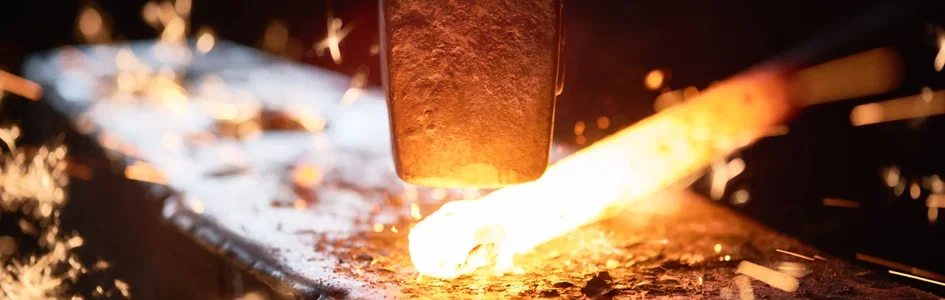
In the Book of Genesis, chapter 4, verse 22, we read: wəṣillâ gam-hîʾ yāləḏâ ʾeṯ-tûbal qayin lōṭēš kol-ḥōrēš nəḥōšeṯ ûbarzel. This translates as “And Zillah, she also bore Tubal-Cain, the forger of every instrument of bronze and iron.” The Hebrew name Tubal-Cain (תּוּבַל קַיִן, Tūḇal Qayīn) identifies him as the instructor of craftsmen in bronze and iron. The root of Qayin (קַיִן, Qayīn), the name Cain, carries an etymological link in Semitic languages to the concept of a smith or metalworker.
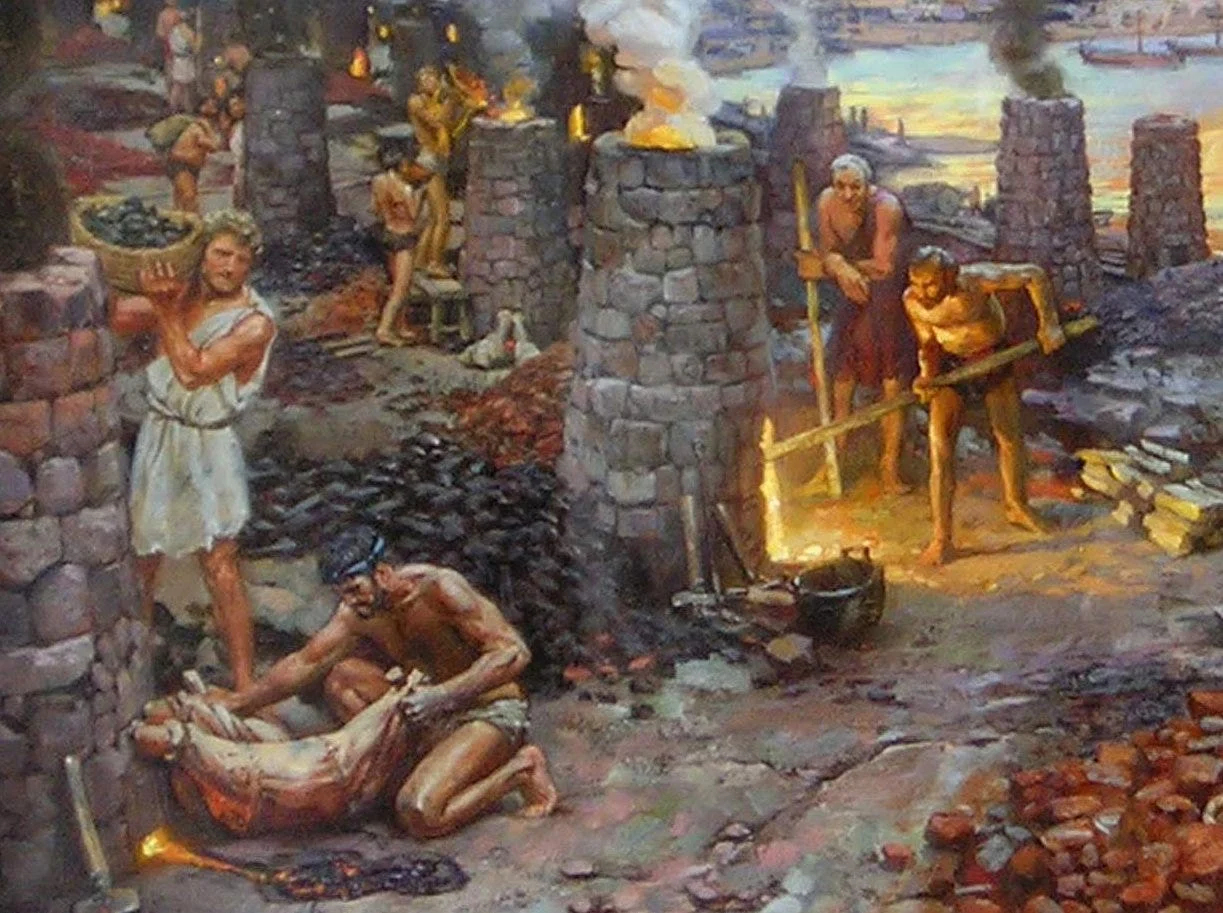
This biblical metalworking clan, associated with the Kenites or Cainites, represents an early guild of itinerant smiths whose knowledge originated in the highlands of ancient Iran. From there, the tradition moved northward through the Caucasus into the Pontic region of northeastern Anatolia. In that area, the Chalybes — also called Khalybes or Khalibs — became renowned for their mastery of ironworking. Classical sources credit them with producing high-quality iron and early steel, so much so that the Greek word chalybs (χάλυψ), meaning tempered iron or steel, derives directly from their name.
A parallel branch of this same metallurgical and fire-keeping tradition traveled southward into the Indian subcontinent. We find in the Rigveda this same guild but by an Indo-Aryan term (Sanskrit) called the Angiras or Angirasa. This clan embodies the same lineage that the Chalybes, Tubal Cain, and/ or Kenites did. Their name comes from the Sanskrit aṅgāra (अङ्गार), meaning burning coal or glowing ember. The Angirasas appear as the great keepers of sacred fire and priests of Agni, the fire god (my contention is that this is why these guilds split in that Cain was still a follower of YHWH and opposed anthropomorphic worship). They are described as radiant beings who discovered and guarded the hidden fire, serving as mediators between gods and humans. Specific references to the Angirasas as fire priests and singers occur throughout the Rigveda, including in Mandala 1, where Agni himself is addressed in connection with the Angiras tradition.
The Angirasa are directly tied to the guild of metalworkers through their intimate relationship with fire itself — the essential force behind all ancient metallurgy. Just as the biblical Tubal-Cain instructs in the working of bronze and iron, the Angirasas serve as the divine keepers and kindlers of the very fire that powers the forge. Their name, rooted in “burning coal,” evokes the glowing embers of the smith’s hearth, positioning them as the sacred counterpart to the earthly metalworking guilds. In Vedic hymns, they maintain the sacrificial fire that parallels the controlled furnace fire needed for smelting and forging metals, linking the spiritual and practical arts of fire mastery.
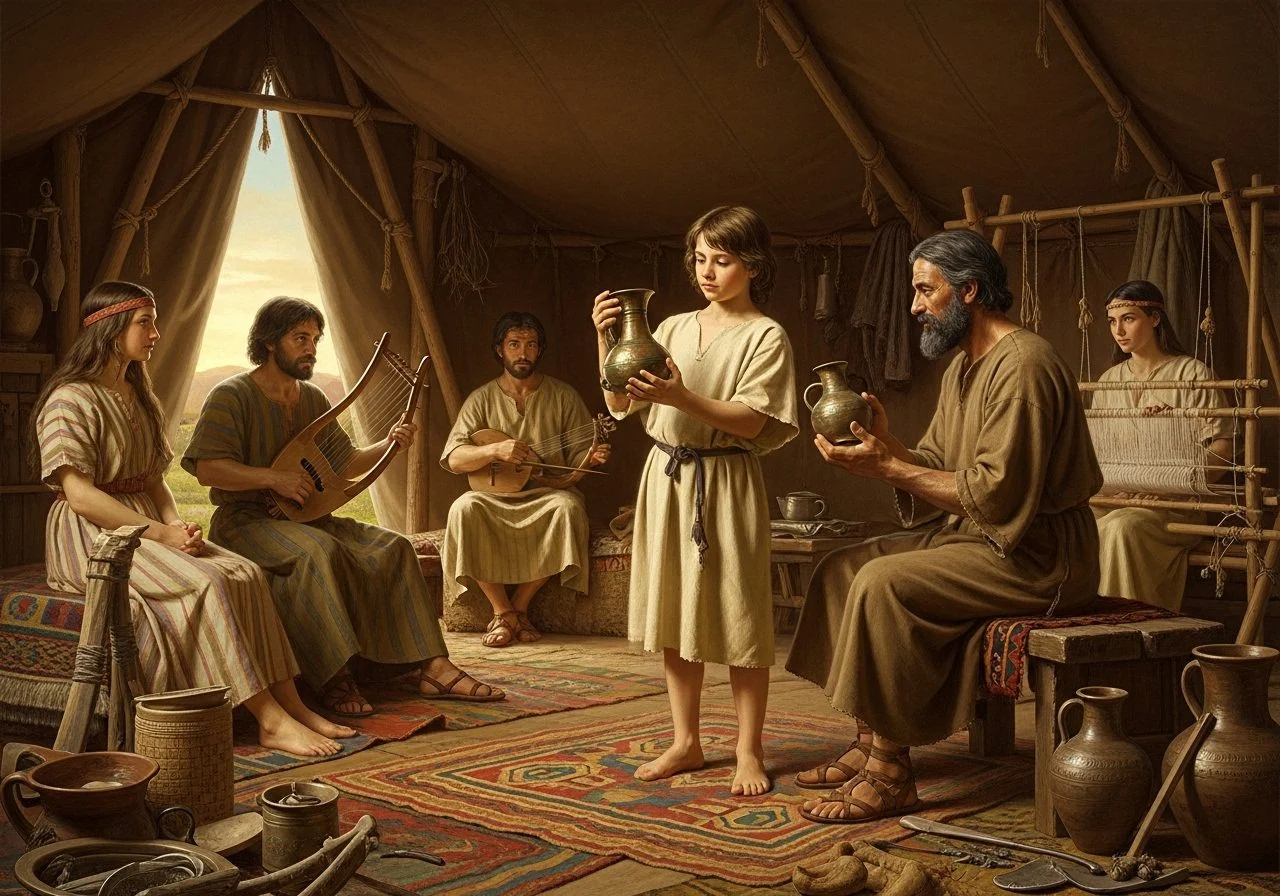
The descendants of Cain through Tubal-Cain were not only smiths but also the creators of musical instruments. Genesis 4:21 tells us that Jubal, their half-brother, was “the father of all such as handling the harp and organ.” This places the origins of both metallurgy and musical instrument making within the same family guild. The metallurgical skills required to craft bronze instruments would naturally extend to the production of metal bells, cymbals, and resonators used in early music.
This ethnomusicological connection finds expression in South India, particularly in the Tamil region. The ancient Tamil culture maintained close trade and cultural links with Sumeria and the Near East from very early times. Two of the most iconic instruments of Carnatic music trace their roots to clay and percussion traditions that echo the ancient metalworking and fire-keeping guilds. The Ghatam, a clay pot drum, and the Mridangam — literally “mud body” from Sanskrit mṛd (clay/earth) and aṅga (body) — represent this lineage. The Mridangam is a double-headed drum with one skin struck on the left and another on the right, embodying the duality of sound production that parallels the dual mastery of fire and metal.
Further strengthening this connection are the names of key drums found across India and beyond. The word Tabla (तबला), the most widespread term for drum in the region, shares a consonantal structure — dental stop, labial, and liquid — with Dhavul (a large drum common in Turkish and Central Asian traditions) and the Tavil (தவில்), the powerful barrel drum of Tamil Nadu temple music. These names reflect a deep etymological thread: T-B-L, Dh-V-L, and T-V-L. Through Grimm’s Law and regular sound shifts across Indo-European and related language families, these terms point to a common ancient root associated with percussion and resonance, likely carried by the same wandering guilds of metalworkers and instrument makers who spread from the ancient Iranian highlands.
Thus, the Cainite guild of artificers, skilled in bronze and iron, gave rise to both the sacred fire traditions of the Angirasas in the north and the vibrant percussion culture of Tamil Nadu in the south. The Ghatam, Mridangam, Tabla, Dhavul, and Tavil stand as living echoes of that ancient metallurgical-musical guild — a brotherhood of fire, metal, and rhythm that traveled from the forges of Tubal-Cain to the temples and courts of South India.
Bibliography
1. Amzallag, Nissim. The Forge of Tubal-Cain: Biblical, Archaeological, and Cultural Perspectives. Jerusalem: Hebrew University Press, 2017.
2. Meskhi, Anna. “Sumerian Urudu and Kartvelian Metallurgy.” Humanities in Information Society 4 (2023): 45–67.
3. Erb-Satullo, Nathaniel L., Brian J. Gilmour, and Nana Khakhutaishvili. “The Metal behind the Myths: Iron Metallurgy in the South-Eastern Black Sea Region.” Antiquity 94, no. 374 (2020): 401–419.
4. Monier-Williams, Monier. A Sanskrit-English Dictionary. Oxford: Clarendon Press, 1899.
5. Tylecote, R. F. A History of Metallurgy. 2nd ed. London: Institute of Materials, 1992.
6. Wertime, Theodore A., and James D. Muhly, eds. The Coming of the Age of Iron. New Haven: Yale University Press, 1980.
7. Moorey, P. R. S. Ancient Mesopotamian Materials and Industries: The Archaeological Evidence. Winona Lake, IN: Eisenbrauns, 1994.
8. Hauptmann, Andreas. The Archaeometallurgy of Copper: Evidence from Faynan, Jordan. Berlin: Springer, 2007.
9. Mondriaan, Marlene E. “Who Were the Kenites?” Old Testament Essays 24, no. 2 (2011): 414–436.
10. Khakhutaishvili, David A. The Manufacture of Iron in Ancient Colchis. Oxford: Archaeopress, 2009.
11. Yalçın, Ünsal. “Early Iron Metallurgy in Anatolia.” Anatolian Studies 49 (1999): 1–15.
12. Pleiner, Radomír. Iron in Archaeology: Early European Blacksmiths. Prague: Archeologický Ústav, 2006.
13. Sagona, Antonio, and Paul Zimansky. Ancient Turkey. London: Routledge, 2009.
14. Picken, Laurence. Folk Musical Instruments of Turkey. Oxford: Oxford University Press, 1975.
15. Rowell, Lewis. Music and Musical Thought in Early India. Chicago: University of Chicago Press, 1992.
16. Pesch, Ludwig. The Illustrated Companion to South Indian Classical Music. New Delhi: Oxford University Press, 1999.
17. Wade, Bonnie C. Music in India: The Classical Traditions. New Delhi: Manohar, 2001.
18. Meissner, Bruno. Babylonian and Assyrian Texts. Leipzig: J. C. Hinrichs, 1920.
19. The Holy Bible. New Revised Standard Version. Genesis 4:21–22.
20. The Rigveda. Translated by Ralph T. H. Griffith. 1896. Reprint, New York: Book Jungle, 2008.
21. Beck, Guy L. Sonic Theology: Hinduism and Sacred Sound. Columbia: University of South Carolina Press, 1993.
22. Nettl, Bruno. The Study of Ethnomusicology: Twenty-Nine Issues and Concepts. Urbana: University of Illinois Press, 2005.
23. DeVale, Sue Carole. “Musical Instruments and the Concept of Metallurgy.” Yearbook for Traditional Music 19 (1987): 1–18.
24. Amzallag, Nissim. “The Origin of Israelite Religion and the Kenite Hypothesis.” Journal for the Study of the Old Testament 41, no. 3 (2017): 259–280.
25. Bitarello, Maria Beatrice. “The Chalybes as Mythical Blacksmiths and the Introduction of Iron.” Mouseion 13 (2016): 497–534.
26. Mikaberidze, Alexander. Historical Dictionary of Georgia. 2nd ed. Lanham, MD: Rowman & Littlefield, 2015.
27. Picken, Laurence E. R. Folk Musical Instruments of Turkey. London: Oxford University Press, 1975.
28. Krishna, T. M. A Southern Music: The Karnatik Story. Chennai: HarperCollins India, 2013.
29. Sambamurthy, P. South Indian Music. 6 vols. Chennai: Indian Music Publishing House, 1999–2002.
30. Ghosh, Manomohan. The Nāṭyaśāstra: Ascribed to Bharata-Muni. Calcutta: Asiatic Society, 1951.
Glossary
1. Tubal-Cain (Tūḇal Qayīn) — Biblical instructor of every craftsman in bronze and iron (Genesis 4:22).
2. Qayin — Hebrew name of Cain, etymologically linked to “smith.”
3. Kenites — Biblical clan associated with Cain and itinerant metalworking.
4. Jubal — Brother of Tubal-Cain, described as the father of musical instrument players (Genesis 4:21).
5. Chalybes — Ancient Pontic tribe renowned for ironworking and steel production.
6. Chalybs (χάλυψ) — Greek term for tempered iron or steel, named after the Chalybes.
7. Angiras (Aṅgiras) — Vedic clan of fire priests and keepers of sacred knowledge.
8. Aṅgāra — Sanskrit term for burning coal or glowing ember.
9. Agni — Vedic god of fire, central to the Angiras tradition.
10. Rigveda — Oldest Vedic text containing hymns attributed to the Angiras clan.
11. Ghatam — Clay pot percussion instrument central to Carnatic music.
12. Mridangam — Double-headed drum from Sanskrit mṛd-aṅga, meaning “mud body.”
13. Tabla — Common percussion instrument across North India.
14. Tavil — Large barrel drum used in Tamil Nadu temple music.
15. Dhavul — Large cylindrical drum found in Turkish and Central Asian traditions.
16. Bloomery — Ancient furnace used for producing wrought iron.
17. Pontic Region — Southeastern Black Sea coast, homeland of the Chalybes.
18. Colchis — Ancient Georgian region with early iron production sites.
19. Itinerant Smiths — Wandering metalworkers associated with Cainite guilds.
20. Ethnomusicology — Study of music in its cultural and historical context.
21. Carnatic Music — Classical music tradition of South India.
22. Mandala 1 — Section of the Rigveda containing early Angiras references.
23. Fire-Keeping Tradition — Sacred maintenance of fire linking metallurgy and ritual.
24. Grimm’s Law — Set of sound changes explaining consonant shifts across language families.
25. Metallurgical Guild — Organized group of metalworkers and artisans.
26. Kura-Araxes Culture — Early Bronze Age culture linked to early metallurgy in the Caucasus.
27. Sumerian Trade — Ancient maritime and overland connections between Mesopotamia and Tamil regions.
28. Resonator — Acoustic device used to amplify sound in early musical instruments.
29. Percussion Culture — Musical traditions centered on rhythm and drums.
30. Cainite Guild — Ancient brotherhood of metalworkers and instrument makers descended from Cain.