Once, when seas were younger and stars still argued over their places, there was a circle of light hovering above the Atlantic-a ring of twelve knights in a blazing celestial plate, each crowned by his own sun. They weren’t men, they were the zodiac itself, wearing flesh only because mortals needed mirrors they could touch.

Uther Pendragon, taught of Merlin, the Druid,  read them as riding out from Avalon in their heavenly signages, as their spears tipped with the dawn.

In his vision, Uther thought they were questionable omens until one appeared before him as he lowered his visor. Behold, it was the solar god, Galahad, flesh received. Galahad’s face, older than language, saying to Uther the same thing every version of the story forgets to make obvious: “we’re echoes, your legend’s just a noise we haven’t shaken off yet.

Pendragon didn’t flinch. He bowed instead, the way you’d greet lightning after it promised to stay polite. Then, came the other incarnations acknowledging Uther as they dismounted.

Lancelot’s horse was still sweating plasma. Bors, one of Arthur’s faithful knights, had frost on his beard; while Arthur’s knight Kay smelled like iron filings.

They sat in Pendragon’s hall, told him how they’d started elsewhere-how Marduk once split a dragon named Tiamat and scattered her scales into constellations, how each scale grew teeth, how those teeth became spears, how the spears forgot they were once scales and thought they were gods.

Persia heard the crash first-Ahura Mazda watching firebirds turn into armored men who guarded orchards of gold apples. Greece tried to rename them: Apollo for Gawain, Aries for Percival, Hermes for Merlin who’d always been older than the rest.

Rome stamped coins with their profiles, forgetting the solar god’s origins continued to mint more. Babylon burned the coins, built ziggurats out of the ash, and waited for eagles. Eagles never came; the knights rode west instead, chasing a rumor that a child would be born who wouldn’t need armor.

Christ arrived anyway, quiet as snowfall on a battlefield. The knights were drunk in a stable-Tristan teaching shepherds to sing in seven languages they’d invent centuries later. They watched the manger from shadows, arguing whether redemption was just another quest. Lancelot said yes. Mordred, who hadn’t drawn breath since Troy but still counted as family, said no. No one asked Mary her opinion; mortals rarely get that luxury in myths. They left Bethlehem before dawn, leaving behind only hoofprints that glowed for three days. Then centuries blurred: Rome fell, fell again, kept falling like a drunk who thinks gravity’s optional. The knights followed the dark, armor dimming to candle-flame.

Somewhere between Lindisfarne and Camelot, they shrank back into human size, edges softening, suns cooling to hearths. Still, every dawn carried their fingerprints-Gawain’s red hair streaking the horizon, Percival’s silence in the frost, Galahad’s brief smile when fog again lifts just enough to see Avalon.

Arthur inherited the leftovers: a round table cracked where Mordred once stabbed it, Excalibur humming faintly like a radio between stations. He didn’t know the blade was Tiamat’s last tooth, and didn’t need to.

Myths work best when the listeners finish the story themselves. So when the final battle comes-because it always does-Arthur mortally dies holding a spear older than his kingdom, only to return to the land of apples.

The knights ride out one last time, not as gods but as afterimages, scattering across oceans they’ll never own, finding their identities circumferencing the Solar King’s image.

Jesus says in Matthew 16, what you bind on earth is bound in heaven. The Pharisees twist law into chains.  They make Sabbath rules so tight a man can’t heal, tithing taken while widows starve.  
 
Concerning the Binding of many world serpent mythologies:  the dragon’s coil everything’s motion making all things halted — including mercy which is now dammed. Yahweh’s loosing or releasing of the binding: it is the opposite: Exodus 2:24, God heard their groaning and snapped Pharaoh’s yoke; Isaiah 58, loosen ( loosed/ released) the chains of injustice. 
 
A comparative analysis:
 
Freedom isn’t permission-it’s blood-flow. Jesus flips the script: Pharisees hoard commandments like Vritra hoards rivers-legal waters stagnant, life choked. They bind (Hebrew , same root as curse) and loose ( patar , release) by vote in council-human votes pretending divine stamp. But only Yahweh binds chaos (Leviathan, Job 41, I bind his tongue) while the Pharisees bind people. 
 
Wordplay seals it: their fence around Torah is literally , boundary-dragon-wall. Jesus calls them whitewashed tombs (white scales, bone under)-looks holy, reeks inside.
 
 
Final conclusion: 
 
Norse dragons blocks the road; Pharisees block repentance. Yahweh looses sin like Indra splitting up the dam; Pharisees re-dam it with handwashing. 
 
Pharisees are dragons: not cosmic, just petty. Jesus doesn’t kill them-he unmasks: You nullify God’s word by tradition (Mark 7) yet Jesus slayed the Pharisees by exposing their hypocrisy. So, the Dragon shrinks when the  Verb, YHVH, courses through our “soul highway”.

A glossary of terms supporting the anatomy of the Will from the Hebrew perspective.

A compliment to the Greek toxiphilus/ lover of archery.

(1) Y-R-H

Y-R-H is often translated as law, but that’s too narrow of a translation, for the Biblical Hebrew carries a much broader sense. Y-R-H means teaching, instruction, or way.

In the Hebrew Bible, Y-R-H (“to shoot” as in shooting an arrow) can refer to the whole Pentateuch, a specific law, or just wise guidance.

When one keeps in mind what I have said earlier in my book concerning the “Boule” of God, or the “ intentfully trajected Will of the shot of the arrow”, one can see the implications within the Hebrew root “Y-R-H” , meaning to teach intentfully or to shoot (like an arrow), which gives it a sense of direction.

Y-R-H is one of those loaded terms in biblical Hebrew. Its common translation is law but that’s a bit misleading as it is much broader, especially when Y-R-H are applied to teaching, instruction, or guidance.

Think of Y-R-H, “the arrow”, as the way or a path that you’ve been directed to follow. Whether it’s the whole of the Pentateuch, a specific rule, or even wisdom passed down.

The root Y-R-H also spins off other words, like (teacher or guide) or (instruction). You see this in Genesis 46:28 in the context of someone showing the way.

(2) D-’A-T(th) – “To Know”

Let’s start with da’at (דַּעַת, pronounced dah-AHT). This noun comes from the root y-d-‘a , which means to know, but it’s not just head knowledge-it’s deep, experiential, or relational in its knowing.

So, think of D-A’-T(th) as understanding with intimacy or insight. In Genesis 4:1, when it says Adam “knew” Y-D-’A (יָדַע) his wife, Eve, an intimate connection, not just awareness, was made.

(3) D-A’-T(th) and Y-R-A paired

In Proverbs 1:7, da’at is paired with “fear” or “yir-at” –which is the very feminine form of Y-R-A!  The “fear” of the Lord is the start of wisdom”– “yeret (y-r-a) h’hi roshyt hachochema”. So, “y-r-a” does not mean to “be scared out of your wits”, rather, contextually, y-r-a, or “fear”, as in the subject of “knowing”, is in conjunction with God’s Sovereignty (ribonoto shel Elohim)– and in that, we “know (yada)” Him and obey. “Fear”, therefore, is practical and intelligible, not blind and unintelligible; i.e., fear is knowing how to live rightly.

You also see da’at in legal texts as mentioned in Exodus 35:31where artisans are “filled with da’at” for their skillful work-think expertise or know-how. The root y-d-‘a also gives us (יוֹדֵעַ, one who knows, a knower) or M-’-D-’A/ moda-’a (מוֹדַע, acquaintance). The verb forms shift by stem: in the causative stem, hodi’a (הוֹדִיעַ) means to make known or inform, like in Psalms 98:2. Da’at is feminine in grammar, often taking feminine verb endings, and it’s used with prepositions like l’ (לְ, to/for) in phrases like l’da’at (לְדַעַת, to know or for knowledge). Its depth makes it central to biblical thought-knowing God or His ways isn’t just intellectual; it’s personal, even covenantal.

(4) Torah

“Torah (תּוֹרָה, pronounced toh-RAH)”, meaning teaching, instruction, or law, isn’t just rules; it’s divine guidance like an arrow pointing the way. You see it in Exodus 24:12 where God gives Moses the Torah (תּוֹרָה) andcommandments.

(5) Branches from Y-R-A and T-R-H (תּוֹרָה)

Other words from y-r-a/ t-r-h include Moreh (מוֹרֶה, teacher or guide), like in Genesis 46:28 where Jacob directs Judah to Joseph by using the “R-H” root of Y-R-A meaning “to point to/ direct to the face” = “le-ho-w-rot” [Strong’s 3384: “yarah” or “yara”: to “point, direct, cast”]. Such a root as we have in Torah (T-R-H/ הוֹרָה  “instruction”). The grammar of Hebrew here concerning the word, Torah, is a straightforward feminine noun which is often paired with verbs like SH-M-R (שָׁמַר, to keep) or L-M-D (לָמַד, to learn), as in “keep the torah ( shamor et ha-torah , שְׁמוֹר אֶת הַתּוֹרָה)”.

The consecutive can flip yarah‘s tense in that Y-R-H *(וַיָּרֶה) could mean:  “and he taught” in past narratives. The arrow metaphor shines in Proverbs 6:13, where the “Torah is a lamp guiding your steps-straight and true like a well-aimed shot”.

D-’A-T(th) (דַּעַת, pronounced dah-AHT), Y-D-’A (יָדַע, yod-dalet-ayin), Y-R-A (יָרָה, pronounced yah-RAH) and T-R-H (תּוֹרָה, toh-RAH) connect, weaving a theme of knowing deeply and being guided like an arrow to the target of God’s will.

Starting with Proverbs, it’s a goldmine for both da’at (דַּעַת) and (תּוֹרָה), since the book of Proverbs in Hebrew is all about wisdom and living right. In Proverbs 1:7, you get The fear of the Lord is the beginning of da’at (דַּעַת), but fools despise wisdom and instruction M-’-S-R ( musar , מוּסָר). Here, da’at is the knowledge that starts with reverence for God, setting the stage for wise living. It’s not just book smarts but knowing how to act justly, tied to God’s guidance. Now, Torah/ T-’-R-H (תּוֹרָה) shows up in Proverbs 3:1, where the teacher says, “My son, do not forget my torah (תּוֹרָה), but let your heart keep my commandments M-TS-V-TH ( mitzvot , מִצְוֹת). So, this kind of T-R-H (תּוֹרָה) isn’t just the Pentateuch, it’s also known as a parent’s teaching for it is rooted within the same Y-R-H (יָרָה) idea of aiming straight, like an arrow pointing to a life well-lived. The root, Y-D-’A (יָדַע) pops up too, like in Proverbs 1:2, “To know ( ladat –  לָדַעַת) is wisdom and instruction” which carries the same root, da’at (דַּעַת), as the goal of learning.

These verses link up: D-’A-T (דַּעַת) is the deep knowing you gain by following the Torah (תּוֹרָה), the aimed guidance. In Proverbs 4:2-6, the connection gets tighter. The teacher says, I give you good instruction L-Q-CH ( leqach , לֶקַח); do not forsake my torah (תּוֹרָה), and later, “Get wisdom, get understanding; do not forget my words or turn from them”. Here, torah (תּוֹרָה) is the teaching that leads to da’at (דַּעַת), though da’at itself isn’t named, rather, it’s implied in the call to understand. 

The grammar of torah (תּוֹרָה) here is typical: feminine noun, often with possessive suffixes like the Hebrew “torati (תּוֹרָתִי, my teaching)”, as in Proverbs 3:1, showing personal guidance. The verb y-d-‘a (יָדַע) appears in Proverbs 4:1, “Hear, sons, a father’s instruction, and be attentive to know ( ladat , לָדַעַת) understanding”. It’s like the teacher is aiming, as an arrow, (יָרָה, guiding) you to da’at (דַּעַת), i.e., aiming you like an arrow toward wisdom.

“Instruction”: MuSaR: מוּסָר 

Proverbs 8:10-12. “Wisdom herself speaks: Take my instruction ( musar , מוּסָר) instead of silver, and da’at (דַּעַת) rather than choice gold. I, wisdom, dwell with prudence, and I find da’at (דַּעַת) of insight”. Here, da’at is the prize, the deep knowledge that comes from heeding wisdom’s or torah’s-like (תּוֹרָה-like) guidance. The root Y-R-H “arrow (יָרָה)” doesn’t appear directly, but the idea of instruction echoes its teaching sense, like aiming at a target. Here, I offer you a little grammar note: da’at (דַּעַת) often pairs with prepositions. Such is this case found in the example of Proverbs 2:10, “When wisdom enters your heart and da’at (דַּעַת) is pleasant to your soul ( l’nafshekha , לְנַפְשְׁךָ)”. This shows da’at as something internalized, almost felt. Outside Proverbs, the interplay of da’at (דַּעַת) and (יָרָה) or (תּוֹרָה) shines in places like Isaiah 28:9-10, where God asks, “To whom will He teach (יָרָה, yoreh) da’at (דַּעַת), and to whom will He explain the message?”.  The text disqualifies, not damns, those who can’t grasp God’s teaching, using Y-R-H (יָרָה) for the teaching and da’at (דַּעַת) for the knowledge they’re missing (much like “aboulia” in the Greek as “unwilling” or “ignorant”/ “those who miss the mark”—”harmateia”). Y-R-H and D-’A-T are followed by precept upon precept, which feels like Torah (תּוֹרָה) in spirit-guidance layered to aim people right. The verb Y-R-H (יָרָה) used in the context here is in the hiphil stem or causative stem, meaning to cause to know, and it’s paired with D-’A-T (דַּעַת), showing how teaching Y-R-H ( y-r-h , יָרָה) produces knowing (da’at , דַּעַת). Grammar-wise, Y-R-H (יָרָה) takes the consecutive in narratives, like wa-YA-Re-H (וַיָּרֶה, “and he taught”), but in Isaiah is in the imperfect suggesting ongoing action. In Psalm 119, the Torah (תּוֹרָה) is mentioned 25 times, like in verse 18, “Open my eyes that I may see wonders from your Torah (תּוֹרָה)”. Da’at (דַּעַת) shows up in verse 66, “Teach me ( lammad , לַמֵּד from another root, but teaching is the kernel of meaning found here) good judgment and da’at (דַּעַת), for I believe in your commandments”. Here, da’at is the outcome of following, i.e., the Torah (תּוֹרָה) – the arrow-straight path of God’s law. The verb y-d-‘a (יָדַע) appears in verse 152, “I know ( yadati , יָדַעְתִּי) your statutes”, linking back to da’at . Grammatically, Torah (תּוֹרָה) often takes suffixes like toratkha (תּוֹרָתְךָ, your law), and da’at which pairs with verbs like natan/ N-T-N (נָתַן, to give), as in God gives da’at (דַּעַת).

Let’s keep exploring these words-da’at (דַּעַת, pronounced dah-AHT) from the root y-d-‘a (יָדַע, yod-dalet-ayin) and (יָרָה, pronounced yah-RAH) with its key word (תּוֹרָה, toh-RAH)-focusing on their interplay, especially in wisdom texts like Proverbs and Psalms. Diving back into Proverbs, da’at (דַּעַת) is a key word exemplifying the pursuit of wisdom. As we have quoted before, Proverbs 9:10 says, “The fear of the Lord is the beginning of wisdom, and da’at (דַּעַת) of the Holy One is understanding”. Here, da’at qedoshim (דַּעַת קְדֹשִׁים, knowledge of the Holy One) is the intimate grasp of God’s nature, not just facts but a relational knowing that shapes your life. The root y-d-‘a (יָדַע) drives this. In Proverbs 10:14, “The wise store up da’at (דַּעַת)”, meaning they treasure understanding like wealth, while fools speak ruin. The verb form, Y-D-’A (יָדַע), shows up in Proverbs 12:1, “Whoever loves discipline loves ladat (לָדַעַת, to know)”. It’s like da’at (דַּעַת) is the reward for heeding guidance, and that guidance often comes from (תּוֹרָה). In Proverbs 6:20 we have: “Guard, my son, your father’s commandment, and do not forsake your mother’s torah (תּוֹרָה)”. This Torah (תּוֹרָה) is parental teaching, rooted in y-r-h/ Y-R-H (יָרָה), meaning to aim or instruct. Again, it’s like an arrow pointing to da’at (דַּעַת), the understanding you gain by following the path. Grammatically, da’at (דַּעַת) is feminine, often with prepositions like b’da’at (בְּדַעַת, with knowledge), as in Proverbs 24:4, where rooms are filled b’da’at (בְּדַעַת) with riches. The verb y-d-‘a (יָדַע) flexes into forms like hodi’a/ H-’-D-Y-’A (הוֹדִיעַ, to make known), seen in Proverbs 22:19, “I have made known (הוֹדַעְתִּי) to you today”.

Now, let’s lean into Y-R-H (יָרָה) and Torah (תּוֹרָה) as used in conjuntion. The root Y-R-H (יָרָה) is about shooting straight-literally an arrow, metaphorically teaching. In Proverbs 4:4, a father says, “I was taught (horeni , הוֹרֵנִי, from y-r-h (יָרָה)) by my father, let your heart hold my words”. It’s the act of aiming someone toward wisdom, and H-’-R-H/ horah (תּוֹרָה) is the tool. Proverbs 13:14 says, “The torah (תּוֹרָה) of the wise is a fountain of life”. Here, Torah (תּוֹרָה) isn’t just Mosaic law but wise instruction, guiding like an arrow to life’s target. The grammar of Torah (תּוֹרָה) is consistent: feminine noun, often with the article ha-torah (הַתּוֹרָה) or suffixes like torati (תּוֹרָתִי, my teaching), as in Proverbs 7:2. The verb (יָרָה) appears in hiphil forms like horeh (הוֹרֶה, he teaches), and with a vav-consecutive, it’s vayyareh (וַיָּרֶה, and he taught), though that’s rarer in Proverbs. In Psalm 32:8, God says, “I will instruct you OhR-aR (אוֹרְךָ, from ‘A-R-A’) and teach you in the way you should go-pure arrow imagery, aiming you right”. The connection between da’at (דַּעַת) and Torah (תּוֹרָה) is tight in wisdom literature. Proverbs 2:1-5 ties them explicitly: “If you accept my words and store my commandments, turning your ear to wisdom, then you will understand the fear of the Lord and find da’at elohim (דַּעַת אֱלֹהִים, knowledge of God)”. The path starts with Torah (תּוֹרָה)-the teaching you follow, rooted in Y-R-H (יָרָה)-and ends with da’at/ D-’A-T (דַּעַת), the deep knowing of God. Psalm 119 hammers this home. Verse 99 says, “I have more insight than my teachers, for your testimonies ( edotekha , עֵדֹתֶיךָ, a synonym for (תּוֹרָה/ Torah) are my meditation”, and verse 104 adds, “Through your precepts ( piqqudekha , פִּקּוּדֶיךָ, which is another Torah synonym), I gain understanding ( etbonan , אֶתְבּוֹנָן, related to da’at )”. The verb y-d-‘a/ Y-D-’A (יָדַע) shows up in Psalm 119:125, “I know ( yadati , יָדַעְתִּי) your judgments”.

Jeremiah 3:15, God promises the shepherds who are after God’s heart, that God will feed them with da’at (דַּעַת) and insight, implying they teach Y-R-H (יָרָה) God’s Torah (תּוֹרָה) as well as God teaching them. The grammar of Y-R-H (יָרָה) in the hiphil (causative) is key here: horeh (הוֹרֶה, he causes to know), as in Job 6:24, “Teach me ( horeh , הוֹרֵנִי)”. For da’at (דַּעַת), suffixes like da’ati (דַּעְתִּי, my knowledge) appear, as in Ecclesiastes 7:12. Da’at/ D-’A-T (TH) (דַּעַת), y-r-‘a/ Y-R-H (יָרָה), and Torah (תּוֹרָה) – with Hebrew script, keep it clear that these words make Biblical Hebrew sing-da’at (דַּעַת) as the heart’s knowing, and that the Torah (תּוֹרָה) is indeed from the Y-R-H (יָרָה), the aimed path to it!

As I see it, it’s as the Torah (תּוֹרָה) is the arrow,  the y-r-h/ Y-R-H (יָרָה) is the act of shooting it, and the da’at (דַּעַת) is hitting the bullseye of understanding.

ENDCAP

In Hebrew, the root Y-R-H ( י-ר-ה ) means to shoot with intention as in aiming at the bullseye. Y-R-H shoots out to teach, learn, or direct as in guiding someone’s mind. The Talmud/ T—L-M-D isn’t just facts, it’s pointing, aiming truth right at you. Yirah adds fear or awe, so yirah elohim is a holy aimed and reverent focus upward.

Prefixes steer all Hebrew words. Such an example of a Hebrew prefix might go as follows:

Le- means “to”, turning yarah into le-yarèh, directing the shot.

“Hi-“ intensifies, like hi-yarèh, for strong guidance.

“Te-yarèh” points you somewhere specific.  Therefore, te-yareh is teaching with purpose. It’s all about trajectory: shoot an idea, learn by aiming back, fear as laser-focus on God. Direction’s baked in-roots don’t wander, they hit their mark.

Prophecy, Methodology, Fulfillment, Proof

“The world was not created but only for the Messiah” – Sanhedrin 98 b

“All the prophets prophesied not but of the days of the Messiah” -Sanhedrin 99[1]

Before we commence, there are two important terms to know:

  1. Stacking: I interchange this term with “sandwiching”. Stacking means to place one or more of the 5 Noble Truths[2] on top of each other.
  2. Layering: to place one or more examples of just one of the 5NTs on top of itself. I used  layering (in contrast to stacking) since it was for only one of the 5NTs.

This particular example of the prophetic view[3] consists of only layering three prophets. One of the prophets is considered ‘pagan’, which I refer to in the ‘a-moral’ sense. The other two prophets are ‘Messianic Jews’ in the truest sense of that title. All three prophets share a portion of Jesus’ character sketch[4]. As I see it, the two Messianic prophets[5] that lived before Jesus the

[1] Edersheim, Alfred, The Life and Times of Jesus the Messiah pg.1 (Edersheim 1910)

[2] The Five Noble Truths or 5NTs: The Prophetic, Predeterminate, Apocalyptic, Universal Salvific, and Teleological views.

[3] I.e., 4 of the 5 noble truths. The other 4 are: the teleological view, pre-determinative view, apocalyptic view, and universal restorative view (i.e.apokatastasis/ apokatakaleo).

[4] It is claimed by the Oxford Doyen, Dr. Alfred Edersheim, that there are at least 456 prophecies from the Old Testament that were fulfilled in Christ Jesus alone. If this is true then the collage’ sketch of Christ’s life would be more than ample evidence to claim Jesus as the Messiah: Book II: chapter 5, page 163: ‘’Their (the ancient synagogue) number amounts to upwards of 456 (75 from the Pentateuch, 243 from the Prophets, and 138 from the Hagiographa), and their Messianic application is supported by more than 558 references to the most ancient Rabbinic writings”. Edersheim; “The Life And Times Of Jesus The Messiah (Edersheim 1910)”.

[5] There are, of course, so many prophetic visions that I did not pick. So many of these prophecies bear precision with calendrical accuracy: Dr. Alva J. McClain’s “Daniel’s Prophecy of the 70 Weeks or Shavua (McClain 1969), esp. graph on pages 68 and 69; Dr. J. Gresham Machen, “The Virgin Birth Of Christ” (Machen 1930); Dr. David Hughes’ “The Star Of Bethlehem” —an astronomer’s confirmation, pgs 50 – 84 (Hughes 1979); Dr. Michael R. Molnar’s “The Star of Bethlehem” —the legacy of the Magi (Molnar 1999); Dr. Harold W. Hoehner’s “Chronological Aspects Of The Life Of Christ” (Hoehner 1977); Dr. George Eldon Ladd’s “The Blessed Hope” (Ladd 1956); Kyle Jones’s audio Lectures on “The Fullness Of Meaning Christian Ministries (https://fomcm.com./christ-of-the-zodiac)” audio category, “The Vanderbilt Lectures”, Lectures 5-10.

Messiah had a specific role. Unlike the Sybil of Cumae (Virgil 70 B.C.), the Messianic prophets were to thread prophecy with the law using  prophetic-poetics[1] as the suture. 

Example of layering the prophetic view:

First Prophecy

King David was not just a warrior king but a prophetic voice/ medium through which Jesus spoke ca.1,100 years before Jesus walked the earth. Let’s take a look at this poetic prophecy in the book of Psalms.

Psalm 22: 13-21 (ca. 1,100 B.C.)

They gaped upon me with their mouths, as a ravening and roaring lion. (14) I am poured out like water, and all my bones are out of joint; my heart is like wax; it is melted in the midst of my bowels. (15) My strength is dried up like a potsherd; and my tongue cleaveth to my jaws; and thou hast brought me into the dust of death. (16) For dogs have compassed me; the assembly of the wicked have enclosed me; they pierced my hands and my feet. (17) I may tell (Hebrew: “a-sap-per” – “I can count”) all my bones; they look and stare upon me. (18) They part my garments among them, and cast lots upon my vesture. (19) But be not thou far from me, O LORD; O my strength haste thee to help me. (20) Deliver my soul from the sword; my darling from the power of the dog. (21) Save me from the lion’s mouth; for thou hast heard me from the horns of the unicorns (Hebrew: “qeren”; sharp tooth/ teeth within the jaws of a strong beast or horn(s) of a wild beast).

Second Prophecy

[6] The Book of Revelation is a “Gospel culmination” of law, prophecy, allusion, allegory, poetics, etc. (Koester 2014); “Revelation”, esp. pg. 73: “the glass sea” as the motif within the Canaanite sea god & its religion – “Yam” – “sea” which plays an important role in Ugaritic Epic poetry (Ford 1975). The possible sharing of symbolism might come into play without insult to the validity of Jewish to Christian symbolism. Such is the case as the Bronze Sea in Solomon’s temple: 1 Kings 7: 23-26. Dr. Albright, in his “Archaeology And The Religion Of Israel, pgs. 148-50 (Albright 1946) shows the Brazen Sea as a cosmic significance. The word yam is similar to the Mesopotamian word “”apsu” in meaning which refers to both the fresh water and/ or ocean from which all life and all fertility were derived: and to a basin of holy water in the temple. The author of this part of Revelation, because of his interest in liturgy, may have been thinking not only of Solomon’s temple but also of the significance of blue in the priestly vestments (Thavapalan 2019); The fresh blue ocean waters are relatable to the Sumerian word GIN, the Akkadian ZAGINNU, Hittite KU(wa)NNASH, Ugaritic ‘IQNU, Greek KUANEOS —which all relate to the *color* of Lapis Lazuli — as we see ‘the pavement’ as Lapis Lazuli under God’s feet in Heaven – cf. Exodus 24: 9-11

The second ‘prophet[1]’ or ‘prophetess’ was amongst the oracles of the Roman Sibyls of Cumae ( Virgil 1999) in the early sixth century B.C. She has been mentioned as the particular crone[2] of notoriety amidst a Greek colonial assembly near Naples, Italy. It was to her that most give credit to 9 initial oracles. There was a particular oracle amongst the remaining three (6 having been burnt by king Tarqin until his belief in her as a true ‘seer’) that Virgil recounts in his work, Georgics (Virgil [original date ca. 70 – 60 B.C.] 1999). This heathen prophecy (I use in the a-moral sense) shares with Deutero-Isaiah within a similar time frame in which the Jew’s had their three deportations into Babylon (ca. 586 B.C.). It seems that there were other Messianic allusions already in existence at this time but the Sibylline accuracy of the oracle that was loaned into Virgil’s hope mentioned in his Georgics supported the prophetic  foresight of Deutero Isaiah’s prophecy in Isaiah 53:1-12. Such pagan and believing voices rang in exaltation, a harmony which arrested my attention, intellect, and heart. With high precision from three very distinct personages, religions, and locations, one can see that Jesus the Messiah’s life, crucifixion, and resurrection were on prophetic point as the Gospels exhibited their fulfillments.

Virgil, the pagan poet  (ca. 70 – 60 B.C.)

”Now is come the last age of Cumaean song; the great line of the centuries begins anew. Now the VIRGIN returns, the reign of Saturn (Saturn meaning: renewal, dissolution, abundance, liberation) returns; now a new generation descends from heaven on high. Only do you, pure Lucina (the moon and her gestation period to birth) , smile on the BIRTH OF THE CHILD under Whom the Iron Brood (Rome’s use of iron smithing for weapons) shall at last cease and a golden race spring up throughout the world! Your own Apollo (Son of Zeus) now is King!” (cf. footnote [3])

Third Prophecy

Deutero Isaiah 53 (ca 538 B.C.)[4]

[7] The root of Nabi (Ne’evi) is Naba, meaning, “to bubble forth” like a fountain; Strong’s Concordance #1301 – NB “flourish, fruit, prophecy, seed inside”; NBB = “hollow” as a container to hold something; NBA = “prophecy [ as inside a man not being known of the 5 senses ]; N-BYA = “one who brings forth the inner fruit “ —-cf. to Strong’s Concordance # 5029 and  #5030  (Strongs 1980) and The Brown-Driver-Briggs Hebrew and English Lexicon“, pages 611 and 612 –  #5030 (Brown, Driver, Briggs 1906). The emphasis of this word and its variants starts with the earliest forms of pictographic Hebrew which phonemes were represented by pictures. Such evidenced inscriptions can be found at Wadi El-Hhol and Serabit El-Khadim in the Sinai Peninsula, dating back to around 2,000 B.C. Confer to  Marc-Alain Quaknin’s “Mysteries Of The Alphabet (Quaknin 1999)”.

[8] Crone: Anglo-French: carogne – ‘an insult’; French: charogne – ‘a disagreeable woman’

[9] Virgil. “Eclogue 4.” In Virgil: Eclogues, Georgics, Aeneid I-VI, translated by H. Rushton Fairclough, revised by G. P. Goold, page 49. Cambridge, MA: Harvard University Press, 1999. Also confer to Isodore, Etymologiae viii.8.5’; Servius, In Aeneida vi.72, 321;Lactantius, Divinae Institutiones i.6.10-11; Solinus, Collectanea rerum memorabilium ii.16, 17, 18

[10]Still debated in certain circles, many scholars suggest a later date than what they would consider the “second prophet and evangelist known as “Deutero-Isaiah ( secundus propheta et evangelista Esaias)”. This beloved prophet, distinguished from the first Isaiah,  was to be set in the Babylonian exile, ca. 538 B.C. These ‘argued’ dates still give us at least ca. 560 years before Jesus fulfilled Deutero-Isaiah’s “Christ-Character” sketch. My argument stands that the proto Isaiah was a different prophet than the second Isaiah and not a historical blunder of Scripture but a validation of two different authoritative prophets who bore the same *shem* or ‘authoritative title-name’. I conclude that two distinct prophets under one Salvific God bearing the *shem* “Isaiah (Hebrew)”:‘Yeshayahu’ → ‘Salvation of the Lord’. A treasure trove for this topic can be found in Keil & Delitzsch’ “Commentary On The Old Testament”, pages 38-42, volume 7, first printing: T.T. Clark, Edinburgh, 1866-91, U.S.A. first printing 1996

מִ֥י הֶאֱמִ֖ין לִשְׁמֻעָתֵ֑נוּ וּזְר֥וֹעַ יְהֹוָ֖ה עַל־מִ֥י נִגְלָֽתָה׃

“Who can believe what we have heard?

Upon whom has the arm of GOD been revealed?

וַיַּ֨עַל כַּיּוֹנֵ֜ק לְפָנָ֗יו וְכַשֹּׁ֙רֶשׁ֙ מֵאֶ֣רֶץ צִיָּ֔ה לֹא־תֹ֥אַר ל֖וֹ וְלֹ֣א הָדָ֑ר וְנִרְאֵ֥הוּ וְלֹֽא־מַרְאֶ֖ה וְנֶחְמְדֵֽהוּ׃

For He has grown, by God’s favor, like a tree crown,

Like a tree trunk out of arid ground.

He had no form or beauty, that we should look at Him:

No charm, that we should find Him pleasing.

נִבְזֶה֙ וַחֲדַ֣ל אִישִׁ֔ים אִ֥ישׁ מַכְאֹב֖וֹת וִיד֣וּעַ חֹ֑לִי וּכְמַסְתֵּ֤ר פָּנִים֙ מִמֶּ֔נּוּ נִבְזֶ֖ה וְלֹ֥א חֲשַׁבְנֻֽהוּ׃

He was despised, shunned by others,

A man of suffering, familiar with disease.

As one who hid His face from us,

He was despised, we held Him of no account.

אָכֵ֤ן חֳלָיֵ֙נוּ֙ ה֣וּא נָשָׂ֔א וּמַכְאֹבֵ֖ינוּ סְבָלָ֑ם וַאֲנַ֣חְנוּ חֲשַׁבְנֻ֔הוּ נָג֛וּעַ מֻכֵּ֥ה אֱלֹהִ֖ים וּמְעֻנֶּֽה׃

Yet it was our sickness that He was bearing,

Our suffering that He endured.

We accounted Him plagued,

Smitten and afflicted by God;

וְהוּא֙ מְחֹלָ֣ל מִפְּשָׁעֵ֔נוּ מְדֻכָּ֖א מֵעֲוֺנֹתֵ֑ינוּ מוּסַ֤ר שְׁלוֹמֵ֙נוּ֙ עָלָ֔יו וּבַחֲבֻרָת֖וֹ נִרְפָּא־לָֽנוּ׃

But He was wounded because of our sins,

Crushed because of our iniquities.

Isaiah,  was to be set in the Babylonian exile, ca. 538 B.C. These ‘argued’ dates still give us at least ca. 560 years before Jesus fulfilled Deutero-Isaiah’s “Christ-Character” sketch. My argument stands that the proto Isaiah was a different prophet than the second Isaiah and not a historical blunder of Scripture but a validation of two different authoritative prophets who bore the same *shem* or ‘authoritative title-name’. I conclude that two distinct prophets under one Salvific God bearing the *shem* “Isaiah (Hebrew)”:‘Yeshayahu’ → ‘Salvation of the Lord’. A treasure trove for this topic can be found in Keil & Delitzsch’ “Commentary On The Old Testament”, pages 38-42, volume 7, first printing: T.T. Clark, Edinburgh, 1866-91, U.S.A. first printing 1996

He bore the chastisement that made us whole,

And by His bruises we were healed.

כֻּלָּ֙נוּ֙ כַּצֹּ֣אן תָּעִ֔ינוּ אִ֥ישׁ לְדַרְכּ֖וֹ פָּנִ֑ינוּ וַיהֹוָה֙ הִפְגִּ֣יעַ בּ֔וֹ אֵ֖ת עֲוֺ֥ן כֻּלָּֽנוּ׃

We all went astray like sheep,

Each of us going our own way;

And GOD put upon Him

The guilt of all of us.”

נִגַּ֨שׂ וְה֣וּא נַעֲנֶה֮ וְלֹ֣א יִפְתַּח־פִּיו֒ כַּשֶּׂה֙ לַטֶּ֣בַח יוּבָ֔ל וּכְרָחֵ֕ל לִפְנֵ֥י גֹזְזֶ֖יהָ נֶאֱלָ֑מָה וְלֹ֥א יִפְתַּ֖ח פִּֽיו׃

He was maltreated, yet He was submissive,

He did not open His mouth;

Like a sheep being led to slaughter,

Like a ewe, dumb before those who shear her,

He did not open His mouth.

מֵעֹ֤צֶר וּמִמִּשְׁפָּט֙ לֻקָּ֔ח וְאֶת־דּוֹר֖וֹ מִ֣י יְשׂוֹחֵ֑חַ כִּ֤י נִגְזַר֙ מֵאֶ֣רֶץ חַיִּ֔ים מִפֶּ֥שַׁע עַמִּ֖י נֶ֥גַע לָֽמוֹ׃

By oppressive judgment He was taken away,

Who could describe His abode?

For He was cut off from the land of the living

Through the sin of my people, who deserved the punishment.

וַיִּתֵּ֤ן אֶת־רְשָׁעִים֙ קִבְר֔וֹ וְאֶת־עָשִׁ֖יר בְּמֹתָ֑יו עַ֚ל לֹא־חָמָ֣ס עָשָׂ֔ה וְלֹ֥א מִרְמָ֖ה בְּפִֽיו׃

And His grave was set among the wicked,

And with the rich, in His death—

Though He had done no injustice

And had spoken no falsehood.

יהֹוָ֞ה חָפֵ֤ץ דַּכְּאוֹ֙ הֶחֱלִ֔י אִם־תָּשִׂ֤ים אָשָׁם֙ נַפְשׁ֔וֹ יִרְאֶ֥ה זֶ֖רַע יַאֲרִ֣יךְ יָמִ֑ים וְחֵ֥פֶץ יְהֹוָ֖ה בְּיָד֥וֹ יִצְלָֽח׃

But GOD chose to crush Him,

That, if He made Himself an offering for guilt,

He might see offspring and have long life,

And that through Him GOD’s purpose might prosper.

מֵעֲמַ֤ל נַפְשׁוֹ֙ יִרְאֶ֣ה יִשְׂבָּ֔ע בְּדַעְתּ֗וֹ יַצְדִּ֥יק צַדִּ֛יק עַבְדִּ֖י לָרַבִּ֑ים וַעֲוֺנֹתָ֖ם ה֥וּא יִסְבֹּֽל׃

Out of his anguish He shall see it;

He shall enjoy it to the full through his devotion.

“My righteous servant makes the many righteous,

It is their punishment that He bears;

לָכֵ֞ן אֲחַלֶּק־ל֣וֹ בָרַבִּ֗ים וְאֶת־עֲצוּמִים֮ יְחַלֵּ֣ק שָׁלָל֒ תַּ֗חַת אֲשֶׁ֨ר הֶעֱרָ֤ה לַמָּ֙וֶת֙ נַפְשׁ֔וֹ וְאֶת־פֹּשְׁעִ֖ים נִמְנָ֑ה וְהוּא֙ חֵטְא־רַבִּ֣ים נָשָׂ֔א וְלַפֹּשְׁעִ֖ים יַפְגִּֽיעַ׃ {פ}

Assuredly, I will give Him the many as His portion,

He shall receive the multitude as His spoil.

For He exposed Himself to death

And was numbered among the sinners,

Whereas He bore the guilt of the many

And made intercession for sinners.”

Why did I list these three prophets?

God does not discriminate against His own voice, a.k.a., His own prophets

I picked three distinct prophets (seen above) who were removed by time, and for one, their culture. I presented these distinct characters to show that God is not limited by who we think someone is,

especially the pagan prophetess at Cumae. As we arrive at chapter 22 in this book concerning prophets, professing, prophesying, seeing, visions, etc., we will come to understand that there are many kinds of ‘prophecies’ and many kinds of ‘’prophets”. Some are simply bold sayings of someone who sees sin to be repented of, whether it be their own sin or the sins of a select group. However, isn’t it possible that God was behind these ‘’simple bold sayings” all along?

As we shall see in this book nothing is outside the ‘fullness of meaning’ which is orchestrated by God. Other prophecies are poetical visions ladened with ordained judgments holding both warning and recompense. Many times higher prophecies of this nature call upon prophetic literary devices such as prophetic poetics that deal with events seen as forms and shapes of time, i.e., correlations of ‘sin unto repentance’ as one shape containing many moving pictures. Through the medium of intentional anachronism we can feel in the high prophetic style a sense of euphony–the musicality of poetical flow with all of its blissful sentiments.

Some of the prophets, such as King David and his Son, Solomon, brought us a euphoric musical style (euphony) which was reality based, yet above reality at the same time. Such euphony can be experienced in the prophetic cantos of David’s Psalms. David’s poetical peaks are laden with a combination of supreme agony and supra-a-sexual dispositions which are found in David’s words paralleling what Jesus spoke to His Father in Psalms 22:20: Deliver my soul from the sword; my darling from the power of the dog.

Poetics, without the need for calling them ‘prophetic (for they simply are prophetic)’, can be found in David’s son, Solomon.

Let’s read Solomon’s Song of Songs 1:1

 “Let Him kiss me with His mouth’s kisses! Truly, sweeter is your love than wine, Than the smell of your precious oil. Turaq oil is your name. Therefore the girls love You. Draw me after You, let us run! The King brought me to His chambers. We will exalt You and joy in You. We will savor your love above wine. Rightly do they love You”. 

Ezekiel 38:5-9

Our last Prophetic View article concerned Gog, Magog, Meshech, and Tubal.

This Article will consider the lands, peoples, tribes, etc. that will fall under Gog’s leadership to attack Israel in the last days.

5 Persia, Ethiopia, and Libya with them; all of them with shield and helmet: 6 Gomer, and all his bands; the house of Togarmah of the north quarters, and all his bands: and many people with thee.

7 Be thou prepared, and prepare for thyself, thou, and all thy company that are assembled unto thee, and be thou a guard unto them. 8 After many days thou shalt be visited: in the latter years thou shalt come into the land that is brought back from the sword, and is gathered out of many people, against the mountains of Israel, which have been always waste: but it is brought forth out of the nations, and they shall dwell safely all of them. 9 Thou shalt ascend and come like a storm, thou shalt be like a cloud to cover the land, thou, and all thy bands, and many people with thee.

In the days of Ezekiel (ca. 550 B.C.) Israel was no more. Nor were they a ‘divided kingdom’. Israel simply did not exist as a nation or divided kingdom. So, clearly in Ezekiel 38:7-8 Ezekiel is reiterating Ezek. 37:14 that Israel would become a nation again gathered from the nations (Ezekiel 38:8).

The lands that would attack a future Israel (i.e., in Ezekiel’s day)[1] join Gog, Meshech, Tubal, and Magog are listed in Ezekiel 38:5 as follows:

[1] Extra lands that will attack Israel: *A song of Asaph in Psalms 83 is a Canto expressing confederations of other peoples invading Israel in the last days— such nations, tribes, and tongues as: Edom, the Ishmaelites, Moab, the Hagarenes, Gebal, Ammon, the Philistines, Tyre and Assyria. All to say: everyone from every side of Israel will rally against Israel on “That Day”. Psalms 83:1-18

1 O God, be not silent; be not speechless;a

be not still, O God.

2 See how Your enemies rage,

how Your foes have reared their heads.

3 With cunning they scheme against Your people

and conspire against those You cherish,

4 saying, “Come, let us erase them as a nation;

may the name of Israel be remembered no more.”

5 For with one mind they plot together;

they form an alliance against You—

6 the tents of Edom and the Ishmaelites,

of Moab and the Hagrites,

7 of Gebal, Ammon, and Amalek,

of Philistia with the people of Tyre.

8 Even Assyria has joined them,

lending strength to the sons of Lot. Selah

9 Do to them as You did to Midian,

as to Sisera and Jabin at the River Kishon,

10 who perished at Endor

and became like dung on the ground.

11 Make their nobles like Oreb and Zeeb,

and all their princes like Zebah and Zalmunna,

12 who said, “Let us possess for ourselves

the pastures of God.”

13 Make them like tumbleweed, O my God,

like chaff before the wind.

14 As fire consumes a forest,

as a flame sets the mountains ablaze,

15 so pursue them with Your tempest,

and terrify them with Your storm.

16 Cover their faces with shame,

that they may seek Your name, O LORD.

17 May they be ever ashamed and terrified;

may they perish in disgrace.

18 May they know that You alone,

whose name is the LORD,

are Most High over all the earth.

In vs. 5 we see all the nations of ‘one mind’ to attack Israel. This seems to imply a “spirit” by which the nations follow. I will for now, unless something changes my mind, state that Gog, the chief prince of Meshech and Tubal, is the spirit working through all nations against Israel here. In vs.16 I read of *hope* in the final outcome of seeking God’s “SHEM” or authority, but, as we see, that all too human side of Asaph is found  in vv. 17 and 18. Though, in these last two verses, I believe, Asaph is expressing his honesty in the ‘here and now’ of the Bruh ha ha of war in all of its madness.

  1. Persia: A large part of land going into the Caucasus range but also a portion of Iran/Iraq.
  2. Ethiopia: “Cush”, likely referring to Sudan and parts of modern-day Ethiopia.
  3. Libya: Called “Put”. Pretty much the same as the Libya of today (adjacent to the left of Egypt).
  4. Gomer: another son of Japeth and father of Togarmah (Genesis 10: 2-3). So, Asia Minor during Biblical times and Turkey during modern times.
  5. Togarmah: Armenia and Turkey.

All such armies are under Gog.

7 Be thou prepared, and prepare for thyself, thou, and all thy company that are assembled unto thee, and be thou a guard unto them. 8 After many days thou shalt be visited: in the latter years thou shalt come into the land that is brought back from the sword, and is gathered out of many people, against the mountains of Israel, …

THE PROPHETIC VIEW (backed with historical evidence).

In Revelation 13:8 the Bible makes a proclamation that Jesus was “the Lamb slain before the foundation of the world.” What does that mean for all of the events that would have had to have taken place at creation and throughout its history until the very location, time, situation, reason, etc., for Jesus’ crucifixion (and resurrection)?

Let us consider the threading of things that have to be in place long before Jesus’s ministry, if Jesus was to be the “Lamb slain before the foundation of the world.”

Calendarists such as Harold W. Hoehner, Alva J. McClain, and George Eldon Ladd have taken tremendous care to account for special feast days, times, locations, leap years, etc., in order to show us that in Nehemiah 2:1–8 the Persian King, Artaxerxes (supporting an earlier decree made by the Persian King, Cyrus, in ca. 539 B.C.), in Nissan 1st 445 B.C. (due to the new crescent moon {the Month of Aviv-”spring”} would have shown itself at ca.10 p.m. in the 20th year of the reign of Artaxerxes).

In 2 Chronicles 36:21 we have an account of the ‘sabbaths’ or ‘shavua’ that were not observed by ancient Judah (Northern ‘Ephraim,’ or Israel, was deported and sent away by the Assyrians in 722 B.C.). A‘shavua’[1]is an agricultural term for a group of six years tilling, sowing, seeding, and reaping of the crops of one’s designated field for cultivation. In the seventh year one is to not till, sow, seed. and reap—lest the nutrients of the field for cultivation be robbed and

[1] One interesting point to be made: “Sabbath, Shabboa, Shabbath, Sabbat, Shavua and even the Famous Queen Sheeba connote “completion, final, fulfillment of trials, sealed to the fullness, etc.” no more cultivation can occur. The passage concerning the shavuas which were not observed goes as follows: “To fulfill the word of the LORD by the mouth of Jeremiah, until the land had enjoyed her ‘sabbaths,’ for as long as she lay desolate she kept sabbath, to fulfill three score and ten years [i.e., Judah’s seventy years of not keeping the Shavua]” (2 Chr 36:21).

This last passage in 2 Chronicles 36:21 is multiplied by “seven” in Daniel 9:24 as the final judgment upon Judah and the world that share in the last seven years of this 490-year schemata laid out by God’s providential hand: “Seventy “Shavua [seven-year periods = ‘agricultural weeks’] are determined upon your people and upon your Holy City, to finish the transgressions, and to make an end of sins, and to make reconciliation for iniquity, and to bring everlasting righteousness, and to seal up the vision and prophecy, and to anoint the most Holy” (Dan 9:24).

At what era has transgressions ‘finished’? What era has ‘sin ended’? What era do we find our ‘reconciliation for iniquity’? At what point has any other aeon or era contained an ‘everlasting righteousness’? Where in Revelation does it speak of the ‘sealing up of the vision and prophecy’? Finally, when is the ‘Most Holy anointed’?

Daniel 9:24, 25 “ (:24) Seventy weeks [490 years or 70 x 7 sabbatical years, i.e., 70 ‘shavua’]are determined upon thy people and upon thy Holy City, to finish [Hebrew: le-kal-le: {root: “kala”} ‘to restrict, shut up, be stayed, etc] the transgression [Hebrew: hap-pe-sa {root: pesha: “trespass”} revolt, breach of trust, rebellion, rebellious acts, etc.], and to make an end of sins (Hebrew: chatta’ah: ‘offense’ needing purification), and to *make reconciliation for iniquity [Hebrew:u’le-kap-per {to atone}  a-won {iniquity/ guilt–all forms of perversity}]*: , and to bring in *everlasting righteousness [Hebrew: tsadoq (‘just’, ‘right’) olamim (Hebrew: olam: eternal), and to seal up the vision and prophecy, and to anoint the most Holy. (:25) Know therefore and understand, that *from the going forth of the commandment to restore and to build Jerusalem [Nehemiah 2:1-8: in the month of Nissan, in the 20th years of the King’s reign–ca. 445 B.C.]* unto (until) the Messiah the Prince (i.e., Jesus’s first physical coming)*, shall be *seven weeks, and a threescore and two weeks [69 x 7 x 360 (Jewish year of days) = 173,880 Days or 483 years![1])–This is the exact Day when Jesus rode in as Hosanna! Cf. Luke 19:28-40; Zachariah 9:9

[2] This is the exact Day when Jesus rode in as Hosanna! Cf. Luke 19:28-40; Zachariah 9:9 as April 6, 32 A.D.’s Triumphal Entry of Jesus!

April 6, 32 A.D[1].’s Triumphal Entry of Jesus!]*: the street shall be built again, and the wall, evn in troubled times. (:26). And after *threescore and two weeks* shall Messiah be cut off (Jesus’s death April 3, 33 A.D.), but not for Himself: and the people of the prince that shall come shall destroy the city and the sanctuary; and the end thereof shall be with a flood, and unto the end of the war desolations are determined. ):27) And he shall confirm the covenant with many for one week: and in the midst of the week he shall cause the sacrifice and the oblation cease, and for the overspreading of abominations he shall make it desolate, even until the consummation, and the determined shall be poured upon the desolate.

Daniel 9:24 thus speaks of the teleology of the Bible, that is, the summit of meaning from creation where the Lamb was slain for the fullness of the narrative, to the unfurling of the entire ‘tree of meaning’. The prior events must be sutured to future events in order to have teleological meaning. This hints that our new earth and new heaven (Isa 65:17; 2 Pet 3:13) might be a ‘conclusion’ of meaning to the prior world that we live in now. Not that we will remember this world (Revelation 3:7 makes it clear that the entire world will be suffering during this time) but that we will bear the sufferings that calibrate us to Christ’s image.

But we must return to Hebraic Old Testament prophecy in order to rectify Revelation’s first-century Christian figurations of literal fulfillment. Using the moon as the ‘mene’ or ‘counter’ reference for the Jews, 360 days would comprise a year. Multiplying sixty-nine shavua (‘weeks’) or sixty-nine groups of seven years (‘weeks’—i.e., with a sabbatical year as the last year of the seven years, or week) gives us 173,880 days.

The decree was established by Cyrus to protect the Jews who wanted to go back into Jerusalem and re-establish their worship site. Daniel 9:24–27 had given a decree that sixty-nine shavua (sabbatical ‘years’, i.e., seven years, or groups of seven years) or sevens (= 483 years) would be the exact time element until Messiah rode a donkey into Jerusalem as Hosanna.

In ca. 538 B.C. we find the prophecy of Daniel 9:24 – 27 as follows:

[4] Since a Hebrew year consists of 360 days we must multiply 360 x 69 x 7 (i.e., “the Shavua”). We are left with 173,888 days. Therefore, the ‘going forth of the commandment to rebuild Jerusalem in Nissan (April 14 445 B.C.) until the Messiah April 6, 32 A.D. (Luke 19:28-40; Zechariah 9:9 accounts for the 69 Shavua (or “69 Weeks”/ 69-7-year-periods) from restoration to Messiah.

(24) Seventy weeks[1] are determined upon thy people and upon thy holy city, to finish the transgression, and to make an end of sins, and to make reconciliation for iniquity, and to bring in everlasting righteousness, and to seal up the vision and prophecy, and to anoint the most Holy. (25)Know therefore and understand, that from the going forth of the commandment to restore and to build Jerusalem unto the Messiah the Prince, shall be seven shavua,[2] and threescore [sixty] and two weeks:[3] the street shall be built again, and the wall, even in troubled times. (26) And after threescore and two weeks shall Messiah be cut off, but not for himself: and the people of the prince that shall come shall destroy the city and the sanctuary; and the end thereof shall be with a flood, and unto the end of the war desolations are determined. (27) And he shall confirm with many the covenant for one week:[4] and in the middle of the seven-year period [shavua: ‘week’] he shall cause the sacrifice and the oblation to cease, and for the overspreading of abominations he shall make it desolate, even until the consummation, and that determined shall be poured upon the desolate.

It was in the era of Achaemenid Persian rule that Cyrus had given his decree in ca. 535 B.C.[5] protecting any Jew wanting to go back and re-establish their worship site in Jerusalem.

It wasn’t until 586 B.C. that three deportations of Judah took place—putting Judah into Babylonian captivity.

Going to extant secular sources one can find tremendous resources concerning Cyrus’ decree to restore Jerusalem in Cyrus’ day to Judah.[6] We know the Cyrus decree in ca 535 B.C. was upheld by Nehemiah in 444 B.C. as we have the timeframe in Nehemiah 2:1–8. Daniel’s prophecy concerning Cyrus’ decree “until” the Messiah specifies 483 years (or sixty-nine shavua {‘sevens’}).

[4] Here ‘weeks’ are to be understood to refer to groups of seven years, i.e., ‘weeks’ = Hebrew shavua = seven years with last year not tilling the ground.

[5] Here ‘weeks’ = groups of seven years.

[6] Or shavua = groups of seven years.

[7] Seven years.

[8] Cyrus’ decree was ca. 535 B.C.  Nehemiah enforced it nearly 100 years after. Cf. Ezra 1:1–2; 4:1–5, 11–24; 6:1–5, 14–15; 7:11, 20, and 27.

[9] One such place online is the Associates for Biblical Research under “The Daniel 9:24–27 Project” (subtitled: “The Framework for Messianic Chronology”).

Isaiah 45:1–4

  1. Thus saith the LORD to his anointed, to Cyrus whose right hand I have holden [held], to subdue nations before him; and I will loose the loins of kings, to open before him the two leaved gates; and the gates shall not be shut. (2) I will go before thee, and make the crooked places straight; I will break in pieces the gates of brass, and cut in sunder the bars of iron: (3) And I will give thee the treasures of darkness, and hidden riches of secret places, that thou mayest know that I , the LORD, which call thee by name, am the God of Israel. (4) For Jacob my servant’s sake, and Israel mine elect, I have even called thee by thy name: I have surnamed thee, thou hast not known me.

What does this tell us about rectification before repentance? God had already written the process in which Judah would be restored, especially, in the prophecy concerning Jesus’s fulfillment. God says in Isaiah 45: 1-7 that Salvation was appointed unto the pagan Persian king, Cyrus. Cyrus was called “God’s anointed” before he was physically born[1]! By name Cyrus would be called “Cyrus” as a surname that Isaiah spoke of around three hundred years before Cyrus’ reign! Cyrus would fulfill the exact role that God wrote him in. That is predeterminism and it speaks to a telos.

From the time of Cyrus’ decree until the Messiah would be sixty-nine shavua. The last shavua or seven-year period is the tribulation.

We have that limitation of ‘thousands’ established in Jesus’ words. Consider: in Matthew 24:3 Jesus’ disciples ask Jesus a two-part question: (1) when will the temple be decimated and (2) when will the sign of your coming? (This understands Jesus as the Son of Man coming in the clouds to gather the elect.)

Jesus answers them in Mark 13:2 telling his disciples that these buildings and the temple before them (in their day) will not have one stone of itself that is not thrown down. The reference seems to be less severe because Jesus is referring to the buildings in front of the disciples. Then,

[10] Some argue that deutero Isaiah wrote this ca. a few years before the decree of Cyrus. This makes no argument against Christ and the restoration of the Temple in Jerusalem which came after Deutero-Isaiah’s prophecy, Cyrus’s decree was to have the Jews rebuild the Temple in Jerusalem, which fit Daniel’s prophecy of that time in conjunction with the Messiah riding on an ass into Jerusalem. 

Jesus answered the second part of the question. When will the sign of you in the heavens be? Jesus answers them with talk of an international dismay of special magnificence. Jesus gives the criteria that must happen before he is to come in the heavens by his ‘sign.’ False christs, wars, rumors of wars, famines, etc., are just the beginning of sorrows. Jesus says that the gospel must be “first be published among all nations.” This had not happened in 70 A.D. at the decimation of the temple at Jerusalem that Jesus prophesied about. Jesus continues to talk about the signs of the ‘last days.’ He says in Mark 13:12 that brother shall betray brother, father shall betray son; and children shall rise up against their parents, “and shall cause the parents to be put to death.” His followers shall be hated by all men for Jesus’s name’s sake. Then, Jesus said to look at Daniel’s prophecy. In Mark 13:20 Jesus says that if the days of this tribulation weren’t so short no flesh would survive. But, for the sake of God’s beloved he has made this a short duration so that we would understand what is happening. Finally, Jesus tells his audience in Mark 13:24 that in ‘those days’, after that (i.e., this tribulation), where his Christians are on the earth, you will see the sun, moon, and stars not give off their light; they shall ‘fall.’ Then the sign of the Son of Man will be seen coming with great power and glory. Then he shall send his angels to gather his elect. Matthew 24:29–30 compliments Mark’s passage with “Immediately after this tribulation[1] you will see the heavens shaken and then you will see the sign of the Son of Man in heaven. “In a moment, in the twinkling of an eye, at the last trump: for the trumpet shall sound, and the dead shall be raised incorruptible, and we shall be changed” (1 Cor 15:52). Revelation 10:7 makes it clear that the last (seventh) angel is Christ himself, with nis new name (authority/role): “For the Lord himself shall descend from heaven with a shout, with the voice of the archangel, and with the trump of God: and the dead in Christ shall rise first. Then we which are alive and remain shall be caught up together with them in the clouds, to meet the Lord in the air, and so shall we ever be with the Lord” (1 Thess 4:16–17)

First Corinthians 15:52 qualifies this verse to make clear that it refers to the “last trump”: “In a moment, in the twinkling of an eye, at the last trump; for the trumpet shall sound, and the dead shall be raised incorruptible, and we shall be changed.”

At this point, Revelation offers us the last sevens or successive 7 years in a row with the understanding that the “seventh” of anything mentioned in Revelation will be the last of these

[11] Tribulation—the last shavua—the seven years of Revelation’s plagues.

Revelation is not written in a standard order of sequenced events though we know that each year of the last “sevens” are, if one layers them as a succession. It is a prophetic-dream-scape system of writing which we will cover a little later. The timelines agree with Daniel’s last shavua as the last seven years of desolation of abomination, each year within the last shavua as providing another angel, vial, trumpet, and plague.

The Scripture is clear in Matthew 24 and Mark 13 that after the tribulation (the last shavua) we shall have our reconciliation. “The thousand-year reign” found in Revelation 20:7 is a horrible translation into most English versions. The “thousand” was not a singular “1,000”. It was the Greek “Xilia” which is a Plural-Adjective attached to the Greek  “etay” or the English word for “years”These plural 1,000s (xilia etay) found in Revelation 20:7 must fit into the start of Christ’s birth, ministry, death, resurrection, teleological and eschatological (meaningful and physical) end at the last of this aeon. This would make “xilia etay” at least two thousand years.

For no other time ‘can be’ as Scripture makes it clear: “that time is no more: And swore by Him that Liveth for ever and ever, Who created heaven, and the things that therein are, and the earth, and the things that therein are, and the sea, and the things which are therein, that there should be time no longer”. We find the same circumstance in Revelation 21:4 “there will no longer be crying nor mourning nor pain because the former things *have passed away (apaylthan [Strongs 565 ‘departed/ left’])*.

Looking at Rev 10:6 we take into account that after the tribulation, how can there be more time? There cannot. This means that from Christ to the end of this age, time, orderly arrangement, until tribulation (the last shavua), we would fit into the two thousand year mark if the coming back of Israel is the landmark for that last ‘generation’ : Psalms 90:10 The days of our years are threescore years and ten (70 years) ; and if by reason of strength they be fourscore years (80 years), yet is their strength labour and sorrow; for its is soon cut off, and we fly away” .

I say this because Israel has become one nation again and a generation from 1948 would be at most 2028. Where do I get this? In Matthew 24:32–34 Jesus makes a parable: “33 Now learn a parable of the fig tree [= Israel]; When his branch is yet tender, and putteth forth leaves, you know that summer is near. 33 So likewise, when you see these things, know that it is near, even at the doors. 34 Verily I say unto you, this generation shall not pass until all these things are fulfilled.” Jesus had just been talking about the end of the age/world/creation as we exist in it.

His parable was spoken to nail the timeline in the head. Might I add that the word “generation” is used as the lifetime of a man. It was in 1948 that Israel became a nation again. Could we be in that generation?

Ezekiel’s Vision of Dry Bones

Ezekiel starts off in Ezekiel 37:1-10 as he is ‘transported’ by the Spirit of God where he sees a valley full of bones (Ezek. 3:14, 8:11, 11:1 and :24, 43:5). “Dry bones” are a symbol of complete death, nothing of life. The vision depicts these bones as bleached by the sun and very dry.

God tells Ezekiel to perform a kind of prophetic pantomime or enactment. God says, “prophesy unto these bones” . God says through Ezekiel to the bones: “I will make breath (Hebrew: Ruach[1]: wind or spirit) enter you, and you will come to life”. So, this “ruach” is a life causing wind or spirit. Only God could cause something like this, i.e., a resurrection.

In Ezekiel 37:14 we also have ruach occur but translated as “Spirit”. Regardless of any semantic debate the obvious occurred: Israel, as the ‘bones’ in Ezekiel’s prophecy, “came together (Ezek. 37:7), then flesh, then skin, then breath, then ‘standing up’ was what happened next (Ezek. 37:10). Then, they became a mighty army (Ezek. 37:10).

Ezekiel 37:11 “Then He said unto me, Son of man, these bones are the whole house of Israel; behold they say, Our bones are dried, and our hope lost ; we are cut off for our parts”.

Ezekiel 37:12 “I will open your graves, and cause you to come up out of your graves, and bring you into the land of Israel”.

In Ezekiel 37:22 God promises Israel that they will no longer be a divided nation “two kingdoms”) on that Day.

On May 14, 1948 Israel fulfilled this prophecy.

[12] In Genesis 2:7, God breathes “ruach” into Adam who already is Adam, i.e., the intellect and spirit that mankind shares with God. In Ecclesiastes 12:7 we have “The spirit (ruach) returns to God who gave it”. So, the ruach aspect of us abides forever with God (let alone our new bodies) and, therefore, is eternal.

The Hebrew neshamah seems to carry the sense of being God’s ‘lamp’ or ‘spark’. It is in His breath (neshamah) that we are ‘of’ Him.

The Hebrew nephesh is the ‘breath’ of every ‘living creature’ and seems to imply “bios”. Many Hebrew dictionaries give nephesh the following definitions: lust, pleasure, breath, creature, content, discontent, slay, soul, thing, etc. Leviticus 17:11 “The life (nephesh) of the flesh is in the blood”. All that to say, something of the animal side of man or beast.

Finally, chaiyim as in “le-chaim” –”to life”, “success”, “posterity”, “genealogy”, “fortune”, “blessing”. Eve was called “Chaiva” as “the Mother of all living” – as was her Sumerian counterpart, Inanna—”The Mother of all Living”, i.e., the Great Nana.

The lesson of the Fig Tree

(Mark 13:28-31; Luke 21:29-33)

32 Now learn a parable of the fig tree; When his branch is yet tender, and putteth forth leaves, ye know that summer is nigh: 33 So likewise ye, when ye shall see all these things, know that it is near, even at the doors. 34 Verily I say unto you, This generation shall not pass, till all these things be fulfilled. 35Heaven and earth shall pass away, but my words shall not pass away.

We are officially in the “last generation” with the beginning of this fulfillment.

Keep in mind Ezekiel’s prophecy of Israel’s return as One Kingdom no longer being divided into two[1] . In Ezekiel 37:26 an “everlasting” covenant will be made with God as the Tabernacle in the midst of His people for evermore.

We see Ezekiel 37:23-28’s everlasting covenant expressed in Revelation:

Revelation 21:22 – 25

And I saw no temple therein; for the Lord God Almighty and the Lamb are the Temple of it. (23) And the city had no need of the sun, neither of the moon, to shine it it: for the glory of GOd did lighten it, and the Lamb is the light thereof. (24) And the nations of them which are saved shall walk in the light of it; and the kings of the earth do bring their glory and honour into it. (25) And the gates of it shall not be shut at all by day; for there shall be no night there”.

Whether you want to hold to pre-tribulation rapture or post-tribulation rapture, the everlasting covenant with the entirety of a new creation will not occur until all things are made new and that will be at the Last Trumpet = last angel = last judgment of the last of the seven years in tribulation.

Here we have Jesus explaining the sequence of tribulation Matthew:

Matthew 24:29

Immediately after the tribulation of those days shall the sun be darkened, and the moon shall not give her light, and the stars shall fall from heaven, and the powers of the heavens shall be shaken: (30) And THEN shall appear the sign of the Son of man in heaven: and THEN shall all the tribes of the earth mourn, and they shall see the Son of man coming in the clouds of heaven with power and great glory: (31) And He shall send His angels with a great sound of a trumpet,

[13] Ephraim [northern kingdom] and Judah [southern kingdom]

and they shall gather together His elect from the four winds, from on nd of heaven to the other”. –Jesus–

Ezekiel 38:1-ff reads like a current newspaper article. Basically, the entire 38th chapter of Ezekiel tells us that Iran and Russia are to join together to attack Israel in “THE LAST DAYS”. Every bit of prophecy concerning Christ’s return ends with Gog (Russia) and Persia (Iran) attacking Israel. There will be many other nations following them to attack Israel but these are the two main players that lead this final armageddon act.

Ezekiel 38:1-3:

And the Word of the LORD came unto me, saying, (2) Son of man, set thy face against God, the land of Magog (, the chief prince of Meshech and Tubal, and prophesy against him, (3) And say, Thus saith the LORD GOD; Behold, I am against thee, O Gog, the chief prince of Meshech and Tubal”.

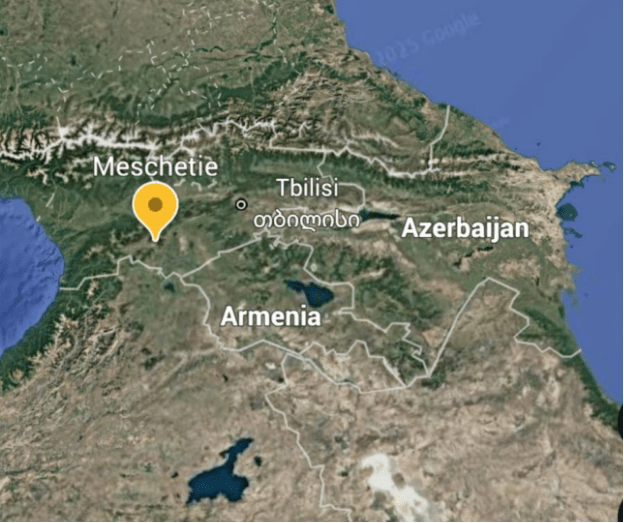
I’d like to start with analyzing the name for “Meshech”, for his name can be found in the Great Father of heroes, Meshkiangasher[1].  On the google map seen below, it is the Meskhi[2] group that we find to the left of Tbilisi (or ‘Tubal’ as mentioned in Ezekiel 38:2). As we below, “Meshetie” is the modern name of the 5,000 + year old province for the Meshech of Ezekiel

[14] https://fomcm.com/nimrods-name-found-in-gilgamesh-nimrods-descendant/ (cf to my audio lecture here on this hero’s name)

[15] cf. to Dr Anna Meskhi’s genealogical work: “The Unwritten History of the Meskhis”

38:2. Tbilisi is a sister city to Mes-chetie (Ezekiel 38:2’s Meshech).
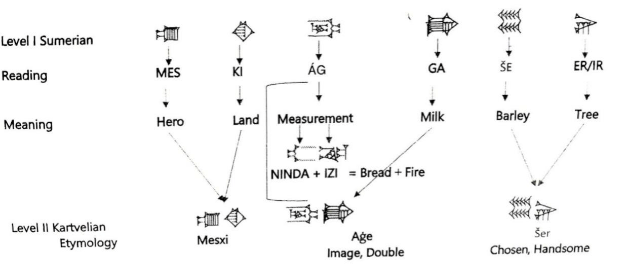
Seen above is Dr. Meshkhi’s “Bi-Logoraphic Code Structure of Meshiagasher’s Name” to show the *relationship* between Kartvelian/ Georgian and Sumerian Prior to the event of Babel, that is, when all the world was of one speech (Genesis 11:1). Dr. Simo Parpola has proven that Sumerian was genetically linked to Finnish, Uralic, Ugric, Hungarian, ——Dr. Meskhi and Dr. Martirosyan showed the links between Old Armenia/ Syunik and Old Georgian (one of the Kartivelian languages that are all linked) together as “one speech” a long time ago, i.e., 5,000 years ago. This supports Genesis 11:1’s “all of the earth[1] was of “one speech”.

In Dr. Meskhi’s Logographic chart seen above shows both of the sister cities (i.e., Tbilisi/ Tubal and Meshech to attack (under the Spirit of Gog revived) Israel in the latter Days[2].

The spirit of Antichrist is found in the name, “Mesh-ki-an-ga-sher” for it is the genealogical name for the Heros, especially that of Nimrod. Please listen to:  https://fomcm.com/nimrods-name-found-in-gilgamesh-nimrods-descendant for an exhaustive treatment to “The Hero’s Name”–i.e., Nimrod, the man of renown. For it tells you that the spirit of Nimrod is alive, he is prepared with Iran to attack Israel. Please watch the news concerning Israel, Russia, and Iran. I believe that these events are the catalyst to Ezekiel 38.

Concerning Ezekiel’s “Meshech” (or “Meskhi” [modern Meskheti]) name. Both “Meshech” and “Tubal” are found in Ezekiel 38:2 as the province-cities by which their “Chief” (or “Rosh[3]”) prince[4] named Gog to be found amongst the Colchian tribes of the Caucasus between the Euxine (Black) and Caspian Sea.

What we know of Tubal is quite a bit. Tubal is reckoned with Javan and Mesheck among the sons of Japeth (Genesis 10:2; I Chronicles 1:5).

Tubal and Meshech are both associated with bringing wealth from their merchandising with Tyre. Javan, Tubal and Meshech brought slaves and copper vessels to the Phoenician markets (Ezekiel 27:13). Tubal and Meshech are nations of the North (Ezekiel 37:15; 39:2). The great historian Josephus is his Antiquities i, 6, 1 identifies the descendants of Tubal with the Iberians (not Spaniards) which is a very ancient race located in a tract of land between the Caspian and Euxine (modern “Black Sea”) seas, which correspond to modern Georgia. Tubal and Meshech are called “Colchian” tribes. Many scholars hold that these Iberians were the genetic group from which the eastern and western Iberian group to have been a branch of. This Iberian group was from the Ural-Altaic-Mongolic-Turkic family (formerly called “Turanian” which is considered a ‘fallable’ title).

[16] that is, “erotz” or “land piece”. As was all of the “erotz” entirely flooded; all that could be accounted from observation with *limitation*. 

[17] Keep in mind, Ezekiel said this when Israel had been taken away by the Assyrians nearly 200 years prior to Ezekiel saying this. This prophecy needed Israel to be a reality in order for this prophecy to be valid. This is my point concerning teleology, predeterminism, and the apocalyptic view to make a ‘conjunction’ at every step of the way.

[18] “top”; “head”; “leader”; “peak”;

[19] Nasi-’rising mist’; ‘cloud’; ‘vapour’ { *as ruler-chief-tribal chief* }.

These two Colchian tribes (Mesh. and Tub.) are mentioned together in Herodotus: first, as forming part of the nineteenth Satrapy of the Persian empire (Herodotus iii, 94) and in Xerxes’s army under Ariomardus, the son of Darius (vii, 78).

The Hebrews called the Tibareni, the Tubal. These Colchian tribes (Mesh. and Tubal) have an exhaustive amount of history that I do not have the time or energy to display here, nonetheless, we have more than ample evidence that Meshech and Tubal are sister cities that did cohabitate in the Georgian region for which we can still see their names echoed from a distant past as the modern Tbilisi (Tubal) and Meskheti (Meshech). 

In Greek mythology, Colchis was the name of a region in the far southeast corner of the Black Sea which is modern day Georgian (XLK [guttural-rotex-guttural]) in which Georgia retains its etymological root. In Greek mythology (which carried much history), Colchis was the homeland of Medea and associated with Jason and the quest for the Golden Fleece.

Gog, the Land of Magog

Ezekiel 38

1 And the word of the LORD came unto me, saying, 2 Son of man, set thy face against Gog, the land of Magog, the chief prince of Meshech and Tubal, and prophesy against him, 3 And say, Thus saith the Lord GOD; Behold, I am against thee, O Gog, the chief prince of Meshech and Tubal: 4 and I will turn thee back, and put hooks into thy jaws, and I will bring thee forth, and all thine army, horses and horsemen, all of them clothed with all sorts of armour, even a great company with bucklers and shields, all of them handling swords: 5 Persia, Ethiopia, and Libya with them; all of them with shield and helmet: 6 Gomer, and all his bands; the house of Togarmah of the north quarters, and all his bands: and many people with thee.

7 Be thou prepared, and prepare for thyself, thou, and all thy company that are assembled unto thee, and be thou a guard unto them. 8 After many days thou shalt be visited: in the latter years thou shalt come into the land that is brought back from the sword, and is gathered out of many people, against the mountains of Israel, which have been always waste: but it is brought forth out of the nations, and they shall dwell safely all of them. 9 Thou shalt ascend and come like a storm, thou shalt be like a cloud to cover the land, thou, and all thy bands, and many people with thee.

10 Thus saith the Lord GOD; It shall also come to pass, that at the same time shall things come into thy mind, and thou shalt think an evil thought: 11 And thou shalt say, I will go up to the land of unwalled villages; I will go to them that are at rest, that dwell safely, all of them dwelling without walls, and having neither bars nor gates, 12 To take a spoil, and to take a prey; to turn thine hand upon the desolate places that are now inhabited, and upon the people that are gathered out of the nations, which have gotten cattle and goods, that dwell in the midst of the land. 13 Sheba, and Dedan, and the merchants of Tarshish, with all the young lions thereof, shall say unto thee, Art thou come to take a spoil? hast thou gathered thy company to take a prey? to carry away silver and gold, to take away cattle and goods, to take a great spoil?

14 Therefore, son of man, prophesy and say unto Gog, Thus saith the Lord GOD; In that day when my people of Israel dwelleth safely, shalt thou not know it? 15 And thou shalt come from thy place out of the north parts, thou, and many people with thee, all of them riding upon horses, a great company, and a mighty army: 16 And thou shalt come up against my people of Israel, as a cloud to cover the land; it shall be in the latter days, and I will bring thee against my land, that the heathen may know me, when I shall be sanctified in thee, O Gog, before their eyes.

17Thus saith the Lord GOD; Art thou he of whom I have spoken in old time by my servants the prophets of Israel, which prophesied in those days many years that I would bring thee against them? 18 And it shall come to pass at the same time when Gog shall come against the land of Israel, saith the Lord GOD, that my fury shall come up in my face. 19 For in my jealousy and in the fire of my wrath have I spoken, Surely in that day there shall be a great shaking in the land of Israel; 20 So that the fishes of the sea, and the fowls of the heaven, and the beasts of the field, and all creeping things that creep upon the earth, and all the men that are upon the face of the earth, shall shake *at my presence*[1], and the mountains shall be thrown down, and the steep places shall fall, and every wall shall fall to the ground. 21 And I will call for a sword against him throughout all my mountains, saith the Lord GOD: every man’s sword shall be against his brother. 22 And I will plead against him with pestilence and with blood; and I will rain upon him, and upon his bands, and upon the many people that are with him, an overflowing rain, and great hailstones, fire, and brimstone. 23Thus will I magnify myself, and sanctify myself; and I will be known in the eyes of many nations, and they shall know that I am the LORD.

*Region* of Gog: It appears that “Gog” means “Mountain”, i.e., the Caucasus (cf. to the Persian: koh, Ossetic[2] (ghogh = “mountain”. The Ossetic Koh-Kof was the “chief seat of

[20] Matthew 24:21 “Immediately after the tribulation of those days shall the sun be darkened, and the moon shall not give her light, and the stars shall fall from heaven, and the powers of the heavens shall be shaken: (30) And THEN shall appear the sign of the Son of man in Heaven and THEN shall all the tribes of the earth mourn, and they shall see the Son of man coming in the clouds of Heaven with power and great glory. (31) And  He shall send His angels with a great sound of a trumpet, and they shall gather together His elect from the four winds, from one end of Heaven to the other”. –Jesus–

[21] Spoken in the Caucasus region, primarily in North Ossetia-Alania (Russia) and South Ossetia (a disputed territory with Georgia). Ossetian is the only remaining branch of the Scythian-Sarmatian group of Iranian languages. There are two dialects of Ossetic: “Iron” and “Digor”.

the Scythians (or Magogites)” who were and will be again a barbarous warring tribe whose practice was to put hooks in the jaws of the leaders they conquered. The Hebrew etymom of this same word meant “roof”, “high”, “lofty”. The Arabic, “juju”, the heightened part of a ship; or the head figure that is placed on the prow of a ship. But Gog is more than just a figurative ‘mountain’, he was indeed known to be the “Rosh (Head)” prince of the warring tribes of the Scythians (or Tartar) in the Caucasus mountain range. 

Therefore, Gog is, for sure, revived as the “Chief” or “Rosh” Prince (Nasi) of the Caucasus region (The Magogites/ Magog) that will attack Israel in the last days.

I believe that “Rosh” is indeed one and the same as the Russian forces that will align with Iran (Persia) to attack Israel in the Last Days. We are already seeing this happen in its beginning stages. The Bible is reading like a current news article.

I will continue to cover more details of prophecy in future articles for https://fomcm.com.//  concerning prophecy, especially of the Medes, Persia and Togarmah, whose tribal identities mix with the Magogites/ Scythians under Gog.


 Sin and Hell *UNTO Salvation 

This is the expanded look at Job 14’s Proto-Sinaitic “Tsaror”. I believe this study will shed some light on the Scrolls of Final Judgment found in Revelation 5:1,3,4,7,9; 6:14; 10:9; . 

 Job 14:1, 14-ff. 

Job 14:1: “Man born of woman, Short-lived and sated with strife1” 

1 please refer to my video lecture: “Job and MacBeth – a comparative analysis” on my website: fomcom.com (in the video lecture section) “Man of Woman Born is a theme Shakespeare understood to mean “the fate of the flesh”. 2 

14 “If a man die, shall he live again2? all the days of my appointed time will I wait, till my change come3. 

15 Thou shalt call, and I will answer thee4: thou wilt have a desire to the work of thine hands5. 

16 For now thou numberest my steps: dost thou not watch over my sin6? 

17 My transgression is sealed up in a tsaror/bag7, and thou daubs/sewest8 up mine iniquity9. 

18 And surely the mountain falling cometh to nought, and the rock is removed out of his place. 

19 The waters wear the stones: thou washes away the things which grow out of the dust of the earth; and thou destroyest the hope of man.

2 i.e., “will a man live after he dies?”. 

3 i.e., after his death, he ‘waits’. He ‘waits’ in Sheol, as understood by the Jews and A.N.E. (ancient near east) thought among certain circles, later, the Jews. “Until my *redemption* comes”. To be changed from the ‘state’ of being in the ‘abode of the dead/ shadows’ is *redemption* to the A.N.E. God ‘believer’ an, later, the Jew. Cf. to Dr. Irving Finkel’s “Mesopotamian Ghosts”; Tur Sinai’s “The Book of Job”; Marvin Pope’s “Job “ (The Anchor Bible Commentary series. In verse 19, there is a grim maxim for the ‘state of man’. Job says in 14:19 “The waters wear the stones: thou washes away the things which grow out of the dust of the earth; and thou destroyest the hope of man”. But, this is the ‘state’ and ‘plight’ of mortal man. Many commentators do not account for the shade or soul of man not being of the “adama” or “soil, earth”). I believe this is a spectacular passage to the contrast of many commentators. A hope in an eternal soul to continue. 

4 the hope that God calls to us, that HE *acts* upon us.

5 a continued thought to the first part of this verse: Thou *Acts* upon me and *Does* the works of His Hands. Again, God is acting and doing upon us, ←-i.e., “us” = those who are already in “the Shadows” of sin, death, remorse, iniquity, hell. 

6 As Tur Sinai says, ‘this is not affectionate watching’ – Satan was the ‘watcher’ – Hebrew: “m-SHT” – the “rover/ satan/purger/challenger/rogue/ etc.”. In Zechariah 4:10 we have the “eyes of the Lord” as “m-SHT”, or, the “satan” of the Lord, the roving watcher. Cf. to 2 Chronicles 16:9; Jeremiah 16:17; and Hebrews 4:13 as well. Job’s *sin* is not overlooked but as we shall see, Job is in the next verse alluding to not just Job’s gift of grace from God but mankind’s gift. 

7 Tsaror- “sealed up/ tied up document”. This mentioning, by Tur Sinai’s words, meant a document of the living (cf. 1 Sam. 25:29: “but the soul of my lord shall be tied up in the *tsaror* of the living”. That is, in this book, the Tsaror of Job, the Tsaror was tied up and contained the names of all living persons who were inscribed. Cf. Ps. 139:16: “his days are tied up (in the Tsaror) and none can be added”. 

8 “thou sewest = “daub; daubest; seal” over my iniquities”. 

9 (a)Here we see the contrast of judgment unto the ‘cutting off’ or “sheol” to the Salvation imbued us all through the Tsaror. “My transgression/ (and iniquity) (pishiy) is “sealed up (chatum)” in a “bag (tsaror)”/ You cover (wat-tit-pol) my iniquity (a’woniy). (b) This is, I believe, stated to contrast the fate of ‘mortal man’ with that of universally sanctified man as an eternal being, and not mortal. 

10 as I stated: the plight of mortal man, “fatalism”, ‘fate, fatality, the ‘end result of mortality’. Nature is determined to be destroyed as we know it. 

20 Thou prevailest for ever against him, and he passeth: thou changest his countenance, and sendest him away (refer to footnote 9b) 

If I may use Job as a perfect example of the two separate forms of belief :The “nature” of the Illusory Doctrines of ‘determinism’ as a replacement theology for Predeterminism 

In Job 3:3, we find the ‘nature religion’ of the Fates and their illusory doctrines of fate as called upon by Job through his newly ‘gifted’ worldview. Though the “Fates” did not exist in Job’s day, as they do in Norse mythology, it was a ‘natural default’ to become fatalistic when one’s belief in the Sovereignty of God is dismissed. 

If I may turn my explanation to an interpretation of the storyline of Job for a moment: *God places Job in “Abad (Hebrew: Abaddon: “place of perishing”)” without dying. In a sense, Job is a journalist placed into the world of nonsense (a place of ‘no-signage’; ‘no-significance’) which generates an infinite regress (one action leading to another without resolve or significance). This “Abad” (place of no ‘signaling’) takes its toll upon Job’s critical thinking and emotional well being. Nonetheless, Job remains consistently truthful to his ‘report’ within his shadow logic. 

I do share Job’s sentiments as I did with my parent’s failing health. How would you like to be judged as ‘evil’ by actions out of your control such as schizophrenia, bi-polar disorder, manic-depression, borderline personality disorder, –or, the natural deterioration of one’s well being such as Alzheimers, etc.? A concluding question arises out of these afflictions, namely: if these are not meaningless afflictions then they must be meaningful. Then, the question arises: what is meaningful? 

To me, maybe to you, a dog cannot ‘choose’ to purr like a kitten, gibber like an ape, chut like a guinea pig or whinny like a zebra by its nature. A dog, by the *limitations* of its nature, does ‘act’ to bark. In this ‘act’ to bark there is honesty/ integrity to the ‘integral’ function of what “dog”, as verb and noun “means” and “does”. Therefore, there is no sin accrued to the account of the dog. 

From my take on Job’s case, I do not see that Job has sinned in his newly found *limitations*. He ‘acts’ from the limitations of his nature”. Job acts within the integrity of his beset delusion. 

I believe that the DARK honesty spoken through Job’s mouth was from the “moors” or heathen field of Satan’s limited voice. Consistently, I witness throughout the dialogues of Satan in the Bible the laws of limitation, hence, the dark “moors” by which he must travail upon. 

Being somewhat of a cult classic Horror film fan, I’m always fascinated by my favorite ‘monster’, the Wolfman. In many of the traditional ‘takes’ on the original idea of the Wolfman we have gypsies who carry ancient knowledge of such an occult being as the Wolfman. In one of my favorite cult classics, “An American Werewolf in London”, though no gypsies, the bar keep and patrons of the bar called “The Slaughtered Lamb” tell Jack and David (two American college students who are travelling through England by foot) to stay off the Moors, travel on the path away from the Moors. The “Slaughtered Lamb” has somewhat of an allusion to the ‘safe house’ for the patrons felt safe there from the Wolfman. Grendel in Beowulf was known for being a “moor walker”. Though, we know that the relationship of Satan to God and to others is not a necessary constant in memorialized Heathen Literature – or movies, comic books, etc.. Though, the “Monster”, etymologically speaking, comes from the Latin “monstrum” which means a “Divine Omen”. Yet deeper than the Latin, monstrum, we are given in the Proto Indo European the word “ *moneie – “ which means, “to be mindful of, admonish, advise, warn, instruct, teach, to think about —[zero grade: p.i.e. : *men – “to think”. Interestingly, the Anglo Saxon gives us the ‘’monster” – as “aeg-laec” – “ugly”. Grendel was a moor walker (Anglo-Saxon: “mearc-stapa”—> “moor wanderer” —’’going to and fro on uncultivated ground/ heath [ Beowulf: line 103] ). Grendel traversed the moors, especially the rim of the moors, the ‘bounds that enclose’ the moors. I say, away-laec’s playground/ lair”. 

Job 3:3-5 (vs. 3) “Damn the Day I was born 

The night that said, ‘a boy 

was begot’ 

(vs. 4) That Day -let it be darkness. 

God above ignore it. 

No light break upon it 

(vs. 5) Darkness and gloom claim *it*, 

Cloud settle over it 

Eclipse terrify it 

In Job 3:3, Job says, “damn *The Day*”. In the Hebrew text of Job 3:3 – we read: “ya-abad-yom” {Qal imperfect – “let perish the Day”} 

In this statement, Job assigns no Deity to Damn the Day in the Hebrew. 

SO, I ask the question: by what “agency” is Job referring to? That is, who would “Damn the Day”? 

The Integrity of error 

Job declines from his sound doctrinal stance with God yet does not sin–because he is still saying the truth from the perspective of his worldview. That is, Job is consistently honest with his new participation inside Shadow Logic. 

The MISS 

Job spoke for AGONY as though it was Reason. Still, in Job’s Shadow Logic, Job never attributed power or causality to another Deity other than YHVH. Even in the words of Job’s Shadow Logic, Job reasoned the “impossibility” of another Deity other than YHVH. Though, constantly not mentioning YHVH, the spoken words from Shadow Logic seemed to ‘give way’ to YHVH. That is, Job’s words were shown to be governed by a specified ‘blindness’ of THE CAUSAL AGENCY —( God blinds, gives sight, gives reason, takes reason away, etc.) first seen in Job 3:3 as Job’s failure to assign in “Damning the Day”. To me, this failure to assign causality was a painfully obvious “aporia (irresolvable internal contradiction or logical disjunction in a theory)” – if applied to the illusory doctrines of fatalism that leads to nihilism. 

Again, Fate cannot hold the title of non-agency of causality and then acclaim “causality”. Fates are meaningless by their definition—a bios, a current, an effect. Nature and Fate might be equitive terms. 

Recalling the interview with Joseph Campbell and Bill Moyers. Joseph, one of the world’s highest acclaimed mythologist, was asked by Bill Moyers: “Joseph, knowing all that you know, travelling to hundreds of remote villages, countries, islands, etc..and studying their languages, religions, beliefs taboos, etc….What have you personally concluded to be meaning of Life?” … Joseph answered: “There is no meaning to life”. Bill Moyers, being a good natured and very liberal ordained Baptist minister said, “this is ludicrous!” “You mean to tell me that in all the knowledge you have acquired you have concluded this?” 

Lol. If I may take over here… Knowing all of Joseph’s works, Joseph was saying with my paraphrase included: ‘meaning is derived from what is meaningful…the chess board is Life –that is, the board of laws, rules, –how nature works. We, the people on the board, are the pieces by which our degrees are respectively played out on the board of rules. This is still not meaning as of yet. Meaning comes from the INTENT by the INTENDER who plays both sides and signifies ITS authority by the intangible act upon the tangible board as Magistrate. 

Job’s actions thus so far have led me to conclude that Job was arrested with what I will call, Shadow Logic. 

Job, the Mythologer 

“Damn the Day I was born 

The night that said, ‘a boy 

was begot’ 

(vs. 4) That Day -let it be darkness. 

God above ignore it. 

No light break upon it 

(vs. 5) Darkness and gloom claim *it*, 

Cloud settle over it 

Eclipse terrify it 

The convolution of commanding particular elements of creation to ACT or FATE– which in Job’s abandoned worldview were all under God’s Sovereign rule– even deny the doctrines of old world Heathenism which give the Fates power over the gods by: 

a) using nonce intermediary compliant forces to “damn” the Day at first 

b) Tells God to “ignore” it (the only time Job refers to God in his delusion) 

c) assuming that he, Job, is in command to speak into existence ‘a reality’ that Reality might be subsumed

Job hides himself from God in the illusory doctrines of fatalism via a ‘doctrine of Shadows’ and not a Reality 

Job’s damns the Day that ‘a boy ( Job ) is begot’ and subscribes to this *Fate* as *Day*/ Day as Fate. 

* I might add here to the “HORROR” of this statement by my hypothesis: I believe that Satan was (seen, heard, felt) as 

a) an ‘objective (seen, heard, experienced in the physical world) literary mechanism’ which talked to YHVH in the first two chapters 

b) the words of Job’s wife’s mouth: “Curse God and Die (for your loss)”. 

c) a Prophet of Shadows for “The Satan’s own demise – does Job not have the very words of Portent or Prophecy from the Devil’s perspective?!? —-Such a Miltonian theme here!! — “Damn the NIGHT that a Boy (JESUS CHRIST) was begotten”. Moreover!–A pre-Mosaic-Mesopotamian which held a SATANIC prophecy of the Christ to come!!! 

have only seen Christ typologies in Job. Job was righteous in all of his ways. The Lex Talionis/ Codex Hammurabi was a law code that would have been stated here during Job’s lifetime had there been an infraction of the law by Job. Yet, no infraction. Job was clean, pure, above the law of retribution … .and still, God caused the calamity upon Job (as accepted in Job 1 and 2 as coming from GOD’s causal act. Job was not indebted to the law but a keeper of the law. Job was stated as righteous in this way which answers to the later false claims of his ‘friends’ who ‘comfort-indicted’ him as having done something to incur a punishment from God. We will find that “THE SATAN” is the one, in his jurisdiction, to act in speech through these “friends”. In the flesh, Job, we will find, was in hell for a few days, ‘cut off from God’ via the beliefs of fatalism, infinite regress, dualism, doctrines of rogue agency-free will, and retributive ideas that have NOTHING to do with Grace. 

Job has not sinned here in his Sheol, or Hell. He is speaking from Sheol with the words of “THE SATAN” —-as did Peter, the Cornerstone of the True Christian Church. 

Even Peter was called, “Satan”, when Peter told Jesus that Jesus wouldn’t “suffer unto death (*THE CUP*). 

Did EVEN JESUS as His Father in the Garden of Gethsemane to “let this CUP pass—none the less, Your WILL will be done!” 

In all of that, Jesus did not sin, regardless of the words of dismissing the CUP unto death. Both Peter and Jesus said words that would have alleviated pain, suffering, death, CALAMITY to ‘have passed’. Peter held to the uncommitted and unfounded Prophecy that substantiates The MESSIAH as Jesus. To deny THIS Death is to deny Jesus for Who He was and IS. 

Job 3:4 – “That *Day*–let it be darkness, God above ignore it (Sheol – out of sight) No light break upon it (–also, “it” is ‘the Fated *Day*- fates supervening fates implied under the speech of “the Shadows” of dark allotments/ doom/ —as Tolkien might say, “in the Land of Mordor where the Shadows lie”) 

Job 3:5 -Darkness (as *Fate*) and *Gloom* (as *Fate*) claim it, Cloud (as *Fate*) settle over it Job uses a ½ antemetabole {antemetabole – example: “foul is fair and fair is foul” MacBeth’s Witches usage of “reversio” and “antemetabole” (cf. bottom for glossary). 

The brilliance I see via usage of the literary mechanism employed in Job is what we call, “Antemetabole” (cf “reversio” as a usual by-product of “antemetabole” in writings such as MacBeth meaning “all things being reversed”, is that there is no “reversed” mechanism found as in MacBeth’s “Fates”— 

There is a dark-brilliance (that we are both controlled by and are not controlled by, 

as is the spirit of “the whore of Babylon” and her ‘train’ or spirit which corrupted the peoples of the world–that she was, is not and will be. A geist of ‘effect’–as the hand of God rather than a substantial objective reality. I remember reading one of my all time favorite pagan poets, Robert Graves, in college (as I should have been studying my chemistry) — who, in my periphrastic attempt to quote him in his work, “White Goddess”, (referring to Revelation 17: – ff) “ ‘She’, the ‘whore’ as the Christians call her, is to be venerated by me. Her life force drives my passions, my life force, my life… it is SHE that corrupted the Christians from their beginnings, naturally, as is mentioned in Revelation. Is SHE, therefore, to be dismissed as illusion?! –if she is, then, the Christians are delusional and exist upon a counterfeit war with “HER” in a counterfeit belief! Such a religion the Jews and Christians have shared from her days of antiquity into the Common era. These religions have made up yet another sacrifice to hate and kill”. 

I confess that I added here the spirit of Robert Graves that I know through my eyes when I was a Heathen-Christian. You must understand the ‘other side’ of things. You must have the ‘full plate’ without fear before coming to a fuller thought. 

I believe that this “life force-goddess” was the goddess worshipped as a Sovereign life giver. This theme, found in the words of Job’s wife, resonates with me. She told Job to basically condemn the god that wouldn’t give life. BUT, you see—this very ‘belief’, not sound in doctrine, is not sound for this very reason: The goddess cannot be Sovereign if “Death” is out of Her hands. If she ONLY ‘gives life’, ‘abundance’, ‘wealth’, allotments, etc… she cannot be ‘known’ as the giver and taker away of these things. THIS is the very statement of Job concerning “THE GOD” who takes away and gives. Simply put, which “Deity” would be more Sovereign – as “Sovereign” SHOULD BE defined? 

found in Job chapter 3Job’s new statement of shadow belief never ‘looks’ at the GOD for whom Job cannot employ in 

—hence, ‘the circle’. Job is IN the circle of Ouroboros (‘snake eating its own tail–rebirthing after its own cannibalization, repeating the ‘cycle’) 

Job “blames” the “nothingness” for his “Plight” – Job attributes “power” to ‘nothing that is’ —the exact opposite of what God teaches Job later: God created the evil and sent the evil to Job to purify and bless him – cf. Job 42:11-17. 

I found 7 points within the Field of Job’s ‘fatalism’ which led to infinite regression/ nihilism: 

1) Job’s attribution to “the plight” as a ‘replacement Theology’ for Job’s past beliefs and doctrine within God’s Sovereign Intent. This ‘replacement Theology’ is laden with inconsistent and antithetical motifs to an Intentful Sovereign God. These inconsistent and antithetical motifs verify their own laws of ‘infinite regress’ 

2) “Plight” is a nonsense word- or “nonce” word as a ‘false signal’ 

3) The “Bru-ha-ha” of war/ devastation/ riot/ eats its own tail only to return again 

4) There is no ‘direction’ other than reaction and muddled self referencing (equivocation). 

5) The ‘field of fatalism’ is the board of no rule containment; the field of fatalism is without loving Intent; the field of fatalism is the field of ‘blankets’ of allotments to debts which are deaths. The field of Fatalism is the field by which the only signals there are are the signs leading to your death. The field of Fatalism’s ‘belief’ is limited and finite: ‘hold on to your goods, riches, stuff and things UNTIL *that DAY* by which “fate” came upon you and signals all things to–i.e., your Death; your debt. 

6) A failed “theodicy” is an invention to believe that God is placed within the field of Bru-ha ha/ –a land of no signals, a land of “evil” – where God has NO part to take from this ‘field of evil’, ‘field of calamity’. As an example: many ‘nicer’ christianties try to implement various theodicies to argue out God’s responsibility of any evil in this world —moral or physical. Such thinking leads inevitably to ‘dualism’ 

7) God’s INTENT is taken out of the illusory belief in Job’s archaic Theodicy, because Job only address ‘calamity’ as ‘evil’ and ‘evil’ as ‘plight’ and ‘the Day’ as the bringer of the ‘plight’ and the Day to be darkened out and ‘not have ever been’. This is Nihilism. Nihilism, in fact, is the result of infinite regressive thinking—-though, an infinite regressive wouldn’t tell you that, initially :). 

I propose that the lessons learned from the book of Job are as follows: 

The Fall of our Nation is based upon the syncretic notion of pagan autonomous “Free Will” within the Church. 

This syncretic practice both extols both the Church and the flesh –defaming both 

The “Story” of Job was not a Heathen one but the explanation of the condition of the natural man as a believer in YHVH who MUST BE PURGED by a satan. 

The Sumerian contemporary and possible Eblaite story of the man Job built us a foundation from which we have hope to rise from. 

The distinction is vast between modern Christian belief and the story of Job’s relationship with the pre-Mosaic understanding of YHVH’s expression as found in the Narrative of Job. 

The blame is not upon the satan in Job. This is not so in much of modern thinking, especially that of modern Christians. 

Job’s story is about the purging of Job, let’s say, “Job in hell” —if only for a moment to observe the best of us in hell 

THEREFORE 

Job’s recap via formula might go as follows: 

Job chapters 1 and 2 Antagonist ( “the Satan”) > Antagonist is subsumed as the ‘Will of God’ – that is: God creates Good and Calamity > Job’s wife’s words denote her following a Satanic alliance- i.e., “the doctrine of Dao-mne” as what we find in the Early European and Greek meaning “to distribute fortunes”. Therefore, loss of gain is the negation of good > Job acts as a prophet of God’s Divine Will by what Job does not/ cannot say–being that Job is “fixed” to fatalism, nihilism, infinite regress” of ‘negation’ of Divine Will >Job, as the voice of Satan, still prophesied the “boy begotten” as a cursed Day within the context of Nihilism’s rule-THIS, is possibly the Satanic Prophecy of the coming of the Messiah and the Despair of Nihilism’s rule> ‘half antemetabole’ used: “THE DAY – LET IT BE DARKNESS —” is not completed to say, “ The Day – let it be darkness and Darkness, let it be Day” – Job doesn’t say, “tables turned” in this..what Job is saying is: “let the Light be Black” and nothing else. Let the Darkness rule and no light be used. This tells me that Job is not sinning, that he is only seeing Creation without God and the justification that there can’t be an employed “SENSE, PRIMA CAUSE, INTENT, RESOLVE, etc. 

*To know what something is – is to know what it is not*

-k.j.-

PREFACE

The Greek word for “time segment”, or, Aionios was contrasted with Adios – meaning “infinity”. These two terms were used throughout Homeric times down to the 1st century A.D. Christian Church. As we introduce the term “Adion” for infinity in this lecture piece we will see what Aeon is not.

I will be clear: Aeon, meaning “a segment of time”, “an era”, “an eon”, “an age” and “a limited/unknown ‘finite time”, was employed by the Biblical writer, John, in his Revelation – or, “Apocalypse”, for the usage of Hell within its “aeon of purpose”. Moreover, the “ontology” or “coming to be” of ‘an age’ of ‘being a sinful human’ requires AN aeon or “era” of hell to refine them to God; this intimates ‘direction’, therefore, INTENT of a GOD to create a passageway by which we will be refined, ready, and reserved for the final destination, i.e., UNION with GOD.

We, therefore look at our part 4 focusing on the ‘’vocabulary bank’’ by which the New Testament used its terms for Eternity, Perpetuity, Eons, Ages, and infinitude.

Parts 1-3 covered Aeon in all of its forms. We conclude that “Aeon” was used as an *finite undefined time segment*.

Our next focus is Adios (Adion). Since we have seen by its usage that Aeon is not an ‘unending’ term we therefore look to Adios.

We continue to go to the archaic authors of the Greek and Hellenized world to see that ‘Aidios’ was socially normalized in its usage. Again, words are used in their participation of the figuration of a culture. I reiterate from my past 3 lectures that the beginning New Testament community (ca 30 A.D.) had its rich linguistic heritage spanning at least 800 years, if not more, from the Classical Greek authors.

Examples of TIME: ETERNITY Adios and Chronos working together

Time (1)
One of the earliest cultural usages and accounts of Adios is found in Homer’s “Hymn to Hestia” (ca. 800 B.C.). Here, the ‘goddess resides on a throne’ with mortals. This, by context alone, should give us ample information to see that there is a kind of “time” that can ‘participate’ in this “throne realm” but is separate from….for …if mortality exists there, then ‘mortality’ requires sequential time or “chronos”—which is separate and distinguished from Aidion as we shall see.

Chronos is neither subsumed or supervened by Adios at this aforementioned juncture, rather, they (Chronos and Adios) share their ‘attributes’ at certain juncture points for a fuller gestalt of meaning. That is, time and eternity (chronos and Aidios) are ‘conjunctive’ as ‘time’ meets the eternal…or, relating to mortals → **the epiphanal**.

We see Hestia, the Goddess of the *Hearth/ Throne* sitting at her ‘permanent seat’….”edren aidion elaxes”. Such as ‘seat/ throne’ is the hearth at the fireplace. It is where the family convened to talk, eat, share, cook, stay warm, associate with HOME. Hestia, was considered LOVE, THE BELOVED…and, in this Maiden Housekeeper sense, she was Divinely Eternal Without End. Hestia was called, “She of the Public Hearth”. So, there is a sharing of the “time” of mortality and this AIDION throne. This is no more contradictory than when the Eternal God of the Bible talks with the Patriarchs, Matriarchs and Prophets. How About the answerable Platonic idea of “coming to be” to the FULLNESS of the UNIVERSAL found in the very NATURE of JESUS CHRIST ‘coming to HIS FULLNESS?!? I.e., When the UNIVERSAL meets the Particulars. The “participation” by which the gods, Gods act involves such a confluence of different “times”.

Time (2)
We find Aidios inscribed in Hesiod’s “Shield of Hercules” saying, “‘aidion eixon ponon”. This means that no one side can win in this athletic competition. It states the ‘stasis’ by which movability cannot be achieved, therefore, ‘without end’ —–in the duration of the game. But here’s the catch: it is in the ‘picture’ of stasis without resolution. This depiction fires on the mind a never ending battle for glory without resolve….a state of being…a longsuffering of worldly effort…the battle of the EPOS (‘epic ones’) or “eroes” (“heros”).

Time (3)
Anaximander’s ( A.NAX’.uh.MAN.der) Greek says, “Tayn Aidion Kinaysin” —i.e., “The Aidion is perpetual movement”, —-therefore, Aidion shows no retirement of motion, hence, no *aging*.

Time (4)
Anaximenes (A.NAXIMENEEZ) says,”Kinaysin de kai hootos aidion poiei” as to agree with Anaximander.

Time (5)
Anaximander went on to say, “There is a certain NATURE of the infinite” – “phusin tina tou apeirou” – “and that this NATURE is ETERNAL and UNAGING” – “Aidion ein kai a.gayro {“a” = “not” + gayro’ – aging/ i.e., ‘geriatric’}”.

Time (6)
Xenophanes (XSE.NAH’.fa.neez) attests Adios as “indestructable”, immortal, and ungenerated (i.e., uncreated). Xenophanes uses Adios in contrast to anything that is “coming to be” —or “generated”. To conclude Xenophanes: anything that segways to the next event is not Adios.

Time (7)
Diogenes (DIE-AH.jeh.neez) Laertius (Lay.er.ti.uhs) simply agreed with Xenophanes here.

Time (8)
Anaxagoras agreed with Aristotle that “Adios” is ‘without end’

Time (9)
Heraclitus says, “Adios is perpetual motion of things without end”. These “Things” therfore do not share in the attributes of Aeones.

Time (10)
Empedocles says, “There is a “THING OF NECESSITY”, an ancient DECREE of *gods ETERNAL*—- i.e., “Anankayce Krayma Theon Psaypheesma Palaion Aidion”. Conclusively brilliant, Empedocles continues to his conclusion that Aidion is “spherical, eternal, and immobile” – i.e., “Sphairo-eides Kai Aidion Kai Akin-ay-ton To Hen”.

Time (11)
Parmenides used the term Aidion to mean “ALL” in the sense of “ALL that will always be…ALL that is ungenerated and imperishable”.

Time (12)
Simplicius says, “nothing that has a beginning and end is Aidion”

*Time (13)
For me, maybe the most important statement was from Metrodorus of Chios who stated, “The ALL (TO’ PAN) is Eternal (AIDION), Because, If It Came Into Being At A Certain Moment, It Would Come To Be From Non-Being; And It Is Unlimited (Apeiron) Inasmuch As It Is Eternal: For It Does Not Have A Principle (Archay) From Which It Began, Nor A Limit (PERAS) Or An End (TELEUTAY)”.

For today I will end our section on the usage of Aidion in Greek Antiquity.

Thank you, Kyle Jones


Post Statement and Recap

Our job at fomcm.com is to search for historically overlooked material that substantiates the Bible to the regard that it should be given.

Often, the Westerm “orthodox approach” ‘limits’ the purview of the authentic linguistic content, a.k.a., “Message” of God’s Word by *Westernisms* or recognizable ideas that fit into ‘our sense’ of our Orthodox god. Sadly, the robbery is by and to the ‘church’ by which its failures are founded upon limitations of Eastern Understanding of the Biblical Text. One limitation after the next, always trying to ‘keep up’ with the ever reducing idea of the ‘so called biblical text’ which is currently founded upon man-made notions of God.

Fear is the engine by which ‘an orthodoxy’ fights not repent. Scientists have to secularly ‘repent’ when they find something that counters and finally disproves an older thesis–which becomes no-more-scientific…but simply, WRONG….. . Likewise, Theology SHOULD contain the same humility within their “orthodoxies” —as I speak ‘tongue and cheek’. And again, once there has been grounds for challenging the English Text of King James…one should be allowed to find answers to countertheses via an orthodox ‘council’ without agenda. It is here that I make mention of “rhetors” from the Paideia of the class Trivium.

I speak of “rhetors” in the classical sense by which the first grade of learning Greek and Latin language began the Trivium’s rite of passage to academic bliss. Then, from Language to logic. Finally, argumention (or rhetors) was taught by the very wise secular Greek and Hellenized Christian mothers of the first and second centuries.

These 3 phases (language, logic and rhetors) of the Trivium ( by which the educated Greek class lived) led facets of Greek culture to be strung together with respect and congruity of thought……and not as brute beast ‘authoritarians’ who ‘brawl’ over ideas for dominance and not truth. I need not discuss the brutal nature of this approach in today’s world.

In contrast to this last mentioned civil unrest…. the Paidea of the Greek’s Trivium created learned scholiasts of the Biblical Text to find their ‘senses’ in historical comparitive hermeneutics, Biblical Greek analysis and parsing of the stems of Greek Grammar, socially-contextualizing and examining the socio-linguistic understanding by which the geographical ‘neighbors’ of the Palestinian Jews and Christians understood their God. THIS IS of the Hebrews and New Testament Christ, and, finally, exegete the Biblical Textus Receptus or “Received Authoritative Greek and Hebrew Bible”—as well as the LXX or Septuagent, i.e., the Greek Old Testament by which we have transferable Greek terms with Hebrew.

Finally, fomcm.com gathers writers of Greek pagan antiquity to show that the ‘vocabulary bank’ of the New Testament was not out of a ‘vaccum’. Rather, the Greek New Testament used the Greek language that the ENTIRE Greek world had been baptized in, saturated, steeped in since the inception of Greek culture. This is nothing to overlook, and yet, the Western American Orthodox Church has somehow or another concluded to not deem it important to know what the New Testament REALLY WAS SAYING IN THEIR DAY, THEIR CULTURAL CONTEXT, THEIR SEMIOTIC AGREEMENT, THEIR SLANG, THEIR WAY OF SAYING THINGS, IDIOMS,

DIALECTS, etc…. I hear from western ‘authorities’ of the ‘orthodox churches’ saying that “devotion is over theology”. You can’t ‘devote’ to something ill-defined. Why fear exegeting while ‘working on your *devotion*?’. *What IF, ….the “MATHETIKON” (in the Greek) meant “TOTAL DEVOTEE” to the LOGOS or Christ as He spoke on Earth?!!—Well, it does! Lastly, I say….”if you *know* the God you serve then you will serve HIM correctly; otherwise, there will be a false sense by which you relate to the WORDS that HE has spoken and YOU have so neglectfully handled in your isoglossed cultural *SENSE* of “”devotion””.

RECAP

Remember, “Indefinite time” does not have to mean “infinity”, though it could. The WAY in which Aeon and Aidion were used as ‘indefinite times’ were poetically and philosophically expressed a complimentary union of ideas.

Such poetical employment of words could be used to create the seemingly “irrational” mental state of either the poet or the characters by which participate. Therefore, subsuming the ‘rational’ for a beautiful alien ‘irrationality’, if conveyed by the poet correctly, could arrest one’s senses and lure one’s self out of the lust, greed, covet, anger world.

This “irrationality” created words fit for philosophical treatise for the words has concretized into ‘meaning’ and a correlative ‘semiotic commitment’. Hence, the mathematician-philosophers had a ground to work from.

It is not so strange to look at a word complex if we understand ‘pictographic societies’ as our ancestral origins. Herein lies the genius of the Greeks that was not so different, if not related, to the pictographic societies of the Egyptians, Sumerians and the Original Ancient Hebrew pictographic texts of the Pre-Sinaitic Israelites. Such ‘radicals’ as “fire, serpent, toxic, 6 wings, etc.” did indeed mean the “Seraph” or angels that flew with the temple of God in HIS ETERNAL “Train” or Verb of Perpetual – unending Motion through and into this “temporal state”. This is the “Parousia”, per se, of the Old Testament God who condescends to us.

Nonetheless, the force of each archaic Greek word was known by a millennia of usage for the exact purpose to specify categories of thought, therefore, distinguishing one term FROM the other.

The richness of Greek vocabulary is found in how one word can dance around the other, never stepping on the other’s semiotic ‘toes’ —- only reinforcing the other’s role, creating a union of ideas and images due to the strength and value the Greeks held to word care.

To paraphrase Edward Gibbon, the author of the Decline of the Roman empire, “Empires Fall when the study, usage, retention, and guarding of their language is no longer preserved. Double entendres, business-speak, cultural popular slang, etc. are the beginnings of this sorrow”.

Part One:

One could safely say that until the past century, especially at the point of understanding Einstein’s equation E=mc2 , “time” was relatively not understood. Moreover, the Universe was not understood as to how it worked. To the ancient Israelites, “spatiality” was expressed in “rwb” or cubes, more or less, those simple concepts that “measured” objects *relatable* to the purview of the ancient participant.

 “Limitationsto particular analysis of distance and time can also create a ‘genius’ or ‘collective sense’ by which the participant of observation makes sense out of. The earth might have been seen as ‘round’ but as a globe probably not. Therefore, to the ‘primitive’ genius, the ‘water-course’ of the seas circled’ the flat-circular earth. It is within these waterways that our primitive-genius ancestors find the lore, of sorts, that “Leviathan” swims his course round the earth. What a great story to tell your children when not wanting them to get too close to the water!

Though their skill set is ‘limited’, the ‘tribal collective’ sense was non analytically consistent.

Spatiality” was time and time was the space or distance travelled. Examples might be: “to the top of the mountain from here”, “where the land meets the ocean”, “the darkness created by the depth of an abyss”, “the unseen in the darkness of the waters”, etc. With this in mind, “relatable” objects such as the horizon (i.e. sky touching earth) would have been used to express *where* heaven meets the earth (Hebrew: “Olam”), hence, “eternitywas a ‘spatial understanding’ in that the earth stopped accounting for spatiality, or more simply put, the ancient Jewish Semites did not have enough ‘mental *rwb* by which to implement measurement. The *when* would have been *where* the distance met its end. Though these are simple concepts to us the ancient Israelites only had a few tools of conception by which they operated. Might I add here that “sky” was not a concept yet, only “heaven” or the “abode” of that which is above earth. Though simplistic, literal, and naturalistic, these particulars added to the collective consciousness of the early Israelite tribe to make ‘sense’ of Heaven, God, cutting off point, Holy, etc. These are human’s tools masterfully created by YHVH to set the groundwork for HIS evolving “meta-language” and unfurling relationship with not just Israel but the world. 

Permanence”

These were “permanentideas that the ancient Israelites held to. That is, ‘permanence’ being the groundwork that all other parts of the structure of the ‘house’ are built to their ‘abstraction’, or “off-from-structure. Furthermore, any ‘structure’ built from the foundation is technically/ linguistically an ‘abstraction’ ‘from the foundation we build off of’. These permanent ideas established our pagan heritage by which we exist today in abstraction. I shouldn’t have shocked you to say “pagan” ideas since it is the Jew that held to them. But I said what I said. The ancient Israelites were “coming out  (‘coming off/ from’ – ‘abstracting’)” of very naturalistic pastoralist and agricultural views. If there were ‘revelations’ from God they were His Revelations and not our ancestor’s nor His Holy Writ…rather, cultural participation and ‘reaching’ for the eternal through limitations, did our ancestors use as tools to ‘divine’ and see the Divine.

 The ancient Jews were being ‘pulled out’ of necessary primitive participations. The entire Bible is an account of ‘being pulled out of’ the primacy by which they were launched necessarily. This cannot be fully understood, in my opinion, unless “Intent” of a Sovereign and Omniscient God did not Predestinate a collective Gestalt for all of humanity to come to the fullness of Reason in due time. Answerably, “Divine Intent” would reasonably implement two elements that necessitate one another: Permanence and Eternity (I Declare the End from the Beginning – Isaiah 46:10). Permanence and Eternity are therefore two distinguished terms. One is necessary to carry the other one. If these placements of permanence and trajectories of eternity are rogue-random events there is no sense for the natural human to ‘evolve’ to higher means.  A trajectory needs a point of fixity, reason, obedience to the ‘will’ or ‘boule’ of the mathematical laws set to find the arrow’s “fixity” at its INTENDED point of landing, i.e. the “Bulls-eye” or “boulesthai”. The ontology, or being, of something can be observed in the motions it has taken from a permanent fixture, a starting point. 

 These primitive views were literal views, concrete views, natural views, and they set the precedent. This means the ‘first’ or ‘prime’ views established the permanent foundation. They were base or first. They were foundational but they were not stupid.

Another example of culturally participative – yet, ‘primitive’ (I say “primitive-genius {prime -joining}”) understanding: the sun was the roving eye of God searching the hearts of humankind and scanning the actions of humankind as it appeared in the sky or heavens where God abided. Hence the Proto Indo European, Sanskrit, Avestan, Armenian held roughly the same root name: “dyaus”— from where we later received dei, dea, deity, theos, zeus, etc. So, “day” and “deity” and “eye” were all from such a source. It is from earlier pictographic societies such as the Proto-Syunik (Proto-Ararat/ Proto Armenian/) that give us pictographs/ logograms that predate and absolutely determined the Sumerian pictographs as their *source*. The Proto Syunik/ Syunik pictographs ‘collectively’ had the ‘circle’ drawn as the Sun = Son = God. Such a glyph found on the hills of Ararat was found to have various drawings inside this circle. Such circles were referred to a white tablet or tablet by which ‘events’ inside of ‘god/ God’/ the Sun-Son God roved across the sky. The ‘tales’ or ‘signifiers’ within this roving God were held inside the context of God. A simple dot, for instance, was the ‘porthole’ by which God’s eye designated as the entrance and exit to eternity or the beyond. Names such as igi in Sumerian, Ayin in Hebrew, Oyo, Eye, Oculus, etc. were all related due to such antiquity as the parent and progenitor of semiosis or signifiers of means. 

Truths of God were not the same as the Biblical Patriarch’s understanding of their surroundings. Nonetheless, there was a symbiosis between YHVH and Israel through YHVH’s ‘metalogue’.

God might say “forever” concerning HIS statutes …yet, there was no example of specific ***relatable***Time-mapping’, only conceptualizing of ‘referred continuance’ by the tools given to the primitive sense, not a lesser ‘sense’. Furthered, humankind has a ‘lifetime’, a ‘durative’ notion to the Cosmos by which humankind is cosmologically – agriculturally ‘related’ by not fully conceptualized or mentally ‘relatable’ as ‘comprehensible’. Therefore, “forever” is a toss at the unseen as the unseen is conceptualized. (“Forever”: Hebrew: Olam: Genesis 9:12; Ecclesiastes 12:5; Isaiah 26:4; Psalm 145:13; etc. { all such usages allude to a ‘duration’ of non-accounting-rather, an era or aeon}). This “non-accounting” does not mean that the concept of ‘accountable’ is dismissed, it is not that at all.

So, “forever” is an idea that is beyond the scope of one person’s lifetime. “Forever” was ‘participated’ in hierarchical festivities, agricultural observances, and various religious observances in order to ‘partake’ of the mask of eternity. “Representation” becomes the practical approach. 

Forever”, looked at as an exact time frame, is a very interesting philosophical topic, yet, it is a cosmological, astrological and agricultural ‘event’ as ‘representation’.

As I stated, eternal time was mythically *signified* through the temporal practices of village participants. Such ‘eternal’ participation involved dancing, usage of the ‘masks of eternity’, celebrations of God’s eternal Order such as was found in the Jewish “Hag”. The Hag was a “procession” around the Dabar (Hebrew: “Thing of Order; “Stone of Order; prophecy, judge, bee {animal of the ordered dances}). Likened dances are the Debka of the Arabs and Ancient European agricultural/ cosmological dances called this ‘dance of eternity’ the “Horo” (by which I play in a Bulgarian band who does this very thing). The “horo” is linguistically tied to the Greek “horos” or “horizon” which is where “eternity” meets earth. It is the ‘boundary line’ between the two. None of these dances were considered ‘in the abstract’ by the participants because it is was *how* they participated and celebrated “time-eternal”. Though, we might call such elaborate dances and festivities, in ‘modern’ terms, primeval acts of participation. These dances of eternity set the ‘permanence’ by which our later parents could embellish and traject back to an earlier root and claim to the earth as it was understood. As to ‘when’ the *originations (‘horos’) of such observational dances of eternity began, well, we can’t place a ‘timestamp’ on it, only an indefinite time, —-an ‘aeon’ ago. I remember reading an academic paper written on the ‘ecstatic dances’ of Dionysis and Bacchus. Within the ‘collective’ efforts of the drunken dance and the cheap particulars (“plastikos) used to express the greater ‘sense’ of the dance such as the feathers, the tassels, the shakers, the drums, shawms, anklets, painted bodies moving in processional order, actively leading the participation of the observer and initiate to witness’ the condescension and yoking with the Deity of the dance–i.e., the “Lord of the Dance”. The Verb of the Dance represented the Noun aspect of God’s appearance (‘parousia’ – ‘physical appearance’). Shared dimensions of Time occured at the event’ within the ‘HORO” -the *point where earth ( that which is spatial and tangible)  meets sky (Heaven), “eternity”. 

To conclude:

The Biblical Patriarch/ Matriarch was a recipient of God’s Word and had a limited skill set for a specific purpose. Nonetheless, the conveyed Words were relayed by God while the recipient of God’s Words participated in obedience. Obedience is the key word. Obedience is necessary to have completion of God’s telegraphed ending to HIS Narrative = our Marriage to Him. 

For the Primitive-Genius to ‘analyze’ or ‘parse’ the etymologies of God’s Rema or divine expressions would be not only ludicrous but, in Old Testament Times, idolatrous. This is the evolution of consciousness and levels over time of “how” a tribe is to participate with the God of Ancient Israel. “Analysis” would begin the VERY YEAR that Judah was taken captive (last of the 3 deportations) by Babylon. Thales would introduce deductive thinking and jumpstart a new ‘era’ of ‘anatomizing’ versus ‘collectively participating’. Genius would leave and Wit (Greek: eido’ = “to see”/ “observe”) would begin.

As we delve into the concept of “permanence” vs. “eternal” we will see ‘relational differences such as ‘being with God in a “RELATIONSHIP” that never ends versus a ‘PERMANENT’ ordinance that “NEVER ENDS” only superseded by it’s fulfilments as the original ordinances becomes the stronger “archetype” for its “exponential ‘primacy’ “. All to say, the ‘stacking’ of meaning needs the other to build. The foundation of this “house” requires permanence first, then, eternal trajectory. 

Finally to reiterate:

 “Primitive” is the strongest-purest foundation-generator by which all other mental structures are established. So, as I stated- primitive-genius”– I meant it. “Genius” means to ‘be joined’, ‘to be connected’ to everything and ‘act’ or ‘participate’ within this *connectivity* or *genius*.  For each level of evolution of participation of the figurations of WORD signaling, we have deeper fulfillment to the higher complexity of the original generative WORD. The “Genius” is Pregnant with higher fulfillments yet to come both  semiotically and spiritually. Therefore, I witness that each Biblical epoch/ era/ aeon/ etc. was needed to fulfill a greater archetype (as do we need the grace to ‘evolve’) as a ‘new time segment’ became necessitated.

 We shall see in our future studies that the terms“permanence” and “eternitywill use the terms ‘epoch’, ‘era’, and ‘aeon’ to substantiate coherency of the Biblical Text and shed light on Western Orthodoxy’s ostensible vagaries of contextual confusion. Establishing terms with substantiate linguistic agreement between the Biblical text and pagan authors by which the Bible borrowed.

As Abraham was willing to pimp for profit ( and saving his hide) his wife out in Genesis 12: 12 – ff, he was still influenced by the Ancient Near East way of doing things. It would take time to be called out of acting upon Israel’s seeming immoral irregularities—especially Abraham’s erratic actions as the Grand Patriarch of Judeo-Christianity. But, had it not been the Patristic dominating society that the Jews flourished in, looking at their wives as chattel, then Hosea 2:16 (ca. 785 B.C.) would have never completed the Face of Jesus: “AND IT SHALL COME TO PASS, saith the Lord, THAT THOU SHALL CALL ME *ISHI*, AND SHALT CALL ME NO MORE BA’ALI”. The Jews participated with the God of them as a “Chattel Owner”…ONE who could dismiss, pimp out, sell off, HIS Wife. “ISHI” was the Hebrew Name of an Endearing-Loving-Protecting Husband. What a contrast spoken by the pre-incarnate Jesus Christ!!! Was this ‘necessary pagan horror’ needed in the Grand Scheme to evaluate the worth and contrast the Christ of Grace to the permanence of hard pagan practices. It was just the Laws of God but the creation of paganism by God that established the Eternal Christ.