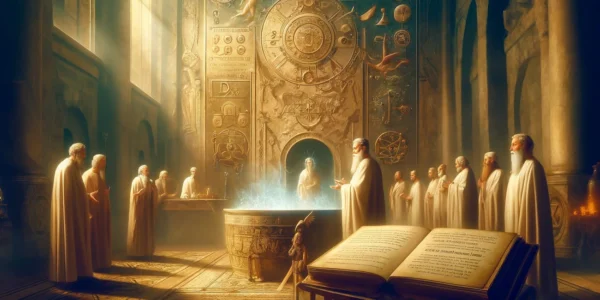
Once, when seas were younger and stars still argued over their places, there was a circle of light hovering above the Atlantic-a ring of twelve knights in a blazing celestial plate, each crowned by his own sun. They weren’t men, they were the zodiac itself, wearing flesh only because mortals needed mirrors they could touch.
Uther Pendragon, taught of Merlin, the Druid, read them as riding out from Avalon in their heavenly signages, as their spears tipped with the dawn.
In his vision, Uther thought they were questionable omens until one appeared before him as he lowered his visor. Behold, it was the solar god, Galahad, flesh received. Galahad’s face, older than language, saying to Uther the same thing every version of the story forgets to make obvious: “we’re echoes, your legend’s just a noise we haven’t shaken off yet.
Pendragon didn’t flinch. He bowed instead, the way you’d greet lightning after it promised to stay polite. Then, came the other incarnations acknowledging Uther as they dismounted.
Lancelot’s horse was still sweating plasma. Bors, one of Arthur’s faithful knights, had frost on his beard; while Arthur’s knight Kay smelled like iron filings.
They sat in Pendragon’s hall, told him how they’d started elsewhere-how Marduk once split a dragon named Tiamat and scattered her scales into constellations, how each scale grew teeth, how those teeth became spears, how the spears forgot they were once scales and thought they were gods.
Persia heard the crash first-Ahura Mazda watching firebirds turn into armored men who guarded orchards of gold apples. Greece tried to rename them: Apollo for Gawain, Aries for Percival, Hermes for Merlin who’d always been older than the rest.
Rome stamped coins with their profiles, forgetting the solar god’s origins continued to mint more. Babylon burned the coins, built ziggurats out of the ash, and waited for eagles. Eagles never came; the knights rode west instead, chasing a rumor that a child would be born who wouldn’t need armor.
Christ arrived anyway, quiet as snowfall on a battlefield. The knights were drunk in a stable-Tristan teaching shepherds to sing in seven languages they’d invent centuries later. They watched the manger from shadows, arguing whether redemption was just another quest. Lancelot said yes. Mordred, who hadn’t drawn breath since Troy but still counted as family, said no. No one asked Mary her opinion; mortals rarely get that luxury in myths. They left Bethlehem before dawn, leaving behind only hoofprints that glowed for three days. Then centuries blurred: Rome fell, fell again, kept falling like a drunk who thinks gravity’s optional. The knights followed the dark, armor dimming to candle-flame.
Somewhere between Lindisfarne and Camelot, they shrank back into human size, edges softening, suns cooling to hearths. Still, every dawn carried their fingerprints-Gawain’s red hair streaking the horizon, Percival’s silence in the frost, Galahad’s brief smile when fog again lifts just enough to see Avalon.
Arthur inherited the leftovers: a round table cracked where Mordred once stabbed it, Excalibur humming faintly like a radio between stations. He didn’t know the blade was Tiamat’s last tooth, and didn’t need to.
Myths work best when the listeners finish the story themselves. So when the final battle comes-because it always does-Arthur mortally dies holding a spear older than his kingdom, only to return to the land of apples.
The knights ride out one last time, not as gods but as afterimages, scattering across oceans they’ll never own, finding their identities circumferencing the Solar King’s image.