Language, in the last analysis, is not a human invention that happens to name a world already there. It is a late, creaturely participation in Logos — the ordering Word that precedes every tongue and every science. An -ology is not a neutral suffix. Biology, cosmology, theology: each is a regional attempt to let logos gather a field into intelligible form. The power I have been describing as pre-deterministic structuring in Hopi, Yucatec, Mandarin, and Russian is, at ground, a shadow of that prior gathering.¹
I do not mean that grammar saves. I mean that the mind’s need to categorize, to cut, to net, is itself evidence that reality arrives already spoken toward an end. A sovereign God who has predetermined all things to the good intention of His will is not a tyrant of outcomes. He is the One whose purpose is teleological: the restoration of all things, the apokatastasis in which what was fractured is not discarded but unveiled. Predetermination, in that register, is not the imprisonment of thought. It is the loading of the world’s prior. History runs inside a will already aimed at reconciliation.²
Human languages then do what they can. They pre-structure attention. They make some distinctions cheap and others costly. Benjamin Lee Whorf’s manifested and manifesting, John A. Lucy’s shape and substance, Stephen C. Levinson’s frames of reference, and Jonathan Winawer’s partition of blue — these are finite nets thrown over an infinite field. They catch. They also miss.³ That is why I refuse both linguistic determinism and the fantasy of a view from nowhere. Every grammar is a gestalt: a whole that arrives before its parts and teaches the parts how to stand. The observer does not first collect atoms of sensation and then assemble a world. The world is given as configuration. Language stabilizes the configuration and hands it back as habit.⁴
Logos is the gestalt that does not fail. Before there is a Hopi contrast or an English tense, there is the Word by whom all things were made and in whom all things hold together. That is why I can speak of language as an -ology of all -ologies: not because a lexicon contains the universe, but because every act of categorization is parasitic on a prior articulation. To name is already to confess that being is speakable. To classify is already to confess that being is ordered. To net all things is already to confess that nothing falls outside the gathering.⁵
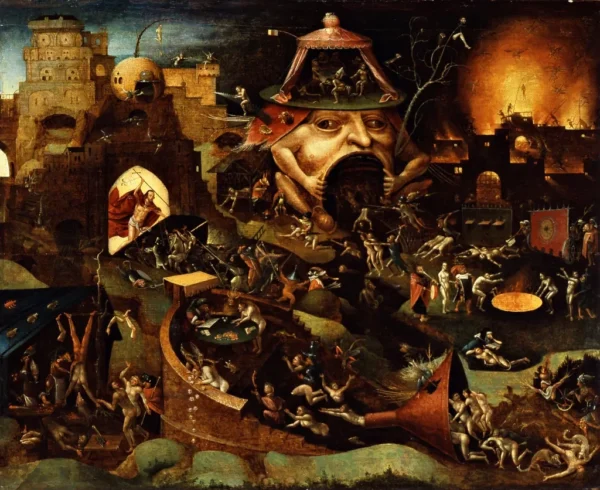
The apocalyptic is the moment when the nets are not thrown away but filled. Apocalypse means unveiling, not mere ruin. In the fullness of time the categories by which we have groped — time and space, substance and shape, past and future, manifested and manifesting — are not abolished as illusions. They are shown as partial cuts across a single restoration. Paul says we know in part; then we shall know even as we are known. I read that as the collapse of our pre-deterministic fog into transparency, not as the death of distinction. The telos does not return us to an undifferentiated blur. It returns us to right relation among distinctions.⁶
When I say the gestalt passes into the quantum, I am speaking analogically, not as a physicist. Gestalt is the given whole. Quantum, here, is the measured particular: the moment a hidden intensity becomes a countable disclosure. Eschatological knowing is that passage. The whole that was always there is rendered in units we can finally bear. Nothing is lost in the net. Nothing remains only probable. The prior that language could only bias, Logos completes.⁷
So the power of language to categorize all things is real and limited. It is real because the world is already logos-formed and therefore categorizable. It is limited because no finite grammar is the Logos. Predeterministic structuring in the linguistic sense is the creaturely echo of divine predetermination to the good. One sets the priors of attention. The other sets the end of history. They must not be confused. They may be analogized. The first explains why Hopi and English do not cut the same joints. The second explains why those cuts, however divergent, are not final. In the unveiling, every tongue’s net is drawn up into the one gathering in which all things are restored, and the categories we fought over are seen at last as so many approaches to the same intended Good.⁸
Notes
¹ Whorf, Language, Thought, and Reality, 57–60. ² Eph. 1:9–10; Acts 3:21. ³ Whorf, Language, Thought, and Reality, 58–59; Lucy, Grammatical Categories and Cognition, 47–89; Levinson, Space in Language and Cognition, 1–48; Winawer et al., “Russian blues,” PNAS 104 (2007): 7780–85. ⁴ Whorf, Language, Thought, and Reality, 59; Lucy, Grammatical Categories and Cognition, 12–30; Levinson, Space in Language and Cognition, 24–48; Winawer et al., “Russian blues,” 7780–85. ⁵ John 1:1–3; Col. 1:16–17. ⁶ 1 Cor. 13:12; Rev. 21:5. ⁷ Talmy, Toward a Cognitive Semantics, 1:409–70; Langacker, Foundations of Cognitive Grammar, 1:183–96. ⁸ Whorf, Language, Thought, and Reality, 57–60; Levinson, Space in Language and Cognition, 298–320.