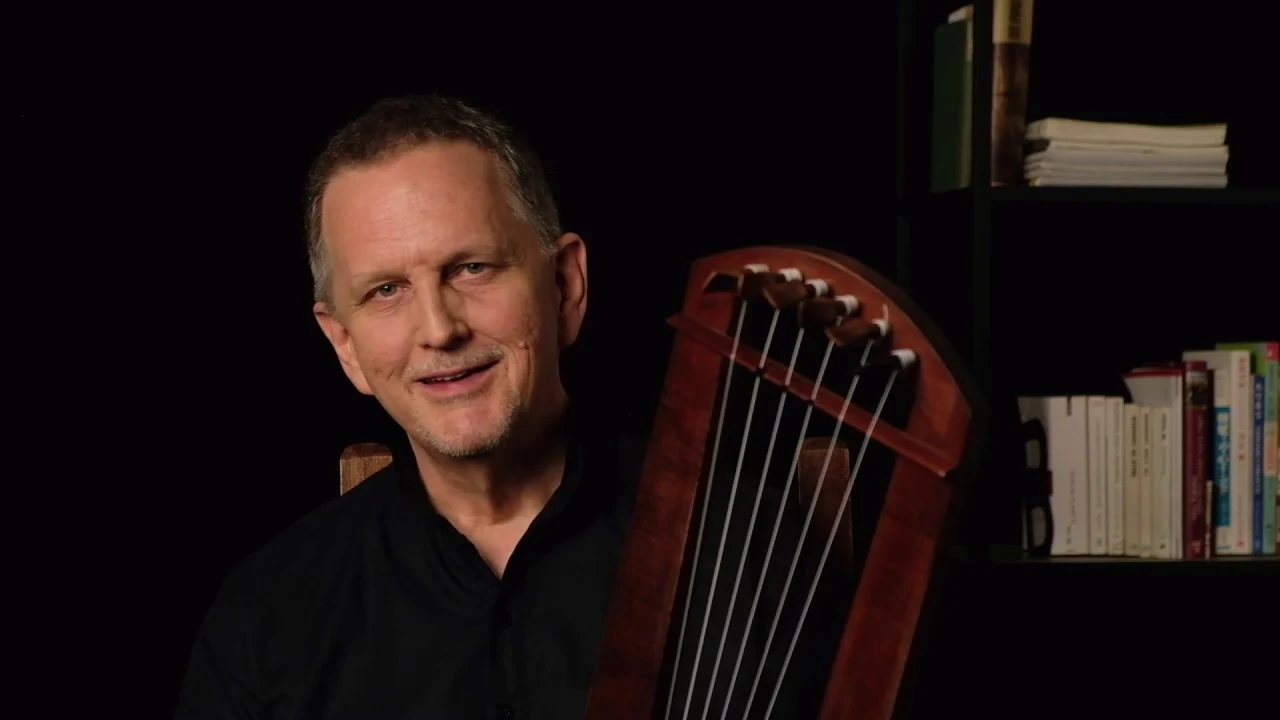
Vocalist, harper and scholar Benjamin Bagby, who was captivated by medieval music as a boy, has been an important figure in the field of medieval musical performance for over 20 years. He was the first graduate to earn a voice degree specializing in early music at the Oberlin Conservatory (Ohio, USA) and he also received a degree in German literature from Oberlin College. After graduation, he was awarded a Thomas J. Watson Foundation Fellowship, specifically for the study of European medieval song. His travels eventually took him to Basel, where he subsequently received an advanced degree in medieval music from the Schola Cantorum Basiliensis, and where he and Barbara Thornton first formed Sequentia. The years since 1977 have been almost uniquely devoted to the research, performance and recording work of Sequentia. Apart from this, Mr. Bagby gives his time to the solo performance of Anglo-Saxon oral poetry: his acclaimed bardic performance Beowulf has been performed worldwide and will be released as a DVD in 2006. In addition to researching and writing program books for festivals, concert series and CD booklets, Mr. Bagby has published articles about performance practice; as a guest lecturer and professor, he has taught courses and workshops all over Europe and North America. He was appointed to teach in the newly-created medieval music performance Masters program at the Sorbonne University in Paris, where he co-teaches with his wife, Katarina Livljanic, the Croatian vocalist, musicologist, and director of the ensemble Dialogos.
Recordings
For all of Sequentia’s recordings, which were researched and assembled by either Bagby or Barbara Thornton (usually working as a team), the accompanying booklets are appreciated for their rigorous scholarly quality, with great attention to detail, to the sources, and to the work of philologists (such as Peter Dronke, Pierre Bec, Heimir Pálsson, Jan Ziolkowski and Ulrich Mueller) who collaborated on the textual editions. In addition, Sequentia’s projects have witnessed collaborations with musicologists such as Leo Treitler, Edward Roesner, Barbara Haggh, Katarina Livljanic, Hartmut Möller and Richard Crocker. Two recent CD releases of Sequentia, Edda: Myths from Medieval Iceland and The Rheingold Curse were based solely on the original musical research of Benjamin Bagby, reflecting his interest in oral poetry and the use of traditional music in reconstructing ancient modal vocabularies. A more recent Sequentia CD, also based on Bagby’s original research, Lost Songs of a Rhineland Harper was released in 2004 on the BMG/DHM label, and features numerous reconstruction of songs from the 10th and 11th centuries. For this project, Bagby collaborated with the Harvard philologist Jan Ziolkowski.
The major project for the Sequentia men’s ensemble 2003-5 was Chant Wars, a musical collaboration between Sequentia and the men’s voices of the Parisian ensemble Dialogos (dir., Katarina Livljanic). The preparation of this project was made possible by a research fellowship from Harvard University. Following initial rehearsals at the Abbey of Aubazine in 2003, there were performances in Europe, Columbia, Mexico, and a North American tour. The CD of this program was released by Sony-BMG (DHM label) in the autumn of 2005. Also in 2005, the women’s voices of Sequentia – in conjunction with the exhibition ‘Krone und Schleier’ in Bonn & Essen – released a CD of vocal music from women’s cloisters in medieval Germany (recorded by the WDR Köln and released on the museums’ own label). The year 2006 will witness the release of the DVD of Benjamin Bagby’s legendary Beowulf performance.
A complete, annotated discography of all published recordings made by Sequentia since 1980 can be found on the Ensemble’s website.
Music Theater
In addition to the program Edda Eins (performed as a theatrical production 1995-7 in Scandinavia, North America and Africa under the auspices of the Goethe Institute), Sequentia’s other music-theater projects have included Hildegard von Bingen’s Ordo Virtutum (West German Television, 1982 and subsequent tours in 1984, 1986, 1990, and 1998-9); the Cividale Planctus Marie; the Bordesholmer Marienklage (West German TV, 1992, and Boston Early Music Festival, 1987); and Heinrich von Meissen’s Frauenleich (Frankurter Feste, 1987 and recording 1990). The Edda project continued in 2001 with a new production: performances of the Eddic poems which later formed the basis of Wagner’s ‘Ring’ cycle. For this project, Mr. Bagby collaborated with the New York stage director Ping Chong, in a project commissioned by the Lincoln Center Festival and the University of Michigan at Ann Arbor (and subsequently performed in the Utrecht Early Music Festival, USA tour, and in Scandinavia).
Research and Education
Since 1984, Sequentia has been consistently dedicated to teaching intensive courses and workshops in medieval music performance. The most important of these has been the 2-week summer course given at the University of British Columbia in Vancouver, Canada (in collaboration with Early Music Vancouver). Of the more than 200 musicians who have attended this course over the years, more than 20 have gone on to become either associate members of Sequentia or performers of medieval music in their own professional ensembles. Beginning in late 2005, highly-motivated students have been able to study with both Benjamin Bagby and Katarina Livljanic (director of the ensemble Dialogos) in the newly-created Masters program in medieval music performance at the Sorbonne in Paris.
As a guest lecturer and professor, Bagby has taught courses and workshops at the Schola Cantorum Basiliensis, Indiana University School of Music, University of Oregon, Duke University, Stanford University, the Autunno Musicale (Como, Italy), University of Chicago, the Modus Centrum (Oslo), Amherst Early Music (Tufts University), Wellesley College, the University of Texas at Austin, Northwestern University, the New England Conservatory of Music, Sarah Lawrence College, St. John’s College (Santa Fe), the Studio Alte Musik (Berlin), the Royaumont Foundation (Paris) and the Stary Sacz Festival (Poland), and many others.
In 2000 Bagby was a guest speaker at New York University’s Medieval Studies Program, and he spent a semester as a visiting Krieger Fellow at Case Western Reserve University (Cleveland); in 2001 he was invited as Patten Lecturer at Indiana University (humanities and School of Music), a humanities lecturer (together with Ping Chong) at the University of Michigan, and he taught an intensive May Term medieval music course as guest professor at Illinois Wesleyan University (Bloomington, IL). In 2003 he was awarded – together with Katarina Livljanic – a fellowship by Harvard University (the Religion and the Arts Initiative, Center for the Study of World Religions, in conjunction with the Music Department). In 2004-5 Bagby was twice in residence at the University of Oregon as the Trotter Professor of Music. In 2005 he was named as a part-time professor in the newly-created Masters program in medieval music performance at the University of Paris IV / Sorbonne. In early 2007, both Bagby and Livljanic will be Cornille Professors at Wellesley College (Massachussetts, USA), teaching medieval music courses for both faculty and students.
Sequentia presents several new programs during each 2-year period, each of which carefully researched in collaboration with other scholars. The ensemble has also received research grants from the Siemens Foundation (Germany) and from the Volkswagen Foundation (in association with research & performance of music from manuscripts at the Herzog August Bibliothek in Wolfenbuettel, Germany).
In addition to reseaching and writing more than 65 program books for festivals and concert series, and writing (or co-authoring, with Barbara Thornton) more than 25 CD booklets, Benjamin Bagby has written about performance practice, with articles appearing in Early Music, in the Performer’s Guide to Medieval Music, edited by Ross Duffin, the Basler Jahrbuch für historische Musikpraxis, and in Performing Medieval Narrative (ed. Evelyn Vitz, Marilyn Lawrence and Nancy Regalado).