There is no doubt in my mind that Tolkien felt the bankruptcy for the meaning of words in his time. Tolkien knew that words and WORD (the substantive reference by which all things refer to for meaning), via “Narration”/ “Story”, were the cure for giving those who cared about meaning a hope. Such a hope was the consistency of ‘signals’ and ‘semiotics’.  A “world” without double entendre, doublespeak, ‘dark sentences’, ‘shadow logic’, etc. was a ‘world’ of pure expression, pure thought without cloudiness. A world that disallowed ‘those’ who would rule by ‘witty-word play’ and carelessness for meaning, only the power to make those around them fear potential shame for not being in the illusory ‘in the know’.

Tolkien knew that a linguistic vaccination could be carried out by a Philological treatment under the beautiful cloak of The Myth/ The Fantasy that England never had, namely, The Lord of the Rings.

Wales had Arthur, Scotland had hobgoblins and Fairie as did Ireland. Ireland had the Dun Cow as a staple of myth, but England only had fancy writings which referenced other’s myths.

The sickness of social and verbal (one and the same to Tolkien {and to me}) relativism had obviously taken hold of the world through the blind war of rejecting Theology all together. This darkness had covered the world prior to Tolkien’s day. Relativism, as a social shadow logic, called certain men to arms such as Owen Barfield, C.S. Lewis, Charles Williams and J.R.R. Tolkien to arms.

To repeat, the works of the Silmarillion, Hobbit, Lord of the Rings and his many other correlative and supplemental  histories surrounding ( especially, the Lord of the Rings), were of a Philological nature. And, the IMPORT of this Philological treatment incurred THE NARRATION.

This is where Tolkien’s Theological understanding bypassed his blind Sacraments. A new and yet very ancient *faith* in the meaning of words within Fantasy’s exercise of the True LOGOS could replace the blind acts of objectivism in stale motions ever unending.

Tolkien had an ‘extra-Christian’ approach.Tolkien understood that the MECHANISM by which ALL THINGS COME FROM, GO TO, EXIST BY (one might refer to Colossians 1:14-ff)  could be expressed within The NARRATION regardless if the narrative with Fantasy or Objective-Real-World.

The pure-inner-consistent NARRATION is the eternal-a-tempo *WORD* which unfolds in TIME and SPACE). Therefore, “IT IS DONE” means both NARRATION and WORD——this is the truest sense of coherent and consistent meaning. Another way to say this, Eternity unfolded is true Narration because ‘eternity’ cannot contradict itself as being self contained outside of time and space. This also gives hint to what Abaddon is. A thing placed into eternity with never ending reduction, non sustainable, contradictive.

The hint of objectivity, externality and eternal nature find themselves allowed to function in conjunction inside of Fantasy. That is, Fantasy allows both NARRATION and WORD  (a seemingly contradictory, yet, coherent *idea-figuration*) to exist in it’s world as the same thing – i.e., some kind of predeterminism is sensed due to Author to that which is written relationship, or. “Idea” to “pen” to “words” to “narration”.  In the mind of Illuvatar and in the mind of Tolkien were all themes created and nothing was before. So, where’s the ‘free’ and the ‘will’? Tolkien’s Silmarillion makes it clear that his Ainur or Holy Ones were given the freedom to subcreate upon the themes of Illuvatar and Illuvatar was glad to see this. But, nothing was made that wasn’t made of Illuvatar and HIS “EA” which is, “Let it Be” and the WORD.

Theologically speaking, this is the “REASON” by which we must *believe* in the Lamb that was slain from the foundation of the world (Rev. 13:8) —-i.e., we ‘hold two seemingly contradictory ideas at the same time to see REASON. He both talked to His disciples in the tempo of this world, created the world, ends the world, loved us before the world began, predetermined us to believe before the foundation of the world, knew us before the foundation of the world—that is: had a living relationship with us before anything was made  (Romans 8:28-31/ Ephesians 1:4, 13/ Ecclesiastes 1:15, 3:15, Isaiah 45:7-ff. ), . This means that part of Christ’s existence is outside tempo and space, the other, He works, dwells, dies, resurrects, etc. in time….and then, goes back to a place of non-tempo only to see us again…and, if you will, MUST be here and there at the same time – ‘time’ as we say, and the language of eternity are hinted in philology for us to see His eternal mechanics.

Yet, only the type of “sense” acquired for the magnitude of a GOD who could truly do all that HE claimed, requires a participation of belief. Such a concept was defined by Tolkien in his Monsters and Critics lectures presented at Oxford to mean, “a suspension of belief in the primary world”. This is applied to Fantasy, though,—-or is it?

Fantasy allows proportionate “inverses, obliques, corollaries, etc” to the primary or objective-cold-metrics world by which ONLY Fantasy writing can do—that is, time can go back and forth with a Christ figure of the Fantastic whereas it cannot with the Christ in this world. Fantasy can allow for a Christ figure to break the primary world’s rules, that is, show HIS epiphanic Nature before the cross event, or many other virtues of LOGOS before the Objective Gospels show HIS unfolding. In Fantasy, the Christ figure could show Himself as a Shaman, but, as a Christ figure, never could HE defame HIS virtue if HE is a figuration in the Fantastic Narrative *as* a Christ figure.

But, as these ‘changes’ or ‘delineations’ occur which separate Primary (objective) vs. Secondary (fantasy) worlds, these ‘changes’ MUST come with rules to support the same valuation of the Christ, if HE is to be of equal value *in Story* that the Christ holds in actuation or objective reality.   

It is most important to understand that Tolkien believed that Fantasy would not bring blasphemy to the Biblical Text as ‘another Gospel’.  This is WHOLLY what Tolkien would NOT WANT. Again, his works were ‘extra-Christian’.

It is in the FANTASTIC writing of all of Tolkien’s works that we can see LOGOS actually work through a different medium other than time as we know, light as we know, purity as we understand and the fleshly limitations that we bear in this primary world. On the other hand, bread, mushrooms, carrots, stew, fire, pipes, tobacco, and coziness exists much to our liking in this primary world.

Lastly, for the PURE ARTIST, i.e., Tolkien, he was driven to write the pure narrative. Through this purity striven to achieve, it was enough to convey an alien beauty not seen in its like before. There is an ‘arrest’ of the senses and a draw to this other world where, I, personally, could find myself happily lost.

If there is a contradictive *NATURE* to the poem, myth, story, fairy tale, …then, there was a disobedience to the WORD or LOGOS by the Narrator. These holy rules are real for Tolkien’s fantastic writing and therefore, IT is REAL. Only when there is agreement with Narrator, Logos, Narration, do we have PURE art, fantasy, meaning, significance, semiotics, TRUTH.

To ‘empathize’ and/or form an ‘alliance’ with the ‘other’ gender, especially if you’re a 12 year old, is indicative of the poison already set in by the trending leaders.

“Sexual preference” is objectification-identification. It is not a subjective desire for meaning. This is an “us and them” partition.  

“Alliance” with objective sexualities, genders, ——is the MOST dangerous practice because it denies objective truth. Gender/ Sex preference alliance supervenes logic, reason, ‘truth’.  What do I mean? When you talk to a person, and really want to know them, want to even use them to get to understanding about them, the world, life, etc.,… you don’t look at them as an objective sexual preference but, rather, you look for their ‘flow of reason’, ‘flow of meaning’.

“LGBTQ ALLIANCE” assumes a stance without reason if you (1) haven’t been any or all of these ‘categories’ (2) assumes that anything else *is* an objective obstruction from their alliance. (3) an objective ‘stance’ assumes that you stand with ‘rightness’ and it is fixed (4) such a ‘fixed’ nature prejudges the ‘others’ as ‘them’.

The new-pagan-cancel-culture- enforces their “Puritan” ideas, as Ben Shapiro says (not always in his camp), that *nothing other than those things which cancel out historical Family ideals which do not accept pornography and sexual license are accepted. Mock sex acts on stage with profane lyrics on the stage at the Grammys is the new Puritanism.  Licentiousness is the new Puritanism and hypocritically cancels, pre-judges, aborts anything but its own world view (feel free to watch the ‘highlights’ of the Grammys of 2021 and discern for yourself).

Again, the danger: the ‘blind faith’ of ‘alliance of a movement of objectification of gender (and of race) creates division.

Jesus NEVER objectified the sexual nature, preference, disposition, prejudices, differences of ‘self based fixed world myopic world views’. Jesus ‘subjective’ ALL under HIS grace.

We are coming to be into the likeness of Christ. The hardest part, as a believer, is to not ‘react’ to God’s Will (let alone our error) in ordaining these fleshly ‘dilemmas’ when HIS Grace is the ONLY THING that is proven right through all of this societal cacophony.

“Cancel Culture” is a new thing to me, yet, an old thing. To eliminate history is to eliminate the foundations of reason.  History has direction. History goes forth on paths *from* some fixed point in time. To eliminate these paths is to eliminate ‘truth’.

“Truth” means, ‘root, stem and branches’. To eliminate the linked system of history is to eliminate all of suffering, suffering unto death, suffering unto *REASON*.

It is a ‘trending’ thing now, as witnessing my own children who were raised in a gracious and loving home, to assimilate such judgemental and hateful positions.

My wife and I have never taught anything but unmerited love and universal salvation through Christ who showed us all that we must suffer many things to save our brothers and sisters.

Finally, just getting off the phone with one of my best friends (while typing via inspiration of our conversation/ multitasking-psycho-me), Matthew told me that after 6 years I should take a flight from Florida to Nashville. I said, great….nonetheless, it is enough that we are given the gift to share reason, humility through grace, meaning, linguistics, theology, societal issues, teaching at colleges issues, etc. Face to face is great, but what is greater (as C.S. Lewis said) is ‘cheek to cheek’ and side by side going on the same path, in the same direction, to the bullseye.  To “cancel” our confirmed experiences over our long history of friendship would be equivalent to ‘cancel’ culture, past bigotries, past false judgements, past angers, past arguments, past error….ALL of which, being on the path of Reason, has led us to being best friends. I thank ‘history’ in all of its trauma/ drama that purged me. I’ll never forget and I’ll never let my progeny forget my history and I’ll never let ‘meaning’ be forgotten.

Technically, Plato would deem “cancel culture” *diabolical*. ——Such a statement would be without ‘moral’ significance. I say, because Reason and Order are fought for, anything that tries to destroy that is immorally Satanic/ Diabolical. Reason IS morality, technically

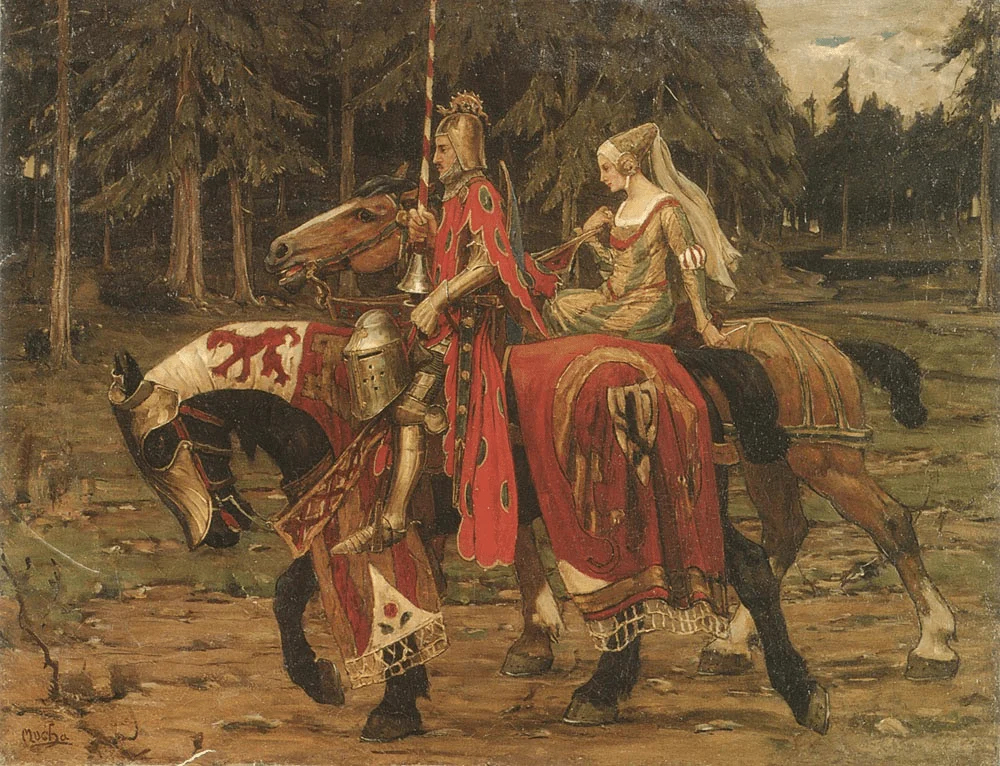
The writings at the ending of the 11th all the way into the 13th century exemplify “amour courtois {amur- kurtwa}. This amour courtois or, “Courtly Love” was a medieval European conception emphasizing nobility and chivalry.

Amour Courtois showed Knights going on errands for their “ladies” which showed their courage and their ‘love’ for them — in this particular fashion.

This kind of “Love” was originally a literary fiction created for entertaining the nobility.

Later, “Courtly Love”, as a full bodied idea, took hold as the codex by which Knightly conduct would fashion itself from fiction to fact.

THE SUFFERANCE OF COURTLY LOVE

“Loving Nobly” or “noble love” was considered to be an enriching and improving practice by which the subject was imposed upon. At the same time, this Noble court love in all of its “courtesies (“court—-esy”)” could garner suffering and heartbreak in the medieval allegorical writings.

The allegorical poems of Amour outside amour courtois proved to be deadly. Such is the case for Tristan which  means  “sad”. Tristian, from the Welsh, “Drystan”; French, triste—‘sad’ and the German, Tristan.

Tristam’s “Paramour”, Iseult, meaning, ‘one who is to be gazed upon’ or ‘fair lady’ has a slightly less interesting title. Iseult was Tristan’s paramour. Paramour meant ‘secret or illicit lover’. In the Latin based French we have, “par = “through” + amour = ‘love’. In this formula, it means, “through the lover…as in the physical sense, not abiding by societal standards. It is this sense of the word that we have “Eros”. In Eros’ original form, the very archaic Greek spelled Eros as Eisrous.  “Eis = to go into + Rous = flow as a river to its destruction—-as in, “rui—-for RUIN. The paramours, therefore, through the entrance of their eyes saw what they desired and took their destruction floated out to sea. (One might confer to Platos’ Cratylus for this exact treatment on “Eros”). Nonetheless, they fulfill their roles in their ‘names’ as Paramours.

THE STORY/ THE ALLEGORICAL NAMES/ AMOUR/ DRAMA

In brief, both took a love potion and fell madly in love with each other. Prior to taking the love potion, Tristan was overwhelmed with Iseult and thought it would be good if his beloved uncle, King Mark of Cornwall would marry her. Was they imbibed upon the potion they were inseparable. Iseult, ended up having to marry Mark while Tristan and Iseult were having secret liaisons. The two got caught and much drama ensued.

The errors of courtly love were brought to view in the convoluted sense of two different types of love.  Eros and Agape. BOTH of these types of “love” were/are  impersonal.

By the end of the 11th century, both erotic love and agape love were to be fused together. Eros was an ‘organ-based’ love while ‘agape’ was a ‘do good to others’ love at your own cost, demeanment, loss, etc.’ love.

LESSON TO BE LEARNED FOR CLASSICISTS, THEOLOGIANS, US —-VIA MEDIEVAL AMOUR COURTOIS

In both cases, “Gamos”, —-an entirely ‘other’ love was overlooked. Gamos, or “marriage”, meant ‘joined’ or ‘union’. In this sense, “Gamos”, was a ‘connecting’ love that entangled not only impersonal sex and impersonal selflessness—but took them and made them personal. Gamos ‘fulfilled’ them to their potential. Gamos made not only a ‘friend (REALLY THE ONLY OTHER ‘LOVE’ NOT ENTIRELY LOOKED AT{philos})’ as well, but a *Comrade* or a ‘fellow measured’ lover. This might be a term that is missed even by today’s standards for the ultimate form of “love” here on earth. Sadly, even my beloved C.S. Lewis didn’t place “Gamos” amongst the ranks of the main forms of “love”.

*Concerning the experience of Gamos we might have an unspoken set of words, or unquantifiable words, now, through ALLEGORY, were spoken in poetical form or sung.  Such experience was given to the Medieval by the Troubadour.

The Machinery of allegory used by the Troubadour’s song or poem may always be regarded as a system of conduit pipes which tap the deep and unfailing sources of poetry in the minds of the common folk and noble. Such machinations of ALLEGORY provided and do provide refreshment to those via the Troubadour.

THE UNSPOKEN-SPOKEN WORD—‘MUO’

As a side note, the Proto Indo European language group denotes such a mystical union of ‘sense’, ‘signal’, ‘sign’ to the heart and minds of the commoner and noble via the mimicry or miming of the sense of the unspoken reality. It is in miming that we have a type of this ‘myth’ or ‘mystae’ represented. It is interesting that “mouth, myth, mime, mimicry, mystea and mystery do come from the same ancient Parent. In this understanding, “allegory” is just that sense of “muo”. It is the unquantifiable —which is in the quantifiable language of “allegory”.

Such origins of ALLEGORY began in ancient paganism, not the Middle Ages.

But, it was in the fiction’s entertainment that was later put to real world practice. In this, allegory had been aligned to the real Knight’s errands. Though a Dragon wasn’t what the Knight fought, the Dragon was the world of despair for the Knight that he had to fight through….therefore, “dragon” could allegorically be called “dragon” though understood as the essence of depression.

Inevitable cruelties would come when this fictional world —-with all of its traumas/dramas returned its victories and losses. The harshness of the allegory of the knight’s errand was the ultimate price for Valor. The once fictive allegory would now also take hold onto a new reality that, in turn, had copied that which was fiction. Thus, the title of the HERO must be attempted—— though this all together, another Segway on the “Hero’s journey, a monomyth of epic proportions — it should be known here that “the Name” only exists as ‘that which can fulfill its meaning’.  Anyone can carry an appellate, but few can Donne the “authority, name, Hebrew-Shem, or Greek Nomos. Such is the Son of Man and Son of God — in His ‘coming to be’ that NAME.

THE DISTANCE FELT

The main thing that catches me in ALLEGORY  is the need to reach from your position on earth to and for a higher language in order that one can ‘signify’ that which cannot be quantified in ordinary speech. The distance is felt—-that is—— the allegorical speech has tethering lines from the ground upwards. (In contrast, not necessarily does “Fantasy” offer this distance between two realities that can both exist in the primary world of real-cold-metrics).

IS THE BIBLE ALSO AN ALLEGORY?

In some ways, I see that in the Bible. That is, many of the “NAMES” had the meaning of their function, therefore, they were the ‘virtues’ of their appellate—-at least for the narrative that they were found in. What isn’t answered is: were they always like their “name”?—-such is the case for King Saul. “Saul” means “blindness, darkness, separation from light, “SHEOL” = “SAUL” = “HELL”.  Was King Saul always ‘blind’, ‘in the dark’, ‘in a kind of hell’? —-probably not. But, as I stated, for the narratives read in the Biblical passages, many to most of the time, the names were fulfilled by the action of the characters in the Biblical stories.

An example of ‘name giving’ in the Bible: In 1 Corinthians 11:23-24, Paul the Apostle does not mention Judas by his “appellate” but by his “name”—-paradidomi = “to hand over”.  More than anything, this “name” would fulfill the allegorical “name” of Judas by his ‘role’ in the narration. Jesus’ name means, “salvation”, “Peter”, “Paul”, “Matthew”, “devil”, “Satan”, “church”, “eyes of the Lord”, “Seven golden candlesticks”, etc. all either have ‘tethered’ meanings to a bigger sense that just the physical or they fulfill the “name” of their bigger function to its completion in the Biblical narrative.

Is one to call the Bible an Allegorical Historical Theology?—-I don’t know…but I do know that the characters in the Bible who fulfill these virtues are surely fulfilling an allegorical essential.

CONTRAST

*If we remember that FANTASY started in a different or secondary reality and continued its suspension of primary reality without ‘tethering’ to the Primary world,  THEN —-I might say, a new reference language is employed to entertain the numinous or hierarchical senses.  

This to me is just another way of humankind reaching out to a higher idea, sense, and I say, God.  C.S. Lewis was in this camp. The Troubadours were too.

On the other side, I can see J.R.R. Tolkien’s affinity for sub creating—-i.e. participating as a Child of God in his Father in Heaven’s image—-the Creator. This, in one sense, is a very serious role, though Fantasy, the art of writing pure Fantasy would be the effort to be purely honest. I think that Tolkien took his writings to a heightened sense of Christianity——- a place of Freedom in the Rules of the Grace of God. One could call him a Roman Catholic, a Christian and, I believe, an extra-Christian. Tolkien was one who who trusted their Faith to exercise it in the unreal and watch the same creative laws exist. —>For this, I love J.R.R. Tolkien.

For me, both Allegory and Fantasy can be used as an exercise in numinous aesthetics. To touch the Holy, to reach out to the LOGOS and feel HIS Order, His command, His being; to be totally arrested by the nearness of Christ in His purity of any form of art. To see the inner and outer consistencies of reality and unreality.

ADDED HISTORY

As an added history: it was the Provincial troubadour Girhault de Borneilh, who flourished in the middle to the end of the 12th century and epitomized the troubadour ideal.

Borneilh synthesized the 2 traditions of the understanding of Love in the following way:

Borneilh proclaimed that “Love is born of the eyes and the heart. The eyes are the scouts of the heart. They are looking for an appropriate object of beauty; that is to say, they are selective.  This is discriminative, this is elite, this is a personal choice, and having found their image, the eyes recommend that image to the heart—-not to just any heart but to the noble heart, the gentle heart,  the heart capable of love; this is not a case of sheer lust. When these three meet: that is,  the two eyes and the one heart are in accord, LOVE IS BORN. Love is born of the eyes and the heart; it is an individual experience. The eyes quest in the outer world for the object of inspiration, and the heart receives the image, and this image then becomes the idol of individual devotion”.

MY THESIS ON BORNEILH

Borneilh fails to include the conclusive “love”, Gamos, and ends his theme with objectification of one’s interest as ‘the idol of individual devotion’. The eyes are never satisfied, the idol is by Greek terms, ‘the eye which fixes and serves without thought’—hence the word, ‘idiot’, and finally, serving that which one doesn’t or couldn’t possibly know in an objective relationship might be more deadly that just following a court appointed marriage…like in the good old days. Lol

Epithets for angels, Satan, kings, priests, queens and gods

One of the earliest sentient cultures of great intelligence was the Kartuli culture. The Kartuli culture spoke a language that was shared with Sumerian. Kartuli language, or Kartvelian, is now known as the modern Georgian language. This shows you how old Georgian is!

This highly evolved (in excess of 300,000 years) Kartuli or Kartvelian  linguo-culture gave the Sumerians a meaningful relationship between nature and the heavens. Kartvelian culture made sacrosanct the Sumerian Language, culture and practices. Prior to the Kartvelian influence, the Sumerians, seemingly,  were just an agrarian culture.

One can see an ‘imprint’ from the Kartvelian’s language to the Sumerians when one looks at the etymological origins of Sumerian inherited words.  Such borrowed words are seen later in the vocabulary surrounding the Sumerian agricultural, religious, and political practices. That is, commonly observed objects with associative names from the Kartuli or Kartvelian speaking peoples, most certainly lent their vocabulary to the Sumerians. Suc examples of Kartvelian words loaned to the Sumerian vocabulary are: “xe”-“tree”; “Kakalli”-“walnut”; “Ugula”-“overseer/ “heartless”; etc. —-as we shall see later, are from a narrative —-i.e., a similar story to the “nag” or ‘ugly ones’ who guarded the Paradise or the ‘encamped garden’.

The beautiful language of Sanskrit has also been affected by Kartvelian such as seen in the word, “Angira”-“Angel”  (nasal + gutteral + rotex formula) shows old Indo European ties with the “Angelos” of the Greek language  and the Sanskrit, “Angira” -the  fire keepers/ ‘brazier (hot oven/ thing) watchers’, NG/ naga/ snake people.  The (non-mythological) Oxford Sanskrit Dictionary gives us many word pictures concerning these beings as, “serpents with  human faces”.  Once such being is the “Angarika” (masc.) – “charcoal burner”; “angarasa” – “fire keepers”. Whether placement of the -gn- or -ng- occur in the “anga” or “agni” to create the shape of the meaning of the Sanskrit ‘fire burners’.

I am beyond perplexed as to the Cain culture that travelled east of Eden into the Biblical Nod, if one is used to reading their Scripture as a serious historical and geographical reference. A major city just under 30 miles South-East of the 3 regions of Nod (Noqdi) do we find thriving Ardabil, Iran.

The 3 Noqdi or “NOD”:

1)Naqdi ya Sofla is 29,7 miles North-West of Ardabil

2)Naqdi-Olya is 24 miles N.W of Ardabil and finally

3)Naqdi-Bala is ca. 20 miles N.W of Ardabil.

One can see the Proto Aryan root word, “Nag”, carried through in the Persian. Other archaic Indo Aryan and possible Mongol, Old Japonic-Altaic words could and would retain such names as those of the Khan-ite clans as in Cain-ites. As Cain was given a mark that all men would know who he was and that he would be distinguished from every other man on earth it interests me to who these naga people are. It is of great importance to study the “naga” clans or naga people who keep a cauldron of fire burning day and night. Such a naga/ Cain-ite/ Khanite might represent something of the offspring of Cain as a cursed race. Was he a giant based on the sexual intercourse of a fallen elohiym? Was the Satan and Eve story another account of the ‘fallen sons of God/ fallen angels interbreeding with the Daughters of men (the Huwites/ Eve-its/ Chaiva clan)? Was all of the earth at this time an Eve culture without a Patristic warring leader? Was Cain the offspring of Satan and Eve (the misunderstanding of reproduction during this time of antiquity would have possibly played into the Goddess myths which gave way to the belief in Parthenogenesis {‘self birthing’} at that time, and the “Blessing” from either Satan or YHVH)? I think this is a possibility.

Another reference to the conjugal relation of Satan and Eve resides with the Sumerian text of Inanna and Enki where the Serpent-god imbibes a type of soma libation with Inanna or the Eve (“Life-Bearing”) antagonist of the story. In the story, such drunkenness led to coitus between the Sumerian Inanna and Enki (Eve and Satan)  in the story. Was this the Genesis 3 account? I find the ‘fruit’ of the garden to very well have been shared with not just Adam and Eve but of the Serpent-god and Eve.

I am beyond perplexed concerning the Sanskrit/ Rig Veda collage’ of ‘priest, snake, fire, copper, ugly, outcast, and watcher. All of these branding terms seem to fulfill an archaic-mosaic for me concerning Eden, the Fall, The Garden, The Cherubs, The Most High Angel that Fell, and the borrowing later of these signs, symbols and metaphors.

Similar themes of Enki/Naga are found in the Nachash in the Hebrew, with the name and function of the “Serpent” in the “Pairidaeza (Persian: “park land”)” or technically, the Greek which continues the Farsi: “para” = ‘around’ + “deisos” = ‘garden’/ ‘park’ = *enclosed garden*

As the “Cherub”, “Griffin” or “Kerabou” (gutteral + rotex + labial formula), or Chorobai as mentioned throughout Sumerian, Akaddian, Babylonian and Persian myth mention the “Guardian” as the hired one. He was the Watcher. The “Igigi” (eye + eye {or: ‘intense eyes’; ‘maloik’ or ‘malacchio’ in Italian}) in Sumerian means, “watcher”. Igigi also means, “to watch with rapacious eyes”. One might look to ‘rowb’ in the Hebrew for “the Raven” or “eye of the Witch” “Eye of Odin {Adon/ Adonai/ Atum Ra})” over Eve and Adam. These were the first two protagonists for the narrative in the “enclosed garden”. Norse myths are directly related to Georgian and Sumerian myths. It is a wonder that the Vikings spread such a relatable myth to the Sumerian tales and Biblical accounts. Such a beautiful tapestry of history and language!

Parallel accounts of the Biblical Sons of elohiym (earliest redaction of the Biblical account is found in Job 2 and 3) are the Mesopotamian creation gods-the Anunnaga (Enuma Elish/ An = “heavenly” / Naga – sons of An, i.e., Anunnaki) had their “fall”.


Hebrew linguistic cognates:

I find that the high and Lifted Cherub of the Biblical Genesis account became the cursed belly crawling “serpent” of the Garden of Eden after his dialogue and temptation to fruition with Adam and Eve. This very serpent was called in the Hebrew text, a Nachash (Nach-Nag). We see the Nag in India as having Serpent God parents who went into the sea, as their myth goes. We see the Nephilim in the Hebrew as the Fallen Ones to match that of the Giants who terrorized the earth. These Giants are also found in every myth, religion of antiquity, tale, fable that one would like to read about.

From a distant past we still retain a yezdi clan in Zagros Mountain region which would have bordered southern Eden in its day. They worship Melek Taus, the “Peacock King” or “Shaitan”. They say that he only wanted to be close to Elohiym, the I Am. As the I Am kicked Melek Taus off His holy mountain, he took of the angels or gods or elohiym with him. Forever worshipped, Melek Taus’ clothing, headdress, rituals, totem poles (Pole or Tree of wisdom in the Garden where the Shaman witch reclined) is found in the earliest Native American Indians.

Concerning the utmost antiquity of the Naga, Cain-ite, and Steppe culture Khanites

that I have researched, one can reach to the Kartvelian language (reaching back 5 to 6k B.C.) to find the word, *na-qsir.  Na-qsir means, “coal”. “Coal” was the term necessarily used in explaining the function of the ‘coal burners’ or “Angira” or “Angels” of the old world in the Northern plains of ancient India, Pakistan, and Iran.

The earliest Cainites did indeed smelt metals and work to make weapons and musical instruments. We do find his son’s name, Irad (“descended”; “fallen down to earth”), eponymously named in the very first city-state on earth, “ERIDU”. This city-state was generated by a secret guild of metallurgists who began the same production that they started in Nod or Noqdi. The ‘descended’ to an area between the Tigris and Euphrates. One can Google-Earth this area (just type in Eridu, Iraq). It is beyond haunting when the satellite’s view brings you down to a little square no bigger than a few football fields, yet, this is a remnant time immemorial—our very beginnings.

So, in our possible Satanic genes carried from Cain to us, wars Christ against our very urges every minute. Cain might be the generator of all Nations through his Satanic craft, though, practical and burdensome at the same time, his craft is handed to us to forge through this world. Funny how the Garden of Eden was ‘forged’ by God to retain Peace and it is in Cain that we bear the mark to forge those things which are unnatural to make a ‘living’.

Would it surprise you to also know that “Cain” meant, “Forger” (QN -Hebrew root: “to forge”, “to join”, “to smith”), or ‘one who is a Smithy’. I am convinced that the archaic Kartvelian gave root to the word for angel, for there is nearly nothing to be found on ‘angel’ in the Greek or Hebrew Theological works I have read that satisfy me. Such practices were done in secret and held as magical. Only a select few could be revealed this metallurgy for if fallen into the wrong hands, the enemy could learn to make weapons to fight back. Words to form images: “fire, seraph, six wings, flying, sparks, coal, Holy, Temple, God’s *Train*, veil, etc “ are ‘fired’ into my brain as were the ancients who thought in terms of images which carried their innate logic and not the logic of Aristotle’s deductive syllogism.

The all too natural ancient etymologies of God’s “epithets”


“Gud God, Holy Cow, What kind of Heavenly Cheese?

3 Main Epithets:

Epithet 1

“God”

Very early influences

With the etymological observance of the very ancient Kartvelian languages, we see Kartvelian languages as being a Caucasus parent language of the Sumerian language. Kartvelian is simply a ‘Proto-Sumerian’ language. This is to be distinguished from a “pre-Sumerian” language which would mean, by linguistic relations, the possibility to have no relation to Sumerian.

We see naturally binding relations between the two cultures and their respective languages in simple bucolic terminologies.  Such an example of this can be found with a pastoral or bucolic (Greek: boukolos = “herdsmen”, from “bous” = “ox”) term found in the Sumerian language for the word for bull, ox or cow. Such a term or terms is as follows:  “Gud, Gur, and gu4”.

With the influence of the already Divinely appointed sense to “guda” from the Kartvelian culture ca. 3,000 B.C., Sumeria was given an astronomical and astrological sense to its agricultural practices. The Kartvelian brings us the heavenly word, “guda”, =  (gud, gur, gu – the divine bull, sun and moon. steer, bullock, ox, “that which pulls the plow”),

We see the same in the Akkadian (MUL (of the heaven) GU (cow/ ox) AN NA (Heaven)= “the Bull of heaven”—therefore, “that which brings/ treads the Day”).

Other epithets that can be seen to hold the same function are found in the names:

UTU in Sumerian or SHAMASH (son of Sin) in Akkadian were Mesopotamian deities that were seen as part of a Trinitarian idea.  These two, UTU and SHAMASH, were seen with the Moon god, Sin (in Akkadian {Sumerian: Nanna}), and the goddess, Ishtar (in Akkadian {Sumerian: Inanna}) which is also the equivalent to the Roman Venus or Greek Madonna. 

Thanks to the Kartvelian world, we see many world  “Bull” myths that led to the first senses of “baptism” that might be related to the “christian baptisms” of today. Walter Dale did a wonderful treatment of the 6 main forms of ‘baptisms’ that the Bible refers to as priestly ritual washings, prophetical pantomiming-analogous acting, Johanine {John the Baptist’s prophetical and fulfillment to the Christ baptism}, ordinance of Jewish law/ Heathen lands/ dirt washing to enter into Jerusalem, ordinance of the land laws, Christian obedience to the Judaistic laws baptism, baptism of fire unto holiness {no water] baptism (plus the extra pagan rite baptism of the Bull’s blood which I believe is syncretic practice between ancient paganism and Israelite cultic practice). Such 6 ‘baptisms’ mentioned in his 4 volume treatment on “Baptisms” start with the ‘pagan-rite-taurobouleum’ or ‘bull’s-blood baptism”.

After Kartvelian influence, many Sumerians observed the horns, the moon, the maiden, the god UTU, etc. as collective symbols by which their culture’s “sense” of well being between farming, God, sex, procreation, birthing, neighbors, etc. began.   

We also see how this very early observance did spread to much of the Asian, Mediterranean and Occidental world. Such divine observance of was seen/ still seen in Hinduism, Jainism, Buddhism, Egypt, Greece, Israel, Rome and Germany. 

In the ancient rituals of the Kartvels (or ancient Georgians), the “guda” was observed as the divine Bull, Sun and Moon from which we see that the Sumerians associated all 3 together in their ancient religious observances.

The word, “Quat “, or “Kwat “ (such is the gutteral + dental formula akin to ‘gud’, ‘guda’, etc.) is an early Proto-Indo-European word. Its origin shows us the word, “Cheese—the curdled milk of the cow”.  This, in turn, became a morphological division word for the interrogative, “What is this?—-hence, “WHAT?” The skin sack of the bull represents the “DIVINE BULL” coming from HEAVEN and descending into the Skin Carcass or sack. Such an incarnation is very well seen in our Lord and Saviour, Jesus Christ,  in one sense: Christ is God. Christ came into the ‘form of a man’ to endure as man and God. Jesus Christ is God wearing a human skin sack, to say equivocally to the Kartvelian idea of Guda. So, the words, “what?, cheese, bull, sack for libations which were formed from the skin or carcass of the cow, and God” did originate from the all too natural and mundane terms that were seen everyday.

From now on, you might think of the “heavenly cheese” of the Dutch (“kaas”), or, “Gouda” and all its cognates mentioned here and way beyond, when gormandizing on such a delight! Oh, yeah, did I tell you that the “Kaas” was “Das Got “….Old German, Got = “The Good’ = “ The God”.

————————————————————

Epithet 2 – “The Word”

The LOGOS and his base beginnings.

P.I.E. (Proto-Indo-European) = “lg- as a “classifier” or “organizer” of firebrands or logs.

P.I.E. – *LG*= ‘the logs that were *collected* (Grimm’s law: labial/gutteral) and categorized in orders of sizes and types to burn, build, etc.  The smaller logs were used, obviously, to start the fire while the larger logs were placed later for the greater heat.

The strongest logs were used for possible tools, wheels, carts, weapons, house building material, etc. 

We get our suffix, -ology, as to mean, “classification, category of, study of, words of “. 

Hence, *leg*, *lg*,  (Greek:‘logos’) = “the classification and categorization of things”.

It is not a wonder that Plato looked to the “Driving Force” of the universe as “Logos”.  Plato expounded on Logos as a part of a Divine Trinity consisting of ‘good’, ‘logos’, and ‘world spirit’.  Logos’ attributes, as seen by Plato, were the aspect of Wisdom, Reason, etc..  It is interesting that the very archaic, “LG”, meaning categorizer, organizer, Collocator, etc,….collectively, meant, “Judge”.

The development of “LOGOS” finally came to its fruition in the Johannine Gospel (Gospel of John) as “…and the LOGOS ***became flesh*** “. 

What an astounding sense to the first century Chrestoi who understand the Greek classics, the Ne’evim ( the prophets ) and Messianism as ‘the Fulfillment of the World’s Pain and Cure!!!

————————————————————

Epithet 3 “EL and YAH”

Egyptian and Babylonian scriveners, bards, poets, prophets, historians, and Astrologers all looked to the bull as the strong one.  The Bull, Apis (Egyptian), or the Sinaitic Hebrew pictograph: Aleph* (The bull is the ‘first’, ‘the lead’-hence, the “Aleph”, or “ALPHA”, hence, the first letter in the Hebrew Alphabet {aleph – beyt/ alpha (in Greek) and, the letter “a” in English}).

“AL”, “The “Heavenly-Bull”, or, “UTU”, represents the divine treader or maker of the traces by which the Lead Bull has established. The Taurus, or Bull) , which was and is the vowel carrier for the “A” sound and means, “Bull; Ox”. “AL or EL (Hebrew)” became known as “the God” of the Hebrews. “Elohim” was the ‘congress’ or ‘hierarchs’ of “EL” that did the bidding, expressed the notion, etc. of EL.

The Hebrew took the AL Verb to the morphological EYEH. Eyeh carried the “prosthetic E” or removable “E” (in this case, the prefix) which led to “Yah”, which, in turn, became the hypocoristicon of the more elaborate, “Yehoua”, (YHVH). Once again, the VERB, Yah, denoted “THE ALL POWERFUL ONE”. Yah, in its most simple definition means = “makes to exist”. Yahweh = Yahoua comes from the Mesopotamian relation of man to God and God to man meaning: “Friend of Man”.  “Creator of Man” and, “the God who Warned man before Flood”.  This same YHVH God talked and walked with mankind millenia before Moses!

Agnoia and Gnoia

So strong are words when they are represented in their proper context and so damning when they are misappropriated.  I am a believer and sold out that Jesus Christ is my Lord and Savior. I believe in the inerrancy of the Biblical Text, i.e., the  Antiochus-Textus Receptus-Text.

This is my statement to a dear friend and colleague:

“Dear ….., this is the ‘genius’ of *agnosticism*: It is a term that has been misunderstood by our religious community. Amongst most church goers prevails an “us and them” attitude with “us” being the “believers who are saved” and the “them” as the unbelievers which include atheists and agnostics.

Such a term as ‘agnosticism’ has been disenfranchised from its original and proper usage. Many deemed the term, ‘agnostic’, as in relation to “disreputable, hedonistic, heathen, pagan, non-believing”, etc. Yet, for me to proclaim ‘agnosticism’, in the categories of sensible philology, etymology, linguistics, word usage and not cultural bastardization of words, etc. frees me up to be a REAL believer. I can say, “I don’t know what’s past this veil”, “I don’t know everything that should comfort those who suffer”, etc.

Technically, I most certainly could be called  a “Christian Agnostic” because I am a Christian who doesn’t know it all. If I said, “out of the 2,253 inflectional forms of the Finnish noun, “kauppa” = “shop”, I don’t know the Genitive Singular 2nd person of said noun, I would claim the title of ‘agnoia’ and my rightful throne to honesty for the moment would be instantaneously bestowed to me by heaven and earth.

Well, concerning the Finnish noun, I just didn’t know that factoid—-darnit! I guess I’m an agnostic. Yet, I’m FREE from the anxiety of being a know-it-all. I’m free from keeping such a pretense.

I see the safety in claiming agnosticism within the Christian community because they all want to ‘save’ your soul. In such a social status I’m never in harm’s way of the social Guitiene. I can never ‘become heretical’ when I must already be a heretic. The JOY I have in conversing about ‘salvation’ in the original Biblical Greek to the ‘them’ or ‘believers’ is like, well, almost sinful… sigh..

All I want to do is talk of Christ and what He has done for me.

Title me, label me, label others, judge others, bestow your damnation upon them—- who’s the atheist? Who’s the agnostic now?

But…be careful…pulling this word “agnostic” from your “Wyrd Hoard” can remedy all ills, save anxiety disorders, relieve mental constipation, disinfect puritanical strained faces, save us from pretense, and dissolve depression! But, with a great price, maybe the ultimate price, this kind of Truth will set you and all of those who you TRULY love *Free*. Try saying it out loud: “I don’t know”. Feels good, huh?

I posted on Facebook the other day a passive aggressive cloak and dagger very conflicted response to a person who is so ill in their prejudices that it would probably bother them none if they knew that they were being admonished. I can’t go much further with why I did not directly address them. Suffice it to say it would affect more than just me and this particular person.

So, here’s my altruism posted to Facebook:

“True strength is not displayed by repetition of ignorant blind faith. Rather, true strength is engendered by an ethical and moral impetus. Such impetus carries its own ‘will’ or ‘direction’. Furthermore, this moral impetus with directed will ( with a moral compass ) not only finalizes its motion at its terminal point or target” but expresses an eternal continuum of goodness as the essence of this moral impetus”.

Then, as was expected, a ‘participation reaction statement’ came not too long after.

This was not the person that I was directing the statement at, by the way.

Nonetheless, they said to me:

“Prosperity can come with perseverance of a plan”

(Admittedly, I got cocky and asked about their ‘alliteration’ skills)

So, let’s define what I had really said:

I was making a definitive statement or ‘maxim’  that one could ascertain ‘postulates’ from:

From my maxim: *True strength is not displayed by repetition of ignorant blind faith but engendered by an ethical and moral impetus* I entwined the following postulates:

Postulate 1)  I implied that “strength” comes from ‘that which is good’.

Postulate 2) I implied that ‘ethics’ and ‘morals’ engender the impetus by which ‘strength’ is active, mobile, viable and empowered.

Postulate 3) By implication, I delineated ‘blind faith’ from morals and ethics (the ‘handling’ of morals).

Postulate 4) I implied that sustainability was found in morals

Postulate 5) I implied that by eliminating morals and ethics we could therefore act on ‘blind faith’ because there is no substance upon which to act with and such a ‘freedom’ from morality now allows us to act on blind faith ( In other words, “blind faith” and the activity developed from it, is immoral. This puts the western church into a conundrum). 

Postulate 6) I implied by eliminating morals and ethics that ‘strength’ is illusory and not sustainable and the ‘resolve’ would be ‘blind faith’ or ‘fantastic thinking’ – a.k.a. ‘Fantasy’ or ‘Phantasmagoria’-i.e., bizarre or fantastic combinations, collections or assemblages of ideas, icons, images that are in shifting patterns—-much like the mosaic church windows which actually depict the problem I’m referring to.

Postulate 7) I implied that a ‘strength’ based on illusory blind faith IS AN exercise of the subjective nature without ontological reference. That is, the will of the id or ‘the set of instinctual desires’- when acted out through a ‘mosaic mind’, concludes to delusion and eventual failure of direction, purpose, plan and failure to continue the ‘will’ of TRUTH, not the WILL of limited-myopic self.

After making my “simple” Maxim—-this person said that I was countering him. This person said: “All I was doing was supporting your statement but you keep challenging and dismiss me on this post”.

It’s funny how ‘statements’, when pregnant with meaning (supported by many entwinements, in this case), can “offend” those who have a different, let’s say, world view.

Then, I said to this person:  “I’m definitely not trying to challenge or dismiss you.

Then, I said, “The differences that can be ascertained  in our statements are as follows: Hitler had an idea of prosperity with a plan. He certainly persevered for a time. Hitler’s perseverance was only sustainable for a short time due to a lack of civil morals. Though Hitler had a ‘code of conduct (one could say a ‘type of morals’) it certainly wasn’t a code of conduct that was in continuity with the rest of the human race.

You see, what I’m saying is: Hitler did not act on ‘ethics’ and ‘morals’ befitting the human race. His ‘strength’, by his own life’s definition, failed him because world domination by means of ethnic cleansing and creating the ‘pure’ race was not sustainable. Therefore, that ‘type’ of strength failed him. It’s math, it’s inevitable.

This person continued to act as if I were talking to him; nearly comically to me, not them. That is, something was touching at their soul.

Then, *the catch*. I asked them to stop responding/ reacting. I told them that they were ‘reacting’ to an idea held in their own mind. I told them that apples to oranges is what you’re comparing. Mine is an ethical one…yours is a format to accomplish. I said, in and of itself, yours is not nefarious, but, given into the wrong hands, it is. Mine is governed by itself: goodness, —-ethics and morals are caused by this goodness which gives impetus to the strength and directs the strength with it’s eternal sustainability. Such a sustainability is eternal but can and does perform in our tempo or temporal clause. That is to say, eternal goodness acts upon us until our time is done with this or that. This person STILL continued to ‘challenge’ me because they didn’t understand that their feeling of getting burned was not by me. I said, “warning, don’t continue this conversation—-it’s wasn’t directed at you initially, but, it is becoming by itself more directed at you until one of us, or both, or neither, is filtered with its reason. Finally, I asked: “Are you the one who says, ‘any good n….. is a dead n….. and any good democrat is a dead democrat?! Because if YOU ARE I am totally disgusted with you and a social, moral, spiritual judgement will set itself upon you!!’ Are YOU that person or not!??” They said, “absolutely not”.  I said, “thank you, have a great day”. Didn’t hear from them after.

I want to show the ‘mechanism of failure’ is not necessarily in the ‘sack’, ‘Saeculum’, or ‘secular’ sense. That is, both “christian” and “non-christian” *conundrums* are not necessarily on equal playing grounds when one of the two (or both) are acting with fraudulent representation.

“Blind Faith”, as defined by the modern ‘church’, doesn’t necessarily use the word  “blind”  to connote their ‘belief’ but they most certainly do ‘believe’ in ‘blindness’ as ‘ignorance to something’ and make it the only moral way by which they should operate their “true faith”.  Somehow, this has become a laudable ‘ethic’ in ‘the church at large’. This is also an example of falsely moralizing a term.

The ancient Greek (immoral or amoral) used the term “aletheia (alle’ to wander/ theia {with} the goddess)” as a valid term for “Truth”—whether they practiced it or not. Therefore, to the pagan Greek, they knew what Truth meant. It meant to trust in the goddess and act by her lead. Interestingly, it is a ‘blind term’ to act upon….that is, “to be blind to your will and follow the WILL of the goddess as She guides you through the Forest”. 

Such is one of the conundrums distilled here: the ‘christian’ *believes* that willing to act by willful blindness is a pass to not know, to be lazy, to not exegete, to not parse and apply, ….hence, immoral christian agnosticism.  I have known many agnostics who are not lazy, do believe in Christ, but admit what they DON’T know. Many agnostics, i think, are more ‘moral’ than the ‘christian’ who makes their ‘belief’ *agnoia*. 

Many of the ‘churches’ have created a fantasy of agnoia or ‘agnosticism’ that is immoral, by their terms that they fail to see. There is an apocalyptic ‘christianity’ that is alive now that neither exists in the sack of humanity or the well thought out discourses of the early church fathers. There is a failure to exegete to know where they come from, yet, claim the ‘appellate’, “Christian”.  The modern apocalyptic immoral agnostic christian neither matches in morals or substance of existence  the language which conveyed apogee truths found in the realm of pagan Epic dramas, Pagan poems and Greek philosophies which so used the etymologies of Homeric myths’ vocabulary. Neither does this ‘modern Christian’ regard the Reason by which the martyrs of the Apostolic-First Century Christianity lived and died by.

Therefore, the illogical is not moral. Rather, the illogical is always deviously created in a vacuum to operate in shadows for its own desires. It would take great effort to ‘deviate’ from that which has naturally flowed by it’s own poetry since the dawn of consciousness.

END OF THE WORLD, the APOCALYPSE and ARMAGEDDON

Post Tribulation *rapture* is a coherent doctrine that confirms the ‘harpadzo’ or ‘snatching up’ by Christ in 1 Thessalonians 4:17 at the Last Trump (1 Corinthians 15:52). To qualify this phrase, “snatching up” or “caught up”: “caught up” is an Anglicized and ‘child-buffered’ word which is used *euphemistically*.

The classical Greek term “harpadzo” was employed the same way the Bible used it: ‘overpowering’, especially as in “rape”, “the act of the eagle’s talons which seize, puncture, carry off their prey”, etc..  Hence, this verse verse denotes the violent overtaking of our wills into His where we are no more ourselves but His.

The *signs* are in the suffering through the Tribulation (7 angels, 7 vials, 7 churches,  and 7 plagues.  *Easy believism* and no suffering “doctrines” make the church lulled to sleep. Such doctrines are found in the false doctrine of health, wealth, prosperity, feel good, etc that is being promoted by many popular evangelists of our day. Sadly, these easy-feel good doctrines have found their way into every facet of the Babelized earth. There used to be a Rome to escape from, there used to be a Babylon to escape from- no longer. The entire earth is sick with these infestation doctrines. How is there to be a confirmation of the Holy Spirit if there is no suffering!? 2 Timothy 3:12- “All that shall live Godly shall suffer persecution”.  In Matthew 7:21 Jesus tells us of *a kind of minister* that will be doing, professing, proclaiming certain doctrines. Jesus talks here of these particular people in the last Days saying, “ not everyone that says unto me, Lord, Lord, shall enter into the kingdom of heaven, but he that do with the will of the father which is in heaven. Verse 22 many will say to me in that day, Lord, Lord, have we not prophesied in your name? And in your name have we not cast out devils? And in your name done many wonderful works? Verse 23 and then will I profess unto them depart from me you that work iniquity”. 

It is at the “Last Trumpet ( of the 7 ) that we see Christ’s return (Revelation 8:1-ff).  The “harpadzo”- or “snatching up” is at the end of the Tribulation is mentioned by Jesus in Matthew 24:29:  Jesus says, “Immediately after the tribulation of those days shall the sun be darkened and the moon shall not give her light and the stars shall fall from heaven and the powers of the heavens shall be shaken. And then shall appear the sign of the son of man in heaven and then shall all of the tribes of the earth morning and they shall see the Son of Man coming in the clouds of heaven with power and great glory and he shall send his angels with a great shout  of a trumpet and they shall gather together his elect from the four winds from one end of heaven to the other the other”. 

We also have another good eschatological reference point in Luke 21:29-ff where Jesus tells us that “When the *fig tree (Israel)* is back in its own land that THIS generation (Jewish term: ca 70-80 years) shall see ALL things come to pass (concerning the end of the world). What so many good Christian eschatologists fail to teach is that Revelation ( John’s Apocalypse ) 1) wasn’t the end of the world until the last trumpet where the elect would THEN see Him 2) the motifs of the judgements of the 7 trumpets are retold in a layering and suturing to express God’s “dimensional” language to us. For example, the 7 trumpets are the 7 vials are the 7 churches are the Seven Angels are the Seven Stars as we see in the “glossary”, if you will, found in Revelation 1:20 and in the Jewish style of writing by going back, repeating, revamping, recapping. Finally, this final act “at the last Trumpet ‘will cause all to changed in the blinking of an eye where this corruptible shall become incorruptible” <—1 Corinthians 15:52 and it is found I. 2 Peter 3:10 —-“the elements ( stocheia—Greek: building blocks of our existence) will melt with a fervent heat at the Day of the Lord as He comes as a thief in the night, coming unexpectedly”.  Interestingly, the Greek reads that Christ, as a ‘Klepto’ or thief will rob the creation of its light, elements, time, space.  Again, careful reading to the original Greek text.

For now, what’s left to look for? Revelation 13 makes it clear of a one world system with a mark. This will be 3 ½ years into the BEGINNING of the 7 Trumpets or 7 years of Apocalypse. 

We will look to Ezekiel 37 and 38 concerning Russia, Iran and China to attack Israel at The Hill of Geddo or Armageddon at the last point of the Apocalypse (last of the 7th year/ 7 trumpets).  

We might very well study Daniel 8 and 9 to see the character of the Anti-Christ. 

Much more will I attempt to fill in from this fist blog. 

Restating part one, addendums, extra mentions and exonerations

Technically, the term,‘belief’, never meant to act in “blindness” until our recent perversion of this term—that is, the ‘moralization’ of this term.  Initially, the term, “belief”, would have carried a primitive ‘scientific’ connotation. I also condemn (Latin: damnus -‘critique’’ {not send to hell}) the scientific community when they condemn the ‘believing’ communities for employing ‘faith’ or ‘belief’. Such ‘science’ such be criticized for not doing their research into their word usage. No word, no act, no energy comes out of a vacuum. There’s always a ‘string’ attached; you Quantum P-braners know what I’m talking about! 🙂

Origin of “belief (noun)” and “faith (verb)”

“Bheidh” is the Proto Indo European/ Kurgan root for “belief”. “Bheidh” carries a collage of meaning. It carries with it the meaning of “abode” or “abide”. As the Holy Spirit ‘abides’ in us; as the Holy Spirit makes His “abode” in us. It is a place of resting, trusting, etc.  King David “trusted” that he could kill the Giant. Not because he “saw” it but because he had been protecting sheep since his youth with his slingshot. David had “FAITH” in his past *accounts*. David had taken a ‘marking’ or ‘talley’ of his kills of predator animals that had the nature to kill his gentle sheep. This *kind* of faith is not to be moralized.

Such a “Faith” as David’s has been perverted by false moralists to say, “David’sthe type of faith was ‘blind’ “. It was not. Moreover, let’s turn it around: today’s moralist could use the ‘modern’ sense of ‘faith’ to say, “one must *act* in blind trust and go forth. This is unsound doctrinally and clashes with David (who was the ultimate example of “Trusting” in God as a mere human), any military action past or present, science, music, art…etc.

Another shade of error:  to act “blind” is separate from acting on the “unseen” from which we know makes sense in the Gestalt fashion. Much like the Holy Spirit is always with us but makes sense to us in the here and now. Yet, while Jesus was only here for a period of time in the flesh, His *Acts* were quantum in their meaning. HE fulfilled the Father’s written book about HIM before HE walked the earth. Therefore, each act fulfilled the next as a tightly woven poem. And, it is only through the Spirit can we “See” this Logos walked the Father’s preordained pathway.

Both the Holy Spirit and Jesus are “blind” to us now, because we don’t physically see them, but their substantial natures solidified one another in our worldviews if we are calibrated to look through these lenses. In this kind of Trust, faith, belief, Jesus, the Father, and Holy Spirit are not ‘blind things’ to us.

Many modern “christianities” have made “Faith” a ‘blind thing’ partly because it is much easier to control the ‘flock’. When there is a *command* to act on the illogical, then, power is given to the leaders. “Faith” became an implemented word for those ministers who would abuse their sheep. Never before have we seen this word, “Faith”, be so abused!  Yet it is greed, power, herding of the masses, etc. by ministers that have allowed it to be so mistranslated. Distilled down to it’s primal meaning: keeping the sheep blind equals money and power.

In the face of so many ministers is the knowledge of the original Greek and Hebrew Bible given, yet, they do nothing to aid the knowledge of this or many other terms. The ministers do not encourage the ‘flock’ to study, to know, to exegete, to exhaust the Scripture. There would be questions then! There would be a need for a Teacher of the Word who could answer and keep in check Biblical error! For God’s sakes, I need it!  There would be a counter balance to power given to the minister.

Sadly, I have been told from the highest level of my former “church” this past couple of years that I was weird for wanting to know the Greek and Hebrew. That I was ‘different’. They told me, “the study of Greek and Hebrew is ‘crazy, too much, too intense, etc.”. From this mindset, and the courses of actions, sociologically, I’m gone from this club. It took my wife, in different ways, to see the selfish side of this minister. As Covid hit in full force during December of 2020, this minister continued to push for *THE FAITHFUL* to ‘fill the pews’. That the “FAITHFUL” would not be deterred. All while, we encountered deaths by COVID in our “church”.  One way or the other, “FAITH”, “Belief”, “Trust”, etc. has been perverted by this man. He is only one of the other high percentages of ministers who do the exact same thing!

1) Federal government = Fader, Pater, Patri, —-labial-dental-rotex. Father-Government

2) Metropolis=Mother, Matri, Mordor, Matron, Matrix, etc. Mother-Government

3) Infantry = infantus, infant, infaunt, ‘in’-not/ ‘fari’-to speak. //P.I.E. root: ‘bha-‘ = “to speak, tell, say”—-plus ‘in (not)’.

4) Villian=Villager/ villa, ‘one who lived outside the ‘house’ of the Father. Sometimes, —and later, the Old English combined the meaning of ‘outside’ the house and bad/ criminal. The Amoral sense would hold, ‘one who lives in the village

5) Heathen=one who lives on the Heath, the uncultivated person living in an uncultivated area, Ie, ‘the heath’.

6) Pagan = “one who is on a different *page* than you. Paganus (Latin)-‘country’, ‘backwards’, —- not necessarily wicked or evil until this word became heavily *christianized (should I say, “moralized” by a select few self appointed nomothetes*.

7) Economy = ‘oikos (Greek-“house”)’ + ‘nomos’(Greek-“rule, name, law, authority, lineage, genetics, genius, joining

8) Doom= domicile, dominion, “Dom (Anglo-Saxon)” = JUDGEMENT = the words of the Master of the Domicile. Free from peasant speak, free to will outside/from peasant speech. Peasants are ‘free’ from obliged Master Speech. They speak ‘freely’ with loose lips, cutting, back biting, judging without frame of reference.

Under the “dome” of the house, ALL receive the gifts of the MASTER, …such as freedom FROM danger, hunger, sickness, weather-cold/sun/rain/snow, etc. Even the peasants children born in the HOUSE, the OIKON, are under the NOMOS of the MASTER.

The Greek, “oikonomos (‘economy’)”, or “house name, house law, house rule, house herald, house genealogy,” is established under the DOM, DOMESTICITY, DOMINION, DOMICILE, DOOM, JUDGEMENT ( all same word) of the MASTER.

Under the Master’s ‘judgment” or “word”, “dominion”, “rule”, “Dom”—-you are “”FREE”” *FROM* being cast out into meaninglessness and wander. Slave, pagan, heathen, peasant, nobility, sons and daughters of the Master, relatives of the Master can ALL receive gifts UNDER HIS GLORY (or LOF and DOM).

LOF- ‘lift’, that which is “lofty”, leof, —-see, ‘leaven’ —(that which ‘rises’).   A pagan’s (a-moral sense) elevated status.