
Brandon Heinzelmann
The “dung god” or “fly god”, Beelzebub, seems to be first built upon its early onomatopoeia of a pestilential creature flying by. Later, ‘sound-name’ to ‘cultural word-idea’ or word-representation would establish the frame by which theological-mythological abstractions could arise. Kartvelian, Georgian, and Sumerian (all dating to at least 4,000 B.C.E.) have the onomatopoeic “bzz, blzz, v’v, etc. which was used in such ancient kingdoms to represent a pestilent bug, especially that of the fly”— i.e.— blzz + z’b. The genius resides in the Messianic configuration of the village’s hatred and adoration for the hideous god who attracted rot, dung, flies, filth and went into hell. History (and Biblical history) show us strong beliefs in this god that he, Beelzebub, could take away ailments and pestilence of kinds. Could there be validity in the skewed view of Jesus by the Pharisees when they said that Jesus cast out demons in the power of “Beelzebub”? I think so. Even chaotic- angered minds cannot help but to validate Jesus as The Messiah.
In the earliest cases for “beginnings” of gods, demons, etc. one demon god comes to mind simply because of his primacy, simpleness and relatableness to many ‘next generation’ shamanistic and quasi religious practices that sprung from the primal ‘dung heap’ as him. His name is many but one of his earliest names is “ Beelzebub, the Chief of Demons”. The earliest name for Satan was the root word “SHT”
which literally means, “shit”
The richness and thickness of the primary belief in this dung god is that he is a myth housed in the simpleness and ‘ordinariness’ of life by which a “primitive” might have believed.
1
Proto Uralic Saksa – filthy; unclean/ SIT – to bind/ SITTA – (slang) shit/ SIJTE – Grove – offering place (garden)/ SIB (as in the Philistine “FLY” – Lord of the Flies) ‘to cast a spell”
Sumerian —-Shesh’ (all Sumerian words received from the P.Uralic and arer represented here for 1) filthy 2) bind 3) (slang) ‘shit’ 4) Grove/ Garden/’offering place 5) ‘fly’ (as pestilence) are cognates to the Proto Uralic, Ugric, and Finnic (Finnish) — i.e., Sumerian matches the P.U., Ugric, and Finnish — even nearing in spelling (Grimm’s equivalents)
Ugric Shosh (same meaning as above)
Finnish tade, tadeh (same as above)
*In each case, the morphology of Saksa and Sit do fit the original meaning for “shit” as ‘unclean, Hebrew “corban”, “dung”, “filthy”, etc.
The Arabic borrowed this later meaning, Shaytan or Satan, and once again, loaned it into the later medieval Hebrew language – which reinforced it as a Word of Assimilation into the Hebrew Culture. Yes, the Hebrew translators could have used “SHT” for a more contextually fitting “SHT” – i.e., “satan” – versus our modern ‘rogue actor of evil’. This is, for sure is a result of the Babylonian influence on the Hebrew Pharisees in Babylon which ‘borrowed’ this word and I believe has caused our modern Church to be ‘dualistic’ and corrupt.
It is my contention that the Aramaic from the Peshito in Christ’s words must be brought in concerning Be’elzebub. In Matthew 12 of the Peshito (Aramaic Gospel Text) Jesus employs the word “bab’el-zebub” for Ba’alzebub or Ba’alzebul. I have read numerous references to the name. The most simple is “Ba’al’s Dwelling”. In the pagan Roman world during Christ’s days on earth, many pagan idol worshipers “housed” their gods. Interestingly, as a tabla player, I have played Indian music at several concerts called “Bhajeons” which loosely mean, “a music flow jam session for the gods” or god, deity, etc. of focus in that particular house. Further, I know of some very wealthy Indians who buy homes for their deity or deities. This is not too far off from Greek and Roman idol worship in their housings or temples. Nor is it too far off from Catholic images or icons such as Mary or any of the apostles taking ‘sainted’ status. I tread on dangerous ground in that I am not Catholic, Hindu worshiper. Yet, I find some “kind” of merit in these icons by what they do for those who use them to ‘shoot past’ the dead thing to an alive idea. This kind of worship seems to attract the tactile senses by which we primitively seek. Oddly, I find myself seeking this kind of primacy through words hoping to find a ‘tactileness’ to the weightiness of their meanings and unions with a grander Theology. The Medieval Latin word
2
I use “primitive” in the jocund, rather my view is that “primitive” should mean ‘a holy approach, whole approach, pure, without mixture, without double vision, etc.”. Therefore, “primitive” means ‘in the genius of the minds of that time long forgotten’ and not as a derogatory nor ‘backwards’ definition.
Furthermore, such ‘primitives’ would have, with simple clarity, associated such abstract notions as unitive or singular. Their collective and multidimensional (as we see the world now) world was without the fatigue of one important fallacy: the ‘knowledge’ of *good and evil*.
As in the story of Adam and Eve after they took of the ‘forbidden fruit’ they had their ‘eyes opened’ and could see good *and* evil. They were both under judgment and did judge. They became ‘as gods’ as The Satan said they would. This double vision wasn’t always so and neither was the view of the ‘dung god’ which was naturally born in the mind of earlier man. If something would take flies away from your village you would reckon it to a force that worked in that way. You would regard it with value and over time venerate it.
THE DUNG GOD’S EARLY REPRESENTATIONS
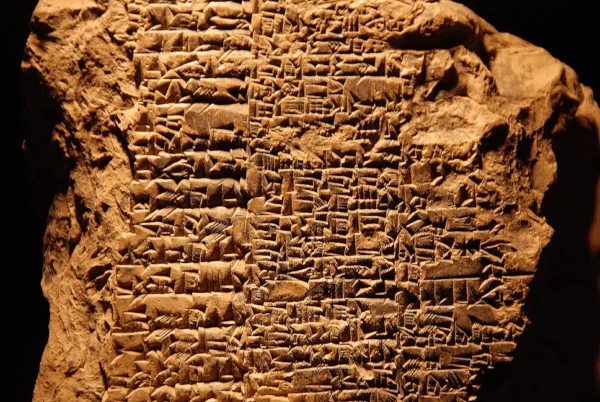
The “dung god” or “fly god”, Beelzebub, seems to be first built upon its sound and then the word-representation of such a sound via onomatopoeia. In the Kartvelian 3 , Georgian, and Sumerian 4 (all dating to at least 4,000 B.C.E.) we have the onomatopoeic “bzz, blzz, v’v, etc. which was used in such ancient kingdoms to represent a pestilent bug, especially that of the fly.
Words beginning with natural representations such as bird, river, tree, rock, bug, etc. also carried ‘associative name sounds’ or abstract meanings by which they move, act, ‘are as’, etc. Such words can become, over a process of time, assumed social memes. Furthermore, these social memes can be culturally integrated into the fantastic. I use the word ‘fantastic’ in the Tolkien sense here to explain such examples of fables and superstitious associations. Both Tolkien’s view of ‘temporary suspension of disbelief of the ordinary mundane world fused with Owen Barfield’s “collective representation” we can find an early world by which pestilence is related to the sound and name is of the ‘name-sound-thing’ called “Baal-zebub”. Such acts were
not view as efforts but rather as assimilation into a self-referencing tribal colony.
Therefore, ‘name-sound-thing’, in many early cultures, is one and the same. These societal associations can be hard to detach. Such associations become what we call endonyms, or insular socially based names. These can represent particulars which are a part of insular social structures.
From there, linguists can study cultures of focus for their semiotic usages such as signs and symbols by which they once upon a time were interpreted within their mythology/ideology/ theology/ sociology, etc. These phenomena do take ‘body’ or ‘social anima’ wherewith a particular culture can participate in its daily activities.
Such representations are found in 2 Kings 1:2 where the King of Israel, Ahaziah, fell through a roof injuring himself. Ahaziah, the King of Israel – knowing YHWH, calls on the god of the flies instead of YHWH. This god of Ekron called Be’el-zebub (god of flies) was an interesting social
4 Simo Parpola’s Sumerian etymologies; volume 3
3 Klimov’s Kartvelian etymologies
god that allows for us to view Ancient Near East primitive beliefs that many others believed in at that time, both Israelites and Philistines. It is interesting that the ‘type’ of injury was somehow addressed by Ahaziah as an injury that Beelzebub could fix. We see that Ahaziah’s belief was in Beelzebub’s ability to ‘take away’ an injury.
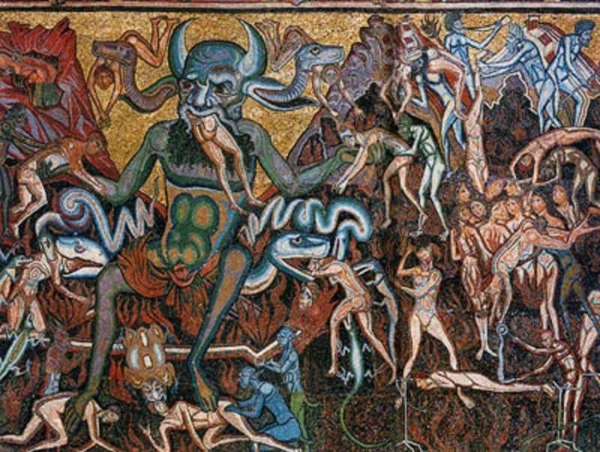
The boar is considered a ‘cthonic’ taxi into hell. Dr. Marija Gimbutas and Ted Hughes do quite an extensive treatment on the boar as the taxi which ‘takes away’ and ‘puts into hell’ some-thing. This belief can be read in William Golding’s, “Lord of the Flies”. Such a demon and god are interchangeable with Beelzebub, Lord of the Flies, the dung god, and reaching back to Biblical stories – the god of Ekron.
As Ahaziah, the King of Israel, believed that Beelzeb could “take away” his injury we can see this same belief predating the Bible in ancient Canaan and post dating Jesus’ scenario concerning powers of bind and loosing and attributions to Beelzebub 5 . Again, we see a rich verbal imagery in the Lord of the Flies represented as the Boar’s head who could take the flies ‘away’ from the camp and give ‘power’ to the leader of the group who was maddened with a “faux primacy”. Brilliant was William Golding to bring this out within his story for we have no recourse but chaos when our eyes are blinded to order. So, in the antimony of *God as Satan* we can see that we come to a seeming crux that is eliminated by Narrative such as in Job. The story begins with ‘representations’ of ‘evil’ as a rogue or roving Satan nearly ending Job’s existence to the end of the book of Job where it was GOD-YHWH all along Who did this destruction to Job *unto* Job’s betterment and rectification with God.
I find this so interesting when reading the Bible in Isaiah 45: 7, Romans 13:1-ff, and Colosians 1:16-17 that ALL THINGS ‘good and evil (both representing to us)’ are from, by, made for, made of, fulfilled in, determined by the LORD. Where is there dichotomy? Where is there room for dualism? Who can oppose the Prime Mover, the Only Mover, The Verb of all things?
Literary mechanisms for indefinable comprehensions
JESUS AS A BEELZEBUB
5 Grimm’s “Teutonic Mythology; volume 3; pages 998 and 99 we see the ‘shape’ of the devil as a fly. In the LXX, Jacob Grimm quotes 2 Kings 1, 2 as Baal-zeebub to be called in the Greek Baial muia, i.e. the fly god. In the ancient religion of Zoroastrianism (possibly dating back as far as 2,000 B.C.) we see the defiant spirit against Ahura Mazda known as the ‘devil’ named Ahriman. Ahriman is seen in the shape of a fly. In Lithuania, there is a myth of mussu birbiks – fly god. Such a god is usually found buzzing and blowing. Fairytales from Germany hold that diabolic spirits can be held in glass or “phials” (vials) as “flies”. Loki turned into a fly or ‘fluga’ when defrauding Freyja. A Lombard myth found in Paul Diac. 6:6 of the ‘malignus spiritus’ who settles on the window as a fly and gets a leg chopped off. Loki as a fly can get through keyholes (Norske folktales). Grimm’s “Teutonic Mythology; volume 4; pages 1604 and 1605 give us Belsebuc in the fragments of Madelghis. Referenced as “a fly such as a spirit shut up in a glass”. Hence, the myth “there’s a devil in the glass”.
Jesus was reproached as prophetically found ca 750 years prior Jesus’ stay on this earth in Isaiah 53. As we read from Isaiah 53 in paraphrase: “we esteemed HIM not as HE was stricken but that we knew HE was God’s anointed”. Isaiah tells us that we loved to cast our evils on Him — likened to Ahaziah’s view of Beelzebub . In Potts’ “Bible Proper Names” he says that Baalzebub was a “God of wandering” (vagationis, vel muscarum) as flies ‘wander’. Going “to and fro”, “roving”; the raven’s eye that scans back and forth. Josephus says in his Antiquities 9,2,1 says that King Ahaziah sent his ‘sickness’ (as a thing) to THE FLY’ <- that is, the god of Ekron was the ‘caster’, ‘carrier’, ‘exorcist’ and ‘receiver’. So, the god Baalzebub was viewed as the god of healing to Ahaziah. So, Beelzebub represented a ‘healing aspect’ to Ahaziah while reigning as king under the God of Israel which was YHWH.
Likened to Ahaziah’s beliefs, the Pharisees shared somewhat a muddled view of Jesus and blamed Jesus as the Lord of the Flies for Jesus could ‘take’ the disease from and (I assume) take the disease upon Himself ——making Him both a healer and an unclean thing (according to the Pharisees’ accusations).
COMPLEXITY ABOVE REASON TO THE PHARISEES
The complexity lies in the fulfillment of the One who would ‘loose’ or ‘release’ the ‘binding’ by which mankind has been ‘bound’ in prison to, i.e., sin. The exorcisms Jesus did were an ‘outward manifestation’ of the power that He held and could consistently do. The intriguing tie in between the word ‘cast out’ in Greek ( *ekballo* ek {out} + ballo {cast}) and exorcise gets close to the primitive view of Beelzebub. The Pharisees were relegating Jesus’ works to Beelzebub because many fallen men of Israel such as Israel’s king, Ahaziah, actually believed that Beelzebub could ‘exorcise’ or ‘cast out’ or ‘take away’ an evil spirit.
Already we are dealing with the Pharisees misunderstanding that “evil (Ra’ah – ‘destruction’) ” is ordained by God and that in their misunderstanding of the total Sovereignty of God, they fall into dualism making the world a good and evil place by which They can judge.
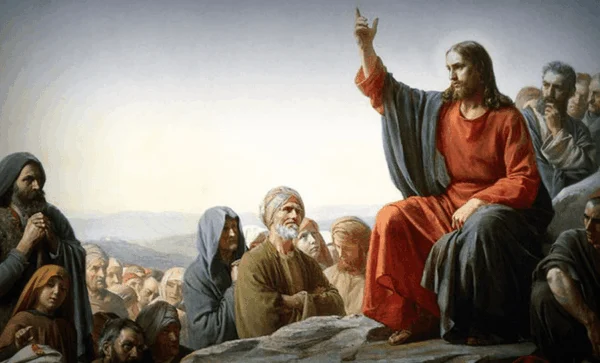
The Reason that Jesus brings is brilliant in Matthew 12:24. Jesus takes Sovereign Reason to the Pharisees. He shows the difference between “casting” and “loosing”. Again, ‘casting’ was believed to be an attribute of Beelzebub and to many Shamans throughout time. Whether they be smoke and ladders or ‘real’, Jesus showed His ‘casting’ to be consistent as (1) The Power of God (2) In respect by which most Jewish exorcist thought was the proper procedure.
Point number two was made by Jesus in order that He not stick out of the crowd as being anything more than a Jewish exorcist. But, it was the fulfillment of loosing that only Jesus had to release what His Father in Heaven had bound. In this, Jesus would *show* not only His title as exorcist but as Healer and fulfiller of Joel’s prophecy as the forerunner to the Holy Ghost Who would continue the work of God until the Kingdom of God be complete on this earth.
Jesus addresses the Pharisees’ blindness of the Kingdom of Heaven that the Pharisees claimed to be, i.e., the kingdom of heaven. It takes a complete understanding of the distinction between ‘casting’ and ‘exorcising’ to understand the ignorant judgments made by the Pharisees concerning Jesus ‘casting out’ as using Beelzebub’s spirit to exorcise when in totality, Jesus was ‘loosing’ spiritually and prophetically, though ‘casting out’ physically.
Here is my paraphrased attempt at Jesus’ famous words to the Pharisees based on Matthew 12:24 and following. I attempted to put in historical, social, prophetical and linguistic interpolations to bring a modern coherency for my understanding. My paraphrastic attempt here is ONLY for my inability to read rough-shod over these verses and ‘get it’.
“ Oh, you wretched Pharisees! How can an unclean thing cast out an unclean thing? How can Satan cast out Satan lest his house collapse? If I am Satan WHY am I casting out Satan lest I fall? What do you think I am doing then? Can you not see the incoherency in your Idle words? If I cast out devils being a devil then who’s authority (shem) do your children (disciples) cast out devils by? Am I not a Jew? Therefore, what ‘standard’ is held to the Jews to be an exorcist? Am I not exorcising before you? Do you not optically see the healing of this demoniac? Is there more to me than just me being a Jewish exorcist? What draws you to me, a Jewish Exorcist who is actually doing his job correctly and by the book? Am I not doing legitimate exorcisms?Do you
not see the miracles I do in the physical world before you? Do your eyes betray you? In contrast, are other Jews displaying this power? Are there other Jews in the name of the law and not the prophets that are doing the same things as I? In contrast, are there successful exorcists using My Name who are completing these same miracles? Yes, there are! Would you argue that they are not? Are they working or not?
I say that there is not only the physical miracle that your eyes see before you here and now but the fulfillment of the Kingdom of God which was prophesied to come. I am that fulfillment of prophecy. It is now which the prophets spoke of. I justify not only my acts of exorcism, but the fulfillment of binding and loosing by which you claim to understand. I am releasing – loosing that which was put into binding by My Father in order to show prophecy’s fulfillment. It is Me and My Kingdom, my Children of My Authority, that are fulfilling not only All Righteousness but the
grasping for hope in a failing pagan’s idea of just who Beelzebub was supposed to be for them. Just and true is judgment and fulfillment of prophecy here and now. I am the Judgment. I am the answer for the Prophets of the Jews and the fallen pagans of this world who were bound to find a ‘representation’ of a savior type.
Until your time and your children’s *time* has come, your children shall be without knowledge feigning your judgment. They shall be your exorcists feigning you to be exorcised or exorcising someone that is not needing such an exorcism. You feign loosing and binding yet have no understanding of this time at hand to fulfill such prophecies that Joel spoke of. It is I which is in agreement with what My Father and the Holy Spirit do.
Yet, for now, you define whatever ‘evil and good’ means to you and you teach it to your followers. But as to your followers, students and future Pharisees who watch and hear me teach the Gospel and then listen and watch you incessantly contradict yourselves, they will remember my Words to see if your words and your actions hold up. They will see which is evil and good – i.e., that which builds up and that which breaks down upon itself. To those who are two fold the children of blindness that you teach, they will either judge you by my words, wittingly or unwittingly, or they will judge you by what you call devilish and judge you by the confusion which you have taught them. Loosing and binding is Joel’s prophecy concerning now. I AM the fulfillment of God’s Will that by the Holy Ghost I shall cast out that which is bound by God. You condemn the very Spirit by which I cast out. If I cast out by the Spirit of God then the Kingdom of God has come upon you and you are already judged. Again, you call yourselves the Kingdom of God, yet ironically enough, you are already in Judgement since I AM the Judgement. All is exorcised now and judgment is already done for I AM the Judgement. Therefore, If I come “casting out devils” then I am here to cast you out. Yet, this is not what I am doing. I am releasing the bindings by which my Father established in order that I might show the Power of the Kingdom of God is here and now with me. You are either with me or not. You either gather or scatter. But don’t you dare mock the Holy Spirit which releases those who are captive in this world with many sins too grievous to bear. I am here for my little ones who will follow in My Shem – My authority! You can mock me as a man but you will not be forgiven in this life nor the next if you mock the Holy Spirit which works in me. Nonetheless, you are vipers. Nothing good comes out of your muddled hearts, minds, mouths… you lay in wait to strike, injure, maim, kill. For whatever your heart is, your words will reflect your heart. For your words will either justify you or condemn you”.
THE SUFFERANCE AND GENTLENESS OF JESUS AS EXORCIST
There’s a hint that I get in the Gospels where Jesus heals but is fulfilling the act for what man has staged. This may be way out of line at this juncture but I wouldn’t oppose this hypothesis right now since the “Logia or Memra” brings us to this juncture: *of all the ‘powers that be’ – (Greek:‘exousia’) they are indeed of God…so, how could God be casting His own works out? Jesus makes this clear to the Pharisees. Why would He loose and bind at random? He wouldn’t. Jesus told the Pharisees that they make laws and break them —all which make life unbearable
to the sons and daughters of the Pharisees- spiritually speaking. Why shouldn’t there be binding of HIS own accord? Wouldn’t this fit the schemata for all of the Old Testament Evil Spirits or Satans? That is, the demons, evil spirits, Satans, etc. were nothing more than Secretaries, Agents, “The Hands”, “The Eyes”, etc. of the LORD. Wouldn’t exorcism, therefore, be the loosing of the necessary binding that God put on mankind for a while? A binding to make those who were most bound most thankful? I couldn’t argue against this in the field of Sovereign thought. Could it be, in my final thoughts, that Jesus was gentle with the mysticisms of HIS day and that HE did not ‘break the traditions of men by doing something different according to the formulas for exorcisms but rather had the REAL POWER to exorcise?
Also, Christianity had not begun as we call Christianity. Jesus was a Jew preaching the “euhados” or the “well way”. So, the Pharisees would have to mete out with their judgment with the same scrupulosity that they gave Jesus. If the other Jewish exorcists weren’t casting out or loosing the demons how much more judgment should they meet out! Than Jesus? If they didn’t then the inequity of their judgment would proclaim their hypocrisy and Jesus’ Godhood. Concerning not only the potency of Jesus’ exorcism power His ‘style’ would have shamed the snakes and ladders show with His meekness.
I say that Jesus gently respected and implemented the idea of ‘formulae’ for exorcisms as understood by 1st century Chrestoi and Jews. Jesus did the formulae revealing His sufferance to the incompleteness of such mysticisms within exorcisms. This earmarks the title of Son of Man where He took on all of the fallacies of man while His title “Son of God” is His authority over Heaven and earth. ///// Yet, by His true healing hand did He fulfill and reveal His role and the role of the Holy Spirit in the prophecy of Joel 2:25 – 32. This passage is somewhat shroudedin apocalyptic verbiage but is fulfilled soon after Jesus’ resurrection in Acts 1:11.
The Holy Spirit is doing His work now on earth to confirm the power of healing, exorcisms, preaching the Gospel through the Martyrs of the first century Church with signs and wonders. The Holy Spirit’s power at that time (ca. 35 A.D. to 100 A.D.) was expressed in Palestine and in foreign lands. They continued Jesus’ work by casting out or ‘loosing’ those who were ‘bound’ to a littany of sin. They experienced hearing the Gospel in foreign languages that are intelligible and understood.
Therefore, Jesus’ binding the ‘demon possessed’ would be ‘loosed’ by the First Church Martyrs. It was therefore, by Jesus’ “NAME” or “Shem” that his exorcising power would continue with Jesus’s Disciples through the Holy Spirit which is the Seal of God upon these precious Martyrs.
THE NATURAL MAN
The Natural man is only condemnable when left to his accord. He is not, however, left to his accord for God is working through ‘all things’ to bring an ‘apokatakalleo’ – or ‘return to wholeness in perfect harmony’ as we see in Colossians 1:17-ff:
Colossians 1:17-ff – “He is before all things and in Him all things hold together. {18} And He is the head of the body, the church; He is the beginning and firstborn from among the dead, so that in all things He may have preeminence. {19} For God was pleased to have all His fullness dwell in Him, {20} and through Him to *reconcile {Apocatakalleo – ‘restore and bring back to harmony) to Himself *all (panta – ‘every’; ‘not one thing missing; all) things, whether things on earth or things in Heaven, by making peace through the blood of His cross.
Therefore, not only must the natural man have a supernatural reckoning with Christ it is obvious in Colossians 1:17-ff he will! Colossians 1:21 continues with addressing our ‘once upon a time natural man’ that was hostile (by *nature*) to God but that we are now (all) reconciled to God in our continuance (not our works but of God’s) of our new man which is reconciled. In God’s working through us we will continue, we will establish, we will not be moved from the hope of the Gospel ! Why? Phillippians 1:6 “Being confident of this, that HE Who began a good work in you WILL carry it on to completion until the day of Christ Jesus”.
Ephesians 2 makes it clear that we were at one time “naturally damned”. What does this mean? We’re damned for good? No. It means that our ‘state’ was, is, will be damned ‘in that state of fleshly being’. That is, the ‘state of the flesh’ is already damned. The NEW you is not. And it i this Hope that eliminates the illusory battles of ‘good vs. evil’. It is the NATURE of man that will be used mathematically by God until at each increment that lesson of Natural damnability is no longer needed. We are no longer ‘our flesh’. When the lesson that we can’t get it together in the Natural state is learned we’ll be moving on to higher ground. The Will with its stories to tell along
the way will be used as a witness concerning Sovereignty. We will preach to the world of our being saved from the impotency of the flesh.
It is under the umbrella of being human that we are all bound to the flesh and the fallacies that go with it. We are bound to it until we are ‘scored’ with the tattoo of God slowly but inevitably. We are marked for Life. This is binding and loosing, this is the exorcism of the flesh out of us – a supernatural act, and a direction not chosen by man but God UNTO salvation.
Preface
Who is the ‘god’ of this Age?
Let’s start here in Ephesians 2: “Once (pote – ‘a *time when*) YOU (the predestinated child Ephesians 1:4) WALKED according to the age (AEON- era) of the world…of this accordance to the “archon” or “ruler” ***of the air*** and the ***spirit** NOW working in the sons of disobedience.
This is the Greek archon, leader or god of the age (aeon/era/ hora/ hour/horizon/) by which 2 Corinthians 4:4 refers:
“The god of the age (aionos-era) has blinded (tuphlos) the eyes of the unbelieving (*apeitheia* = ap {not} + peitho {persuaded}. So, at one time you, believers, were ‘hardened, immovable, insensitive, not persuaded so as not to beam forth (augasai) illumination of the gospel”.
So, Ephesians 2 and 2 Corinthians 4 give us terms such as “ruler, authority, air, spirit, —all which are *now working (Greek: Nunti)* , in the sons of disobedience. This means that we have a ‘present day god’ who is currently-now working (energountos) in the ‘sons of apeitheias (‘the immovable-unrepentant’)’.
So, I continue with WHO is this ‘god’? Well, he walks, talks, rules, blinds, acts, acts within THIS AGE, THIS TIME, THIS DURATION, THIS ERA, THIS AEON.1
This is most important to understanding what he is by name. The Indo European root for “Time” is “timon” which shares the exact origin with Demon. “D’-mn is the P.I.E. root for “divider of time + god” . To find the zero grade root for ‘time’ and ‘demon’ has its primacy-root in “de”. A good treatment on this amazing root can be found in Dr. Joseph Shipey’s work on Proto Indo European roots to the American and English language. It is in the here and now as to when and where “The Divider” acts. That is, both in space and tempo. Should it be a wonder therefore, that the Latin Vulgate gives us the Latin “TEMPUS” for “Temptation”. It means ‘to be strung across time, to be stretched, pulled, torn, divided, rent, —i.e. “TEMPO- ed” … or, “OVER-TIMED” …i.e., you have been tested on the duration of your faith.
1 Chronos, as in ‘time’ and ‘god’, most certainly fits the bill for “The Satan as ‘tempo’ or ‘tempter’. Chronos ‘consumes’ us all in his ‘divisions’ of time and is the head or “archon” of ‘time divisions/ the eras’. His consort/ bride is Ananke. Ananke was given a tremendous treatment in Plato’s “Cratylus”. She/ It is the
field of thorns and thicket by which one traverses for their erotic fulfillment at the end of such a telegraph. The outcome is never what it seems to be in one’s hopes and initial desires.
James 1:13,14 – “(let) no one being tempted (“Tempo – Latin/ Greek:peirazomenos – put through trials, dragged, pulled through {in this age/ time/ duration} ) say, “By God I am being tempted –for God cannot be tempted and He tempts no one. A man is tempted (*peirazetai* – drawn out, pulled through, dragged, put through) by his own desire ( epithumias – passions that drive one) – being drawn away and being enticed (deleazo – ‘baited’, ‘lured’) …THEN, *desire* or your *passions* (eros – ‘e’ – ‘out’ + ‘rous’ – ‘flow’/ ‘river’), having conceived, gives birth to sin (harmateia – that which misses the mark). Once sin has become fully grown it brings death”. ——-/// So, I’m immediately brought to the first chapter of Job in the dialogue of God and “the Satan”. Satan was given the boundary lines by which he could ‘do his work, authority,
authorship, energy, work, etc). Satan was always known in the Farsi, old Hebrew, and old Slavic as a word that denotes ‘sifting without mental cognisance’. Even when “the Satan” in the book of Job answered YHVH as to what he was doing his reply was, “Going to and fro” – i.e., ‘meandering, roving’. In Zechariah 4:10 –God’s eyes were considered “The Satans” because they rove in judgment. / His (Satan) was governed by an overriding force and in our terms, bound to or limited to which he could ‘work’ or ‘sift’. In Isaiah 45:7 – ff. it is God who says, “I, the Lord, *create both Good and Evil”. The Hebrew says that “evil” is “ra’ah” which means ‘falling down, destruction’ (such is found in the “evil” or “ra’ah” that God creates in Isaiah 45:7). So, it is God’s essence that is shared with Father and Son having set the ordained plan from God’s Tselem (Hebrew “mind/ imagination”) to create all things and to reconcile all things unto Christ. /It is God’s eyes which are ‘fully fit’ to scan, judge, see, etc. — i.e., His “Satans”…Zech 4
Does the god of this age have free agecy?
Colossians 1:15-20: (15) (Jesus) is the image of the invisible God, the firstborn of every creature: (16) For by him were all things created, that are in heaven, and that are in earth, visible and invisible, whether they be thrones, or dominions, or principalities, or powers: all things were created by him, and for him. (17) And he is before all things, and by him all things consist. (18) And he is the head of the body, the church: who is the beginning, the firstborn from the dead; that in all things he might have the preeminence. (19) For it pleased the Father that in him should all fullness dwell; (20) And, having made peace through the blood of his cross, by him to reconcile all things unto himself; by him, I say, whether they be things in earth, or things in heaven.
Isaiah 53:1-ff (750 B.C.) supports the brutal enactments unto a predetermined glorious ending:
(1) Who hath believed our report? and to whom is the arm of the LORD revealed?
(2) For he shall grow up before him as a tender plant, and as a root out of a dry ground: he hath no form nor comeliness; and when we shall see him, there is no beauty that we should desire him.
(3) He is despised and rejected of men; a man of sorrows, and acquainted with grief: and we hid
as it were our faces from him; he was despised, and we esteemed him not.
(4) Surely he hath borne our griefs, and carried our sorrows: yet we did esteem him stricken, smitten of God, and afflicted (Scapegoat/ Sacrificee theme fulfilled).
(5) But he was wounded for our transgressions, he was bruised for our iniquities: the
chastisement of our peace was upon him; and with his stripes we are healed.
(6) All we like sheep have gone astray; we have turned every one to his own way; and the LORD hath laid on him the iniquity of us all.
(7) He was oppressed, and he was afflicted, yet he opened not his mouth: he is brought as a lamb to the slaughter, and as a sheep before her shearers is dumb, so he openeth not his mouth.
(8) He was taken from prison and from judgment: and who shall declare his generation? for he was cut off out of the land of the living: for the transgression of my people He was stricken.
(9) And he made his grave with the wicked, and with the rich in his death; because he had done no violence, neither was any deceit in his mouth.
(10) Yet it pleased the LORD to bruise him; he hath put him to grief: when thou shalt make his soul an offering for sin, he shall see his seed, he shall prolong his days, and the pleasure of the LORD shall prosper in his hand.
(11) He shall see of the travail of his soul, and shall be satisfied: by his knowledge shall my righteous servant justify many; for he shall bear their iniquities.
(12) Therefore will I divide him a portion with the great, and he shall divide the spoil with the strong; because he hath poured out his soul unto death: and he was numbered with the transgressors; and he bare the sin of many, and made intercession for the transgressors.
As we see in this prophecy (Isaiah 53:10) 750 years before the Birth of Christ that it pleased God (Father) to ‘bruise’ Jesus —put Him to agony unto death…for the PURPOSE of (Colossians 1:20) *reconciliatory (apokatallazai) salvation literally ‘unto all’ (Panta – every) …not a random meaningless pointless act but a Providential Intention.
This includes the *works of evil* which is done by God’s ‘tool of evil’ – “the adversary” – “the antagonist” – The Satan – The Devil “. Otherwise, “evil” would exist as part of the essence of God and therefore Creation would have evil in its essence via its Creator. This leads to senseless arguments about redefining the lines of evil and creation at this juncture. If there be ‘evil’ *as* God, or at least part of His ‘essence’ then it wouldn’t be called ‘evil’….it would be called God.
Therefore, there is a “narrative” of *good* and *evil* as is defined through the complex and multilayered stories of the Bible.
How does the god of this age ‘work’ with a Sovereign
God in all of His goodness?
Does evil have an office by which it acts in accord with
God’s Sovereignty?
Is sin your choice or is it an ensign to remind you of your
inability to go to God?
ENTER SIN INTO THE HOLY
Is ‘sin’ a random act from a compulsory sense of being or is ‘sin’ participatory in the ‘coming to be’ process to shed ‘what is’ in the scheme of God’s ordination?
If (Romans 13:1-ff) ‘all powers (“archons” – ‘governments/ leaders/ rulers’) “that be” are ordained of God” then what are we to think of the ‘coming to be’ of both good and evil leaders? Can Hitler claim ‘independent agency’ in his actions if (1) his sins be true – by the literal definition and (2) Romans 13:1 says that God ordained his actions? Not by etymon – not by Scripture.
sin (n.) (the more simple definition)
Middle English sinne, from Anglo Saxon synn, syn “violation of divine law, offense against God; moral wrongdoing,” also “injury, mischief; enmity, feud; guilt, crime, misdeed,” from Proto-Germanic *sundiō “sin” (source also of Old Saxon sundia, Old Frisian sende, Middle Dutch sonde, Dutch zonde, German Sünde “sin, transgression, trespass, offense,” extended forms)
**The older notion of ‘sin’ means “it is true,” i.e. “the sin is real” (compare Gothic sonjis, Old Norse sannr “true”), from PIE *snt-ya-, a collective form from *es-ont- “becoming,” present participle of the root *es- “to be.”
The semantic development would be via the notion of “to be truly the one (who is guilty),” as in Old Norse phrase verð sannr at “be found guilty of,” and the use of the phrase “it is being” in Hittite confessional formula. The same process probably yielded the Latin word sons (genitive sontis) “guilty, criminal” from present participle of sum, esse “to be, that which is.” Some etymologists believe the Germanic word was an early borrowing directly from the Latin genitive.
As I have found that “sin” is found in the Latin “SENEX” to mean ‘old, without direction, wavering, stumbling, demented, to have travelled from the line, traverse past the straight line. Interestingly, “SENATE” connotes “elders” of the State who ‘have come to be true to their seat’ —- though they be full of maturity in their office have they ‘spoiled’? After all, where do you go when you have absolute to near absolute power?
Another support to the fuller color of this meaning: Aristotle’s “Coming to Be” and “Going Away” treatment give us the disposition by which we should ‘know something or someone’. The question he poses is simple: “And then what did it do? and then? and then? and then?…etc. This leads to (maybe in all respect, came from) Plato’s study of “Phusis” or “nature”. With all that is defined concerning “sin” plus both genius minds of Plato and Aristotle we come to the conclusion we see that sin means ‘a concluded truthful view of the actions of something’.
Evil entered Holy Creation through sin. But this has nothing to do with an idea of what we think “free will” means. If Jesus was the Lamb slain from the foundation of the world then JESUS was a part of the Holy act of creation — INCLUDING the “””evil””” that man would do to put HIM on the ordained cross. In other words, ALL that was in the mind of God to *CREATE* the beginning to end and ALL of the sequences of events in the middle were set before they happened and this *IS GOOD* (“good” – Hebrew: *tov*-”beneficial”; “builds upon itself”, “anabolic”, “supports itself and the next step”). “Tov” or “Good”, as the Hebrew mind conveys, is not necessarily ‘happy’ but ‘beneficial’ in the plan of God, not sinful man’s plans.
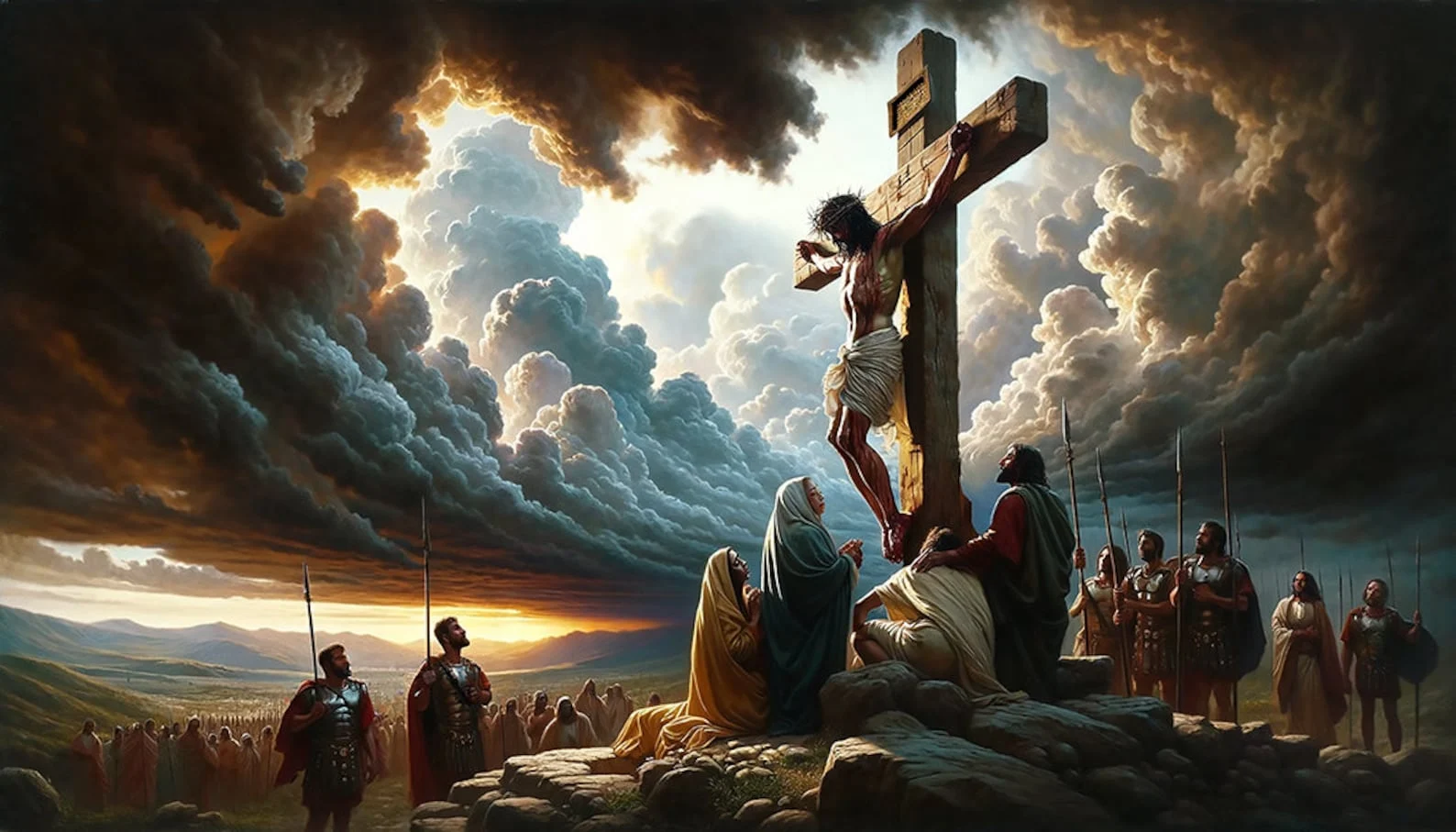
God did not sin but ordained the ‘archons’ or ‘rulers’ in HIS grand Narrative to put Jesus to death at the act of creation (Revelation 13:8). It pleased God the Father to This was not an act of man’s ‘free will’ but an act of ordination by God – > Acts 2:23 “Him (Jesus), being delivered by the determinate counsel (‘te’- BOULE = “the WILL”) and (also) the foreknowledge of God—– (this verse goes on to speak of the ‘narrative’ by which the ‘actors’ do put Jesus to death—”ye have taken (you have taken Jesus), and by wicked hands have crucified and slain”. Again, Revelation 13: 8 makes it clear that Jesus is the Lamb that was slain from the foundation of the world…i.e., at the “creation point” our God-Father WILLED (boule) Jesus be put to death. Moreover, Revelation 13: 1-8 un-caps’ {apo = ‘off’ + kalupto =’cap that covers’} the Kingdoms of the earth for whom power was given (by God) to mock God in HIS holy temple service. Babylon-Persia (lion), Greece (leopard) and Rome (Bear). Not just the Bible but us…as to how *we* should play out. As Revelation 13 continues we read that there is yet another Beast that had/has not/ will have a power likened to that of the first – I believe this first beast was Babylon led by the ‘god-king’ with various names for the various cultures which called him by their view of him: Nimrod/ Nebrod/ Marduk/ Enmerker/Narmer. In any case, it is “new Babylon” with its Final System of Worship – much like that of the Old Kingdom where ALL bowed to
Nimrod. This time though, the ‘system’ would be a full-on contagion that marks the world with His power. Anyone not worshiping his system – a.k.a. ‘receiving the *mark* of his likeness’ should be put to death. I remember studying the Sumerian/ Babylonian word for such a mark or ‘demarcation’ of *power*. The Sumerian word was called: “ME”. Not as in “me” in the English
(yet ironically – exactly what it is). The Sumerian word “ME” defined by Dr. John Halloran meant: “essence, function, office, responsibility, ideal norm; the phenomenal area of a deity’s power; divine power; divine decree; cult {the culture beset by the norm of operations}; silence as to anything against such a system”.
Such a system was ORDAINED yet—-the ‘authority’ by which it stands was already mentioned here in reference to Ephesians 2:2: “The ruler of authority of the air – aka, the Spirit now working in the sons of disobedience”. Also, read on in 2 Corinthians 4:4 – “the god of this aeon – “. Satan as a ‘roaring lion’. In all such cases, this Satan character is the head of the cosmokriton (world) and aeon (age) but not the Kingdom of Men as we see in Daniel 4:17. All men, whether in the faith or not, experience the Roaring Lion, Satan, in the world. In 1 Peter 5:8 says, “Be sober, be vigilant; because your adversary the devil, as a roaring lion, walketh about (just as the Satan in
Job), seeking whom he ****may (‘be allowed’ to do his nature)**** devour: (9) Whom (Satan) ‘resist stedfast *in the Faith*, **** knowing that THE SAME AFFLICTIONS ARE ACCOMPLISHED IN YOUR BRETHREN THAT ARE IN THE WORLD.****
Is this not Universalism? Is this not Sovereignty? From the oldest book in the Bible, that is, the book of Job, we have absolute agreement as to how Yahweh uses Satan to do YHWH’s desire.
This devouring is done on all men to ‘accomplish’ us. We have read this all wrong in the English!!! ugh!!
Another example is prophecy. Unless everything goes perfectly (that is: required WILLED ‘ra’ah {“evil”} and ‘tov’ {“good”}, then prophecy could never come about. Just as in Daniel 8 and 9 prophecies an exact number of years for the Messiah to come back concerning the 70-sevens/ Shavua (490 years) from decree to Jesus and the final 7 years (Shavua) of the 490 being Revelation’s final 7 years. Unless Nehemiah was given a decree by Artaxerxes, the Persian King, to go back into Jerusalem and rebuild the temple..then we wouldn’t have the final prophetical event of Daniel – i.e., Christ, to the Day, riding into Jerusalem as King of Kings. One act requires the next and so on. Daniel 9:24 – “Seventy Shavua (490 years) are determined upon thy people…..etc. :25 “from the going forth of the commandment to rebuild Jerusalem (Historically, we know that this was ca. 445 B.C.) UNTIL THE MESSIAH will be 69 SHAVUA (483 years {this puts Jesus roughly at 34 – 38 A.D. – depending on the calendrical formulas proposed by numerous ‘calendricists’. After this, the sons of disobedience (sons of the Prince/ANTICHRIST) will destroy the Temple (at Masada–ca. 70 A.D.). (then-at a futurative date) He (antiChrist) will confirm a ‘covenant’ for 7 years <- that is, the last “SHAVUA”. ///
So, this is ‘mathematically’ set at the beginning of Daniel’s prophecy to us. Daniel lived as a Persian captive who knew Persian astrology and probably taught this prophecy to the Persian Magi. Even the horrors of Herod slaughtering all of the children under two years of age (Prophesied by Jeremiah 31:15 and fulfilled in Matthew 2:16 – 18) was a necessary evil to drive Mary, Joseph and an unborn Jesus to Bethlehem where Daniel most assuredly told the Magi where Jesus would be…otherwise, the Magi were told directly by God.
Either way, all of these chain events could not be at ‘random’ if the Scriptures concerning prophecy about “what Will happen”. There are no dates that the heathen, atheist, agnostic, or anyone has placed on the prophecy of Daniel that would nullify the coming of Christ on a donkey and being praised as The King of Kings.
Part 2
Satan is the Agent of Evil While the Lord is the Prime
Cause, Intender, Motivator, and Predeterminer of Evil
June 26, 2023
Look at the phrase: “The Patience of Job”. Why is this such a catch phrase for the ages? It is because Job exercised “patience” in God’s will….not in a chaotic action by an arbitrary ‘evil’ force. Otherwise, we would have a dualistic ‘faith’, i.e., ‘believing’ that either good or bad ‘might’ win. Using reason, this IS an insane ‘kind’ of faith. Sadly, in our Christian culture, this is where we’re at. Therefore, why not ‘believe’ in the Devil if he is the ‘other’ lord of action, force, dynamism in this world? Optionally, “dualism”, -i.e., good vs. evil, renders theological insanity within the Christian church.
Examples go as follows for ‘dualism’ in the Church: “Eugene died in a horrible car crash – God would never have this happen”. “Those Christians in the train wreck died not at the hand of God”. Etc. So, where is God? Where is the Hand, Intent, Providence, Predeterministic God of the Bible? Our Biblical answers to our modern day catastrophes can be found in the ancient but timeless Word of God: The Evil (or The Satan found in Job) is a *quantity* brought by The LORD (cf.Job 42:11). Job’s family comforted Job ‘’from all the evil that the LORD had brought upon him (Job)’’. Again, the *agent* of destruction is The Satan. The Satan is found in the first two chapters of Job as being ‘directed’ to Job. The LORD ‘limits’ Job’s destruction at the
‘borderline of death’ —but everything else is within the “legal limitations of destruction by Satan”.
Dr. Tur Sinai in his book, “The Book of Job”, makes it clear that “Satan” did not have the suffix“-an” originally–as in “Shat-an” or “Sat-an”. Rather, this added suffixial “-an” came later to make it personal…i.e., “THE doer of disparaging- destroying, etc.” Such was NOT the case in ‘ITS’ original and oldest Semetic form as in Shat, which meant “to disparage”. Here, we must contrast “Shat/ SHT” from “Shatan, Satan, Shaytan”. For it was a social convention in assimilating with the neo-Babylonians and Persians that the Jews in Neo-Babylonian and Persian captivity adopt the ideas of the Babylonian and Persian ‘verbs of motion’. These approaches, for sure, gave power to the quality of action as “the mover, intender, actor upon, etc.{ cf to footnote 1}”. This
was not so in the earlier conventions of language concerning a Satan – i.e., SHT or Shat. ”Shat/SHT” was not a personalized doer, rather, SHT was the *agency* by which destruction occurred in the context of the story. It was the INTENDER that was the Prima Causa to the agency.
I find it interesting that the ancient usage of “SHAT” or “SHT”, i.e., “to disparage”, is the verb which means ‘to belittle to nothing; to make someone feel like nothing’. It is the VERY *picture* of the New Testament Greek word“MISEO” which is used in Romans 9 to mean “hated” in the sense of “reduced to non-importance, dismiss (hence the Greek: “Miseo”, not count (at least, for now)”. It is little things like this (from Sumerian to Older Hebrew/ Semetic to New Testament Greek semiotic/ endonymic agreement) that give me the rest in the consistent Theology of a
timeless God and His agents. This is why it is so important to study the ancient pictographs of the old world – for when the pictograph went away for ‘advancing societies’ the picture went away as to the IDEA to the word. Yet, not all is lost! Much study can ‘reconstruct’ the Sovereign Word of God which holds us all together.
Another highly interesting point that I have found in Scripture is that “SATAN” is used as the agent OF God and Later ‘dismissed’ into non-existence for the Story’s sake. Zechariah 3:1 makes it clear that Satan was an adversary innately while he was *at the right hand of God*. And, yes, Satan was *rebuked* because Zecharia’s prophetic *Joshua (i.e., the archetypical Jesus found here in Zecharia’s prophecy)* would be tempted and overcome. Was the act of overcoming sin by the prophesied Joshua/ Jesus THE rebuke, THE dismissal of Satan in this timeless-a-tempo prophetical scenario? I say, YES. Zechariah lived nearly a
thousand years after Joshua and YSHUA is both Jesus’ name and Joshua’s name.
This development of *the word and idea* is encased in a web of traditions that I plan on solving by going back to the very origin of Word and Idea.
WORD AND IDEA
Let’s start with the unbelievable comparative philologies and threading to both THE WORD “Ba’al – zebub’ and the Idea of what the “Lord of the Flies” really meant (*repulsion, offense, directives due to such repulsion, hating yet needing, etc.) to the ancient Philistines — probably an ancient Agean culture with its 5 main cities encamped in old Philistia (Canaan — now Israel).
Words related to the birth of the Name, “SHT”
Here are some of humankind’s oldest languages (nearing the Mother of all of our languages) with their similarities in a composite sketch for “Satan”. KEEP IN MIND, WE ARE DEALING WITH PICTOGRAPHIC SOCIETIES WHICH ‘DEPICTED’ STORIES WITHIN THEIR ‘WORDS’…SOMETIME, MANY EVENTS ARE SEEN WITHIN ONE PICTOGRAPHIC WORD.
Proto Uralic Saksa – filthy; unclean/ SIT – to bind/ SITTA – (slang) shit/ SIJTE – Grove – offering place (garden)/ SIB (as in the Philistine “FLY” – Lord of the Flies) ‘to cast a spell”
Sumerian —- (all Sumerian words represented here for 1) filthy 2) bind 3) (slang) ‘shit’ 4) Grove/Garden/’offering place 5) ‘fly’ (as pestilence) are cognates to the Proto Uralic, Ugric, and Finnic (Finnish) — i.e., Sumerian matches the P.U., Ugric, and Finnish — even nearing in spelling (Grimm’s equivalents)
Ugric (same as above)
Finnish (same as above)
*Conclusive ideas:
1)There was ONE STORY that was CARRIED THROUGH THESE PICTOGRAMS and
germaine to the entire old literate world spanning from the Saami (Old Finnish) culture to the Ural Mountain ranges to southern Mesopotamian Sumeria. This WAS the World.
2)The ‘nature’ of “the Satan” is to tempt, but, the mover of the agency of temptation is the Lord
Himself. Keep in mind, the suffix “-an” for Satan was not Hebrew, rather, a loan suffix given by a corrupted Neo-Babylonian and Persian idea which they corrupted from a much earlier form –i.e., SHT/ Shat..
3)When the pictograph went away the picture went away as to the IDEA to the word.
4)To think that “SATAN” came from its first beginnings as the literal “shit” and where we have taken it into some ‘rogue’ agent that can fight the Lord’s will IS “satanic”..lol
5) The Evil (or The Satan found here in Job) is a *quantity* brought by The LORD (cf.Job 42:11). Job’s family comforted Job ‘’from all the evil that the LORD had brought upon him (Job)’’. Again, the *agent* of destruction is The Satan. The Satan is found in the first two chapters of Job as being ‘directed’ to Job. The LORD ‘limits’ Job’s destruction at the ‘borderline of death’ —but everything else is within the “legal limitations of destruction by Satan”.
Footnote #1 The Arabic borrowed this later meaning, Shaytan or Satan, and once again, loaned it into the later medieval Hebrew language – which reinforced it as a Word of Assimilation into the Hebrew Culture. Yes, the Hebrew translators could have used “SHT” for a more contextually fitting “SHT” – i.e., “satan” – versus our modern ‘rogue actor of evil’. This is, for sure is a result of the Babylonian influence on the Hebrew Pharisees in Babylon which ‘borrowed’ this word and I believe has caused our modern Church to be ‘dualistic’ and corrupt.
Part 3 – Biblical – Historical/ Zechariah 3’s Achaemenid
“Satan/ Satrap”
The middle argument for Persia’s influence on Judaism’s language
Zechariah 3:1 ►
NASB Lexicon
NASB © Hebrew Strong’s Origin
Then he showed וַַּי ְר ֵ֗א ִני
(vai·yar·’e·ni) 7200: to see a prim. Root
me Joshua יְהֹו ֻׁשֻׁ֙ש ַ֙ע
(ye·ho·v·shu·a’) 3091: “the LORD is salvation,”
Moses’ successor, also the name of a number of Isr.
from Yhvh and yasha
the highַ הָּג ֔דֹול
(hag·ga·do·vl,) 1419: great from gadal
priest ַה ֹּכֵ֣הן
(hak·ko·hen) 3548: priest from an unused word
standing עֵֹ֕מד
(o·med) 5975: to take one’s stand, stand a prim. Root
before ִל ְפֵנ֖י
(lif·nei) 6440: face, facesfrom panah
the angel ַמ ְלַ֣אְך
(mal·’ach) 4397: Strong’s Exhaustive Concordance
ambassador, angel, king, messenger;
From an unused root meaning to despatch as a
deputy; a messenger; specifically, of God, i.e. An
angel (also a prophet, priest or teacher) —
ambassador, angel, king, messenger.a messenger
from an unused word
of the Lord, יְ ָהו֑ה
(Yah·weh) 3068: the proper name of the God of
Israel from havah
and Satan וְ ַהָּׂשָ֛טן
(ve·has·sa·tan) 7854: adversary, also the name of the
superhuman adversary of God of uncertain
derivation
standing עֵֹ֥מד
(o·med) 5975: to take one’s stand, stand a prim. Root
at his right hand יְ ִמ ֖ינֹו
(ye·mi·nov) 3225: right hand from an unused word
to accuse ְלִׂש ְט ֽנֹו׃
(le·sit·nov.) 7853: to be or act as adversary
denominative verb from satan
him.
I argue that the first appearance of the term “Satan” as a noun in the Hebrew Bible ought to be understood as an administrative official. It is in the ‘solidity’ of the Achaemenid Empire that one can now apply this ‘Satan’ as official to the Achaemenid council, Jewish Priestly class, and the angelic hierarchy. From the bottom up, the politically known evidence for Achaemenid structures provide a new way to read Zech 3 as we find in Herodotus’ account of Darius and his organizing the Persian Empire into tax districts or “satrapies”.
In the honorary Davidic era it was always the king who chose the high priest. In the
Achaemenid era, the priest would be chosen by the Great King. We have a parallel of
‘grounded- political actions founded by both political entities. Amongst the Persians the kingly duties were fulfilled by royal surrogates, the satraps. That the satraps represented the king and— as our Biblical Satan is with his emissaries, likewise, the
Persian satraps attempt to replicate the Persian King’s Kingly abode and jurisprudence. This ‘representation’ by the satraps to the King’s realm is a well documented fact.
As I stated previously concerning Zech 3, Joshua stands before “the Angel”. Again, it is so interesting to read in Hebrew that “MELEK” means “angel” here as much as it means “King” in other places. Who should decide which is a better translation? Context gives us the means by which we can translate more accurately. Therefore, why can’t this be another allusion to the Christ figure? It is YHWH’s “KING” – (as it is equally translatable to “angel”) that is presented. Would the King “TO COME” not be Christ Himself in this allegorical consecration? Are we still not in Zechariah 3’s prophetic vision? Yes, we are.
The temporal authority by which the satrap had to establish satraps as royal representatives is found in Zechariah being transferred to the heavenly realm, where the King/Angel of YHWH fulfills the same role in relation to YHWH himself. Such an act fulfills the satrap to the Persian King and the extension of the Lord via the Satan. In other words, Zech 3 would represent a court of a lower scale than in the pre-exilic period.
Zech 3 is described as a consecration ceremony for Joshua – the.already-high-priest. Yet the text is promulgating an “otherness” consecration or consecrations. Indeed, Joshua is described as already “Great Priest,” as Job was a great god-fearing man. Zachariah 3’s scenario appears to be dealing with an accusation. This “consecration” seems to fit the antemetabole role by reversing the act of consecration. Surely this is abnormal for a priestly consecration.. /// I call this next part “the sandwiching” or “stacking” of layered elements that put us into a kaleidoscope of events all into one past, present-future- earthly – priestly-Heavenly:
(1) Zechariah 3 does not show here any biblical reference of literature on Priestly
consecration such as festivities, sacrifice, or priestly processionals.
(2) Joshua is before the Melech (“King”) of YHWH instead of YHWH himself, and this
parallels the place of the Christ.
(3) The ceremony involves elite rather than priestly clothing. This makes a priestly ordination
unlikely.
Yet, the “Melech” of YHWH gives me thought that it is neither a Achaemenid courtly act nor a Judaistic-Priestly act, but a Spiritual act using the Achaemenid court and Judaistic Priestly analogies to promote a higher picture of the Messiah.
Historically, if Zech 3 is read as a scene of satrapal confirmation, then the figure of the Satan would only correspond to the accusers who read the written accusation against Tiribazus (a satrap in the time of the Pharaonic Darius 1st) in Diodorus. At this point we could simply end reading the prophetical text of Zechariah. I do not believe such is the case. We know that the satraps had the role of reading the accusation and commenting on its legal validity. In the Persian satrapy system even a lower rung satrap could represent the king. Still, a satrap consulted other officials for objections to new appointments before confirming them and acquiring their oaths of loyalty. Such legal action held the criteria for some form of interrogation
to be established.
The Zech 3 passage depicts the moment where Joshua was vetted by the satrap by having to profess his loyalty to the king and in return was allowed to set-up a civil cult irregardless of how he had been chosen for the priestly position by the Judaeans. Using a theological interpretation in Zecharia 3 we can see where Joshua the priest did the same towards YHWH’s angel and that The Satan (a.k.a. spiritual ‘satrap’) was ready and waiting to vet the Priest of YHWH. Theologically, I see Joshua as Yeshua {or Jesus} acting as the *afflicted suffering servant* WHO served humanity, His Father in Heaven, Rome’s laws —as Pontius Pilate saw no fault in. Also, Jesus fulfilled the philosophies and wisdoms of the Greeks and their Paideia, which ironically
concluded the Gospels as the fulfillment of Platonic and Aristotelian LOGIC. Finally, Jesus, the GREAT PRIEST that was vetted by Satan, fulfilled the Law and Prophets of the Jews. The ‘straight’ in which Zecharias’s Joshua found himself would only be a light foreshadowing of the Messiah to come. The comparisons of the Achaemenid political-historical-reality was a striking reflection of Zecharia’s prophetic panoramic vision. Why do we ‘choose’ to see only one or the other? Why can’t the multidimensional God project HIS revelation into the Political, Priestly and
Angelic abodes? I think this approach would solidify a ‘composite sketch’ that only a Sovereign God could draw and force us to see more deeply with a faith in such a Sovereign Deity.
Therefore, it is easy to see how the Satan/ Satrap figure is also an ‘archangel-type’ when the theological meets the political Achaemenid assembly tradition. If Zoroastrianism was interpolated into the minds of the Jewish Rabbis and Scribes causing the Zoroastrian Angra Mainyu (destructive spirit/ mentality) connotative redactions in Persian captivity, it is not hard to understand how the original “class of satraps” later became a ‘referent’ to the Archangel of Destruction – i.e., “The Satan”. Is this a corruption of the Biblical text or God’s imprint through time using us all?
PART 4
Joab, the archetype of the Satan and David’s doer of dirty deeds-emissary
We should go back in the past to get this fuller story of Joab and David. The scene began as follows. Young David was a warrior in the house of King Saul of Israel, a close friend of the king’s son and heir apparent, Jonathan, and the husband of the king’s daughter Michal. But out of jealousy, King Saul turned against David and drove him from his service. Saul soon after lost the favor of God, and was killed in battle. When Saul and his sons died, David took the field of battle, and after a series of conflicts established himself first as king of Judah and after as king of all Israel.
Joab first shows up as a commander in David’s service when David was ruler of Judah in the south of the holy land, while one of Saul’s remaining sons, Ishbosheth, was still ruling northern Israel.
Abner, a commander from the north, met Joab and his brother Ashael in lands between north and south, and fighting broke out. Abner reluctantly killed Ashael in self-defense and fled, with Joab in pursuit. The men remained mortal enemies ever after this first armed encounter.
King David wanted peace with the northern kingdom, and agreed to meet with Abner, and the two men greeted each other with courtesy and terms of friendship. On hearing this, Joab used his role as a commander in David’s service to request to speak with Abner after he left David’s presence. When these two men met, instead of greeting Abner in peace as David had done, Joab stabbed him in the belly. (2 Samuel 3:27)
David made a long lamentation, fasted for sorrow for the murder of Abner and declared that he had absolutely nothing to do with the murder of the popular northern commander.
Joab next appears in the story of David’s adultery with Bathsheba, the wife of Uriah, whom David impregnated while her husband was on duty in the army. David was unable to persuade Uriah to go home and sleep with his wife to cover up his own adulterous act.
He then gave a message to Joab to make sure Uriah got slaughtered in battle, and the evil deed was done. God later punished David for his sin, but Joab got off the hook again.Joab knew when to keep the king happy. When he was made commander of the army of Israel, he made sure David got credit for his own cunning in battle (2 Sam. 11:26 ff.)
Then, God spoke through David’s seer named Gad giving David 3 options of punishment. David took the shortest punishment in duration. In 1 Corinthians 21:14 God sent pestilence upon Israel killing 70,000 men. In vs 15 God sent an angel to destroy Jerusalem and halted the angel as the angel had done enough.
Again, we see the arm of God doing horrible things. Moreover, we see God Himself sending pestilence to kill innocent people for an evil that David did, —while Satan goes untouched by God and so does Joab—the one who went out to collect the immoral census.
Reaching back through 1 Chronicles we can see what a blood thirsty General Joab was. Joab had wreaked fear not only in Israel’s enemies but also in David’s army and David himself. David told Solomon that Joab must be killed in order to stop the violence of David’s echoing war machine.
Is it too hard to see that Joab was a *kind* of Satan and that David was a *kind* of archetypical, at least in part, Christ?
**
Joab’s ability to use hard politics reached its zenith when King David had to contend with his troublesome son Absalom. Prince Absalom had first gotten into trouble when he avenged the rape of his sister Tamar by murdering her attacker against the king’s will.
The politically astute Joab cared little for Absalom, Tamar, the rape, or the revenge murder. But he could see that David did not want to punish his favored son in spite of his guilt, so he arranged for a pardon to please the king.
But when Absalom subsequently revolted against David, Joab led the king’s army against Absalom, and defeated him in battle. When the other officers refused to kill the king’s beloved rebel son, Joab had no such scruples.
He fired three darts into Absalom’s heart and buried his corpse in a pit, not a royal grave. Joab did what was in the best interests of the king, and therefore himself.
King David promptly went into mourning for his wayward son, and the troops who had secured the victory glumly wandered back into Jerusalem, sorrowing with the king. But Joab had the political sense to tell the king to declare it a victory, to hide his feelings, and to reassert his power. David followed Joab’s grim advice.
Tired of his hatchet man who had polished off his beloved son, David demoted Joab and appointed one Amasa as the new commander of the army. But very soon, Joab took care of that matter.In a subsequent military encounter, Joab asked to speak privately with his new commander. Joab made to give General Amasa the kiss of peace, and while puckering up, Joab grabbed Amasa’s beard and stabbed him in the bowels with a concealed sword.
While Amasa was bleeding to death in the street, Joab rallied the men on the very military expedition David had sent Amasa on, and won the day. He got his old job as David’s warlord back as well.
Joab made only one serious political mistake. When David was on his deathbed, one of his other sons, Adonijah, attempted to make himself king in his father’s place. Adonijah wisely consulted Joab, and got his support.
But David’s favor went to his son Solomon, and Adonijah soon was discredited, and for a time Joab kept his head low enough to keep it connected to his neck. But when David’s actual death drew near, he summoned Solomon to his side and reminded him of every single thing Joab had ever done.
David advised Solomon on dealing with his evil but useful nephew Joab, saying, “Now therefore hold him not guiltless, for you are a wise man; you will know what you ought to do to him, and you shall bring his gray head down with blood to Sheol.” (1 Kings 2:9)
When the discredited Adonijah stupidly asked his brother Solomon to wed his father’s beautiful but still virginal handmaid, Solomon had Adonijah put to death on the very day he made the request. Sleeping with the old king’s wife might have been seen as a claim to David’s throne, and this King Solomon could not tolerate.
It also provided an excuse to deal with Joab. Hearing of Adonijah’s fall, Joab fled to the tent of the Lord and grabbed onto the horns of the altar, pleading for sanctuary. Solomon was not impressed and ordered Banaiah son of Jehoiada to hack Joab to bits at the altar, which he gladly did.
In 1 Chronicles 21:1 we see Satan as he ‘stood up against Israel and provoked David to number Israel’.
Initially, Joab is the first mentioned to whom David is speaking. Only after the mention of Joab does the Scripture include ‘the rulers of the people’ with Joab. We see that Joab actually tells David that it is a trespass against the Lord to take a census of David’s army. Yet, it is Joab who is the arm of David and goes out to do this heinous act.
Then, God spoke through David’s seer named Gad giving David 3 options of punishment. David took the shortest punishment in duration. In 1 Corinthians 21:14 God sent pestilence upon Israel killing 70,000 men. In vs 15 God sent an angel to destroy Jerusalem and halted the angel as the angel had done enough.
Reaching back through 1 Chronicles we can see what a blood thirsty General Joab was. Joab had wreaked fear not only in Israel’s enemies but also in David’s army and David himself. David told Solomon that Joab must be killed in order to stop the violence of David’s echoing war machine.
Is it too hard to see that Joab was a *kind* of Satan and that David was a *kind* of an
archetypical Christ— at least in part?
Joab ran to the tent of the Lord and grabbed onto the horns of the altar, pleading for sanctuary. Regardless of the humble sentiment displayed by Joab, Solomon ordered Banaiah to chop up Joab to pieces at the altar.
Benaiah was made commander of the army and then spent his days murdering Solomon’s opponents, as Joab had done for David before him.
Is Benaiah another Satan figure for Solomon? Returning to Isaiah 45: 7 – ff. “I form the light, and create darkness, I make peace, and create evil; I the Lord do all these things”. Isaiah 46:10 “Declaring the end from the beginning, and from ancient times the things that are not yet done, saying, My counsel shall stand , and I will do all my pleasure”…etc. If it is God who is ‘good’ and ‘creates evil’ then what does Satan do?
***In 1 Chronicles 21:1 we see Satan as he ‘stood up against Israel and provoked David to number Israel’.
Initially, Joab is the first mentioned to whom David is speaking which begs me to question who was Satan here? I will not conclude anything here. Only after the mention of Joab does the Scripture include ‘the rulers of the people’ with Joab. We see that Joab actually tells David that it is a trespass against the Lord to take a census of David’s army. Yet, it is Joab who is the arm of David and goes out to do this heinous act.
Add Your Heading Text Here
Look at the phrase: “The Patience of Job”. Why is this such a catch phrase for the ages? It is because Job exercised “patience” in God’s will….not in a chaotic action by an arbitrary ‘evil’ force. Otherwise, we would have a dualistic ‘faith’, i.e., ‘believing’ that either good or bad ‘might’ win. Using reason, this IS an insane ‘kind’ of faith. Sadly, in our Christian culture, this is where we’re at. Therefore, why not ‘believe’ in the Devil if he is the ‘other’ lord of action, force, dynamism in this world? Optionally, “dualism”, -i.e., good vs. evil, renders theological insanity within the Christian church.
Examples go as follows for ‘dualism’ in the Church: “Eugene died in a horrible car crash – God would never have this happen”. “Those Christians in the train wreck died not at the hand of God”. Etc. So, where is God? Where is the Hand, Intent, Providence, Predeterministic God of the Bible? Our Biblical answers to our modern day catastrophes can be found in the ancient but timeless Word of God: The Evil (or The Satan found in Job) is a *quantity* brought by The LORD (cf.Job 42:11). Job’s family comforted Job ‘’from all the evil that the LORD had brought upon him (Job)’’. Again, the *agent* of destruction is The Satan. The Satan is found in the first two chapters of Job as being ‘directed’ to Job. The LORD ‘limits’ Job’s destruction at the ‘borderline of death’ —but everything else is within the “legal limitations of destruction by Satan”.
Dr. Tur Sinai in his book, “The Book of Job”, makes it clear that “Satan” did not have the suffix “-an” originally–as in “Shat-an” or “Sat-an”. Rather, this added suffixial “-an” came later to make it personal…i.e., “THE doer of disparaging- destroying, etc.” Such was NOT the case in ‘ITS’ original and oldest Semetic form as in Shat, which meant “to disparage”. Here, we must contrast “Shat/ SHT” from “Shatan, Satan, Shaytan”. For it was a social convention in assimilating with the neo-Babylonians and Persians that the Jews in Neo-Babylonian and Persian captivity adopt the ideas of the Babylonian and Persian ‘verbs of motion’. These approaches, for sure, gave power to the quality of action as “the mover, intender, actor upon, etc.{ cf to footnote 1}”. This was not so in the earlier conventions of language concerning a Satan – i.e., SHT or Shat. ”Shat/SHT” was not a personalized doer, rather, SHT was the *agency* by which destruction occurred in the context of the story. It was the INTENDER that was the Prima Causa to the agency.
I find it interesting that the ancient usage of “SHAT” or “SHT”, i.e., “to disparage”, is the verb which means ‘to belittle to nothing; to make someone feel like nothing’. It is the VERY *picture* of the New Testament Greek word“MISEO” which is used in Romans 9 to mean “hated” in the sense of “reduced to non-importance, dismiss (hence the Greek: “Miseo”, not count (at least, for now)”. It is little things like this (from Sumerian to Older Hebrew/ Semetic to New Testament Greek semiotic/ endonymic agreement) that give me the rest in the consistent Theology of a timeless God and His agents. This is why it is so important to study the ancient pictographs of the old world – for when the pictograph went away for ‘advancing societies’ the picture went
away as to the IDEA to the word. Yet, not all is lost! Much study can ‘reconstruct’ the Sovereign Word of God which holds us all together.
Another highly interesting point that I have found in Scripture is that “SATAN” is used as the agent OF God and Later ‘dismissed’ into non-existence for the Story’s sake.
Zechariah 3:1 makes it clear that Satan was an adversary innately while he was *at the right hand of God*. And, yes, Satan was *rebuked* because Zecharia’s prophetic *Joshua (i.e., the archetypical Jesus found here in Zecharia’s prophecy)* would be tempted and overcome. Was the act of overcoming sin by the prophesied Joshua/ Jesus THE rebuke, THE dismissal of Satan in this timeless-a-tempo prophetical scenario? I say, YES. Zechariah lived nearly a thousand years after Joshua and YSHUA is both Jesus’ name and Joshua’s name.
This development of *the word and idea* is encased in a web of traditions that I plan on solving by going back to the very origin of Word and Idea.
WORD AND IDEA
Let’s start with the unbelievable comparative philologies and threading to both THE WORD “Ba’al – zebub’ and the Idea of what the “Lord of the Flies” really meant (*repulsion, offense, directives due to such repulsion, hating yet needing, etc.) to the ancient Philistines — probably an ancient Agean culture with its 5 main cities encamped in old Philistia (Canaan — now Israel).
Words related to the birth of the Name, “SHT”
Here are some of humankind’s oldest languages (nearing the Mother of all of our languages) with their similarities in a composite sketch for “Satan”. KEEP IN MIND, WE ARE DEALING WITH PICTOGRAPHIC SOCIETIES WHICH ‘DEPICTED’ STORIES WITHIN THEIR ‘WORDS’…SOMETIME, MANY EVENTS ARE SEEN WITHIN ONE PICTOGRAPHIC WORD.
Proto Uralic Saksa – filthy; unclean/ SIT – to bind/ SITTA – (slang) shit/ SIJTE – Grove – offering place (garden)/ SIB (as in the Philistine “FLY” – Lord of the Flies) ‘to cast a spell”
Sumerian —- (all Sumerian words represented here for 1) filthy 2) bind 3) (slang) ‘shit’ 4) Grove/ Garden/’offering place 5) ‘fly’ (as pestilence) are cognates to the Proto Uralic, Ugric, and Finnic (Finnish) — i.e., Sumerian matches the P.U., Ugric, and Finnish — even nearing in spelling (Grimm’s equivalents)
Ugric (same as above)
Finnish (same as above)
*Conclusive ideas:
1)There was ONE STORY that was CARRIED THROUGH THESE PICTOGRAMS and germaine to the entire old literate world spanning from the Saami (Old Finnish) culture to the Ural Mountain ranges to southern Mesopotamian Sumeria. This WAS the World.
2)The ‘nature’ of “the Satan” is to tempt, but, the mover of the agency of temptation is the Lord Himself. Keep in mind, the suffix “-an” for Satan was not Hebrew, rather, a loan suffix given by a corrupted Neo-Babylonian and Persian idea which they corrupted from a much earlier form –i.e., SHT/ Shat..
3)When the pictograph went away the picture went away as to the IDEA to the word.
4)To think that “SATAN” came from its first beginnings as the literal “shit” and where we have taken it into some ‘rogue’ agent that can fight the Lord’s will IS “satanic”..lol
5) The Evil (or The Satan found here in Job) is a *quantity* brought by The LORD (cf.Job 42:11). Job’s family comforted Job ‘’from all the evil that the LORD had brought upon him (Job)’’. Again, the *agent* of destruction is The Satan. The Satan is found in the first two chapters of Job as being ‘directed’ to Job. The LORD ‘limits’ Job’s destruction at the ‘borderline of death’ —but everything else is within the “legal limitations of destruction by Satan”.
Footnote #1 The Arabic borrowed this later meaning, Shaytan or Satan, and once again, loaned it into the later medieval Hebrew language – which reinforced it as a Word of Assimilation into the Hebrew Culture. Yes, the Hebrew translators could have used “SHT” for a more contextually fitting “SHT” – i.e., “satan” – versus our modern ‘rogue actor of evil’. This is, for sure is a result of the Babylonian influence on the Hebrew Pharisees in Babylon which ‘borrowed’ this word and I believe has caused our modern Church to be ‘dualistic’ and corrupt.
THE THING THAT HAS BEEN IS THAT THING WHICH SHALL BE; AND THAT WHICH IS DONE IS THAT WHICH SHALL BE DONE; —THEREFORE, THERE IS NO NEW THING UNDER THE SUN. Ecclesiastes 1:9
THAT WHICH HAS BEEN IS NOW; AND THAT WHICH IS TO BE HAS ALREADY BEEN; AND GOD REQUIRES THAT WHICH IS PAST. Ecclesiastes 3:15
DECLARING THE END FROM THE BEGINNING AND FROM ANCIENT TIMES PAST THE THINGS THAT ARE NOT YET DONE, GOD SAYS – ‘MY COUNSEL SHALL STAND AND I WILL DO ALL MY PLEASURE. Isaiah 4:10
I FORM THE LIGHT, AND CREATE DARKNESS; I MAKE PEACE, AND CREATE EVIL. I THE LORD DO ALL THESE THINGS Isaiah 45:7
I HAVE EVEN FROM THE BEGINNING DECLARED IT TO YOU; BEFORE IT CAME TO PASS I SHOWED IT TO YOU – LEST YOU SHOULD SAY ‘MY IDOL DID THIS’
Isaiah 48:5
Let’s start here in Ephesians 2: “Once (pote – ‘a *time when*) YOU WALKED according to the age (AEON- era) of the world…of this accordance to the “archon” or “ruler” ***of the air*** and the ***spirit** NOW working in the sons of disobedience.
This is the “god” of the age (aeon/era/ hora/ hour/horizon/) by which 2 Corinthians 4:4 refers: “The god of the age (aionos-era) has blinded (tuphlos) the eyes of the unbelieving (*apeitheia* = ap {not} + peitho {persuaded}. So, at one time you, believers, were ‘hardened, immovable, insensitive, not persuaded so as not to beam forth (augasai) illumination of the gospel”.
We’ve got terms such as: ruler, authority, air, spirit, *now working* , in the sons of disobedience./// So, we have a ‘present day god’ who currently-now (Greek: “Nunti”-now) works (energountos) in the ‘sons of apeitheias
So, I continue with WHO is this ‘god’? Well, he walks, talks, rules, blinds, acts, acts within THIS AGE, THIS TIME, THIS DURATION, THIS ERA, THIS AEON.1
This is most important to understanding what he is by name. Demon. “D’-mn is the P.I.E. root for “divider of time + god” in Dr. Joseph Shipey’s work on Proto Indo European roots to the
1 Chronos, as in ‘time’ and ‘god’ most certainly fits the bill for the Satan as ‘tempo’ or ‘tempter’. Chronos ‘consumes’ us all in his ‘divisions’ of time. His consort/ bride is Ananke. Ananke was given a tremendous treatment in Plato’s “Cratylus”. She/ it is the field of thorns and thicket by which one traverses for their erotic fulfillment at the end of such a telegraph. The outcome is never what it seems to be in one’s hopes and initial desires.
American and English language. This book is backed by a litany of academic scholars concerning this P.I.E. language (proto indo european).
It is in the here and now as to when and where “The Divider” acts. That is, both in space and tempo. Should it be a wonder therefore, that the Latin Vulgate gives us the Latin “TEMPUS” for “Temptation”. It means ‘to be strung across time, to be stretched, pulled, torn, divided, rent, —i.e. “TEMPO- ed” … or, “OVER-TIMED” …i.e., you have been tested in duration your faith.
Now, as to WHO causes this. I will appropriately take that time at a sooner than later date. I have to tend to the Family.
James 1:13,14 – “(let) no one being tempted (“Tempo – Latin/ Greek:peirazomenos – put through trials, dragged, pulled through {in this age/ time/ duration} ) say, “By God I am being tempted –for God cannot be tempted and He tempts no one. A man is tempted (*peirazetai* – drawn out, pulled through, dragged, put through) by his own desire ( epithumias – passions that drive one) – being drawn away and being enticed (deleazo – ‘baited’, ‘lured’) …THEN, *desire* or your *passions* , having conceived, gives birth to sin (harmateia – that which misses the mark). Once sin has become fully grown it brings death”. ——-/// So, I’m immediately brought to the first chapter of Job in the dialogue of God and “the Satan”. Satan was given the boundary lines by which he could ‘do his work, authority, authorship, energy, work, etc). Satan was always known in the Farsi, old Hebrew, and old Slavic as a word that denotes ‘sifting without mental cognisance’. Even when “the Satan” in the book of Job answered YHVH as to what he was doing his reply was, “Going to a fro” – i.e., ‘meandering, roving’. In Zechariah 4:10 –God’s eyes were considered “The Satans” because they rove in judgment. / His (Satan) was governed by an overriding force and in our terms, bound to or limited to which he could ‘work’ or ‘sift’. In Isaiah 45:7 – ff. it is God who says, “I, the Lord, *create both Good and Evil”. The Hebrew says that “evil” is “ra’ah” which means ‘falling down, destruction’. So, it is God’s essence which sets the ordained plan from the Tselem (Hebrew “mind/ imagination”) but the *work of evil* is done by God’s ‘tool of evil’. Otherwise, “evil” would exist in God and Creation would have evil in its essence via its Creator which has an essence of evil. If this is the case, the creation would fall apart…by the very meaning of “Ra’ah (Hebrew: “collapse”; “break down”)”.
Evil entered Holy Creation through sin. But this has nothing to do with an idea of what we think “free will” means. If Jesus was the Lamb slain from the foundation of the world then JESUS was a part of the Holy act of creation — INCLUDING the “””evil””” that man would do to put HIM on the ordained cross. In other words, ALL that was in the mind of God to *CREATE* the beginning to end and ALL of the sequences of events in the middle were set before they happened and this *IS GOOD* (“good” – Hebrew: *tov*-”beneficial”; “builds upon itself”, “anabolic”, “supports itself and the next step”). “Tov” or “Good”, as the Hebrew mind conveys, is not necessarily ‘happy’ but ‘beneficial’ in the plan of God, not sinful man’s plans.
If we can agree to see how Scripture is coherent here then we can conclude that the Scripture conveys a PREDETERMINER–GOD. Looking at Scripture from this view God did not sin but
ordained the ‘archons’ or ‘rulers’ in HIS grand Narrative to put Jesus to death at the act of creation (Revelation 13:8). This was not an act of man’s ‘free will’ but an act of ordination by God – > Acts 2:23 “Him (Jesus), being delivered by the determinate counsel (‘te’- BOULE = “the WILL”) and (also) the foreknowledge of God—– (this verse goes on to speak of the ‘narrative’ by which the ‘actors’ do put Jesus to death—”ye have taken (you have taken Jesus), and by wicked hands have crucified and slain”. Again, Revelation 13: 8 makes it clear that Jesus is the Lamb that was slain from the foundation of the world…i.e., at the “creation point” our God-Father WILLED (boule) Jesus be put to death. Moreover, Revelation 13: 1-8 un-caps’ {apo = ‘off’ + kalupto =’cap that covers’} the Kingdoms of the earth for whom power was given (by God) to mock God in HIS holy temple service. Babylon-Persia (lion), Greece (leopard) and Rome (Bear). Not just the Bible but us…as to how *we* should play out. As Revelation 13 continues we read that there is yet another Beast that had/has not/ will have a power likened to that of the first – I believe this first beast was Babylon led by the ‘god-king’ with various names for the various cultures which called him by their view of him: Nimrod/ Nebrod/ Marduk/ Enmerker/Narmer. In any case, it is “new Babylon” with its Final System of Worship – much like that of the Old Kingdom where ALL bowed to Nimrod. This time though, the ‘system’ would be a full-on contagion that marks the world with His power. Anyone not worshiping his system – a.k.a. ‘receiving the *mark* of his likeness’ should be put to death. I remember studying the Sumerian/ Babylonian word for such a mark or ‘demarcation’ of *power*. The Sumerian word was called: “ME”. Not as in “me” in the English (yet ironically – exactly what it is). The Sumerian word “ME” defined by Dr. John Halloran meant: “essence, function, office, responsibility, ideal norm; the phenomenal area of a deity’s power; divine power; divine decree; cult {the culture beset by the norm of operations}; silence as to anything against such a system”.
Such a system was ORDAINED yet—-the ‘authority’ by which it stands was already mentioned here in reference to Ephesians 2:2: “The ruler of authority of the air – aka, the Spirit now working in the sons of disobedience”. Also, read on in 2 Corinthians 4:4 – “the god of this aeon – “. Satan as a ‘roaring lion’. In all such cases, this Satan character is the head of the cosmokriton (world) and aeon (age) but not the Kingdom of Men as we see in Daniel 4:17. All men, whether in the faith or not, experience the Roaring Lion, Satan, in the world. In 1 Peter 5:8 says, “Be sober, be vigilant; because your adversary the devil, as a roaring lion, walketh about (just as the Satan in Job), seeking whom he ****may (‘be allowed’ to do his nature)**** devour: (9) Whom (Satan) ‘resist stedfast *in the Faith*, **** knowing that THE SAME AFFLICTIONS ARE ACCOMPLISHED IN YOUR BRETHREN THAT ARE IN THE WORLD.****
Is this not Universalism? Is this not Sovereignty? From the oldest book in the Bible, that is, the book of Job, we have absolute agreement as to how Yahweh uses Satan to do YHWH’s desire.
This devouring is done on all men to ‘accomplish’ us. We have read this all wrong in the English!!! ugh!!
Another example is prophecy. Unless everything goes perfectly (that is: required-WILLED ‘ra’ah {“evil”} and ‘tov’ {“good”}, then prophecy could never come about. Just as in Daniel 8 and 9
prophecies an exact number of years for the Messiah to come back concerning the 70-sevens/ Shavua (490 years) from decree to Jesus and the final 7 years (Shavua) of the 490 being Revelation’s final 7 years. Unless Nehemiah was given a decree by Artaxerxes, the Persian King, to go back into Jerusalem and rebuild the temple..then we wouldn’t have the final prophetical event of Daniel – i.e., Christ, to the Day, riding into Jerusalem as King of Kings. One act requires the next and so on. Daniel 9:24 – “Seventy Shavua (490 years) are determined upon thy people…..etc. :25 “from the going forth of the commandment to rebuild Jerusalem (Historically, we know that this was ca. 445 B.C.) UNTIL THE MESSIAH will be 69 SHAVUA (483 years {this puts Jesus roughly at 34 – 38 A.D. – depending on the calendrical formulas proposed by numerous ‘calendricists’. After this, the sons of disobedience (sons of the Prince/ANTICHRIST) will destroy the Temple (at Masada–ca. 70 A.D.). (then-at a futurative date) He (antiChrist) will confirm a ‘covenant’ for 7 years <- that is, the last “SHAVUA”. ///
So, this is ‘mathematically’ set at the beginning of Daniel’s prophecy to us. Daniel lived as a Persian captive who knew Persian astrology and probably taught this prophecy to the Persian Magi. Even the horrors of Herod slaughtering all of the children under two years of age (Prophesied by Jeremiah 31:15 and fulfilled in Matthew 2:16 – 18) was a necessary evil to drive Mary, Joseph and an unborn Jesus to Bethlehem where Daniel most assuredly told the Magi where Jesus would be…otherwise, the Magi were told directly by God.
Either way, all of these chain events could not be at ‘random’ if the Scriptures concerning prophecy about “what Will happen”. There are no dates that the heathen, atheist, agnostic, or anyone has placed on the prophecy of Daniel that would nullify the coming of Christ on a donkey and being praised as The King of Kings.