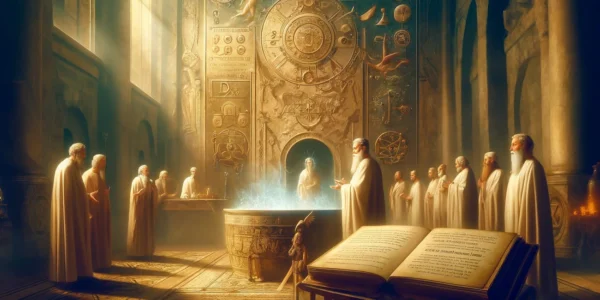
In Sumerian myth, the garden wasn’t called Eden. It was Edin (flat plain). In Sumerian Legend, the steppe was where the gods walked the plains.
In Sumerian, speech was e-me, and clay was i-mi-like Adam and Eve before the fall. When God bent down and shaped Adama from the dust, he didn’t just pack mud; he pressed in the word first. Sumerians knew this: you can’t write until you’ve got a tongue, and you can’t have a tongue until something divine whispers it there. Adam’s breath-ruach-landed with the same click as cuneiform on a wet tablet. That’s why the Egyptians put writing on the ceiling of tombs: every letter fell straight from heaven. Neanderthals could grunt, Denisovans could hum, but only Adam got the upgrade-eme wired in before the clay even cooled. So when you read formed from the ground in Genesis, think i-mi: clay plus the exact same sound God used to say Let there be. You’re not just reading dust; you’re hearing the first syllable spoken into flesh.
A central theme of meaning by which humanity found its border was around the huluppu tree. This tree was never good and evil. It was CALLED gish-bar in Sumerian meaning: “wood-of-seeing-clearly”, i.e., a branch of wit, not wisdom.
Now, the Sumerian igi (eye) shares its root with the Sumerian gid (to know/ “to see”) which is the same idea that we find in the Hebrew da’at. Both mean “a sharp sight”, but not a grace-lit insight. Is this not what Adam and Eve acquired after partaking of the fruit of this “ets1” or “igi” tree.
Adam’s first genius was naming things which was a seamless, effortless, mirrored gift shared in Elohim.
The border crossed:
After the bite of the forbidden fruit came “wit” meaning duality, comparison, defense, bifurcation, dichotomy, etc. The state of “wit” is likened to going left-right, left-right, forever (if the curse of wit is not ended). That’s the fall—-though it is not sin—rather, it is a split. This is our state of being. From this state, however, we sin because it is our nature.
The Hebrew serpent in Genesis (the nachash) doesn’t slither to tempt-he simply is motion, the weave itself, making the pattern unto the necessary Grace of universal salvation that all of us will ultimately know we need.
Therefore, the Sanskrit nag means knot and the Sumerian Ninazu, the serpent-god, bites to heal, not damn. Same figure: tension, not treason. Satan isn’t rogue-he’s the cookie cutter. God folds that back-and-forth into pattern: judge, prosecutor, ha-shatan, the one who goes to and fro. Without the knot, no garment. Without wit, no world to mend. So hell isn’t forever-it’s Theo-physics. A locked loop until its teleology and then its eschatology. Universal salvation?
1 The Hebrew word ets is a pictogram initially implying a reclined man with an all seeing eye.
That’s the hedge burning: wit quieting back to genius, duality folding into one breath. Redemption isn’t defeating the snake, rather, it’s outgrowing the need to blame him. The story stays honest: Eden and Edin, Elohim and An, Adamu and Lullu-same arc, older tongue first. No forgery. Just listen past the noise.