I use the term, “Church”, as interchangeable with “Christendom”.  That is, the New Testament Greek: “he-Ekklektos”, or “she Bride-called-out”. 

Such a title can only mean, “a Bride to the Groom (Christ)”, if one is to apply our relation to Christ via Jewish customs to the Greek language and its newly founded Chrestoi, or Christ followers.

 I also qualify “Church” by saying that such a body is grammatically “female” in the New Testament text. This means that “She” is in the ‘receiving sense’. Grammatically- Spiritually “She” is inseminated and takes in the “Logos Spermatikos”1.  At ‘her’ full term, she births the Logos’ child. 

One can confer to Philo for such historical references as just another ‘pagan’ philosophical idea which was governed by the philosophical fervor of his day. It is such an example of ‘pagan’ ideas that were governed by God. I believe the ‘rocks’ that screamed Jesus’ name were here. As Jesus told the Pharisees, “If you were to quell the voices of those yelling, ‘Hosana is here’, I say to you that these very rocks would proclaim my Name”. This is why I believe in natural Heathenism and natural paganism, without concoction.  Justin Martyr did too. He became a believer in Christ because of such beliefs and then, he was martyred by his ‘fellow christian believers’. 

Such a Body as the “Church” has all of the fullness of the Father, Holy Spirit and Son inflecting through HER as SHE receives eternal accuracy translated to time and space.

I use the term, “Christianity”, as the practice of proper exegesis, hermeneutics, application of the prior two and a death to self by such an application, even unto the physical death – as to seal the ultimate contract if God so wills it. No error or falsity would give enough ‘bank’ for the early Chrestoi (Christ followers) nor me to die for a speculative belief. As my good friend, David Rohl asks, “Would you bank your entire life on a Harry Potter novel to be a valid faith based tool?” 

THE COUNTERPART

I had yet another argument today on the “prosperity”2 doctrine delivered through yet another ‘christianity’ called, “Pentecostalism”. There are many versions of this ‘religious movement’ using the term, “Christianity”, to infiltrate the believing Church at large.  

1 Justin Martyr, a Jew, who lived in the first half of the second century (ca 100 to 150), converted to Christianity after his studies in Stoicism and Platonism.  He concluded that Jesus Christ was the “Logos Spermatikos”. Justin saw that such a pagan culture as that of the Logical Greeks were capable of conveying the ultimate term for God. Justin saw this ‘ultimate term’ as Christ Jesus being the fulfillment of the ultimate pagan nod for “God”. Justin was denounced by his ‘christian brothers’ and beheaded for his coming to be beliefs in Christ. So sad is this, that ‘coming to be’ as a believer was not accepted by the very christians who were only a century later from the writers of the New Testament, who themselves, taught against this action. 

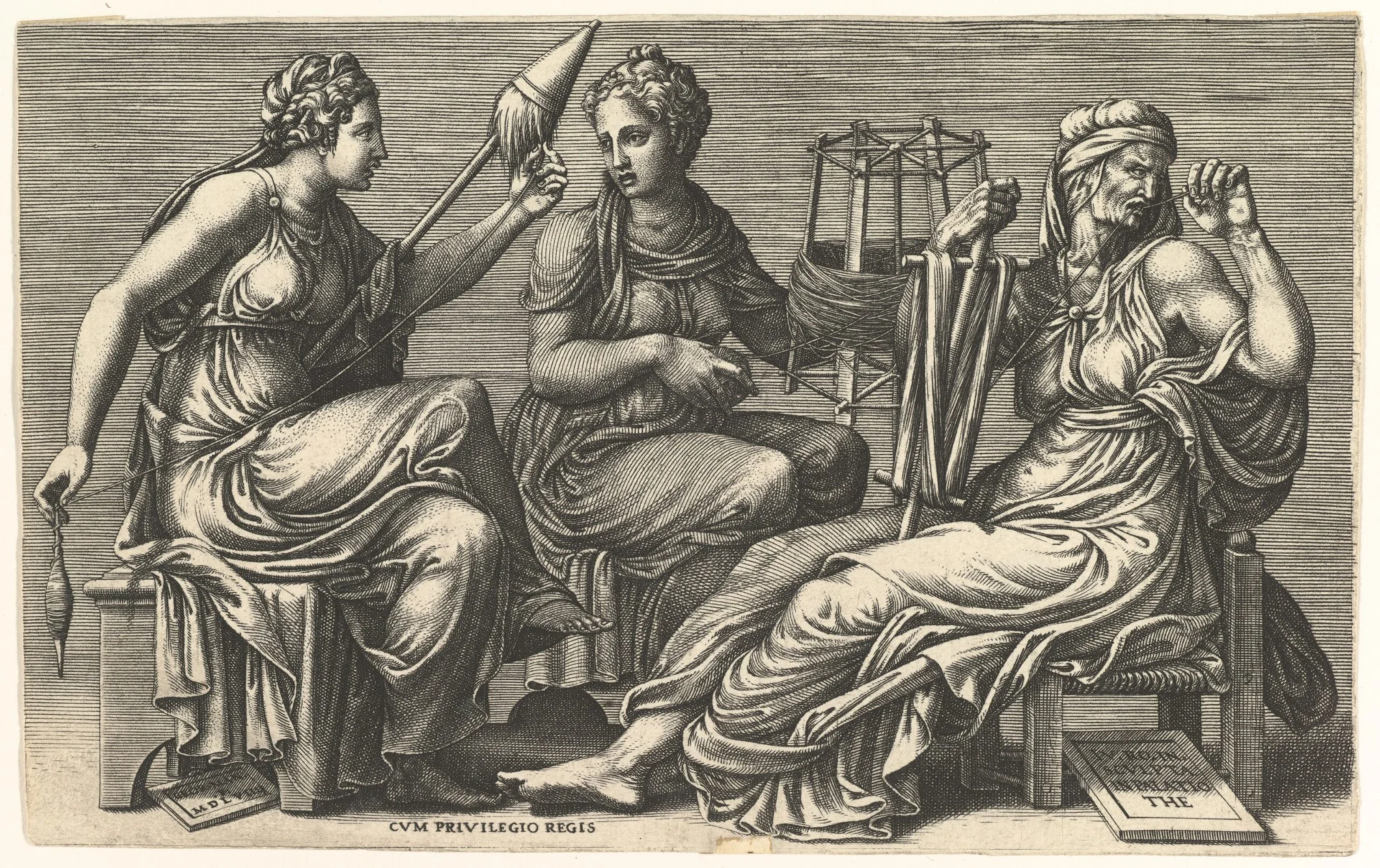
2 Fortune, allotments, distributed goods, lucky, lot, etc. (all terms will fall into play with the “goddess” culture of ‘allotments’, i.e., Fortuna, Parcae, Moirai, Graces, Norns, Jeannie, Ashtoreth, Asherah, etc. Finally, the very term, “fortunes allotted” is called in the archaic Greek: “Daimonidzo” which does mean, “Demon” or “demon of dispensing”. Hence, the distributors of fortune in the male form as well-namely, Enki with Inanna, the Wyrd Hoard Dragon who blessed Beowulf. Such Wyrd Hoard Dragon kept the riches of knowledge and dispensed the gifts of elocution, vocabulary, etc. at his dispensing. This sounds all too much like the Satan in the Garden of Eden who gave the “fruit of the tree of the knowledge of ‘good and evil’ “. They learned to lose genius and gain “wit”. Hence, they were ousted by their new talents from the Garden of Genius. Many similar stories follow this pattern. 

Such an argument brought me to something I have been overlooking for a very long time. The Fortuna, or dispensing of riches goddesses, were alive and kicking as a mythological belief in Roman times.  John at Patmos referred to the “Great Whore” who sits on the Land of the Seven Hills. That she corrupted the entire earth with the wine of her fornication and that the merchants waxed rich with her merchandising. 

As the pagan poet, Robert Graves said in my paraphrase, “I worship “HER” because she was able to make the christians drunk. She was so important as to be mentioned in the Bible as THAT goddess who was capable of doing such a thing!”. 

I always knew that the goddess figure, wherever worshipped, feared, adored, etc. was always an allotment goddess of some sort. Whether you call “HER” a “FATE” or “Goddess”, to me, the terms are nearly interchangeable, though some would argue that the Fates had power over the gods to fate their lives. Nonetheless, I am referring to the FEMININE force, the SHAKTI, the GODDESS of agriculture, the Ashera-consort of EL/ Lady Luck,  fortune of war, fortune of children, riches, ‘lady luck’, ‘dice—a.k.a., “deia”, “Sors”—“sorcery”, “pharamakon”, etc. the Dispenser.  

Good enough. Let’s get Theological.

It is in the Scripture that I find the litmus test for ideas, their consequences, their realities and The Reality. 

Let’s look at Matthew 7:22 – “Many will say to me on that Day, “Lord, Lord, did we not prophesy in your name and in your name drive out demons and in your name perform many miracles?”.

There is NO “christian” religious movement except for ONE and it’s various hybrids that claim this statement currently: It is the Pentecostal-Charismatic Church. The Roman Catholic Church comes very close concerning miracles. 

We see the return to the Greek’s (both pagan and Christian)  mysticism of babbling found in Corinth. One must confer to 1 Corinthians 13:1-following. Glossa vs. Glossalalia.  “Glossa” means, “Glossary” or “Ordered speech”. “Glossalalia” means, “blablablabla-sounds”. Paul addresses the Church at Corinth to know the usage of foreign “intelligent language” is ONLY to confer the word to someone who cannot understand or speak another’s “Glossa” or “tongue” or “language”. Not the  application of “babble” to non believers who need Truth—as the pagans of Corinth do in their mystery religions. 

This practice of babble was obviously known to the believers at Corinth, Paul, the Romans, and, for sure, John the Beloved, who was a prisoner of the Romans.  John wrote with an immense amalgam of  Christian, Jewish, Roman, Greek, Babylonian and Persian poetics all which fused a polyrhythmic sense of meaning. With God’s breath to John’s pen,  John’s “Apocalypse” or “Revelation” became that of prophesy of and by the Lord who guided his talents. 

It was the “Fortuna” that I speak of. SHE was the composite sketch of all of the worlds’ ancient dispensing goddess summed by one guiding force but divided into three.  

Returning to Matthew 7, we find Jesus telling us that in “THAT DAY”, many will be professing such a “dispensing of riches” in the guise of ‘Christianity’ which is not Christianity.  

“SHE”, the goddess who has corrupted us, corrupts poignantly, the “Christian” body, turning them into ‘christians’ who are the “Christos Temporas” or “Christ Merchants” of the last Days.  

Do we not see the “Merchandising” of the great Harlot within christianity that has corrupted us? …Whether it be the ‘daimidzo’ – ‘dispensing of fortunes’ (“demon”) of “christian-republican-capitalism” or the godless ideologies of communism run by big brother in the name of “Democracy”, we have the same source. The Whore

The all too natural ancient etymologies of God’s “epithets”

Gud God, Holy Cow, What kind of Heavenly Cheese?

3 Main Epithets:

Epithet 1 (“God”)

One of the earliest sentient cultures of great intelligence was (and STILL IS!) the Kartuli culture. This Kartuli or Kartvelian  culture gave the Sumerians a relationship between nature and the heavens. Kartvelian culture made the Sumerian Language, culture and practices *sacrosanct*. Sumerians, seemingly,  were primarily nothing more than an agrarian culture.

One can see the ‘imprint’ from the Kartvelian’s language to the Sumerians when one looks at the etymological origins of Sumerian inherited words by which are seen in later Sumerian agricultural, religious, political-organizing a city-state, etc. 

By the way, Kartvelian culture did indeed affect the entire Indo European, Indo Germanic, Semitic, world, as well as Germanic, Norse, Anglo Saxon, and Icelandic Literature.

Such a particular example can be seen as follows in the dynamic between the Kartuli/ Kartvelian culture, Sumerian agrarian to city-state and Akkadian-Semetic

With the etymological observance of Kartvelian being a Caucasus parent language of Sumerian synthetic-aspect language, we see the occurrence of a few things.

The simple bucolic (Greek: boukolos = “herdsmen”, from “bous” = “ox”) Sumerian word for bull, ox, cow, etc. is, “Gud, Gur, and gu4”. 

With the influence of the already Divinely appointed sense to “guda” from the Kartvelian culture ca. 3,000 B.C., Sumeria was given an astronomical and astrological sense to its agricultural practices. The Kartvelian brings us the heavenly word, “guda”, =  (gud, gur, gu – the divine bull, sun and moon. steer, bullock, ox, “that which pulls the plow”),

We see the same in the Akkadian (MUL (of the heaven) GU (cow/ ox) AN NA (Heaven)= “the Bull of heaven”—therefore, “that which brings/ treads the Day”). 

Other epithets that can be seen as the same function:

UTU in Sumerian or SHAMASH (son of Sin)  in Akkadian were Mesopotamian deities that were seen as part of a Trinitarian idea.  These two, UTU and SHAMASH, were seen with the Moon god, Sin (in Akkadian {Sumerian: Nanna}), and the goddess, Ishtar (in Akkadian {Sumerian: Inanna}) which is also the equivalent to the Roman Venus or Greek Madonna.  

Thanks to the Kartvelian world, we see many world  “Bull” myths that led to the first senses of “baptism” that might be related to the “christian baptisms” of today. Walter Dale did a wonderful treatment of the 6 main forms of ‘baptisms’ that the Bible refers to (plus the extra pagan rite baptism of the Bull’s blood which I believe is syncretic practice between ancient paganism and Israelite cultic practice). Such ‘baptisms’ mentioned in his 4 volume treatment on “Baptisms” start with the ‘pagan-rite-taurobouleum’ or ‘bull’s-blood baptism”.

After Kartvelian influence, many Sumerians observed the horns, the moon, the maiden, the god UTU, etc. as collective symbols by which their culture’s “sense” of well being between farming, God, sex, procreation, birthing, neighbors, etc. began.   

We also see how this very early observance did spread to much of the Asian, Mediterranean and Occidental world. Such divine observance of was seen/ still seen in Hinduism, Jainism, Buddhism, Egypt, Greece, Israel, Rome and Germany.  

In the ancient rituals of the Kartvels (or ancient Georgians), the “guda” was observed as the divine Bull, Sun and Moon from which we see that the Sumerians associated all 3 together in their ancient religious observances.

The word, “Quat “, or “Kwat “ is an early Proto-Indo-European word. Its origin shows us the word, “Cheese—the curdled milk of the cow”.  This, in turn, became a morphological division word for the interrogative, “What is this?—-hence, “WHAT?” The skin sack of the bull represents the “DIVINE BULL” coming from HEAVEN and descending into the Skin Carcass or sack. Such an incarnation is very well seen in our Lord and Saviour, Jesus Christ,  in one sense: Christ is God. Christ came into the ‘form of a man’ to endure as man and God. Jesus Christ is God wearing a human skin sack, to say equivocally to the Kartvelian idea of Guda. So, the words, “what?, cheese, bull, sack for libations which were formed from the skin or carcass of the cow, and God” did originate from the all too natural and mundane terms that were seen everyday. 

From now on, you might think of the “heavenly cheese” of the Dutch (“kaas”), or, “Gouda” and all its cognates mentioned here and way beyond, when gormandizing on such a delight! Oh, yeah, did I tell you that the “Kaas” was “Das Got “….Old German, Got = “The Good’ = “ The God”. 

—————————————————————————————————

Epithet 2 – “The Word”

The LOGOS and his base beginnings.

P.I.E. (Proto-Indo-European) = “lg- as a “classifier” or “organizer” of firebrands or logs. 

P.I.E. – *LG*= ‘the logs that were *collected* (Grimm’s law: labial/gutteral) and categorized in orders of sizes and types to burn, build, etc.  The smaller logs were used, obviously, to start the fire while the larger logs were placed later for the greater heat. 

The strongest logs were used for possible tools, wheels, carts, weapons, house building material, etc.  

We get our suffix, -ology, as to mean, “classification, category of, study of, words of “.  

Hence, *leg*, *lg*,  (Greek:‘logos’) = “the classification and categorization of things”.

It is not a wonder that Plato looked to the “Driving Force” of the universe as “Logos”.  Plato expounded on Logos as a part of a Divine Trinity consisting of ‘good’, ‘logos’, and ‘world spirit’.  Logos’ attributes, as seen by Plato, were the aspect of Wisdom, Reason, etc..  It is interesting that the very archaic, “LG”, meaning categorizer, organizer, Collocator, etc,….collectively, meant, “Judge”.

The development of “LOGOS” finally came to its fruition in the Johannine Gospel (Gospel of John) as “…and the LOGOS ***became flesh*** “.  

What an astounding sense to the first century Chrestoi who understand the Greek classics, the Ne’evim ( the prophets ) and Messianism as ‘the Fulfillment of the World’s Pain and Cure!!!

————————————————————————————————

Epithet 3 “EL and YAH”

Egyptian and Babylonian scriveners, bards, poets, prophets, historians, and Astrologers all looked to the bull as the strong one.  The Bull, Apis (Egyptian), or the Sinaitic Hebrew pictograph: Aleph* (The bull is the ‘first’, ‘the lead’-hence, the “Aleph”, or “ALPHA”, hence, the first letter in the Hebrew Alphabet {aleph – beyt/ alpha (in Greek) and, the letter “a” in English}).

“AL”, “The “Heavenly-Bull”, or, “UTU”, represents the divine treader or maker of the traces by which the Lead Bull has established. The Taurus, or Bull) , which was and is the vowel carrier for the “A” sound and means, “Bull; Ox”. “AL or EL (Hebrew)” became known as “the God” of the Hebrews. “Elohim” was the ‘congress’ or ‘hierarchs’ of “EL” that did the bidding, expressed the notion, etc. of EL. 

The Hebrew took the AL Verb to the morphological EYEH. Eyeh carried the “prosthetic E” or removable “E” (in this case, the prefix) which led to “Yah”, which, in turn, became the hypocoristicon of the more elaborate, “Yehoua”, (YHVH). Once again, the VERB, Yah, denoted “THE ALL POWERFUL ONE”. Yah, in its most simple definition means = “makes to exist”. Yahweh = Yahoua comes from the Mesopotamian relation of man to God and God to man meaning: “Friend of Man”.  “Creator of Man” and, “the God who Warned man before Flood”.  This same YHVH God talked and walked with mankind millenia before Moses!

Happy and Sad/ Kob and Satis

2 Terms to know:

1) *Happy*: Proto Indo European: “Kob” = ‘met to the desire of one’s wants to make *happy*’; ‘to suit, fit, succeed’; Old Norse: ‘chance, good luck (allotment)’/ Middle English: ‘chance, fortune’

2) *Sad*: Old English: “saed” = ‘sated’, full, having had one’s fill (of food, fighting, sex, etc.)’; {rooted the same throughout all Germanic etymologies the same as the Old English and Latin} Latin/ Indo European roots: “Satis” = ‘fully satisfied, satiated and sad’.

We culturally believe that “happy” conveys the opposite meaning of “sad” but this is not true. Happy and sad need each other to make ‘secular sense’,‘natural sense’ or “cause and effect” (cf. to footnote 1)

The ‘probability picture (cf. to  footnote 2)‘ goes as follows: “the effect was the ‘satis’.  John’s death was from the complications of a heart attack. The part about ‘John incessantly eating horrible foods and never exercising’ was the “kob” of John. The fulfillment of overeating was the “satis” of John. 

So, in John’s case, Kob, a.k.a., ‘gormandizing’ or ‘gluttony’, telegraphed to Kob’s “SATIS”, i.e., death

As a drug addict is ‘happy’ to get their fix, the telegraph of happy is being sad, depressed, lost, dead, hence, “satis”. Happy to Sad.

The problem all along has been that the individual was ‘dispensing allotments’ to themselves. They ‘allotted’ their ‘apportionments’ to make them ‘happy’ versus ‘met’.

Happy and Sad

METOD or MEASURER (cf. to footnote 3) or Deity that “knows” how to dispense. This is the interconnected genius of linguistics that brings us back in time to the God to history to language relation. God, the Measurer, can ‘Kob’ us, that is, Metod can ‘fully meet us to all of our wants and needs without our hurt. When we find our end result of gormandizing on HIS word, we are never left hurt. We are infinite beings with infinite capacity for an infinite GOD. THIS relationship of cause and effect is the ONLY relationship that no one can ever go ‘overboard’ (cf. to footnote 4).

Footnotes

1 Uninterrupted flow. Plato gives us the term, “poesis” to mean ‘a flow that moves without disturbance’.

2 I.e., ‘what is provable within the *picture frame* of observable or ostensible judgement.

3 Therefore, the cause is kob. The effect is satis. They cannot be disenfranchised from one another unless they are plasticized as terms used for unnatural agendas#. I’d like to say that not always is Kob to Satis a bad thing when taken to the Metaphysical. It can be the best thing when taken to the METOD or MEASURER or Deity that “knows” how to dispense. This is the interconnected genius of linguistics that brings us back in time to the God to history to language relation. God, the Measurer, can ‘Kob’ us, that is, Metod can ‘fully meet us to all of our wants and needs without our hurt. When we find our end result of gormandizing on HIS word, we are never left hurt. We are infinite beings with infinite capacity for an infinite GOD. THIS relationship of cause and effect is the ONLY relationship that no one can ever go ‘overboard’.

The Allotment God#

4 It is only in the Theological sense do we find the ultimate maxim for this lesson:

If we do not count on God as the Sovereign Giver (giver of satisfaction and joy) we replace HIM with dispensing gods# that ‘allot’ —or “luck” to us, our fated ‘apportionments’. For as Ecclesiastes teaches us in chapters one and two, *”We are never satisfied by the objective things in this world; all that is in the world, when objectified and sought after, becomes vainglory, and associated with sadness if not used in relation to God’s Sovereignty, that is, His dispensing”*. 

Genesis 11:1: “The whole earth had (yahiy: had; become; be; becoming) one ‘language’—and there were very few WORDS (Dabhar)1 in those days”.

WHOLE EARTH

In the Hebrew of Genesis 11:1 we have: “Kal (entire) Ha (the)  Erotz (earth) Shephah (speak/spoke) Echad (one) va (and) DABARIYM (**stone of order/ law/ justice/ prophecy/ petroglyph/ Judgment/ the stone by which the Hag (pronounced: “hog”) was to be danced around) echadim (few)”. 

 This means that the ENTIRE (Kal) Earth (Erotz) spoke ONE ‘lingua franca’ and had ONE reference point to *meaning* from henceforth came from these stones of order or petroglyphs. 

HEBREW COLLOQUIALISMS/ CONCEPTUALIZATIONS

As I have said numerous times before, the term, “earth”, meant “land plot”. The (Hebrew: “Kal Erotz”)  Whole Earth” was a conceptualized-cultural word to reference: “All we can see, All we can know, All that is habitable for us to cultivate upon, procreate upon, live and die upon”.

Therefore, regardless of the term, “earth” or “whole earth”, we have the early Hebrew mind conveying a “limited term” or “terms of limitation of spatiality”. That is, the Hebrew mind always used reference points to define. 

The key focus here are “boundary lines”.  Even the Hebrew word, “Olam” which meant, “eternity” or “heaven”, was a ‘limited term’ to mean, “up to the line for which is out of our sights”. Again, the ‘earth’ was a boundary line from which ‘other earth’ could be defined. 

FIRST WORDS/ ORIGIN OF ETYMOLOGY

Dr. Hamlet Martirosyan seems to make clear that all homonymic order would have come from the Armenian/ Syunik culture which gave us these stones of homonymic binding. 

Such First Words were based on the original “ collage’ Syunik “ word, “Areg”.

From numerous decoding principles found in Verner, Bopp, Grimm’s laws, to our highest in genetic-linguistic morphology, we have Areg to mean: “God, Lion, Deity, Bright, Light, Sun, Wheel, Eye, Aries, Ram/ Goat, Ram/Goat of sacrifice, etc. 

CONCLUSION

Such petroglyphs would have bound all of humankind in that particular Caucasus / Steppe region to a ONE IDEA, ONE WORD, ONE SENSE, ONE SIGN, ONE REFERENCE POINT from which all Indo European (including early Eden-i.e., Meidan Valley/ Adji Chay) etymologies, meaning, reference flowed.

The cultural “WELLSPRING” of meaning for early Proto-Indo-European culture was  set in stone in the early homonymic writings of these Armenian Syunik petroglyphs of the Mountain ranges found in Armenia, dating on average to ca. 35,000 B.C. 

SEGWAY

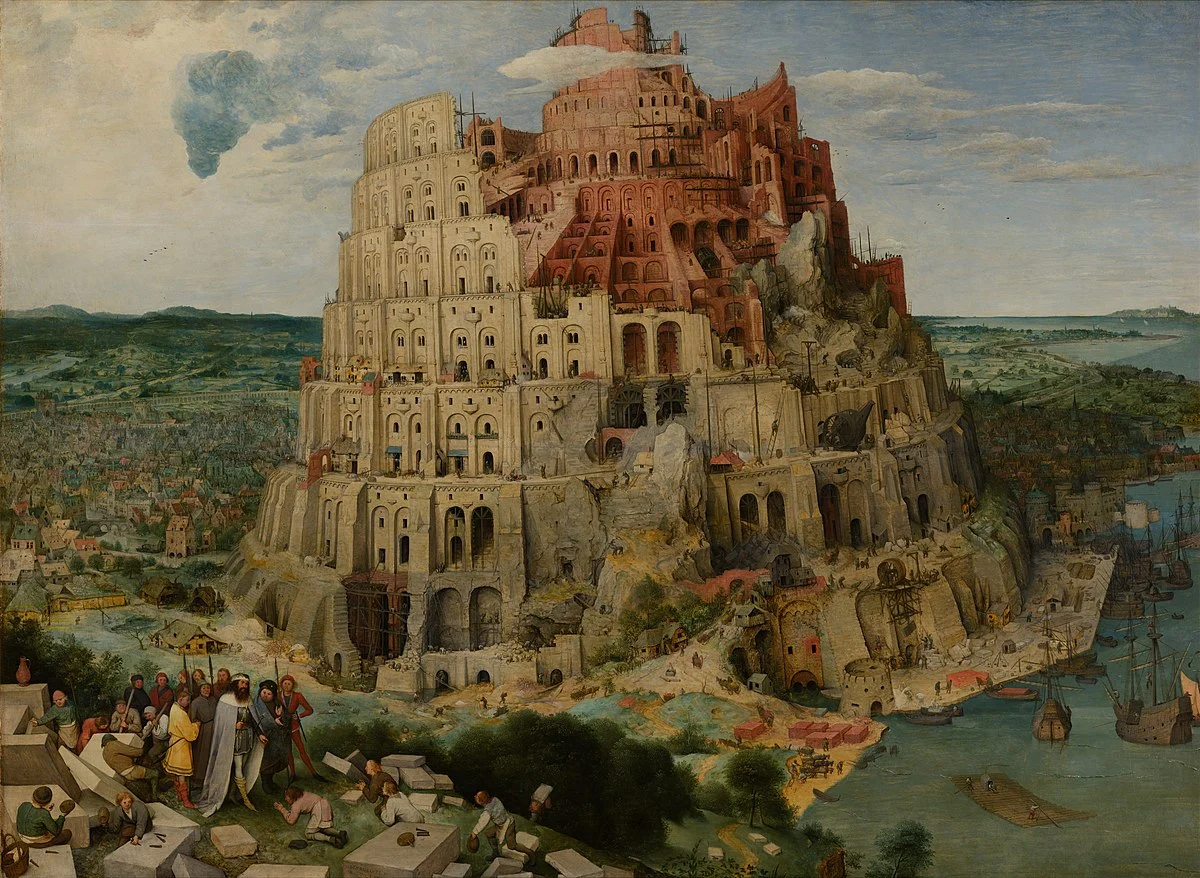
What *evil* did the founders of the ziggurats of Babel do? Was Nimrod the key instigator? Wait for part 3 to enter a world of research unending on this very topic which affects us today. 

(Dabhar is somewhat equal to the Greek, “LOGOS”).  1

In Genesis 8:2 we begin the process of the waters abating. A full chapter is given up to the existence in the ark until the first contact made to soil in Genesis 9.

Genesis 9:20 tells us that Noah was the first tiller of the ground. Hence, Genesis 9:20 gives us contact with the earth’s soil since the deluge began. 

In Genesis 10:2 –  we start with the feet of Japheth and his progeny going forth replenishing the earth as God commanded. 

Genesis 10:5 states that all of Japeth’s offspring was categorized to their respective “Language (Hebrew: “Lashon”- “idiomatic phrasings, cursing, slang, colloquialisms, dialects, etc.). 

This type of “language”, that is, “Lashon”,  is not a distinct language barrier that critically separates people into different cultures as of yet, but it is an indicator of such a division if given enough time! 

A different type of “language” than “Lashon” in the Hebrew tongue is called, “Sephah”. If Lashon is a tribal demarcation language that identifies the group as a ‘click’ (much like as of today when our youth dresses and talks a certain way to be “identified” by that click), then, Sephah is distinguished from Lashon in that Sephah is an entirely different language. 

Sephah also means an area in which one language is distinct from its surrounding languages creating a border, lip, region, state, demarcation line. Therefore, an analogy of “Sephah” can be shown in the comparisons of let’s say, French to German. Two such countries are divided for the exact reason that division takes place. It is this “Division” that is nowhere more brilliantly explained than in the Narrative of Genesis chapter 9 -11.

 Simply said, “Sephah” means: “Lip, boundary, country, law, horizon, border, language”. This will be of most import to understand just a little later. 

We see in Genesis 10:6 that Ham encounters exactly what Japeth did with linguistic division—-mentioned in Genesis 10:20—-“L’shonotam’ or…simply, the root, ”Lashon”. Ham and his progeny were bound together and set apart to trek to a destination suitable to establish a nation using their kindred slang and tribal or click identification to be ‘separate’ from others that were not like them. 

We see in Genesis 10:21 – yet again, the same encounter for Shem, provided by the word, “Lashon”, in Genesis 10:30 -31: (my translation) “All of the progeny of Shem went forth from Mesha in the direction of Sephah to the hill country of the east. Shem and all of his progeny and all of his family’s progeny went together and settled in their “EARTHS” or ‘lands’ (Hebrew root: erots) and their *Nations (Hebrew: “goyim”)* associated with their “Lashon” “. 

I find it terribly interesting that the Hebrew word, “Erots”,  was used in the English Bible to designate the term, “earth”, both in the flood account as the entire earth was flooded and here as a piece or parcel of land. 

**terms to know: sephah, lashon, erots, 

————————

It’s very key to notice that all the nations were being established by their languages, yet, these are a different type of language than the one in Genesis chapter 11:1!

 Genesis 11:1: “The whole earth spoke one ‘language’—and there were very few WORDS in those days”.

In the Hebrew we have: “Kal (entire) Ha (the)  Erotz (earth) Shephah (speak/spoke) Echad (one) va (and) DABARIYM (**stone of order/ law/ justice/ prophecy/ petroglyph/ Judgment/ the stone by which the Hag (pronounced: “hog”) was to be danced around) echadim (few)”.  This means that the ENTIRE (Kal) Earth (Erotz) spoke ONE language and had one reference to prophecy, God, and the laws which came from these stones or reference petroglyphs of order (Dabhar is somewhat equal to the Greek, “LOGOS”).  1

1(Dr. Hamlet Martirosyan gives us more than ample proof that Armenian/ Syunik Upper Paleolithic petroglyphs did indeed affect all of the religious world, including Sumeria. Confer to his work in his scholarly paper, “Lion Character in the Petroglyphs of Syunik and the Ancient World”, June 14, 2014. My theory is that the “Dabhar” were related to these Armenian Petroglyphs and that the Luwian or Levite culture (Non-Semitic) did bring these glyphs and their ideas with them to the Ivri clan (the Hebrews) )

The interruption of the relationship of humankind was truly found at Sumer. It was found in yet another term for the English language’s word for, “Name”.  It is the Hebrew, “Shem”. 

*I used to hear this term, “Shem” being taught at my founding church as some indefinable thing that mysteriously was created by Nimrod or the people who were in his “congress”. I thank that church for setting me on a path that would lead me here. 

Terms such as Nimrod, Shem, The Tower of Babel, The Confusion of Tongues, God literally coming down and *confounding* these particular people at this very particular time, etc. were so interesting to me. 

I believe I am nearing the answer by being surrounded with the world’s most renowned scholars who have dedicated their lives in their very specific fields of genetic-linguistic and archaeological research.

It is the relationship between the original ONE SPEECH and Sumerian as the SHEM-SUMERIAN and not the ONE SPEECH/ ONE DABHAR Sumerian.  This “SHEM” was INDEED manufactured and it is proven to be a *synthetic* language needed its parent to be understood.  This is WHY there are so many Sumerologist because there are so many “Sumerian Languages” or, should I say, faulty-attempted “Sumerian Languages”. 

The real kicker is this: Whoever spoke the mother of this synthetic language during the days of Eden, at the Meidan Valley, spoke what YHVH spoke to Adam and visa versa!!!

It is MOST interesting that this language is the ONLY language that NEVER changed and is amongst us, right now.  Power of Logos? Power of LOGOS?..  

With scholarly knowledge of the usage of endonymic usages in this Sumerian localized region during the late Uruk Period (3,400-3,100 B.C.), we can decipher the name of Cush ( Meshkiagkasher) as the father of Enmerker. Enmerker holds a prosthetic (ker) and (E) to give us an embedded  ‘Shuresh’ or ‘3-pronged-root’ for the Shemetic, “NMR”, or, our Hebrew, “Nimrod”. In the Sumerian King’s list it points to Enmerker beginning his reign as King of Sumer with findings of clay tablets mentioning Enmerker in the Jemdet Nasr Period  (c. 3,100-2,900 B.C. {Uruk 3 period}).

Finally, in  A.R. George’s list of ziggurats found in Mesopotamia called, “House Most High”, we find the name of a ziggurat and the hypocoristic name of its possessor (Marduk=Nimrod=Enmerker) of most interest to me. The ziggurat is called, “bara.sur.ku” which means,  “bara 2” =(Halloran; “barag”“ku” = “base”) / “sur” = “divide”; “demarcate”/ “ku”= “to found”, “to establish”. **This particular ziggurat was literally called, The seat of Marduk”“.  It is found in e’.sar.ra at Ashur. 

This information gives a fix to name, location, reason, time/dates both in the scholarly world and the narrative given us in Genesis 9-11. 


As a footnote to the flood event:

***We now know that a ‘global flood’ of using the ‘continuity’ of Altaic languages (cf. to Dr. Andrew Miller, “Japanese and the Other Altaic Languages” and Dr. Carlos Quiles’, “A Storm of Words”, “Game of Clans” and a “Clash of Chiefs”) to European linguistics.  There was an uninterrupted linguistic continuity from the proto-Uralic-Yukaghir language ( at least tracing back to 7,000 B.C. which leaves its linguistic-genetic trails from the Ural Mountains into Japan and early Samoyed or “pre-Finnish” culture into our Modern European languages….i.e., ca. 7k B.C. To present—-uninterrupted!   That’s 9,000 years of uninterrupted development which doesn’t allow for an English/American ‘face value’ of the Biblical flood to have happened—-on the bright side for us believers, the Hebrew gives us the truth anyway!!

Also, if we used the modern day ‘Biblical-literalist’ ‘timelines‘ (distinguishing between “Biblical-literalists” and “literal” or “literal history”)’ it would put us smack into the Chinese Hsia and Shang Dynasties circa 2,500 B.C. —1,800 B.C which were never ‘disrupted’ by a flood — assuming the “Biblical -literalist” holds ‘the flood’ was ca. 2,400 B.C. — 2,250 B.C.  And, again, the Sub Saharan/ Nilotic groups that met with our Biblical Cush. If Cush was the son of Ham, how could we already have an established culture so many thousands who is forever embedded into this culture’s memory; c.f., “Legend”, David Rohl))) 

What is the Garden of Eden?

Is *Eden* a physical location, state of mind, Heaven, …all the above?

PHYSICAL LOCATION

In the physical sense we do have a ‘fix’ on its name and location as the Hebrew gives us by name:*Gan-Ba-Eden*.

The redacted Hebrew name, “Gan (garden) ba (in) Eden”, or simply, ‘Eden’, is in Northwest Iran central to Tabriz. Eden is a place right of Lake Van and Mt. Sahand and it’s furthest right boundary is the Mountain range of Kusheh Dagh.  Circa 40 miles east of the furthest point of Kusheh Dagh mt. Range is a region called, “Noqdi” or our Biblical, “NOD”. All to say that, Nod, or Noqdi, is the Bible’s Eastern geographical reference to geographical Eden.  “Ardabil” is about 15 miles south of Noqdi.  As further contemporary geographical reference, Eden is also called the *Adji Chay valley* and is known by an older name: Meidan valley.

STATE OF MIND

Let me paraphrase G.K. Chesterton: “We follow signs until we arrive at the point that was signaled to. Here, we find ourselves at the place of ‘non-sense’ because there are no more signs to indicate where we need to travel to. Hence, we no longer need signs, signals, indicators or senses once we have arrived”.

I not only believe but know that the Garden of Eden was a physical location.  In the genius of the Biblical narrative sense, “Eden” was the point of reference for cultural and societal “beginnings” in the Hebrew Bible. I *believe* that this fusion of events was for all of humankind to understand.

I *believe* that the genius of the region of Meidan or “Eden” offered us the first encounters with a Sumerian  culture that didn’t necessarily speak what we call, “Sumerian”.

Comparisons of beginnings

The understanding of ‘beginnings” found in Genesis are simply a different type of ‘beginning’ than the search for “beginnings” found in the research for the first hominids. The distinction might go as follows: The Biblical Genesis expresses a sentient mind exuding intention and Sovereignty personified as juxtaposed to the archeological observations and reconstructions of hundreds of thousands of years of “evolving” by meandering.

I often think of watching a movie that lasts for 300,000 years that gets to no real point other than the killing of some kind of field deer and watching the procreation process without romance. All of which makes a Woody Allen film more depressing, for he reminds me that  we have evolved very little with meaning, yet, a lot with style.

WHY, WHAT, HOW

‘How’ do we obtain ‘what’ versus ‘why’ do we obtain and for ‘what’ purpose?

The “how” and the “what” versus the “why”.  It is the heinous omission that I am leading to by secularists who truly have an objective religion and intention.

Let me make this clear. As Joseph Campbell said, “There is no meaning in life itself. It’s pure biology”. Bios or Life does what it does, it is what it is—-but, it does not explain WHY it is here or WHY we should care about anything other than the scientific and/or Hedonistic sense to ‘life’.  After all, if there was no ‘why’ to life, we would only have “life” to worship which would default, in time, to hedonism, or, “life worship”.

It is in the study of HEDONISM that we find Eve and Adam’s return to the crude practice of self preservation and objectivity—the “WHATness” of their worldview. The “WHYness” was in the Garden prior to this fall—-and, in this contrast of,  ‘why’ vs ‘what’,  we should go forward with a stepping stone from C.S. Lewis’ remark on the ‘elan vitale’, or, ‘life force’. Without proper worship of the force of life, which is our Maker, we would all turn to, by nature, the force within natural causes. We should be halted at every icon of ‘life force’ in an endless pursuit of objects without meaning, only iconic observance via the connotative minds which shift with every wind of ‘new ideas’.  It is of further interest to me that the “HOW” in obtaining the “WHATness” of evolutionary ‘man’ was by killing and overtaking. The “HOW” aspect  in obtaining the *understanding* of the “WHY” aspect of Grace is shown through either a (a) fictional ‘god’ or (b) a Real Sovereign God.  It is interesting, even if God weren’t real, and HIS words weren’t substantiated by a REAL character, the WORDS would still hold in our stage actors semiotic commitments for either living to kill or love. The ultimate man would be found in the ultimate idea of GOD, even if HE were fictive——which would NEVER mean that this ‘finding’ excluding the REAL God who transcended past our metaphors for grace, love, joy, etc.

The “REALNESS” wraps us in HIS “MEANING” now….not later, over there, in the future… HIS “SENSE” abides with us in the here and now, the past and the future. 

*all geographical locations are backed the leading archaeological scholar, David Rohl in his book, “Legend”, and video documentary, “In Search of Eden”.

Preface

In this article, I try to extract and amplify what is already set in the Hebrew text of Job. Job’s story might very well reach back beyond 4 millenia to make it the oldest book in the Bible. Therefore, the time tested story of Job exceeds in antiquity that of the Mosaic Torah. Though the genius of the Hebrew language’s usage was employed to exemplify Job’s timeless lessons (Doctrine of Sovereignty over sheer fate, retribution and rogue agency free will, etc.), Job’s kernel of genius was found all throughout Mesopotamia in several different languages. Such stories of “the man of affliction”/ “the despised one”/ etc. did indeed time capsule other ‘notes’ to the Story of the Biblical Job. These “notes” all do compliment Job’s narration and fill us to the brim with meaning, reference, sense, significance, etc.

The “nature” of the Illusory Doctrines of Fatalism

In Job 3:3, we find the Fates and their illusory doctrines of fate called upon by Job through his newly ‘gifted’ worldview.

If I may turn my explanation to an interpretation of the storyline of Job for a moment: *God places Job in “Abad (Hebrew: Abaddon: “place of perishing”)” without dying. For the “story’s sake”, Job is the journalist placed into the world of non-sense which generates infinite regress (one action leading to another without resolve or significance). This “Abad” takes its toll upon Job’s critical thinking and emotional well being. Nonetheless, Job remains consistently truthful in his Shadow logic throughout his delusions much like an Alzheimer’s patient who speaks truthfully through their afflictions. Poignantly, how would you like to be judged as ‘evil’ by actions out of your control such as schizophrenia, bi-polar disorder, manic-depression, borderline personality disorder, etc.? -If these are not meaningless afflictions then they must be meaningful. Then, the question arises: what is meaningful?

To me, maybe to you, a dog cannot ‘choose’ to purr like a kitten, gibber like an ape, chut like a guinea pig or whinny like a zebra by its nature. A dog, by the limitations of its nature, does ‘act’ to bark. In this ‘act’  to bark there is honesty/ integrity to the ‘integral’ function of what “dog”, as verb and noun “means” and “does”. Therefore, there is no sin accrued to the account of the dog. Therefore!!! –wait for it—ALL DOGS GO TO HEAVEN!! 🙂 –sigh, I had to.

From my take on Job’s case, I do not see that Job has sinned in his newly found limitations. He ‘acts’ from the limitations of his nature”. Job acts within the integrity of his beset delusion.

The Hand of Darkness

I believe that the DARK honesty spoken through Job’s mouth was from the “moors” or heathen field of Satan’s limited voice. Consistently, I witness throughout the dialogues of Satan in the Bible the laws of limitation, hence, the “moors” by which he must travail upon, always governed to being on the outskirts of the sheep gate of God unless let in by God for ‘a time’. In contrast, the relationship of Satan to God and to others is not a necessary constant in memorialized Heathen Literature – or movies, comic books, etc..

Job 3:3-5 (vs. 3) 

“Damn the Day I was bor

The night that said, ‘a boy 

was begot’

(vs. 4)  That Day -let it be darkness.

God above ignore it.

No light break upon it

(vs. 5)  Darkness and gloom claim *it*,

Cloud settle over it

Eclipse terrify it

In Job 3:3, Job says, “damn *The Day*”. In the Hebrew text of Job 3:3 – we read: “ya-abad-yom” {Qal imperfect – “let perish the Day”}

In this statement, Job assigns no Deity to Damn the Day in the Hebrew.

SO, I ask the question: by what “agency” is Job referring to? That is, who would “Damn the Day”?

The Integrity of error

Job declines from his sound doctrinal stance with God yet does not sin–because he is still saying the truth from the perspective of his worldview. That is, Job is consistently honest with his new participation inside Shadow Logic.

The MISS

Job spoke for AGONY as though it was Reason. Still, in Job’s Shadow Logic, Job never attributed power or causality to another Deity other than YHVH. Even in the words of Job’s Shadow Logic, Job reasoned the “impossibility” of another Deity other than YHVH. Though, constantly not mentioning YHVH, the spoken words from Shadow Logic seemed to ‘give way’ to YHVH. That is, Job’s words were shown to be governed by a specified ‘blindness’ of THE CAUSAL AGENCY —( God blinds, gives sight, gives reason, takes reason away, etc.) first seen in Job 3:3 as Job’s failure to assign in “Damning the Day”. To me, this failure to assign causality was a painfully obvious “aporia (irresolvable internal contradiction or logical disjunction in a theory)” – if applied to the illusory doctrines of “fatalism” to “nihilism”. Fate cannot hold non-agency for causality, Fates are meaningless by their definition—a bios, a current, an effect. Nature and Fate might be equitive terms. 

Job’s actions thus so far have led me to conclude that Job was arrested with what I will call, Shadow Logic.

The first 2 Declinations of Job

Job as a Righteous Man

Job 1:1-22 -”

1  There was a man in the land of Uz, whose name was Job; and that man was perfect and upright, and one that feared God, and eschewed evil.

“ISH” (NOM.MS.SING.) =A MAN/ “HAYAH” (QAL PERFECT 3RD MASC. SING.)=THERE WAS ( back then, some time ago ) This was a formulaic way in Hebrew to say, “Once upon a time, a long time ago”. This did not give the book of Job over to a fantastic or fictive category, rather, a ‘distancing’ for the sake of its actual antiquity and its tested truths through time. 

2.  And there were born unto him seven sons and three daughters.

This is a Mesopotamian ratio of Divine blessing as seen in verse 3 where Job has the same ratio of sheep to camels as he does sons to daughters. In a Ugaritic myth, the god Baal had the same divine ratio of children that Job did. 

3.  His substance also was seven thousand sheep, and three thousand camels, and five hundred yoke of oxen, and five hundred she asses, and a very great household; so that this man was the greatest of all the men of the east.

4. And his sons went and feasted in their houses, every one his day; and sent and called for their three sisters to eat and to drink with them. 

At this time, there was a lengthy festival taking place where wandering family members would reside in the houses of each other.  This almost gives the air of an astrological statement. That is, each planet to their own housing for a specified meaning and then, a continuance of wandering for other “significant” meanings.

5.  And it was so, when the days of their feasting were gone about, that Job sent and sanctified them, and rose up early in the morning, and offered burnt offerings according to the number of them all: for Job said, It may be that my sons have sinned, and cursed God in their hearts. Thus did Job continually.  

It is only my opinion but here I think that the possibility of incest was present. The nature of the stay over and the wisdom of Job forced him to urgently perform burnt offering “EARLY” the next morning. 

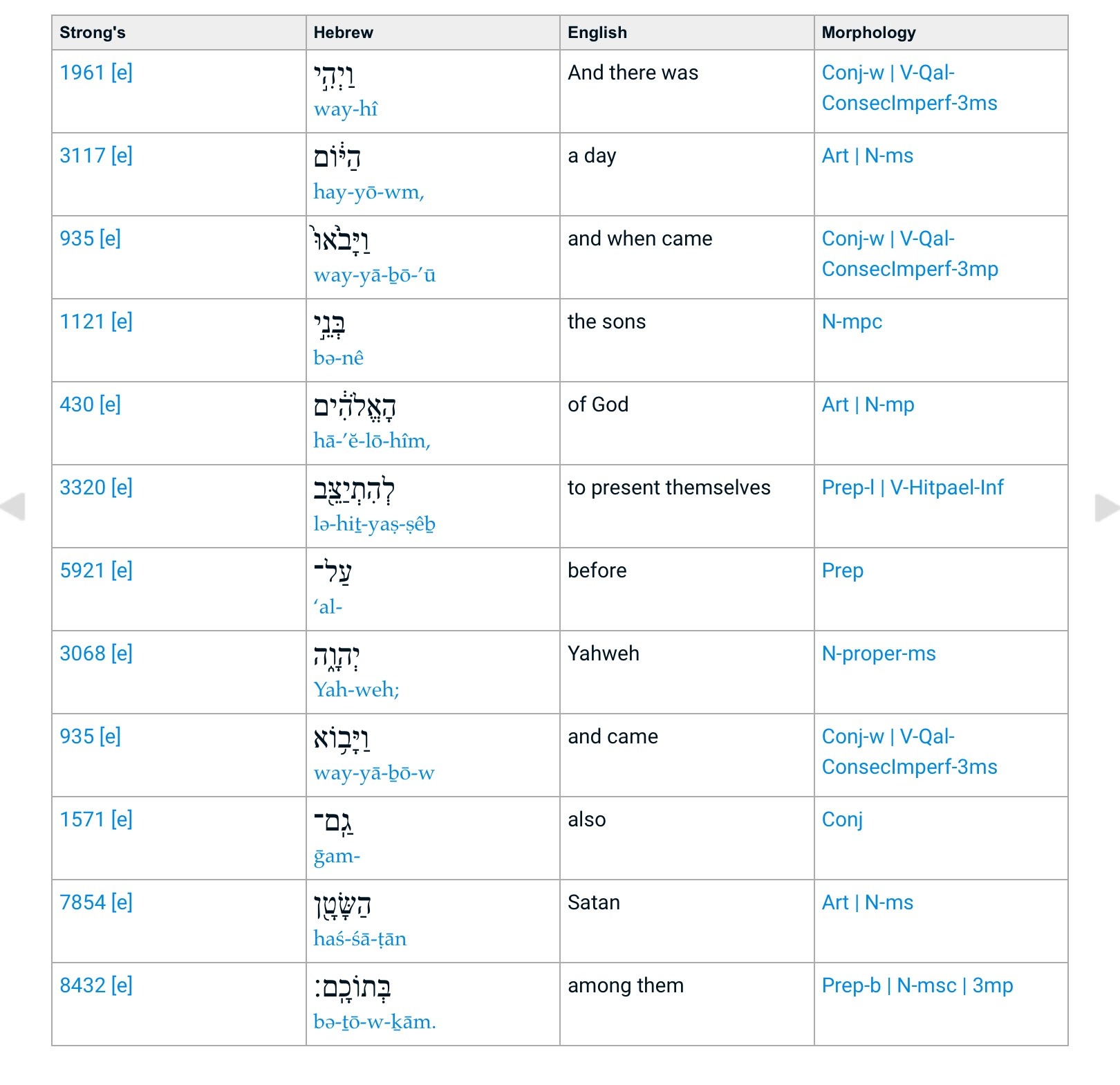
6.  Now there was a day when the sons of God came to present themselves before the Lord, and Satan came also among them.

“Beney Ha-Elohiym” – literally: “the sons of the gods”/ “Lahiythyatsav” -literally: “to take one’s stand”/ “al-YHVH” – literally: “against GOD-YHVH” / “Ha-Shatan”. The celestial beings were indeed the sons of the fallen angels. Amongst these Nephilim in their union against Yahweh, stood, “The Satan” – the sifter, the interrogator, the agitant, — cf. “the SHUT” of the Persian Kings. The “Shut” or “Sheitan” were the C.I.A. officers for the Persian Kings. The “Shut” would go out to the markets surrounding the Palace of the King and ask seemingly innocuous questions to anyone in order to find any scandalous thinking against the King and his Kingdom. The Satraps would then take these people into the inner court to be interrogated further, possibly unto death. 

7.  And the Lord said unto Satan, Whence comest thou? Then Satan answered the Lord, and said, From going to and fro in the earth, and from walking up and down in it. 

This question is a literary device used to find out the ‘agency’ of “The Satan”. Mi-Shut in Hebrew literally means, “going to and fro” without direction, as an agitant to ‘stir’. Mi-Shut is the verbal “name” of “Satan”. Hence, the literary mechanism used to verify the “shem” or “authority” by which “the Satan” operates. 

8.  And the Lord said unto Satan, Hast thou considered my servant Job, that there is none like him in the earth, a perfect and an upright man, one that feareth God, and escheweth evil?

9.  Then Satan answered the Lord, and said, Doth Job fear God for nought?

10.  Hast not thou made an hedge about him, and about his house, and about all that he hath on every side? thou hast blessed the work of his hands, and his substance is increased in the land.

Very important is the boundary line to the Hebrew mind. The hedge represents the sheep within the shepherd’s gate. Inside the gate is where the legal food can be eaten for the sheep. Outside of the gate represents the heath or the heathen lands. In pagan myths we might find a typology that might be considered here-the monster. The monster always walks around the borderline. The monster is relegated to a specified region. The monster always walked amongst the moors. Without invitation, the monster could never enter into the gate of the victim. Here, we find the request from the monster and the acceptance of the request to come in to Job’s life. nonetheless, Satan is bound to only do that which he does best-sift Job within the bounds of meaning and not unto death.

11.  But put forth thine hand now, and touch all that he hath, and he will curse thee to thy face.

This pagan doctrinal approach of “retributive action” will show up later in the pagan doctrines of Job’s ‘friends’. Is this not Partisan politics? Is  this not the syncretism of “christianity” and a particular political party? How can we link our beliefs in a Sovereign God who brings all things together with a “partitive” or “partisan” group? I speak against Democrats and Republicans here. 

12.  And the Lord said unto Satan, Behold, all that he hath is in thy power; only upon himself put not forth thine hand. So Satan went forth from the presence of the Lord.

I must interject that vs. 12 here (the King James Version) is a Horrible translation. God did NOT put Job into the power of God (Romans 13:1 – “All powers  that be are ordained of God”). Rather, the Hebrew says, “Bi-Yadeka” – in your HAND (that is: your scope of sifting/ manipulation/ realm/ jurisprudence/ authority) 

13.  And there was a day when his sons and his daughters were eating and drinking wine in their eldest brother’s house:

14.  And there came a messenger unto Job, and said, The oxen were plowing, and the asses feeding beside them:

15.  And the Sabeans fell upon them, and took them away; yea, they have slain the servants with the edge of the sword; and I only am escaped alone to tell thee.

16.  While he was yet speaking, there came also another, and said, The fire of God is fallen from heaven, and hath burned up the sheep, and the servants, and consumed them; and I only am escaped alone to tell thee.

17.  While he was yet speaking, there came also another, and said, The Chaldeans made out three bands, and fell upon the camels, and have carried them away, yea, and slain the servants with the edge of the sword; and I only am escaped alone to tell thee.

18.  While he was yet speaking, there came also another, and said, Thy sons and thy daughters were eating and drinking wine in their eldest brother’s house:

19.  And, behold, there came a great wind from the wilderness, and smote the four corners of the house, and it fell upon the young men, and they are dead; and I only am escaped alone to tell thee.

20.  Then Job arose, and rent his mantle, and shaved his head, and fell down upon the ground, and worshipped,

21.  And said, Naked came I out of my mother’s womb, and naked shall I return thither: the Lord gave, and the Lord hath taken away; blessed be the name of the Lord.

This would establish by denotation of the text a belief in God’s Sovereignty. 

22.  In all this Job sinned not, nor charged God foolishly.

The acts, words, doctrine and profession of Job are given approval by God

Job gave the Calamity to God as God’s act. This was not accounted as sin or foolishness. How many christians would accuse you of error if you said that God causes destruction? 

We see the doctrine of Sovereignty professed (word) with worship (deed) under Job’s initial affliction by the ‘hand’ of “The Satan” (Job 1:20). In all of Job’s actions, word and deed, Job did not sin within his circumstance. Furthermore, “circumstance”,  was not attributable to Job’s affliction, God was. This would make it personal. 

After Job’s initial “Satanic Affliction” (Job 1:13-19), the narration of Job denotes Job’s Theological worldview by word and deed (Job 1:20). Job professed (word) that “Good and Calamity” come from God.  Following this profession of doctrine, Job worshipped (deed) God. 


The First Declination

What I perceive as the first declination  is the lack of ‘deed’ while ‘word’ was kept. We see Job’s Theological worldview denoted in Job 2:10 where Job reiterates his same doctrine found in Job 1:20 (Good and Calamity” come from God – but without the deed (worship or oblation). , word without deed was found in Job 2:10– as Job states: “Shall we accept good (Hebrew: “tov”: “that which is beneficial”) from God and not accept calamity (Hebrew: “ra’ah”: destruction {distinct from ‘evil’ as shown in my previous articles on ‘evil’}) ”? The doctrine of Sovereignty is correct, yet, Job fails to ‘worship’ or prepare ‘oblation’. 

This question from Job was a rebuttal to his wife’s statement: ”curse God and die’. Job’s wife’s statement would have had to come from her Theological worldview. This worldview would have been very contemporary with the “allotment” gods/ goddesses of Job’s day. 

This common pagan belief would logically reside in her words to Job as to the failure of Job’s God to ‘allot’ Job health, wealth, financial security, a general sense of well being, continuance of his bloodline lost as his children were killed, etc.  Her words were exemplary of her deep rooted pagan beliefs: “curse God and die”. This, again, is a ‘denotative’ key to Job’s wife’s worldview. I believe that we see here the belief in “allotment” gods/ goddesses from Job’s wife that were so prevalent in Job’s day (as hidden in our own day through ‘gods’ known by many names).


The second declination found in Job chapter 3

In Job 3:3, we see Job’s wife no more. We see no more of “The Satan”.

Why is this?!? Because they were literary mechanisms to distill the greater Truth through the genius of the Narration of Job. Does this mean that they didn’t exist in history and/or events? – no. What it does mean is that “the STORY” no longer needed them as antagonists to agitate any further meaning out for “the Story’s” sake. 


Meaning/ Non-meaning/ sense/ non-sense

The doctrine of Fatalism or Naturalism is found in the first words of Job: ‘damn’ *the Day*  (as though ‘the Day’ brought Job’s birth). The worldview of Job’s wife must have been a resonating factor here. Still contrasting natures abide: Job does not curse God unlike his wife who says, “curse God and die”. 

“Where” was Job Ideologically here?

I summarize these 10 points as: “LINEAR( Messianic/anabolic)” vs. “CIRCULAR (cosmogonic/ pagan/ nihilistic/cannibalic)”. 

  1. Job gave ‘force’ to “The Day” rather than to his Sovereign God. Job could not possibly factor in the reason of God’s Sovereignty while factoring “plight” as “a force” or “condition”  by which no other higher order assigned such a plight. 

  2. Job’s worldview of fatalism found in chapter 3 was in stark contrast to his Theocentric Worldview in the first two chapters. One cannot hold to both worldviews. 

  3. Sheol, or “Hell” is found in Job’s ‘plightful’ or ‘circumstantial’ words of “darkness”, “blindness”, “inability to see (cf. the Greek: “phulake”–’spirits in a dark prison’/ night prison watch)”, “separation”, etc. These “placements” of ‘damnation’ limited judgement but stark positioning of the protagonist, Job.  

  4. The CONSISTENCY of denying God’s Sovereignty within the Doctrine of Fatalism, Plight, Circumstance, Naturalism, and Sheol do validate what Sovereignty is NOT. 

  5. Job is forced ( in the genius of Job’s Narration) by *Theological Grammar* to abide either in (a) The FREE sense of being BOUND to GOD’s WILL or (b) the LIMITATIONS of being bound to “Plight”, “blindness”, “agony without meaning or sense”. 

  6. Job was blinded from the consistency of Theological doctrine found within Sovereignty to use a “LINEAR” direction..that is, Job was found incapable of using a Reason TO Something (namely, a PLAN, an INTENT, a group of “SENSES” to lead on a line of direction/ Job consistently ‘hit the miss’

  7. Job was found using the Consistency of repetition found in the ‘circular’ ideologies of the East and A.N.E. pertaining to that of Naturalism, Fatalism, and Nihilism. One might look to the mythological symbol of the Ouroborus (cycle of cannibalism upon oneself in time only to rebirth and repeat–seen as serpent eating one’s own tail) for a meme concerning this ‘repetition’. This is what I call, “Circular” religion or a “cannibalic” worldview. 

  8. It is on the line of LINEAR Theology that one must travel to a final point, namely, the Messiah. 

  9. It is one the CIRCULAR Ideology that one must return to unless “nirvana” is achieved. In the name itself, “Nir/ Vana” –’beyond the turmoil of the web of this life’-’to be extinguished from the fire {of this life} -one sees themselves ‘as God’–”THOU ARE THAT” or, in the Sanskrit: “Tat Tvam Asi”. What a scary moment it must be to ‘arrive’ and ‘realize’ that you ‘are it’. That there are no more ‘signals’ or ‘signs’ to follow. That YOU are THAT or, YOU are the ‘end of the road’. You are the “Reference Point”. No more Signs, no more signals, no more senses – the place of “NON-SENSE” is where you abide to make relativistic meaning.  What a hell defined!

Job had found a loophole of ‘fatalism’ that was blinded to an attributive ‘non-sense’ . This, “non-sense” means that Job had ‘no signal, no reference, no generator, no generatrix, no deity, no one, no direction, no line, no intention in his ‘world view’ within the context of ‘agony’ for ‘agony’s sake’. One might refer to C.S. Lewis’, “Problem of Pain” for some insight to this topic. 

Job was in hell (that is- ‘hidden, away, unseen, “Sheol”) even from the fictional deities or pagan gods of allotments. He cursed no false god, no real God. Job only cursed the plight from which the plight generated (a.k.a. pre-nihilism). Job had taken on a circular form of religion from which no signal began or ended. 

Fatalism becomes Job’s myopic worldview. Job attributes “Fatalism” gets the credit of fate of allotments- health and wealth. Job continues to speak of his life in chapter 3 as a type of “plight”. That is, the ‘abandonment’ done by an ‘impersonal force’. This IS the logic led to by ”fatalism” without God as the INTENDER. A repeat of his wife’s denotative ideology, that is: the doctrine of ‘receiving’ — especially: health, wealth, abundance, etc. is considered  “good” while calamity is to be cursed, to be thrown into hell < Job’s wife’s words, not mine. 

It should be noted that fate is to be distinguished from our marital relationship with God in His Sovereign Intent. “Fate” is more or less a ‘blanket order of naturalistic themes and outcomes. “Fate” is impersonal and finds its closest definition by the Egyptian “netjer” – the allotments by the goddess from the Nile’s life giving/ allotment giving force. The “elan vitale”–the ‘life force’ is yet another close definition. Finally, “nature”, or “naturalism”, — as in Mother Nature and our dependent needs to be allotted from her to us. We find “her” again in the Mesopotamian stories of Tiamat, Inanna, Asherah, Isis, the Ashtoreth, etc.. Interesting, how Job relegates his emotions as ‘doctrine’. Within this “doctrine” he assigns himself under the rules of the “elan-vitale” –or impersonal force. Again, from the original doctrine that Job held, the “elan-vitale”, “nature”, “Fate”, etc,. would be a mere by-product of creation at most/ or a fictitious or fictive force at least.   

 longer the Deity that Job had all along been giving credit to for everything) that he was born (as though Job had the power to “Damn the Day”). Fatalism, as a doctrine, has taken hold of Job// You can see what Fatalism does to the Theological mind right here)

My question: 

Did Job feign to ‘protect God’ by eliminating God in Job’s worldview through the doctrines or professions of ‘fate’ as an impersonal force. Job’s Agony becomes an ‘emotive doctrine’ without intentful causation. Finally,  life is shrunk down for Job to the ‘here and now’ and the overview/ the purview of Sovereignty is no longer to be recognized. 

I associate myself with this question as I’m sure many Christian believers do when we blame: the church-but do not blame God, the hypocrites in the churches-but do not blame God, the people who act like christians-but do not blame God–all for the sake of “justifying the flesh”—a.k.a.–’getting into sin’ using ‘naturalism, fatalism, doctrine of allotments, etc. as a worldview to sin. How close am I getting?

Finally, 

Not to validate this writing with this show: I am reminded of one of my guilty pleasure shows (my wife included) called, “Ghost Adventures”. In this show, the consistent theme throughout every episode is that the ghosts tend to “repeat” throughout the haunt that they abide in. A repetition without end. The hauntings usually include either a gruesome murder, torture, terror, abuse that took place in that particular house or land plot holding these repetition of energies. Simply put, energies that are trapped in replay. No meaning, only suffering. No release, no letting loose—just a cycle of return to the same story. This must be a “hell” if real and for sure, this is what we call hell in this life when we can’t break a destructive cycle. Remember: “CIRCLES vs. LINES” ideology/ Theology. 

Before I address Job chapter 3, I need to recap the seemingly quirky nature of Job 1 and 2 as a ‘necessary evil’. Both chapters were ‘set up’  to distill key elemental players into their proper places within the story or narration of Job. 

These players or idolum (a term so brilliantly used in C.S. Lewis’ works when referring to a ‘higher mind; higher player” using the idolum {example: the objective chess pieces holding their potential degrees of usage for the Prime Mover’s expression upon the chessboard}  to express IT’s *intention*) played their degrees by which ‘signs’ could be made. All such idules or Idolum lead to what I believe is the prime doctrine of meaning: Intentful-Loving Predeterminism.

 I use  the word, “evil”, in jest, for there is no independent agency of evil found in the book of Job under a Predeterministic God, Who Himself, set the parameters for which “The Satan” could only work his or destruction’s own representation of function, degree, machination, ethos, principle, boundary, jurisprudence, authority, ‘shem’. 

As an American, I am so easily attracted to ‘the monster’, especially in the older horror films (i never needed the gore to ‘get the point’ ), that seemed to ‘rectify’ or ‘right-ify’ that which was unrighteous. Such was also the case for the Spaghetti Westerns when Clint Eastwood came in as the ‘a-moral’ player/ idolum (eidolum) as ‘the rectifier’ setting the corrupt town ablaze, leaving only the few “innocent” alive. 

Interestingly, the idolum to which Clint Eastwood played, had no greater moral code than that which is understood by base animals. It was when the actions of the people fell below these basic civil principles (i.e., don’t murder, steal, covet, commit adultery, rape, lie, etc…) did lines get drawn by the tenor or unwavering actions of the ‘rectifier’. 

 In short, I used to love (guilty pleasure:I still do) seeing the “bad guys” get it  by means of the avenging ‘angel/ monster/demon/–or whatever brought about ‘justice’. In this sophomoric view, I was about half-way there concerning the meaning of ‘rectification’ from it’s true sense. 

The truer sense of the Idolum and Meaning of ‘the Story’ of Job

Hopefully, after reading this, I will have dispelled for you the Western Hemisphere’s notion of “Satan” or “The Satan” as a ‘being’ that holds a counter-force to God, man, nature, etc. 

I would like to take you to the Medieval world which was a time that offered us a literary ‘catcher’s mitt’ of archaisms. This era, which cared for ‘the story’ of meaning,  knitted stories such as King Arthur, Sir Gawain and the Green Knight, The Fairy Queen, Shakespeare’s MacBeth, Hamlet, etc., had compiled ancient stories with timeless and most precious archaisms that still give us cultural identity. This era of Medievalism gave us insight into philological treasures that cannot be dethatched in meaning and do safeguard our English language from the aeons of idiocy. 

The Medieval view of “Evil” was distilled by it’s etymology and contextual meaning found in all of the classics as something that ‘did not fit’.  “Evil” meant that which was ‘hated’, that which was a ‘societal discomfiture’, ’ugly’, ’disfigured’, ‘failed as beautiful by the standards of a Medieval “Cosmos” ( cf. Marsilio Ficino’s revival of the Platonic classical schools of thought for the ‘standard’, canon or rule of “that which was beautiful” and that which was not beautiful or cosmos-sound -i.e., ‘not-cosmetically sound’), ‘incapable of societal functions’, ‘mentally deficient’, ‘handicapped’, ‘hunch-backed’ ‘babbler’, idiot {Greek: eido (to see) -tace (to place): to see only what one wants to see or can see}, ‘isolated’, ‘stutterer (usually due to the ‘stuttering sound’ of an uncouth heathen-foreigner to the ears of the more civilized culture, etc. 

Evidenced, or objectified within Beowulf,  Anglo Saxon literature, we have the “Demon”, who was of ‘the bloodline of Cain’ for whom was identified as a Moor dweller. That both, the Grendel and his witch mother, were definitively, “monsters”,  and “ogres” that stayed, usually, to their heathen-outcast regions until provoked. They were ‘misfit’  beings. 

I address at this point the difference between Christian/ Jewish literature and Heathen literature. It is within the Heathen or Pagan literature that a ‘will to choose’ to cross the boundary line gets a little hazy. 

Is it ‘self agency’ which makes ‘the story’ meaningful to the ancients and moderns? Or, was it the Predeterminative God that motivated the entire story – only to be found in the end of “the story” of the ancients? That is, the idolum which were made to be ‘whittled away’…as ‘literary mechanisms’…to get to the Final Meaning/ the Ultimate Truth?… I’ll take the second one. 

Let’s take one last Medieval look at it’s literary mechanisms before going back to look at the synchronic and diachronic view of Job. 

The idolum assumed as “the Satan” or  “monster” from its philological sense goes as follows: Latin: Monere: “to remind, bring to one’s recollection, tell of, / admonish, advise, warn, INSTRUCT, TEACH; (from the earliest source >): Proto Indo European: moneie; “to make think of, remind” – {causative form of *men – {as in mensae} ) “to think”. 

Looking at the “monster”, Grendel, he was considered in the Anglo Saxon as “AGLAEC” which meant, “CALAMITY”!!! –also meaning: “terror, distress, oppression” – which were ALL the key components in Job 1 and 2, both from the “MONSTER” (as truly defined here and the “Calamity” by which the MONSTER is known to bring. 

The Sutra for “the MONSTER, the SATAN, Job, the CALAMITY” is found in Job’s words, “God brings good (Hebrew: “TOV”- ‘that which is beneficial’ ) and “CALAMITY (Hebrew: “Ra’ah”: ‘terror, distress, oppression, destruction’). 

It is in the genius of the Narration of Job that we find his Theology vs. his wife’s. 

His wife says, “curse God and die” while Job rebuts and says, “Will not God bring both TOV and RA’AH?!” 

The “evidence (e -out/ vide-to see)” of the Idolum or objective character by which the morphing of meaning upon the objects of “the Story” is seen through Job’s story. Job’s narration or Story does offer us an aqueous solution by which we can witness transformation due to the prime mover and irregardless to the individuals in the story, including “the Satan”.  Some idolum dissolved to infinite regress such as “The Satan” –for the “Story’s” sake of meaning, some idolum conform to the ‘identity’ more akin to the prime mover –such as Job being a “Christ typology”— a Perfect man, Pure, without blemish/ not deserving a retributive action upon him. 

It is within this genius of non-retributive action upon Job that I see the error of his friends distilled out. Their error was from their world views tethered to pagan views concerning God’s relationship to mankind and the Devil. Namely, these pagan notions were/ are: dualism (God vs. Satan), Free Will (‘if only you hadn’t done this”), and retributive action (‘because you did this, Job, God is punishing you’).  

All 3 errors are sadly found in most western Churches. All 3 errors are held as Theological constituents to a belief rather than a doctrine taught in the Narration Job. 

It is here that I come to the conclusion that the ‘theology’ of Job was one of Sovereignty and he both acted and spoke to it in the first chapter. Job’s wife, on the other hand, spoke of a “god of allotments” in her denotative ideology–’curse God and die” — due to your “plight” or “allotments” of *loss* or *calamity*. 

God does bring GOOD and CALAMITY for HIS good pleasure and for OUR BENEFIT. Isaiah 45:7 {“I the Lord Create both GOOD and DESTRUCTION for my Good Pleasure).

The story of Job was initially a pre-Biblical-Mesopotamian story. The account of Job, or “Ayub”/ “Iyob”/ stood the test of time before landing into the canon of the Old Testament. The same message we find in the book of Job is found all throughout Mesopotamia. As for my opinion, I believe this single story gives us archetypes of the “Suffering Servant” -i.e., the Christ figure. Though we see that Job and the Mesopotamian suffering servant/ man of affliction was mortal, we see in all of these early case-stories a consistent Theology.  These constant/ consistent factors hold that the Satan, adversary, destroyer of riches (and bringer of riches) was the Deity of goodness. That calamity is ‘good’ if calamity is Sovereignly directed. 

The ‘calamitous’ gears in the doctrine of Sovereignty get turned when the Narration unfolds. and solidifies “a” Sovereignty not defined in many Churches today. That is, many claim that “God is Sovereign” but are unwilling (i.e., the fleshly mind cannot acquiesce) to believe that God would create, make, allow “calamity”. Sadly, I’ve heard the word “allow” as ‘another force’ that God ‘lets happen’. This is just another aspect of “dualism” found within the western church. Sadly, even those that would claim “Sovereignty”/ “Pre-Knowledge” and finally, a “Predeterminate” counsel STILL hold to ‘another force’ wielding its way against ‘goodness’, ‘allotments’, ‘health’, etc. that we need to invoke the Deity or God of the Bible to “fight against”.  This is why comic books are so popular, I guess—just pick two main deities and have them battle it out for “power’s sake”.  

The entire conundrum of dualism can be resolved in believing that God has Preordained ALL things both “good” and “calamitous” —(both working together as ‘signs’ to God).  There is no better book that I can find in the Bible ( or any other A.N.E. book {i.e., “ancient near east”}) that works out the Theological-anatomies of non-dualism/ Absolute Predeterminate counsel/ Non-retributive/ Gracious Marriage by the Themed Deity of *The Story*. 

Let’s begin:

“Job” means “hated” in the Hebrew. Though, in the Arabic language, “Job”  means, 

“he who turns to God”. Both meanings are dubious to their origins but the context of Job’s story gives us his ‘name’. That is, the Hebrew word, “shem”, which means  “authority” or “name” in how we associate who Job is, or for that matter, we know each other by our ‘shem’. Who else can we be reminded of as a hated man who was without blame and sought to save others to his own demise?–cf. Isaiah 53 – Is this not a prophecy of Christ? Is Job not an archetypical sketch and pattern of the hated one, the Suffering Servant, Jesus? 

Job’s “shem” was a man who was righteous, beset with unwarranted affliction, held together by a strong Theological worldview as presented in the statements made of Job ( especially in book 1 and 2). 

 We find that Job chapter 1 gives us a great detail to Job’s life. He was an upright man in all of his ways. God-fearing, Sovereignty believing, that is—Job believed in the ‘kind’ of Sovereign God that would be both good and calamitous. 

We then see the ‘sifter’ or ‘the satan’ which came to do his function. All limitation was beset ‘the Satan’ within the myriad of destruction he wreaked upon Job…just as the damage/ the eucatastrophe beset Jesus Christ. 

Cohesive and parallel texts, etymons, memes, and figurations within the book of Job, Rig-Veda, Sumerian tablets/ texts of Enki Inanna and the Babylonian/ Mesopotamian “Enuma-Elish”. 

We get a very interesting look into the council of the ‘coven’ of these watchers (Sumerian: Igigi: ‘the ones with intensive eyes/ roving/ watching) with their leading Watcher, “the Satan” “(Hebrew) Shut” = “The Rover” – “Raven”  or “Mishut”. I also find it interesting that the ‘descent’ or ‘descension’ from event, to redaction (God to Moses/ Moses to Israel/ Israel to us) to early myths brings us the *Raven* as ‘the EYES’ of the god, God, gods, Witch, Warlock; that is, “the EYES of the LORDS”. 

The Watchers, fallen sons of the “ Fallen-Council/ Fallen elohiym (which are the Fallen angels)”. The nature is ‘to go forward’ as YHVH in HIS root name: “YA” = “to go”, “to cause”, “to do”—we find this name in the Sanskrit as well (which tells me how early/ old this story-account is). The ‘Sons of Heaven’ are called in the Rig-Veda (Pre-Upanishad/ Pre-Mahabharata/ Pre-Ramayana/ (earliest of Hindu referenced literature) in Sanskrit Angirases or “Angira”–from which our word, ‘Angel’, finds it’s Greek cognate, ‘angelos’.

These Rig-Veda ‘angels’ were seen at the SOMA Tree or  Ambrosia Tree where the gods drink this SOMA nectar and ‘see’ with the god’s eyes. These gods by the SOMA tree are known to recline and be the gods at the Tree of knowing in paradise.  Interesting, that this same story can be seen in the pictographic Hebrew word for “TREE” in the Garden of Eden. It is a pictograph of an all seeing eye and a reclining person. 

 These “messengers” of the gods are also referred to as the ‘fire-priests’/ ‘the ones who keep the fires going’  They are also known as the Virupas or in the Sanskrit: “vir” – ‘man’ + “upa” – {literally ‘evil’} = ‘ugly’ —especially in the eyes. 

The accounts of the Annanaki (Annanaki: some scholars believe could relate to the gods/ fallen gods, angels, angira, etc.) had ‘snake-like’ eyes; mis-shapen faces as those of a cobra, serpent, snake—cf. to the “Seraphiym” of Isaiah 6: 1-ff to the Biblical Angels of GOD/ YHVH were actual Serpents with 6 wings; two wings to cover their eyes, two wings to fly and two wings to cover their feet in the presence of YHVH. I also find it interesting that Satan, in the Garden of Eden, had not been finalized in his judgement but referred to as the Serpent. Plus, his curse was to crawl on his belly as the serpent of the field. 


The coven’s limitations of action

We see the fallen ones, or, *the ‘sons of the gods’ with Satan in the midst of them being confrontational in the face of God-Yahweh* as we see in the first chapter of Job (Job 1:6 -)

When reading the Hebrew it is very import to understand the intensity of the verbal form. “Presenting themselves was in the Hitpael infinitive. The “Hitpael” is primarily what we call a Piel verb form but reflexive. Such as, “Gird oneself, Defend oneself, sanctify oneself, to show oneself revengeful, to make oneself great, to show oneself wise, to pretend oneself, etc.”  In brief, the Hitpael is a verb form which ‘roots oneself willfully against anything to its opposition. 


No dualism between ‘evil’ and ‘good’

Here is the “contract of action” within the *dialogue* from the Story of Job. It is God’s ‘handing’ Job into the ‘hand’ of ‘the Satan’ to do all that is in the ‘hands’ of Satan to do with the limitation of: ‘do not lay a *hand* on him’.  

*YOD* or “hand” is the key word here. It is used as an interplay-word to show  the ‘limitations’ of responsibility, scope of function, expression of one’s ‘shem’ or ‘name’ or ‘authority’.  Remember, the actions of the character give the character their “Shem”,  their ‘authority’ or ‘title’ of responsibility. 

Below is the contract of “shems” coded with the Strong’s concordance number for your benefit to look up the word meaning:

559 [e]   

way·yō·mer   

וַיֹּ֨אמֶר      12

And said   12

Conj‑w | V‑Qal‑ConsecImperf‑3ms   12

3068 [e]

Yah·weh

יְהוָ֜ה

Yahweh

N‑proper‑ms

413 [e]

’el-

אֶל־

to

Prep

        7854 [e]

haś·śā·ṭān,

הַשָּׂטָ֗ן

Satan

Art | N‑ms

 2009 hin·nêh

הִנֵּ֤ה

behold

Interjection

3605 [e]

ḵāl

כָל־

all

N‑msc

834 [e]

’ă·šer-

אֲשֶׁר־

that

Pro‑r

lōw

לוֹ֙

he has [is]

Prep | 3ms

         3027 [e]

bə·yā·ḏe·ḵā,

בְּיָדֶ֔ךָ

in your hands 

Prep‑b | N‑fsc | 2ms

7535 [e]

raq

רַ֣ק

only

Adv

413 [e]

’ê·lāw,

אֵלָ֔יו

on his [person]

Prep | 3ms

408 [e]

’al-

אַל־

not

Adv

7971 [e]

tiš·laḥ

תִּשְׁלַ֖ח

do lay

V‑Qal‑Imperf‑2ms

          3027 [e]

yā·ḏe·ḵā;

יָדֶ֑ךָ

a hand


For the STORY’s Sake: There can be no retributive action upon Job due to Job being upright and blameless 

Remembering Job 1:1: “A man there was in the land of UZ, Job was his name. That man was BLAMELESS and UPRIGHT, one who feared God and shunned evil”, therefore, the purging of Job was not due to ANYTHING that Job had done. Rather, it was a metaphysical, meta-Deistic decision made outside the hands of mortal reason, action to retributive action and/ or ability of Job to incite God’s anger due to his mortal will.  

There is no ‘rogue-agency’ or ‘rogue-free-will’ if we are being unfolded for HIS STORY’s sake 

Using the mechanisms of fiction: How can the characters on the pages of a book written by an intentful AUTHOR jump off the pages and demand ‘their rights’, ‘their opinions’, independent behaviors, etc. without (1) destroying “the Story” (2) becoming disenfranchised from ‘the Story’, i.e., —‘cast off from their book of meaning/ cast off from their own book of life/ cast off from the integral nature of their lives with the lives of others within ‘the STORY’?  

Such a question can be employed especially in this time tested book of Job. The Grammar of God is within the Story of Job. The Grammar is the Theology that I hold. I believe this Grammar is the ONLY way to make sense of this world. Sadly, most of the Western Christian Church has denied this Theology titrated from the book of Job because most modern Christians do not believe that God Sovereignly brings destruction upon His people, let alone a righteous Christian…which would be a fictive character–and still, Job, the righteous/ blameless man,  received just that! 

Final footnote:

We find when studying Scripture, one MUST understand that the Identity of the Christ Figure is being unfolded, pulled out, defined, coming to light out of ancient Middle Eastern pagan beliefs and into gentle dispensations for the reader to understand the Grace of Christ–and not a retributive-legalistic god. 

If one is to begin at Genesis with “THE STORY” and finalize in Revelation, one will need to understand the “Social-Baal” or cultural god versus the ISHI (Jesus by title/ name/ “Shem”)  of Hosea 2:16 (ca. 780 B.C. !!! {Jesus talking} – “And it shall be at THAT DAY says YHVH that you shall call me *ISHI*;  and shall no longer call me Ba’al-iy (or “Baal” –i.e., general cultural sense for “God-owner”, “God-Husband-owner of wife (chattel)”, “Dominate of the House”, “Dominate and untouchable”, “High”, “Lord over”, “Master” {as opposed to, “ISHI”, which means, “endearing Husband, protectorate, Lover, bound to, close to, guardian, provider”—- ).

 This is all-together different from being a “Dispensational-ist”. This argument will be for another time. 

My point here: Jesus Christ is the GOD of Salvation through Grace, not works, retribution, ‘free-will (if you are saved ‘by Grace’ before the Foundation of the world {Ephesian 1:4/ Romans 8:28-31/ etc. what did ‘your free will’ do to save you?)