
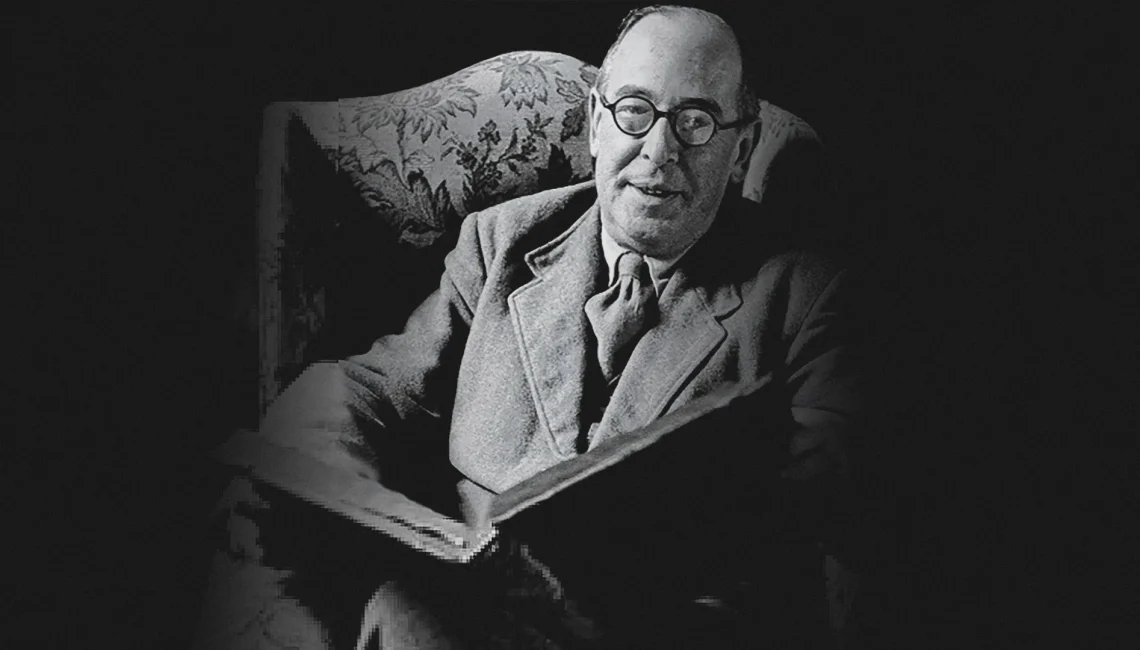
I offer an integrated view of three of C.S. Lewis’s works: 1) The Allegory of Love: A Study in Medieval Tradition (1936), 2) Studies in Words (1960), and 3) The Four Loves (1960).
I find the combination-synthesis of these 3 major works offer a coherent doctrinal inquiry into language, literary history, and the taxonomy of human affection. Together they demonstrate a methodological precision that moves from philological rigor to accurate literary exegesis and finally to theological anthropology.
In “Studies in Words” , Lewis lays the lexical foundation by warning against the “dangerous sense” , i.e., the unconscious imposition of modern connotations onto historical texts that distorts interpretation.
He diagnoses “verbicide, ” the murder of words through inflation (using overly dramatic, exaggerated, or “big” language for small or ordinary subjects ruins the power of language and renders words useless), partisan appropriation, or evaluative drift: “A skillful doctor of words will pronounce the disease to be mortal at the moment when the word in question begins to harbour the adjectival parasites real or true. ” Semantic change must be traced with philological care, distinguishing lexical from speaker meaning. Recovery of original meanings, including Latin and Old French roots for terms central to courtly literature—courtesy (from cortoisie, refined courtly conduct), love (amor), and nature (natura, often personified as a divinely ordained principle)—is prerequisite to faithful exegesis and prevents anachronistic readings of the texts examined in The Allegory of Love.
This philological rigor directly informs The Allegory of Love. Lewis identifies the abrupt emergence of courtly love in late eleventh-century Languedoc as a pivotal cultural shift. He enumerates its four constitutive marks: humility, courtesy, adultery, and the religion of love. Central to this ethos is its “feudalisation of love”: the lover is rendered abject, owing vassal-like service to his lady. “The lover is always abject. Obedience to his lady’s lightest wish, however whimsical, and silent acquiescence in her rebukes, however unjust, are the only virtues he dares to claim. There is a service of love closely modelled on the service which a feudal vassal owes to his lord. The lover is the lady’s ‘man’. He addresses her as midons, which etymologically represents not ‘my lady’ but ‘my lord’ (midon- “maddonna” – “mother goddess”). This posture, drawn from troubadour poetry, Chrétien de Troyes’s “Lancelot”, and Andreas Capellanus’s “De Arte Honeste Amandi”, contrasts sharply with classical depictions of love as sensual indulgence or tragic madness.
Allegory serves as the necessary vehicle for this new subjectivity, described as “the subjectivism of an objective age. ” It externalizes inner psychological conflict through personification, building upon Prudentius’s Psychomachia and the Chartres Platonists, notably Alanus ab Insulis’s De Planctu Naturae.
The tradition reaches its synthesis in “The Roman de la Rose”, with Guillaume de Lorris’s dream-vision complemented by Jean de Meun’s encyclopedic continuation. Chaucer adapts these forms in “Troilus and Criseyde” , while Spenser’s “The Faerie Queene” resolves the courtly tensions by subordinating adulterous passion to virtuous Christian marriage, as seen in Britomart’s chastity and the Mutability cantos.
“The Four Loves” furnishes the theological capstone. Lewis classifies four types of love: affection (storgē), friendship (philia), Eros, and charity (agapē). He notes an unmistakable continuity “that connects the Provençal love song with the love poetry of the later Middle Ages, and thence with that of the present day,” acknowledging Eros as potentially ennobling (and enabling) yet perilous. “Eros ceases to be a demon only when he ceases to be a god. ” Natural loves, including the idealized passion of the courtly tradition, become demonic when divinized; they achieve their proper order and fulfillment only when subordinated to supernatural charity, the self-giving love modeled on divine agapē. Collectively, these works exhibit Lewis’s unified intellect. Philological exactitude prevents misreading of literary tradition, literary historiography reveals the feudalisation and allegorical expression of eros, and theological discernment subordinates natural loves to charity—lest humility devolve into idolatry, courtesy into mere etiquette, or the “religion of love” into pagan parody.
Lewis’s scholarship thereby models an integrated Christian humanism: historically attentive, linguistically precise, and doctrinally acute. It affirms that all loves find their true telos in the charity that “never faileth,” illuminating how medieval innovations in sentiment and expression continue to shape Western understandings of language, affection, and the soul’s orientation toward the transcendent.