Resource Articles
To John Halloran (founder/ President of the Sumerian database-Library of Congress approved)
————————–
(From John)
On Tue, Jan 11, 2022 at 3:48 PM John Halloran
johnalanhalloran@gmail.com>wrote:
Kyle,
So you have switched from Yahoo to Gmail. I last heard from you in 2003 when you ordered the Thomsen and Hayes books. Would you like a copy of my new 432-page book How The Sumerians Became Rich? Here is a description: https://www.sumerian.org/Sumerians-Book.htm
Regards,
John Halloran
Los Angeles
——————-
(From Kyle/ Kyle’s response:)
I’ll order the book now. I can’t believe it’s been that long ago. Sadly, I have simply forgotten my password and it’s nearly impossible to get it back. So, I went to Gmail. I’m working on correlating the basic 269 Sumerian pictographs using sources such as your lexicon. I do not plan on sales from this effort— only the joy of learning. I plan on correlating Armenian, Georgian and Chinese pictograms with this lexical bank. John, thank you for responding to me so quickly!!! In your service, Kyle Jones
——————————————————–
(John’s statement/ question)
Kyle,
Thank you for supporting me by ordering on Amazon. The book will go out today by Priority U.S. Mail.
Do you think that the Armenians of today are descended from the Kura-Araxes or Transcaucasian people?
Best Regards,
John
————————
(Kyle’s answer:)
Seems to me they are more Altaic. We have petroglyphs dating back to 35,000 B. C. with religious significance. Both linguistic evolutions for Georgian and Armenian cultures seem to hold that there was a parent relationship from old Armenian to pre-Sumerian cultures which also are predated by Syunik culture. If a migration from the last ice age involves Siberia as a warmer climate ( I believe) the forced march southwards would probably explain Anna Meskhi’s 300,000 year old hypothesis of Altaic “origins”. This, in turn, affects the Steppe region that you are referring to. I still find etymological matches with Armenian, Georgian and Sumerian which, due to Sumerian being a dead/ stative language we can profit from this kind of stability of research.
These linguistic comparisons show that there was little change from the Sumerian and pre-Sumeria era with Armenian and Kartvelian cognates. Likewise, our present day Kartvelian language, Georgian, still carries Sumerian cognates with it!!!
Sioni culture seems to be responsible for being the predecessor to the Kura-Araxes cultural complex. The South Caucasus (Transcaucsia) reach further east into Georgia and Azerbaijan.
This peaks my interests with David Rohl’s work, “Legend”. I have worked with David Rohl and Anna Meskhi in various situations concerning these geographical locations. Both of these scholars have been on my podcast and website. / I also look at Sioni culture for being a Kartvelian related (Georgian, Svan, Laz, etc.) culture which turns my head to Dr. Anna Meskhi’s work on *Kartvelian-Sumerian Linguoculturology*. It is here that my interests peak with a fabricated ‘key-code’ relationship using Sumerian and Kartvelian as a ‘cipher’ for militaristic purposes (the entire theme of Anna’s Doctoral Thesis–and my Biblical “New Shem” in Genesis
Anna is coming from a non Jewish/ Christian/ Muslim perspective though I have theological speculations that seem to fit like clockwork using the fusion of Syunik-Kartvelian-Sumerian-Hebrew-Egyptian-Chinese pictographs as a ‘synthesis history’. This ‘fusion’ seems to fit the *Narrative* of the Biblical text of Genesis 1-11. // So, ‘theologically’, the South Caucasus view–i.e., David Rohl’s archaeological findings, show me the link between Azerbaijan and Northwest Iran as an “Edenic” region conveying endonymic names that do indeed convey the Biblical names via function, etymology or both (usually both) and the Sumerian – “Shem-arian (David Rohl’s coined name)” view. With that said, I’m hyper focused on the Mother language (in my opinion). So, Sioni and modern Armenia might be related but in the distant past when, I believe, all of this cultural complex was more northern.
——————————————————-Credits to Dr John Alan Halloran:
Loeb Classics; Plato; Cratylus; pg 121; vs. 418
SET ONE OF ‘MOTIONS’
Dei’on – “obligation” (Root: ‘to go through’)
*de’o—-* (root of Dei’on) – “to bind” as a prisoner or animal—-Mt. 18:18
(Cf. “Deismos” as cognate)
Blaberon (cognate)
—————————————-
SET TWO OF ‘MOTIONS’
(Plato says that these particular names signify the principle of *arrangement* and *motion*
Owe-fee’-lee-mohn – “useful”
Lusitelon – “profitable”
Kerda.lay’on – “gainful”
Agathon – “good”
Ksoom-fe’ron – “advantageous”
Euphoron – “prosperous”
—————————————-
SET THREE OF MOTIONS
Zay.mee.OH’.dayce “that which binds motion” – in a good way (halting from trouble)
(Other spelling: daymiOH’dayce = good”)
—————————————-
SET FOUR OF MOTIONS
Hay.doe.nay (from, “hedonism”) – “pleasure”
Lupay – “pain”
Epithumea – “desire”
…………………………………
SET FIVE OF MOTIONS
‘Haydonay’ – ‘the action that tends towards advantage
(Root of haydonay: “eonay” – PN – TO BREATHE
LUPAY – “dissolution of the body which takes place through the process of pain”
Ania – “sorrow – that which hinders motion”
(Root to ‘ania’: “algaynos” – “distress” – “having a hard time”
—————————————-
SET SIX OF MOTIONS
Odu’nay – “grief; putting on the pain;
Aksthaydon – “vexation” – as in weight
Aksthos – “burden” – “as vexation of weight puts upon motion”
Loeb Classics; Plato; Cratylus; pg 125; 420, B, .5
SET SEVEN OF MOTIONS
Doxa (“opinion1” – i.e., ‘shooting for the goal or intention to meaning without knowledge or
certainty as of yet’).
In Plato’s dialogue, Doxa comes from the pursuit {‘dioxis’} which the soul carries on as it
pursues the knowledge of the nature of things, or, most likely, from the *SHOOTING OF THE
BOW (toxon2)*; i.e., though we can’t say for sure that we have hit the mark, we are aiming with
good intention.
Oi’.ay.sis – “belief” —- “the sense of the MOTION of the soul towards the essential nature of
every individual thing (i.e., *trajectory*; *intention*; *goal towards someTHING; from the
universal to the particulars {from the Heavenly to the Earthly—Kyle})
Just as “oi.ay.sis” acts in its motion, so does “Boulay”.
Boulay – “intention” – denotes “shooting (Bolay)”
Boulesthai – “wish”
Bouleu’esthai – “plan” = denoting “aiming at something”
———————————————————-
SET EIGHT OF MOTIONS
Kara – “joy”
Diakoosis – “of the flow of the soul”
Terpsis – “delight”
Terpnon – “creeping of the soul” – “delightful”
{page: 123; vs. 419}
2 Cf Roger Ascham’s, “Toxophilus – The School of Shooting” and “Toxophilus”
1 P.I.E. *op – “to choose”; cf “option”; option: Latin: “to desire, to pray for, choose”; Proto Italic: *opeje- “to
choose, to grab, from P.I.E. *hopeie-“to choose, grab, etc., Hittite: epp/app – “to take, grab”; Avestan: ‘has
reached, reached for’
(Root of “terpnon” – *-pnoay [pne-] = “breath”)
Eufrosu’ne – “mirth” = {“harmony with all things/ universe}
{eu – well; good + sunay – “all things ‘summed’/ ‘joined’ (together)”
EpithuMEE.ah – “desire”; thumos = thusis = “boiling over; boiling of”
*’Ee.oo.sa* = “goes into thumos” – cf. below with above
——————————————————-
SET NINE OF MOTIONS
Hay’.me.roos – “longing”; “the day”;
(Root: “hay’.mee” + “rous”
** Hay.mee.ros** = emera + roos = longing for the flow; the flow that goes away; takes away; the
“rush away as a stream from the soul”; “yearning”
(Cf hay.meh.nos)
Pothos- “yearning”
“Allothi pou” – “that which is elsewhere”
“Hay.me.roos” “present (object)” – “The Day that Has Come Upon””
“Pothos” – “absent”
*Eros – “flows in from out”
(Cf. Root Eros —> root: “esrei” = ‘eis’ = ‘into’ + “roos” = ‘river’ = ‘flows INTO as a river [ from an
outside source].
SET TEN OF MOTIONS
Aboulia – “evil”; “without intention”, “ill-advised” (cf. to notes below)
(“A” = alpha privative = Greek prefix for making negative, negating the meaning)
So, Boulay + alpha privative = “Aboulay” – “evil”; “ill advised; without intention, plan, goal, desire,
wish, trajectory; *therefore, a *failure to hit* = cf. “sin” = Greek: “harmateia” = sin, senex, sine,
missing the mark (even if planned to hit the mark)
Anankay – (‘anagkay’ = ana’g {“g” takes the nasal/liquid-“n”}kay) – “compulsion”
Hekou’sion – “voluntary” —( Hekou’sion means ‘voluntary’ because ‘hekou’sion’ comes *in line*
with the ‘events’ of motion to the *YIELDING* (Greek:eikon = English: ‘icon’) and not in
opposition.
Anankay is the converse of of “hekou’sion” and is ‘compulsory’ and ‘resistant’, which is contrary
to the will and is associated with error and ignorance. Anankay is likened to *walking through
ravines (‘ankay’ {cf. “angst”}), because they are hard to traverse, rough, and rugged, and
*RITARD MOTION*.
SET ELEVEN OF MOTIONS
CONVERSE OF NOBLEST AND THEIR HINDRANCE TERMS OF
MOTION
Aletheia (‘to wander with’ + ‘god (goddess)’ = “To wander with the God”); “Divine Motion”;
Divine Motion of the Universe
Pseudos – “the opposite of Motion”; ‘held back and kept silent – hence, associated with
‘slumberers’ – heu’dousi {the addition of “ps” {or “psi”}, says Plato through Socrates’ daemon
{deity mind}, simply conceals the ‘slumber’ word, “heu’dousi”.
Onoma – signifying “this is *a being about* which our search is”.
Summation
So, Aletheia means ‘motion forward’, Pseudos is known by being the opposite of “truth” or
“aletheia” —-the slumber from Divine motion, and onoma
*signifies* what the divine wandering is about.
This summation gives us hints to our New Testament Theology within the Greek. “Nomos” is the
Name is “onoma” is “authority”. Jesus is the “Name” of God represented on earth. His “motion”
was THE *Sign* or “Onoma” of God the Father’s Will or “boulay”. The Disciples *followed* or
*wandered* with the Name of God, the Onoma of God-Father, aka, Jesus. Their ‘motion’ driven
by the God on earth followed in line with the Narration of the Universal Divine Motion of doing
and fulfillment. Pseudos, to my view, indicates the ‘hated’ mentioned in Romans 9. “Before they
were born, God loved Jacob and hated Esau. The “slumber” is the meaning of Esau. As the
Greek gives us “miseo” for “hate” in this passage of Romans 9, it does NOT say, “I, the Lord,
despise you”, rather, it means “dismiss”, “not include for the narration of motion of Divine
Wandering, hence, the Jews to Jesus to the Disciples to us. The “Sign (onoma)” of God is in US
now. This does NOT mean that Esau, as the Middle Eastern race, shall be damned. Rather, for
now, Islam is not the indicative “Onoma” of Grace, forgiveness, salvation through Jesus’
atoning blood. This is simply factual and not condescending.
————————————————————————————————-
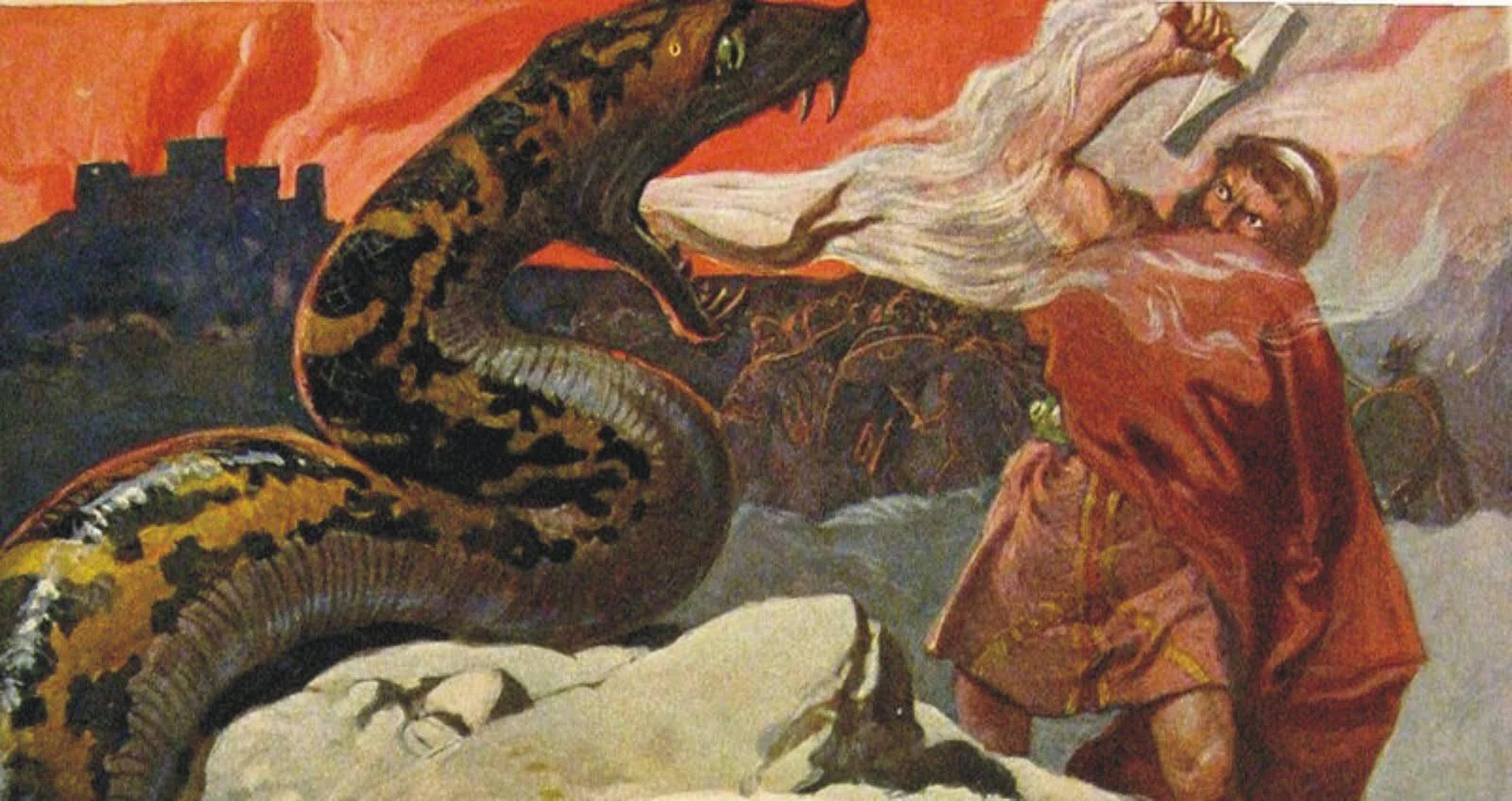
Calvert Watkins’, “How to kill a Dragon”, explains “hindrance (from the societal ideas of
“stoppage”)” as stoppage of waterways to plenish their respective cultures.